Which celebrity would you love to meet, and what would you talk about?
View all responses
Are City Book & Art Festivals about meeting celebrity. A run-down on Durhams’ week
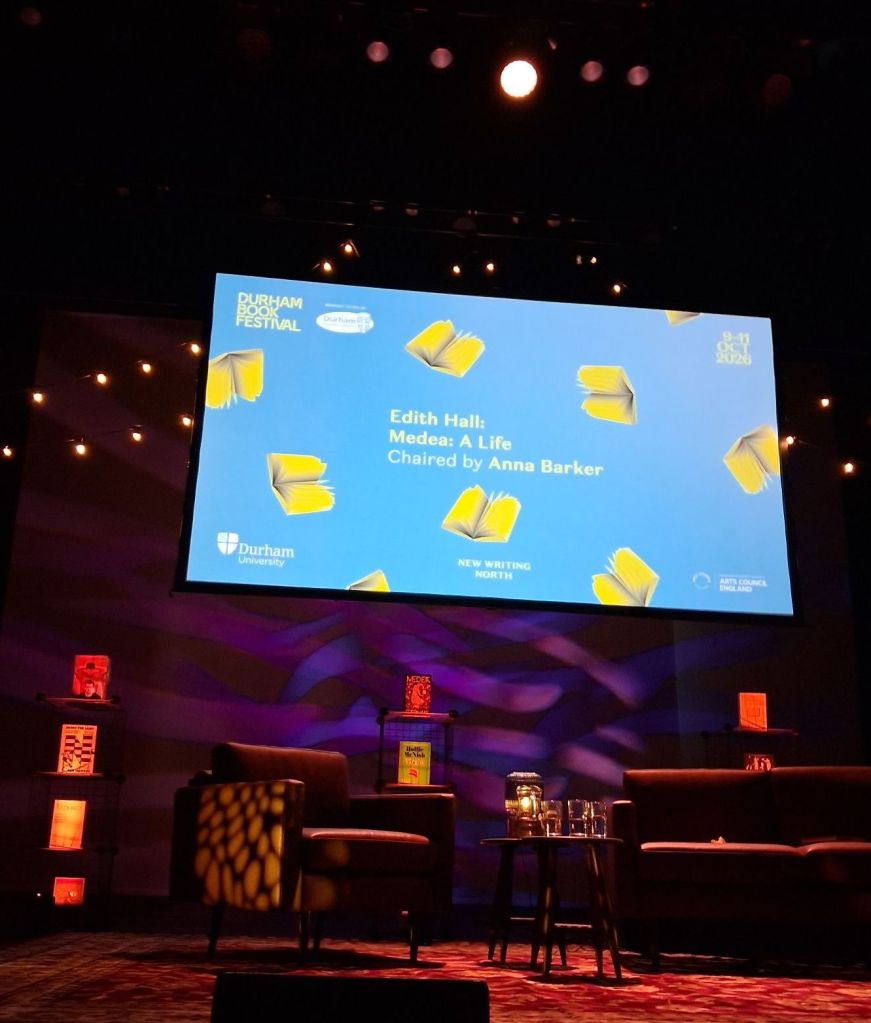
In an earlier blog I previewed the week that ends tonight as a week of Durham’s show at reviving city culture. See the blog at this link if you wish. Since then, the week extended., and I’ve added events to the calendar as attended. Where I have blogged separately, I link those blogs in some way to the event name in the table. I have yet to see Christopher Eccleston reading in memoriam of Tony Harrison – tonight. The remaining events I summarise my thoughts about – based enirely on personal experience – and not at all as reviews – below. I reserve time to write about Ibtisam Azem, that event was transformative, but if I remember, I will link it here if and/or when done.
| Tues 6th Oct To Sun. 11th Oct. | 6th Oct | 7th Oct | 8th Oct | 9th Oct | 10th Oct | 11th |
| Morning to lunch | 10 a.m. Edith Hall on Medea Gala Theatre Preview 1 Preview 2 | |||||
| Lunch to 4 p.m. | 2.30 p.m. Verity Reel Cinema | 2.30 Ragged Trousered Philanthropist Ensemble ‘84 Preview 1 Preview2 Preview 3 Event seen | ||||
| 4-8 p.m. | 6.30 Ibtisam Azem on The Sleep Thief. People’s Bookshop In process | 7 – 8 p.m Evening with Hollie McNish & Michael Pederson Gala Theatre Preview | 5 – 6.30 Tony Harrison Evening with Christopher Eccleston Gala Theatre To see yet | |||
| Evening | 8.30 – 9.30 Lux Muralis on Time Durham Cathedral |
But do we go to see ‘celebrity’ or the ‘celebrated’ at such events. I think not. Sometimes, when they don’t work I wonder why we go at all? As examples of an kind of reflection on that question I will take two of them, previewed but not reviewed. This isn’t at all a review of the events.
Evening with Hollie McNish & Michael Pederson Gala Theatre, Preview
& Edith Hall on Medea Gala Theatre, Preview 1, Preview 2
Let’s start with the Hollie McNish ‘evening’ which wasn’t what I predicted, thinking it in the traditional line of an interview by Pederson, as I saw him do with Kae Tempest at Edinburgh (see blog here) but with McNish. Hence my preview was all on Hollie’s newest book, Virgin. Instead it was a ‘gig’, as the artists described it, that was touring (had already ‘done’ Tokyo) of the two readers, each reading solo from their work half-an-hour each of the time, and alone on the stage with a hand-held microphone. Gigs are, I thought, what stand-up comedians and musicians do, which shows how little I know of modern literary culture and performance poetry events.
I think my acquaintance with the term sadly came through Simon Armitage. It is the title of his early memoir, Gig, about when he himself performed lyrics to music which since then he has reserved for special events. In his book on poetry as Professor of Poetry at Oxford he runs down the very notion of performance poetry, seeing it as a misunderstanding of what poetry ought to be; tbat is, a manipulation of language to affect by unexpected beauty and meaning.
And, though I found McNish charming and sort of frank and wonderful about issues of power, coercion, consent and sexuality, I am not sure this medium really builds her talents as they are very capable of being built as a strong poet who will endure (if tbis is what she wants), being too locked in the breathless speed of voicing the poems and hard-to-get distinctions between equally breathless spoken commentary and the art itself. For it is all performance, and perhaps that it is its joy; wherein every feature of speaking to an audience takes precedence over specific effect in the poems or prose poetry. and then there is the awfulness of handheld microphones, muffling sound you want to hear and emphasing noise you had rather not hear. Yet the rest of audience laughed and clapped as if they were being thrilled.
This effect of a kind of endlessly rhythmic speech in which emphases could fall, driven by pwrcussive voice rhythm alone, was particularly strong in Pederson, who is an artist I always think I ought to like more but cannot get over the entire erasure of his private self in talk, however lovely the language he speaks. McNish is just wonderful in presence but endlessly disappearing in audibililty.
It wasn’t then for us this event and it flattened my soul a bit. Tne next day I went alone to see Edith Hall, Geoff being exhausted after a bad night. I enjoyed this event enormously until the Q & A. The interview was by the enormously perceptive and honest speaking Anna Barker, the daughter and biographer of Pat Barkerì but an artist in her own right. Hall was on form despite having flown from her home in Greece the night before and knowing she would fly back immediately after this event.
One point Hall made, asked by Barker what was one take-away a reader might get from Medea, although she supplemented a much more socially aware one on modern infanticide later, was that she took the commission from Yale University Press for this book because of, despite being a lifelong feminist, the drear effect of so many straitened ‘feminist’ but unuanced readings of Greek women in literature.
This rang bells for me, for I remember so well an event where Natalie Haynes talked with David Vann, both having written novels (many in Haynes’ case) touching on female rage and the Classics (Bright Air Black on Medea by Vann). At one point , Haynes stood up.in rage at Vann daring to claim to speak of feminist responses whilat being a man, calling herself insulted. For me, that was after sign of celebrity not of principle and of divisio n uncalled for and responding to nothing other than predetermined binary labelling.
Hence, at Q&A, I, as usual, shot up my hand to ask about something related to the stereotyping that all over-simplified outlooks that equated the simplicity with radical perception rather than simplicity provide Now I reflect back, it was an unnecessary question, but before I asked it, Edith Hall asked: “Ate you the gentleman who wrote the wonderful blog on me. It came up on my feed this morning’. I suppose I ought to have felt pleased but I felt instead shamed. Why, I do not know. The gesture was kind and spoken kindly but I lost all sense of why I was there – to listen to Edith Hall, flustered my question and slumped, for reasons I still can’t work out. Still, I got my books signed with a kind message on Medea. See below.
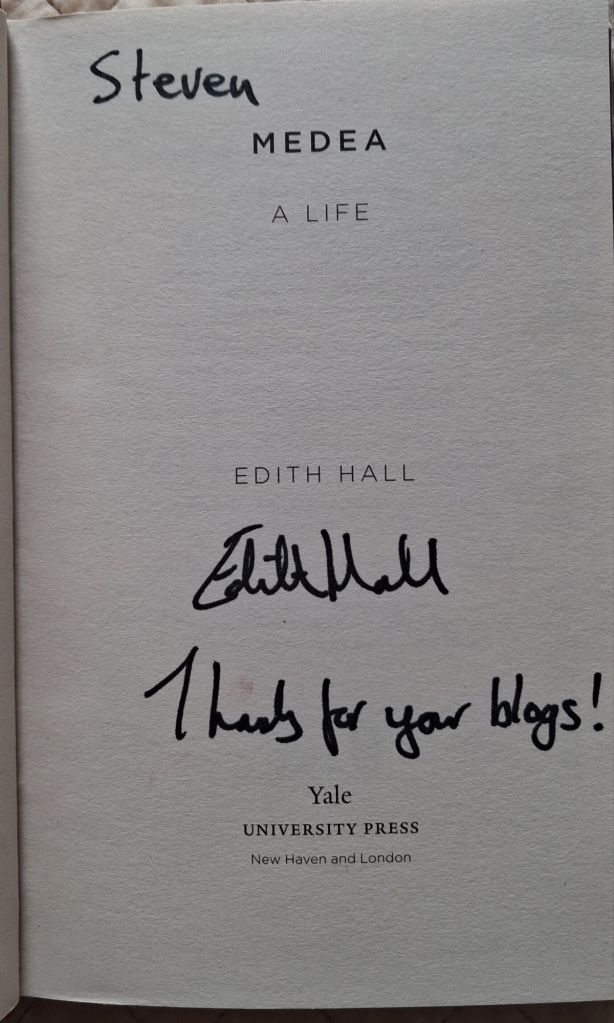
Do we seek celebrity in meeting the already celebrated? The only reason I can understand my confusion and dismay was the shock of being ‘celebrated’ in two .minutes of audience ‘fame’, which rather threw my fixed high-mindedness as functioning as a bogger in myself in my writing only as a learner teaching myself to widen my tbought. I will get over it.
But it was a good event. Now I am geared up to see Christopher Ecclesson read Tony Harrisn. Could there be a definition there of celebrity hunting, even of a deceased poet, that I cannot escape.
With love
STEVEN X̌XXXXXX

