Since Iris Murdoch we no longer have the right to centre our narratives on questions about a morally good person, for that demands consistency. Lets’s instead show how a satifying person in fiction is one who bears their inconsistency. On Edith Hall (2026) ‘Medea: A life’.
Since Iris Murdoch we no longer have the right to centre our narratives on questions about a morallygood person, for that demands consistency. Lets’s instead show how a satifying person in fiction is one who bears their inconsistency. ‘… determined to make Medea the true heroine of his tale’.[1] So writes Edith Hall of Orpheus’ intention as a storyteller in Edith Hall (2026) Medea: A life New Haven & London, Yale University Press. In what ways, if any, does storytelling and the demand coherent and consistent character at as its focus. Why should it?
Let’s clear up one small problem first. Storytellers from the Ancient world, officially thus branded in Edith Hall’s highly-researched collage of those about Medea, artistically moulded into one masterly narrative, from various, and sometimes entirely inconsistent accounts (often made the more inconsistent as those storytellers develop the repertoire of stories to be told – certainly the case with Orpheus) are always MEN. She names three by name: Orpheus, Thamyris and Ischophonos. The latter (a supposed Athenian court poet in the household of Aegeus) is an invention as Hall tells in her introduction.[2] The name Ischophonos does seem to have credibility, however – it is in the comprehensive Liddell, Scott, Jones Ancient Greek Lexicon (LSJ) database – as a Greek term that names someone by a trait of the weakness or queering of their voice or sound from established norms.[3]
The characterisation of male poets as in one way or another weak-voiced affects all – even the wondrous Orpheus but is most typical of Hall’s invented Ischophonos. She almost translates his name in her describing him but without saying that is what she is doing. Medea, deprived of sex with new husband, King Aegeus – whose ability to hold an erection is patchy, to say the least – ‘dallied briefly with the place bard’, as we shall see she tried with Thamyris and Orpheus until told by both, for different reasons, that they preferred sex with young men. Ischophonos does not give that excuse Medea herself finding that ‘she stopped spending time with him because he was such an inferior musician, with a thin, reedy voice, and had no interesting conversation’. Compare him to the chief female voice of Colchis, Keladeine (meaning “loud-sounding female” as Hall explains this invention of an administrative front for Artemis in a footnote).[4] In the world of men, Medea, In compensation, looks not here for a stronger singer but a loud butch female yet engages in a series of a ‘few other affairs with very young men of the court, carefully choosing them for their looks, discretion, and lack of political ambition’. The use of ‘other’ to describe these affairs itself seems to suggest that had it been possible Thamyris would have been the first of her sexual affairs. That is interesting itself in terms of Medea’s claim not to like it when Thamyris treats of women characters who are ‘over-sexed’.
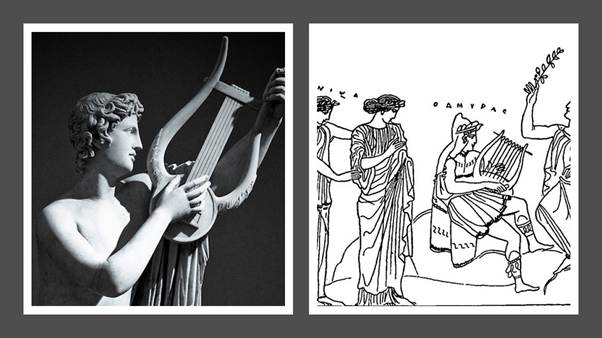
Orpheus & Thamyris
Thamyris, we are told earlier, had a tendency to write about women because his repertoire of geographical and martial subjects favoured by Aeëtes, King of Colchis and Medea’s misogynistic father, was poor – a kind of code for his lack of interest in the masculine subjects of poetry. Hence, he would turn for a subject to stories of women. Yet Medea as a girl found his models of womanhood wanting: his women ‘all weak or oversexed or evil or simply doomed to be raped and killed by masculine gods and heroes’. Some but not all of these accusations were later to be turned against Medea (and perhaps could be even in her girlhood) as the subject of male poets, but for Medea her interest in Thamyris she claims was largely an education in gendered narrative perspective as she ‘wondered whether the portrayal of women might be different if women were allowed to be poets: …’.[5] This sense of the absence of female voices in poetry and storytelling – and oft these two arts were truly one – seems to characterise Medea from the start. Nevertheless, it also seems that Hall emphasises that Medea’s interest in Thamyris was not entirely asexual. As her body matures, Hall says, ‘she became aware that she was physically attracted to men – she blushed when the good-looking, poised minstrel Thamyris spoke to her, although he preferred flirting with boys’.[6]
Fleeing Colchis and misogyny turned into a system of court administration in Colchis, it is not insignificant to Medea that the leader of the Argos crew, Jason, with his mission to take back to Greece the Golden Fleece was ‘the most beautiful man she had ever seen’. [7]But once in voyage on the Argo, Medea cannot help but notice Orpheus, at first as a friend of Thamyris.[8] But, as she uses Orpheus’s knowledge of the world of Greece in which she is to enter, she begins to conceive of leaving Jason, despite the vows she has entered into and forced from Jason. Orpheus however is not available to form this new match. Not only is he preparing to leave the Argo for a new life in the Pangion Mountains to become one of its oracular heroes and the victim of the followers of the Thracian God, Dionysus, stories Hall takes from Herodotus and elsewhere, but he explains the current state of his bisexuality, after his loss of Eurydice, was heavily geared to male lovers: ‘he was past marriage and children and preferred the unchallenging attention of young, admiring boys’.[9] Orpheus too then joins that group of men favoured sexually by Medea, who are also creative forces, that if she cannot be a poet in her own right (Hall has her sharing her poems with Orpheus nevertheless) aims to become the model of the femininity of which they ought to be writing. There is some payout of this desire when Orpheus before abandoning the Argo writes the story of Jason and the Argonauts, but to Jason’s envious dismay, makes Medea ‘the true heroine of his tale’, that determination I cited in this blog’s title.
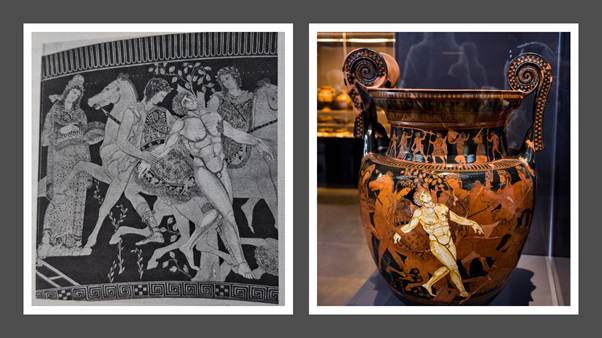
The episode Orpheus chooses to illustrate this however, using entirely ‘an account Medea had given him’ (and therefore marked like other accounts Medea gives to men including her son Medeios, as potential lies) is of the defeat and murder of Talos, the ‘last of his race of androids … evolved to consist almost entirely of bronze’ that Zeus had set to guard the shores of Crete. Hall uses a licensed photograph of the picture (Figure 8 from Hall) from a red-figure volute krater that focuses on a turn of the vase in which Medea looks prominent as singer and performer of the spell that entrances Talos, though the turn of the vase in the Wikipedia picture I collage with it below hides her more and shows a foreground full of embattled men, including android Talos. This characterise Orpheus’ centering of her role too in Hall’s account, using Apollonius’ Argonautica.
The only point I can make about the angle on the picture chosen for the book is that Medea’s role is very much the product of the point of view on, and within, the work of art that so often contains her. Hall goes to great lengths to show that she is the product of artistic creation on Orpheus’ Homecoming, even to the manner in which the sound quality of the verses conveying Medea’s role in Orpheus’ poem ‘impersonates’ her, as if she lived only through that representation.
Orpheus struck sinister, cacophonous chords as he impersonated Medea’s low songs, propitiating the winged, doglike Death Spirits. He sang that she knelt at the prow in supplication, murmuring and muttering constantly, gnashing her teeth and hypnotizing Talos with her hazel gaze.[10]
Orpheus may see her as more significant than Medea thought Thamyris made any of his female characters, but the masculine impersonation of her also implies some of the same stereotypes of womanhood as Medea as girl detected in Thamyris – why is she ‘low’, ‘sinister’ and inharmonious, as if ‘evil’ and why serviced by Death. Her ability to hypnotize even a metal man, with that vey stereotypic ‘hazel gaze’, goes with very unattractive other features betokening some witch-like representation, more the medieval Hecate than that of Greece and Colchis. If this is female heroism, it isn’t like that of the males on the krater that whose role Orpheus minimises in his account. When the homecoming tale reaches Thera, ‘Orpheus now impersonated her, standing on the beach to deliver a great prophecy’. There is much here that is the Orpheus of the Orphic Hymns, oft cited in Hall, than a recognisable female voice speaking for objectives that are also specifically female and serve female interests in the same way that male endeavour does, even in the strange and alien forms it takes in the story. Orpheus’s poem creates her in the same way Thamyris’ poem worked upon her within her interior imagination, displacing all those adventures men get to live in the external world but that somehow Medea feels she does not: ‘She stored up Thamyris’s verse in her mind and replayed them to herself constantly in her aural imagination’.[11]
I am not sure than that Medea ever gets to meet that ambition to be the female poet of external adventure she mourns the lack of in Colchis listening to Thamyris, who presents men with the same bias as men present women. She is too often shut inside her own walls – by Pelias for example, when suddenly she becomes popular in the external world. Her aim is only ever stated as an aim in the book and never illustrated, but its statement is pivotal in the book, where Hall insists that Medea is not a political animal but ‘was obsessed with acquiring complete personal freedom’:
All her life she had been forced to accept one level or another of domination by despotic, brutal, and treacherous men. Aegeus was not as bad as the others, but he still pointed out regularly that she was beholden to him. How she longed to be free of male control.[12]
How can a woman have a life of ‘complete personal freedom’ when her behaviour is initiated, prescribed and under surveillance by the authority (even as authors or oracular authorisers) by men in the role of kings, fathers, brothers, guards, sailors or poets, even those queer ones with a flash of female identification in their bones (how called forth I feel as a kind of Ischophonos versifier myself)? There I think is where Edith Hall sits – looking to free Medea (perhaps even from a kind of over-authoritative feminism illustrated in parts of her final chapter). However, her freedom is bounded by men throughout. Her freedom exists only in telling a different version of herself, that are bound to read as lies, even though they are just extant versions of the Medea story in the history of its contradictory sources and even more contradictory historical reception since the time of Euripides’ drama. .
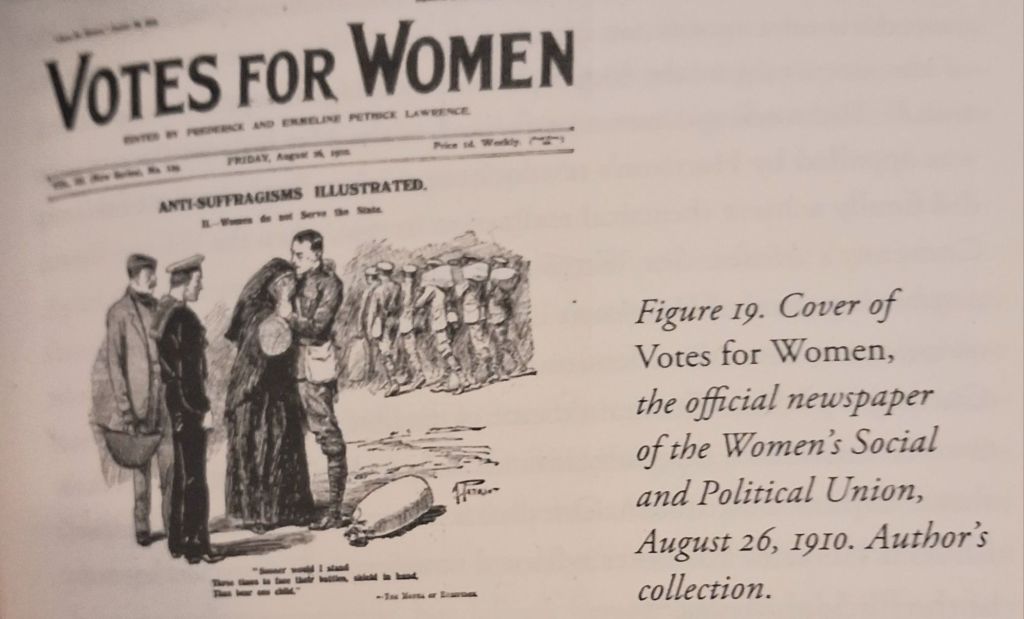
To Medeios, her son (probably by Jason rather than Aegeus to whom she also lies), she entirely misrepresents her story as Hall has compiled it heretofore but in forms the reception and source history can validate.[13] Hers, she can show, is a story of ‘pure altruism and maternal devotion’.[14] And Hall, I believe deliberately, makes much of her ability to lie to women and represent what she cannot in fact be. Let’s take the detail from Euripides’ representation of her that Hall refers us to in her final chapter on ‘Medea as Women’s Heroine’. In the male feminist champion Gilbert Murray’s translation, this quotation from Medea is used on the cover of a 1910 issue of Votes for Women:
Sooner would I stand
Three times to face their battles, shield in hand,
Than bear one child.[15]
The context of the cover and its illustration makes it clear that the standard understanding of this quotation is not being employed. The pain of women is here instantiated by the pain of the loss of sons they once bore as adults in foreign wars, since it depicts mother reluctantly saying farewell ‘to a soldier going off to war’.[16]
Figure 19, ibid: 179
However, that speech is usually used to compare the relative pain of childbirth to a woman to the pain that contention in battles led men to experience. It is obviously thus in the prose translation, presumably Hall’s own, from Euripides used in Hall’s telling of Medea’s story (here in the words she uses to address the women in Corinth), even if the source is the same In Greek:
“… Men say that we are lucky to be safe at home, without companionship. They are wrong. What about childbirth? I’d rather stand three times in the front line of the phalanx than bear a single child.”[17]
But why does Hall choose to show Medea mouthing this to the Corinthian women. Though it makes her a spokesperson for general female experience and the pain in it so often belittled or romanticised and sentimentalised, it does not link to Medea’s experience of childbirth as Hall tells it of Medea herself, for with her first born Marmarus, she had a ‘swift and easy labour’, followed by his brother, Thessalos, ‘eighteen months after his olde brother, also painlessly’.[18] Why give us this detail of the difference to the experience Medea from the women she addresses as example in Corinth using Euripides’ account. It certainly fits with the more comic account of her mother Eidyia as a semi-divine bearer of children, and who also gave birth ‘fast and easily’. Perhaps easy is even an understatement for ‘the baby shot into the midwife’s hands just after a massive bolt of lightning had illuminated the indigo sky’.[19] Hall clearly wants the parallel suggested here of nymph and a special woman, born of a nymph, but it is a detail Hall’s Medea can also easily infer as being otherwise when she needs it to fit into Euripides’s account of her.
How are we think of Hall’s choice then to tell of a life made up of fragments from largely male accounts in her Medea. One conclusion I come to is that her Medea does not try to unite the fragments – for Medea is everywoman in a way that does not stereotype women nor diminish the diversities within womanhood. Her Medea can skip between accounts of her, however contradictory, for in some ways all are true and at the same time – unlike the rather too solid and unitary monotypes of Medea are her in the history of feminist Medea’s. Hall’s Medea is an attempt to pull together fragments and make a woman more diverse, fluid (the water nymph side) and full of her own plenitude of being all types of woman – even the negative things.
With this goes her girlhood delight in playing a satyr with its prosthetic phallus and horns, and her knowledge that it is only being biologically a woman that forces her to take on the limitations set by men which she can evade by acting like boy – all that is but childbirth. And in that she will puzzle history and myth as its most well-known infanticide of her own boys. In an earlier blog (see it at this link) I toyed with the idea that what Hall remains is a person who has lived ‘a life in the classics’ in order to revel in their fragments and add it to her intuition of the wonder of human diversity including gaps between supposed types (positive and negative) of human being and chosen performative roles. She wants a life that can be made to stretch over inconsistencies and accept the tension in human life between desire and the reality, magic and logical thinking, and that which is imagined fiction and that which is a lie told in self-interest for the moment in which power structures dictate the sensible path through life.
The result is not the violently fragmented post-modernism of Anne Carson’s The Autobiography of Red (a book I love for these reasons) but of something more happy to live within its own contradictions using the limited freedoms taken merely in the manner it chooses to mix elements from the past with its own delight in fiction making but o a similar end to Carson’s, if based in composed wit rather than making monsters of the imagination that force themselves to vie their own image. Carson writes (in Hall’s words cited in the last blog) an ‘autobiography of the western Subject in the form it has only recently begun to believe it can hope to inhabit – frank, diverse, post-feminist, postcolonial, intercultural and wryly defiant of normative heterosexist constraints’.[20] In contrast Hall writes biography of her female hero but with an equal attempt to test whether the western Subject can be ‘diverse, post-feminist, postcolonial, intercultural and wryly defiant of normative heterosexist constraints’ without being ‘frank’, though in truth we see through her Medea to her need to survive in this world through the less than frank methods of storytelling.
Hall sticks within some constraints. In her Introduction she looks to her search for consistent ‘psychological plausibility’ for her heroine but in the end ties it down to the need to survive in a world where the professed existence of social support – in family, state, friends and lovers – is in truth compromised. [21] Where the sources disagree sometimes the narrator intervenes to omit any attempt at plausible narrative. This too explains the absence of an Act 6: Medea’s life after her serpent-drawn chariot escape from Athens. In the later case, the narrator settles back into her role as a scholar of the post-writing reception of the fictive or mythological figure Medea. if I were to think of a survival of the biographical narrative in those chapters it would be the theme of the migrant perceived as alien (a pertinent enough theme today) which certainly fits with the discourses that explain Medea around ethnicity, homelessness and oppression. In history Medea remains a migrant everyone has a theory about and to whom no-one takes into their heart to listen deeply. It is a theme on which she quotes the text of Robinson Jeffares’ Medea, which you should read for yourself: It begins ‘Annhilation. The word is pure music, annihilation’. In it Medea explains infanticide as a means of escaping the past that claims her otherwise and breaks her down to a living mess , of which it would be preferable to be ‘clean / Bones on the share’. [22]
Even of the ‘woman’s heroine’ Hall chooses to emphasise that one brought into being by the ‘late and lamented Helen McCrory’, for whom, Hall tells us in a footnote, Hall herself acted as McCrory’s consultant on the text and its interpretation for the National Theatre. And what characterises the representation is that in Medea herself which in Hall’s biography is described thus: ‘humour, lightning intelligence, sexual appetite, and above all inconsistence and volatility’. It is only thus Hall insists that this Medea could ‘speak to women as few actresses ever have, before or since’.[23] Since I saw this production and loved it I can only but agree, adding that it speaks to queer men too, as Hall’s Medea does to the sex/gender temporising poets in her story.
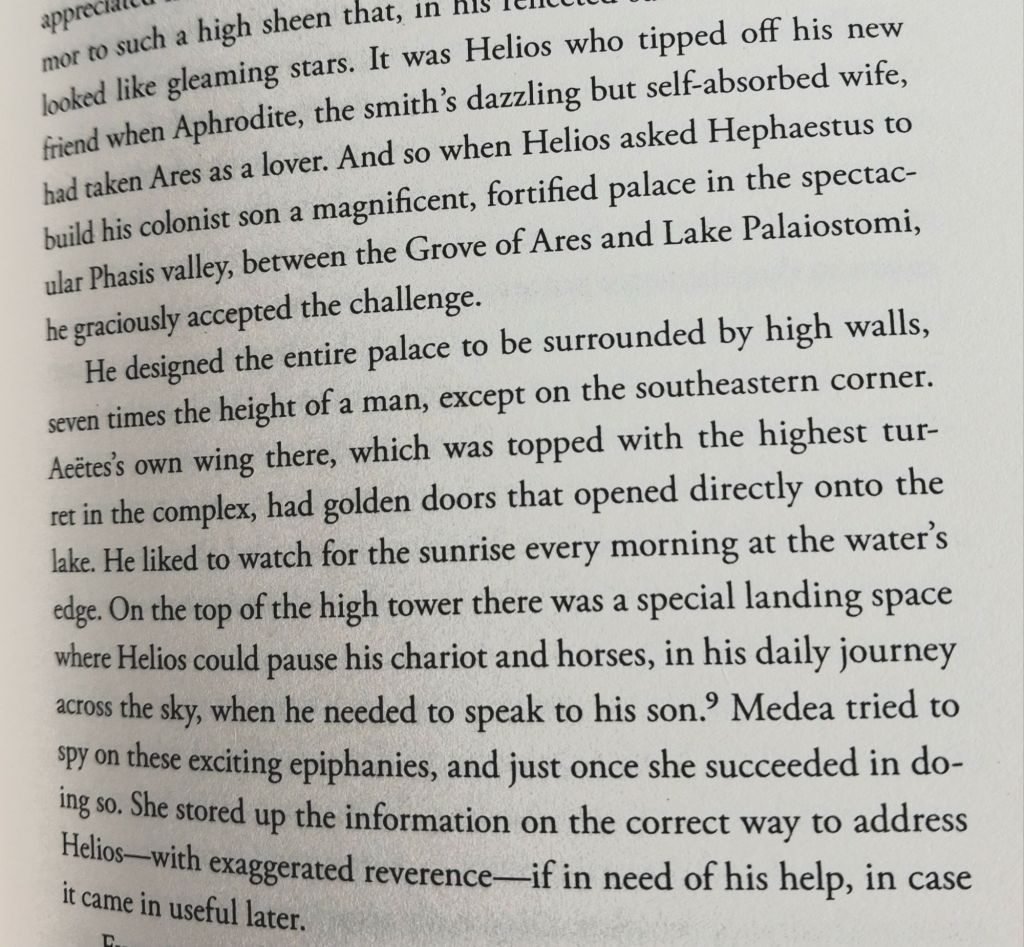
That ought to end this opinion piece but I can’t help returning to how Hall uses her writerly freedoms. My favourite passage remains that cited in my last blog about Eidiyia, but I loved the one below too, for it shows how Medea acted freely with her sources, explaining what she was doing so but not why: the reason is she did it, as Medea does, because she could (at this point in her career freer to be herself), despite the inconsistency it showed up. It relates to the description of Colchis here:
My photogragh of ibid: 17
Of tbis passage she says in note 9 indicated in the passage above, giving precise academic reference that ties description of ‘the whole environment and architecture of the palace’ to Book 3 of The Argonautica, that it is yet again supplemented by ‘my own travels in Tbilisi and central and western Georgia’. Those travels were in the location of the Greek colony that became Colchis. Here is the probable Appollonius passage, although a longer passage would also show the source of how Colchians dealt with the corpses of dead male and female relatives respectively, starting from where the Argonauts stood:
… at the entrance, marvelling at the king’s courts and the wide gates and columns which rose in ordered lines round the walls; and high up on the palace a coping of stone rested on brazen triglyphs. And silently they crossed the threshold. And close by garden vines covered with green foliage were in full bloom, lifted high in air. And beneath them ran four fountains, ever-flowing, which Hephaestus had delved out. One was gushing with milk, one with wine, while the third flowed with fragrant oil; and the fourth ran with water, which grew warm at the setting of the Pleiads, and in turn at their rising bubbled forth from the hollow rock, cold as crystal. Such then were the wondrous works that the craftsman-god Hephaestus had fashioned in the palace of Cytaean Aeetes. And he wrought for him bulls with feet of bronze, and their mouths were of bronze, and from them they breathed out a terrible flame of fire; moreover he forged a plough of unbending adamant, all in one piece, in payment of thanks to Helios, who had taken the god up in his chariot when faint from the Phlegraean fight.[22] And here an inner-court was built, and round it were many well-fitted doors and chambers here and there, and all along on each side was a richly-wrought gallery. And on both sides loftier buildings stood obliquely. In one, which was the loftiest, lordly Aeetes dwelt with his queen; and in another dwelt Apsyrtus, son of Aeetes, whom a Caucasian nymph, Asterodeia, bare before he made Eidyia his wedded wife, the youngest daughter of Tethys and Oceanus. And the sons of the Colchians called him by the new name of Phaethon,[23] because he outshone all the youths. The other buildings the handmaidens had, and the two daughters of Aeetes, Chalciope and Medea.
Although some details are recognisable, there is little justification for comparing the highest turret to a ‘special landing space’ for the chariot of Helios and its horses, tbough the role of that chariot in the commissioning of the city from Hephaestus by Helios for Aeëtes is mentioned. A classical scholar on holiday might be forgiven for seeing a ‘landing space’ like those in sciece fiction and for laughing as she notes that to her family. But to make it a ‘source’ for a description of the palace at Colchis! This might rightly be thought an eccentric liberty, especially in a publication by an esteemed scholar at a prestoigious University. But that is the kind of freedom that makes this book a delight. I like even more how inhabitants of the Underworld later marvel at the innovation of a new place for the afterlife down the road, clearly thinking lightly and satirically of the invention of Hell in Judaeo-Christianity.
Do read this wonderful book. If there are new things to say when I see Edith Hall, I will let you know.
With love
Steven xxxxxxxxxxxx
[1] Edith Hall (2026: 72) Medea: A life New Haven & London, Yale University Press
[20] Edith Hall (2009: 237) ‘The Autobiography of the Western Subject: Carson’s Geryon’ in S.J. Harrison (Ed.) Living Classics: Greece and Rome in Contemporary Poetry in English Oxford, Oxford University Press, 218 – 237.
2 thoughts on “Since Iris Murdoch we no longer have the right to centre our narratives on questions about a morally good person, for that demands consistency. Lets’s instead show how a satifying person in fiction is one who bears their inconsistency. On Edith Hall (2026) ‘Medea: A life’.”


2 thoughts on “Since Iris Murdoch we no longer have the right to centre our narratives on questions about a morally good person, for that demands consistency. Lets’s instead show how a satifying person in fiction is one who bears their inconsistency. On Edith Hall (2026) ‘Medea: A life’.”