What’s the most underrated life skill?
View all responses
The most underrated skill is that which creates poly-mytho-factive worlds using the skills of curation, collage and, sometimes, the best of scholarship. A first blog on the joy of beginning to read Edith Hall (2026) Medea: A Life, New Haven & London, Yale University Press, taking as an example Medea’s plea to help from her goddess-mother, Eidyia in Chapter One (pages 36 – 37).

I have always loved the work of Edith Hall from the early conventional scholarship to her later adventures in the collaging of very generic models of writing, only some of which conventional scholarship sees itself as having a duty to curate. For as in most academic skill-sets, so many of them have been turned to a kind of archival curation, placing the fruits of knowledge, feeling and imagination into categories – genres, styles or periods – that name what they are and what they cannot possibly be, and refusing contamination between categories, evcen when the examples they deal with obviously ignore any category boundaries of which they have control or can negotiate creative mix.Even as a conventional scholar, Hall has taken a radical approach – her doctorate being metamorphosed into a book (Inventing the Barbarian: Greek Self-Definition through Tragedy, 1989) that contributed as much to an understanding of the sociocultural formulations of racism in high culture as to classical Greek scholarship about the rlationship of Greek tragedy to articulation of politics, citizenship, democtacy and the reliance of all these concepts to the exclusion of otherness pf which they pretend to be the opposite. But scholarship – especially in the Classics could bear the strain – after all, so few people read it and certainly not after they had finished their degrees and left behind them flirtation with the thought of the critical left-wing of politics.
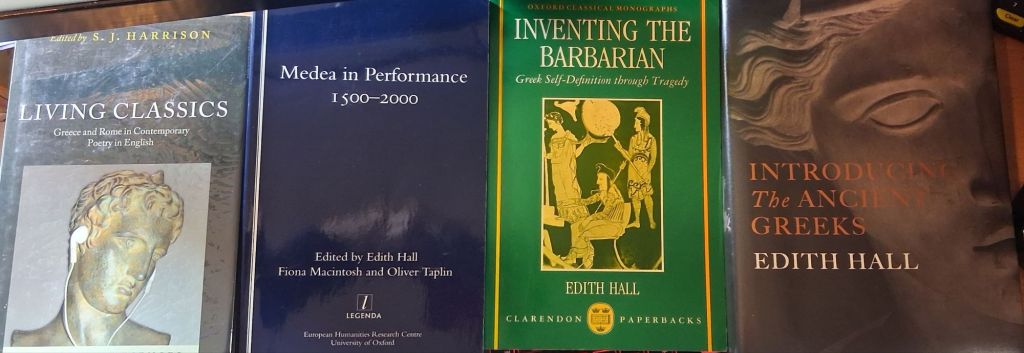
Above are some of the works that fitted into the role of tne traditional classical scholar including some works directed at what used to be called the ‘general reader’, that I have queued at book festivals to get signed or which are anthologies of essays I have treasured mainly because of a contribution from Hall. Take, gor instance, her contribution to S.J. Harrison’s Living Classics, which was part of the turn of Classical scholarship, partly as an attempt to save itself from extinction, to reception studies – the study of the refraction and reflection of Classical writing in later phases of culture and society.
Her essay here is on Anne Carson, also a Classics Professor but mainly a poet and writer sometimes constrained by an academic role, whose work tore a rift through the periodisation and other categorisation of the themes of the Classics to see them alive in modernity and in issues of power, exclusion and the natutre of being itself. Hall writes on the incredible fictional category-buster, The Autobiography of Red, partly as a semi-philosophical reinvention of selfhood, beyond tbe fractures made in it by feminism and queer theory. It is my belief that, though this essay is profoundly the product of a scholar, it points to a new way of curating those domains of thought, feeling and action that scholarship necessarily reduces to something less valuable than its own view of its own value. It is the path Hall seems to me to be taking in Medea: A Life, though I am only reading Chapter 2 currently
If we look back again at her work for more signs of the track she followed, we find that her work during her academic life, still continuing as Professor of Classics at Durham University, turned to other ways in which radical politics linked to the reception of Classical civilisation and its great works – in history, philosophy, and drama. One of my favourite books of hers is one she co-authored with Henry Stead, on the role of the Classics in working-class self-education, especially through avenues which combatted the exclusion of workers and women from those works. Edith Hall & Henry Stead (2020) A People’s History of Classics: Class and Greco-Roman Antiquity in Britain and Ireland 1689 to 1939 is again a highly scholarly work of history but it speaks to some of the exclusions too that set Hall apart from other classical scholars as an explorer of the marginalised voiced that found material dor sociopersonal development in the work (see my blog at this link). I see this linked to to Hall’s advocacy for the work of Tony Harrison, another Classical scholar who has mined the Classics in a way that refuses to accept the long duration of elitism with which it has been absorbed into ‘high’ culture, as if it were the property of white bourgeois and aristoicratic men, an idea not only contested in V (see my blog on Durham’s reinvention of that poem through contemporary poets) but in his verse drama adaptation of The Oresteia and his wonderful The Trackers of Oxyrhynchus (I relish that I saw this in The Olivier stage in The National Theatre in 1990, wherin the satyr is reinvented for modern class politics, with some just attribution of some of those idea to a Euripdes fragment of a satyr-play.
All of this influences have plotted a pathway for new work by Hall herself means that works have to break boundaries between categories, something Hall did tentatively in popular philosophical psychology with Aristotle, in my least favourite book of hers, to the remarkable Living With Furies, in which suicide is rethought in so many ways, although with more enforced cheerfulness and stoicism than I could command when I spoke of it in the blog linked to here. This work is not, I think, as accomplished a thing as this new one – but again I need to finish it before I can come to ant any (even preliminary) conclusions. At the end of her essay on Carson’s The Autobiography of Red, she declares it not only a wonderful way of creating an ‘autobiography’ of a subject from Classical literature< Geryon, but also an ‘autobiography of the the western Subject’: that finction in discourse which uses the word ‘I’ to articulate itself. She says also that it is an ‘autobiography of the the western Subject’:
in the form it has only recently begun to believe it can hope to inhabit – frank, diverse, post-feminist, postcolonial, intercultural and wryly defiant of normative heterosexist constraints. [1]
As I have said twice, I have barely started her latest book but I feel that it does things – even its own prose – that I have not noticed before in her work, even though it is founded on research reading from many sources. Its opening chapters turn the bookinto a third-person biography, which oft takes on and articulates the point of view of Medea herself, finding its material in the very mixed set of sources – crossing boundaries of genre, period, style and function as writing without identifying these sources largely, unless they are, for example, Hall’s own translations of an Orphic hymn (like the one to Hecate in Chapter 2) or discussing their diverse stances and attitudes to their subject. It reads as a straight narrative where inconsistencies read as ironies of character and of humour, and where people, gods, goddesses and monsters are barely differentiated. Every subject seems a hybrid of some sort very much as the the theory of the ‘contemporary Western Subject’ might facilitate – the result: rank, diverse, post-feminist, postcolonial, intercultural and wryly defiant of normative heterosexist constraints.
This blog is only putting a toe into the cool water of what might be going on here and will confine itself to one episode from Chapter 1, with tells of Medea’s birth and childhood in Colchis using many sources. This episode follows the advent of Medea’s sexual maturity and its effects on the’ many men who ‘lasds’ who were associated with her brother and acted as guards in the palace. One, Styros, approaches her sexually and she escapes only by ‘kicking him in the shins’ She runs off to the lake to find her mother, who, as indignant about her husband Aeëtes‘s perfomative masculinity – displayed in acts of power over others – as Medea is of him as a father and his son, her half-brother as a bullying hunk of a sibling. Both father and brother urge on the Henchmen, who act as guards of the palace court and its more vulnerable members, just as much as they despise their lack of status, making it clear that though they may dally with her, should she accept their advances she will be cast off from any future role with status in Colchis.
In such a situation a girl needs her mother. In this case she is a Goddess and water nymph, Eidyia. It is worth looking at the Wikipedia text linked to the name for it shows at least some of the sources Hall uses to fill out her character). What appealed to me in this passage is precisely the manner in which Eidyia is characterised. She emerges only half an hour after being summoned (slow for a Goddess) rising from underneath the lake in which she sojourns in separation from her husband. But Hall gives her neither power nor grace in her emergence: ‘dripping, from the reed’ and rather than dismounting her steed, a hybrid creature with the head of a horse and the tail of a fish – the hippocampus (Ancient Greek: ἱππόκαμπος hippókampos, from ἵππος, ‘horse’, and κάμπος, ‘sea monster’) she ‘slid off it’:
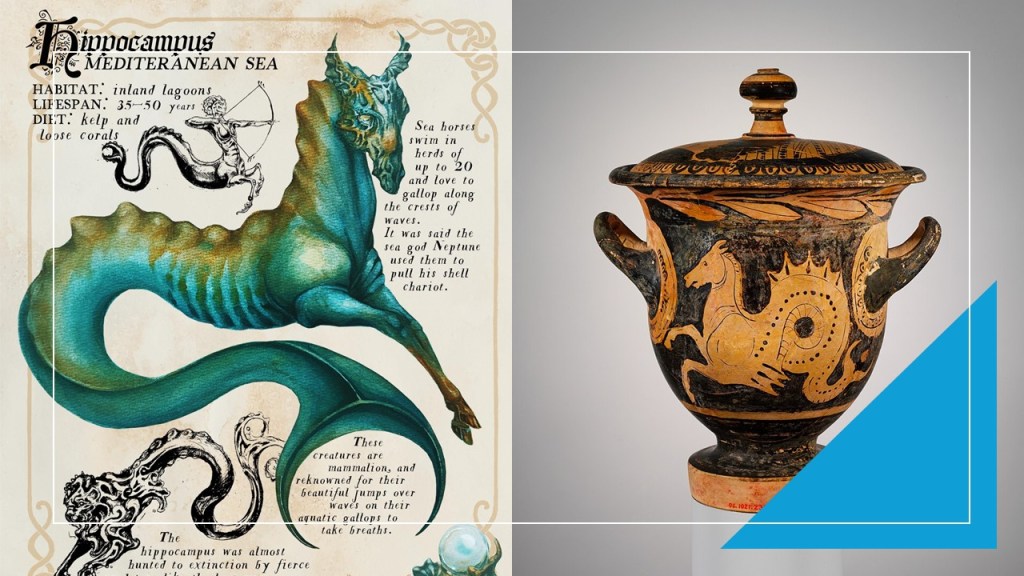
That hippocampus itself hardly emerges with nobility, ferocity or the kind of grandeur it might have in myth, sticking close to the cover of water reeds and bulrushes, passively awaiting its owner’s return.If we first see Aidiyia ‘dripping’, when in the midst of her conversation with Medea she is called ‘her still damp mother’.
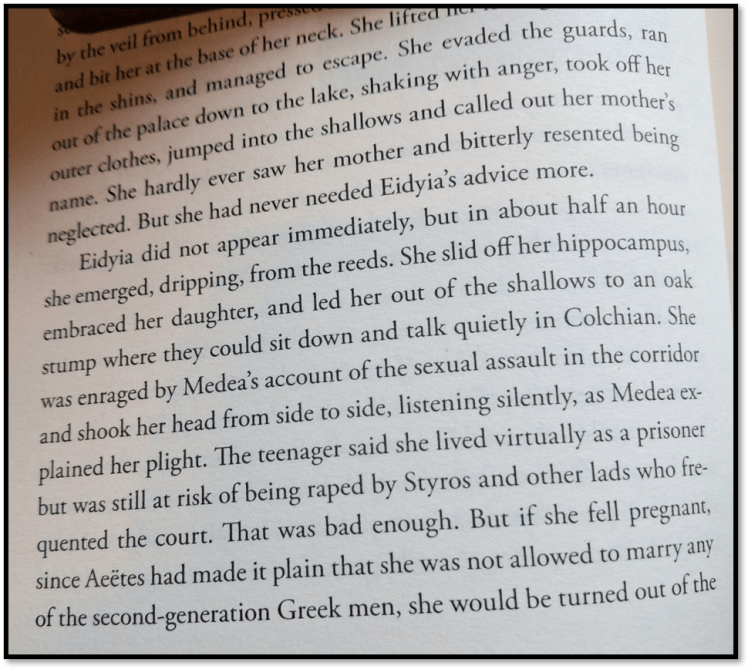
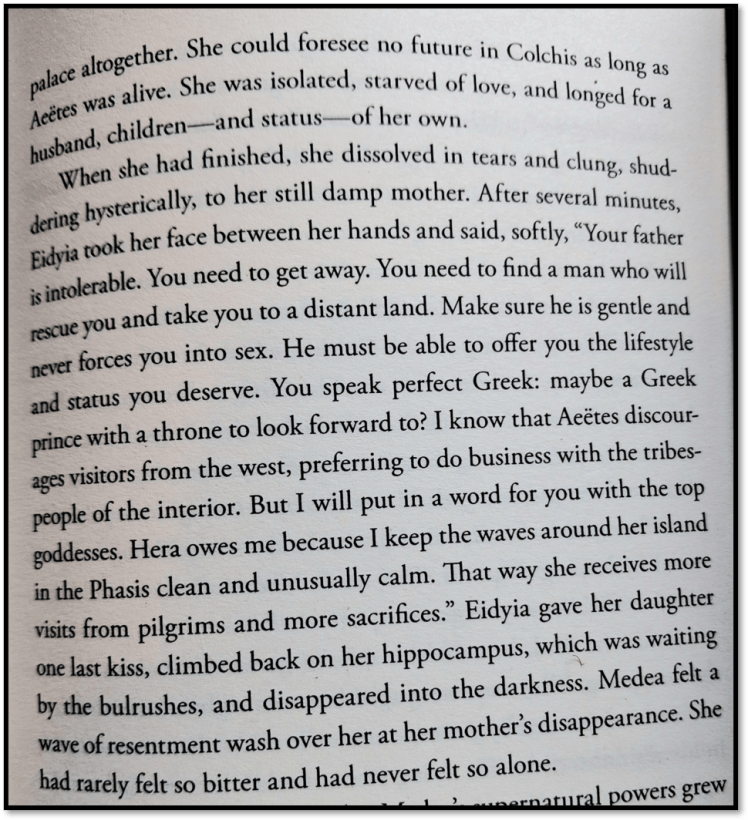
My photographs of the passage I discuss from Edith Hall (2026: 36 & 37) ‘Medea: A Life’, New Haven & London, Yale University Press
There is something very ‘wet’ about Aidiya in the modern sense too – something less than strong and lessthan convincing as a force of maternal emotional support.She is in short, a figure of humour – her and her hippocampus. The feelings she evokes in Medea are stronger than those she causes in us – and ones that evoke the strength of water rayther than its passive dripping sliding fragmentary one. Medea feels ‘a wave of resentment’, the tsunami perhaps of her future. And what a world the Gods live in – with petty concerns about keeping their islands in the river Phasis ‘clean’ to attract more suppliants with sacrifices, like the Hera who ‘owes’ Aesiya. The use of ‘owes’ itself is beautiful comic, capturing something less than gracious in the mothers and goddesses both of this myth. Once senses that anything motherly in a strong sense disappeared a long time before the Goddess who ‘disappeared in the darkness’.
This is not intended I believe to have the strong philosophical drive of Carson’s poetic prose in her Red series, but it does have the comic tone of some of Tony Harrison’s use of myth to bring home the fact that Classical works adress everyday psychology too. Medea is let down by the one person who might have proved a strong model of modern femininity in this passage precisely because no-one who ought to do so translates the effects of near rape and a loveless life as it might feel in prospect to a teenage girl into a ‘rage’ no stronger than that of a society lady living the trivial life of only seeming to care, undertand or remember the role she ought to play for her daughter.
It is delightful here rather than world-shattering but we are not yet, as far as I have read, at the peak of Medea’s significance as a model of female resistance not only to men continually performing a difficult-to-substantiate authority but to the patriarchal trivialisation of female roles that ough, and often do carry weight, like Mothers, for it is as a caution to motherhodd that Medea’s legend lives on.
The book is getting stronger as I read it but I love it in even this piece. I even wonder if that sliding relation to the hippocampus has something to do with that part of the brain named after a ‘seahorse’ because it looks like one in later etymological shifts. ediya has no way of turning her short-term memories into stronger long-term ones, which is one of the functions it is though the hippocampus in the brain performs – not one of enabling disappearance as here but of staying put and strong like good learning.
I will return when I have finished this book which promises all kinds of shifts as it progresses. But first let’s apologise for my jokey neologism in my named skill in my title. Poly-mytho-factive worlds are at base ‘factions’ as Truman Capote used the word – combinations of extremme fictions about some hard underlying facts – like the crises in the life of teenage girls. But myths are both fact and fiction, and all the more so if you mix them up creatively so that their meaning blurs – hence if the faction of this novel works it does so by utilising many (‘poly’) myths, or versions of myths, mixed as a new mythos soup so that it tickles our taste and may have an even sharper effect when fully digested. And scholars who curate knowledge in wider ranges of refernce may also often collage pieces of knowledge in ways that make precisely poly-mytho-factive worlds, much nearer to that of the world seen in the academy or even in bourgeois literary ideology.
I will turn. I am seeing Edith Hall at the Gala Theatre Durham on Saturday 10 October at 10.00 a.m. Get yourself a ticket!
Bye for now. With love
Steven xxxxxxxxxxxxxxx
__________________________
[1] Edith Hall (2009: 237) ‘The Autobiography of the Western Subject: Carson’s Geryon’ in S.J. Harrison (Ed.) Living Classics: Greece and Rome in Contemporary Poetry in English Oxford, Oxford University Press, 218 – 237.


3 thoughts on “The most underrated skill is that which creates poly-mytho-factive worlds using the skills of curation, collage and, sometimes, the best of scholarship. A first blog on the joy of beginning to read Edith Hall, ‘Medea: A Life’, taking as an example Medea’s plea to help from her goddess-mother, Eidyia.”