The genie grants you a wish. What is it?
View all responses
How can a drama about men and their relation to work take on, and does it need to, the belief of its central character that a ‘man who is not married is living an unnatural life.’[1] Some personal and otherwise reflection on reading Robert Tressell before seeing the Ensemble ’84 production of ‘The Ragged Trousered Philanthropists’: Part Two, being on homosocial groups and heterosexual marriage
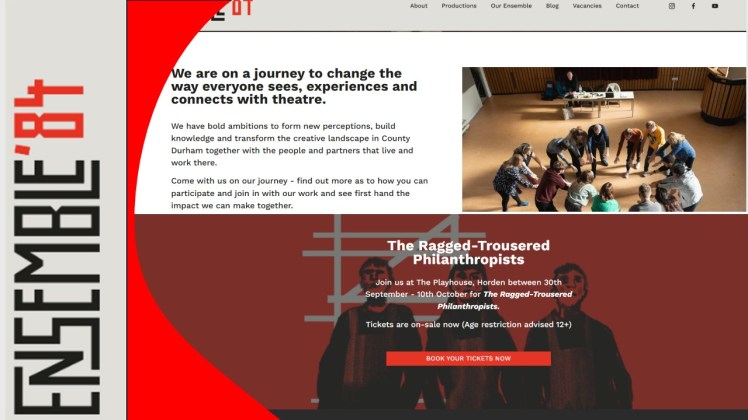
For other blogs touching on this novel, see Part One (‘My Dad’) at this link; and for a bit of verse prompted by it, see this link. But now for this blog, which starts with the same paragraph (if altered) from Part One.
It is my habit to read and prepare to see theatre in order to increase the learning it affords me, whilst hoping that the pre-learning does not obstruct the new learning to be got from the experience I am preparing for. I can only hope this is so, for on reading The Ragged-Trousered Philanthropists again, probably for the first time right through, I am aware of much personal baggage it dredges out of my personal, and perhaps political life. In this blog my wish to my genie would be that the term the things people call ‘natural’ or ‘unnatural’ be understood for what they are to people: conditioned likes and dislikes, conditioned attractions to pleasure or repulsion by conditioned disgust.
This is also Part Two in a series, possibly of only two, about personal responses to a novel with incidental reflection on what dramatisations of important novels can and cannot do. This novel has always mattered in my life because I have long called myself a socialist. Moreover, it is part of the canon of books from the left wing of Labour politics, and yet it isn’t without moments that challenge me personally. One of them is an almost in-passing statement by Owen about sexual politics. In the following conversation, the dominant character of the work – the Socialist craftsman, Frank Owen – is challenged by Slyme, a member of the painting crew who are in general talking about the causes of poverty:
‘Early marriages is another thing,’ said Slyme: ‘no man oughtn’t to be allowed to get married unless he’s in a position to keep a family.’
‘How can marriage be a cause of poverty?’ said Owen, contemptuously. ‘A man who is not married is living an unnatural life’. 1
The two, it seems are talking at cross purposes, for though the general conversation in the male work group is about the causes of poverty (it has just been opined tht women performing male job roles is one factor in poverty’s causation by Harlow) and particularly why it is not ‘money’ (or ‘the great money trick’ as Owen later calls it). Slyme who fills a silence left by Barrington and is actually is addressing the fact that early marriage impoverishes the families that are thus created. These early marriages in turn create a situation where those outside the labour market – supposedly women andnotably children – become as impoverished as the men supposedly ‘keeping’ them.
Owen’s response is surely an overgeneralised one to Slyme’s point, for Slyme is really explaining male responsibility for not bringing children and women, assuming that that these women do nor enter the labour market themselves, into their own state of poverty until or unless thwy have a sufficient income to keep them above poverty. After all he makes it clear that it is ‘early marriage’ that is the issue not marriage per se, although that is how Owen answers his point about ‘early marriage’.
I cannot say whether Tressell wants us to see Owen as unfair in his response. Slyme is hardly a character that the omniscient narrator of the book wants us to think kindly of. On a page before this Slyme had pointed out what he actually thought the ‘cause of most poverty’ was; it being ‘drink’. Owen does not react here but the narrator does, and what the narrator says may bear some relation to Owen’s point of view:
This young man had been through some strange process that he called ‘conversion’. He had had a ‘change of ‘art’ and looked down with pious pity upon those he called ‘worldly’ people. He was not ‘worldly’, he did not smoke or drink and never went to the theatre. He had an extraordinary notion that total abstinence was one of the fundamental principles of the Christian religion. It never occurred to what he called his mind, that this doctrine is an insult to the Founder of Christianity.[2]
Slyme’s view of ‘early marriage’ might then be seen by Owen as another example of his belief in abstinence, although here not total but partial until it is sanctioned within a financially secure marriage. Nevertheless, Owen certainly believes that that there is a social responsibility for children, as detailed in this piece from the novel about ‘the shameful condition of the children of the poor’, for instance.
More than one-third of the children of the working classes in London have some sort of mental or physical defect; defects in development; defects of eyesight; abnormal nervousness; rickets, and mental dullness. The difference in height and weight and general condition of the children in poor schools and the children of the so-called better classes, constitutes a crime that calls aloud to Heaven for vengeance upon those who are responsible for it. [3]
That working classes fathers share some of that social responsibility by not overturning the capitalist system as the end-cause of child poverty, is certainly Owen’s belief, as I showed in my last blog (see this link). There is some justice, Socialists must admit, in Slyme’s view that showing responsibility for children has some relation to not having children if they cannot be raised except in abject poverty.
That is, unless of course, those men who do not marry, and do not do it early in their adult lives, are in some way unnatural. Owen makesthis point again in passing when in his ‘great money trick’ speech he asks the men of Rushton’s to compare ‘the quality and quantity of clothing possessed by the wife and daughter of a rich man with that of the wife or daughter of a worker’:
For themselves, the philanthropic workers manufacture shoddy cloth–that is, cheap cloth made of old rags and dirt; and shoddy, uncomfortable ironclad boots. If you see a workman wearing a really good suit of clothes you may safely conclude that he is either leading an unnatural life–that is, he is not married–or that he has obtained it from a tallyman on the hire system and has not yet paid for it–or that it is someone else’s cast-off suit that he has bought second-hand or had given to him by some charitable person. It’s the same with the food. [4]
That Owen has an axe to grind about single young men, like Slyme (who is in the audience of this informal speech), is clearer still when Owen relates the fact that no working man can afford to use banks to the problems of a money-based economy wherein the role of the banks is based entirely on serving bourgeois interests and control of the products of labour. Slyme intervenes to show that there are thrifty workers like himself and the equally single Crass. Owen’s reply is more than personal:
‘A single man can save money if he likes,’ said Slyme.
‘I’m not speaking of single men,’ replied Owen. ‘I’m referring to those who live natural lives.’ [5]
All of this prepares us for Slyme’s role in the novel and I wonder if this sexual poltical aspect of the novel will be dramatised in Horden? That role hangs round that part of the plot wherein Slyme becomes a lodger with his workmate Easton and that man’s wife, Ruth Easton. Slyme observes Easton’s decline into dependency on social alcohol use and the familial absence ensuing so that often he is at home alone with Ruth, unless his role as an evangelist intervenes.
When, at one time, Easton takes Ruth to the pub with him she is exposed somewhat unknowingly to alcohol of which she is intolerant, becomes inebriated and collapses on her way home alone, Easton staying put in the pub. ‘Rescued’ by Slyme when she collapses on the street, he takes her home and, during kindnesses to revive her, their contact turns to kisses.
The book breaks a chapter here and we only return to Ruth later when her pregnancy becomes detectable, if not explicitly mentioned, and the fact of her rape certain when she bears a child that Easton later discovers not to be his. The issue of consent in the unobserved sexual contact with Slyme we never hear related is elided, rightly one supposes. After all, whatever the true account of the actual event, Ruth was still inebriated, though not at her own agency but her husband’s, when the baby was conceived. We hear only of Ruth’s ambivalence (between loathing and tender love) about the child that is born.
Drink then is implicated in this plot element but so is the abstinence of young males from sex, and in both Slyme acts in complicity with the effect of evils he condemns in his role as a man of observant religious abstinence. But let us return to how Owen responded: ‘’A man who is not married is living an unnatural life’ and its repetition in the view that all ‘single men’ are not ‘those who live natural lives’.
Surely bringing in here the issue of what is natural and what is not is a strange move in the conversations about socialism, that suddenly exempts single men, and we presume women, from the category of the natural. Why is the state of a single man, for instance, ‘unnatural’? To what extent does it depend upon unstated views of male sexuality being a thing that nature (perhaps his role in the reproductive sexual act) demands be a fulfilled need, and if so why should nature so require it be only fulfilled in reproductive heterosexual ‘marriage’? The assumption must be that sex is only ‘natural’ for that function alone.
It is difficult for me not to connect that with the extraordinarily ugly name given to the most prominent singleton in this novel, Slyme, in relation to his plot role. Slyme is almost a signal of a hidden issue behind the plot about the nature of masculinity when not functioning within conventionally validated heteronormative forms.
In a novel where names sometimes indicate moral traits, the name ‘Slyme’ stands out: perhaps because it includes the word ‘sly’, because Slyme is reserved about his life (certainly shy but also perhaps sly), although the kind of evil intent associated with ‘slyness’ hardly appears in him or is hidden, even from the reader.
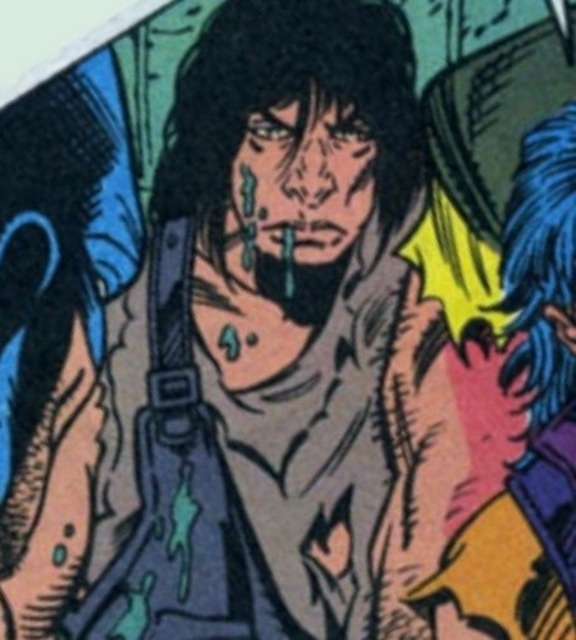
A comic book character named Slyme: available https://comicvine.gamespot.com/slyme/4005-175506/ Pretty boy but pretty disgusting too! And from the margins
The unpleasant wet and sticky nature of ‘slime’ does however seem intended too in the name, as if, if you were to touch his hand it would, like Dickens’ Uriah Heep’s hand, cause you to feel the need to wash your own hand afterwards. Is the ‘unnatural life’ of Slyme, that I suggest of the incontinent masturbater, who only ‘saves himself ‘ and his sexual energies and instincts by refusing early marriage by secret self- stimulation, a secret no reader can be let in upon any more than they can into the sex act between himself and Ruth. The idea that for a man not to marry, and not to marry when most sexually fertile (when young), is in Owen’s world, and perhaps Tressell’s, an unnatural use of natural assets.
It is possible that this theme of the novel, both sly and shy of the novel’s politics, is mediated through Tressell’s own experience of being the illegitimate son of a woman who, though she lived with the respectable bourgeois father of her child, never married. Robert Noonan (he lived by his mother’s name, except in books) must have known how it was to bear a ‘bastard’ in Ireland in the late nineteenth century. The effect of Slyme’s display of being a man held back in unnatural reserve is the sly sex he finds with Ruth. In the story the Easton couple separate but are brought together again by Owen and his wife, the latter couple taking on the illegitimate child of Slyme that Easton cannot (more strictly WILL NOT) take upon for himself the care and duty that would mean he was the child’s de facto father. At least Robert’s respectable father did that, if without the possibility of formal marriage.
All of this plot makes up the skeletal structure this huge novel and yet I wonder if it will at all form part of the drama we shall see at the Horden Playhouse, and, if so how it will interact with its other aims to show Socialism as a way forward through the condition of degraded working-class life, and middle-class hypocrisy, created by Capitalism. That, after all, is why it is a classic!.
Clearly, not taking into account the insistence on what is ‘natural’ in the realms of sex/gender and sexuality must fracture the framework of the novel’s plot structure. However, the plot’s advocacy of socialist reconfiguration of society demands that working men be disabused of the ideological assumptions about basic human nature and ‘natural’ behaviour endemic to capitalism. To Owen, the elder worker Philpot says, contesting his Socialist vision of a world that wastes nothing in competition between human individuals: ‘It can’t never be altered,’ said Philpot. ‘Human nature’s human nature and you can’t get away from it.’ [6]
If Philpot is as stupid as he is represented, we have to remember that Owen’s views of human sex/gender/sexuality rests on nothing more solid than a supposed foundational belief upon human nature just as is the tenet of petty competitive individual self-interest as the driver of human behaviour in capitalism. See how Owen deals with that when opposing the crass opinions of, well, Crass!
‘There’s always been rich and poor in the world, and there always will be.’
Several others expressed their enthusiastic agreement with Crass’s opinion, and most of them appeared to be highly delighted to think that the existing state of affairs could never be altered.
‘It hasn’t always been like it, and it won’t always be like it,’ said Owen. ‘The time will come, and it’s not very far distant, when the necessaries of life will be produced for use and not for profit. The time is coming when it will no longer be possible for a few selfish people to condemn thousands of men and women and little children to live in misery and die of want.’
‘Ah well, it won’t be in your time, or mine either,’ said Crass gleefully, and most of the others laughed with imbecile satisfaction. [7]
Owen here, backed by Barrington’s Great Oration, stands for a complete revision of the ideologies which sustain a system by saying it is ‘natural’, like the division between rich and poor. However. if you can ‘get away’ from the ideologies of what is human nature towards a new system of equality under co-operative socialism, then why do we need to exclude the non heteronormative from what is ‘natural’, including Slyme; whether his sin is illicit sly and secreted sex in the margins of supposed decency and natural human behaviour or slimy self-abuse (as they name masturbation).
Of course Slyme is created such that the behavioural model he represents is despicable. No reader feels a wish to identify with him in the novel. It is out of the question – he is on the wrong side of history and, for Owen, the wrong side of the norms of nature. Perhaps that is why Barrington is needed in the novel, for he reserves his advocacy for socialism as much as Slyme reserves his sexual power and the little surplus that being single gives him in money.
When Barrington after the election is confronted by the Socialist who has turned to the ‘dark side’ to support Liberals for his own self-interest, that dark soul like Satan in Paradise Regained aims to convert Barrington to the same darkness. Barrington counters by saying how priests and working-class parents have taught their children to ‘regard themselves and their own class with contempt–a sort of lower animals–and to regard those who possess wealth with veneration, as superior beings’. This is nurture not nature, as is clear when Barrington continues, by questioning whether what people call ‘natural’ has anything to do with nature at all and more to do with teaching and inculcating false consciousness (to invoke that old Lukacsian category) and ideology. A Socialist view of ‘nature‘ is opposed to divisive capitalist ideology:
The idea that they are really human creatures, naturally absolutely the same as their so-called betters, naturally equal in every way, naturally different from them only in those ways in which their so-called superiors differ from each other, and inferior to them only because they have been deprived of education, culture and opportunity--you know as well as I do that they have all been taught to regard that idea as preposterous.
‘The self-styled “Christian” priests who say–with their tongues in their cheeks–that God is our Father and that all men are brethren, have succeeded in convincing the majority of the “brethren” that it is their duty to be content in their degradation, and to order themselves lowly and reverently towards their masters. Your resentment should be directed against the deceivers, not against the dupes.’ [8]
The reason Owen might not have been able to say this as well as Barrington is that Owen is still a dupe of nature, forcing a notion of heteronormative nature that need not be what nature is, a prescription and proscription for human behaviour in any realm. It is an uncomfortable moment in the novel this . In it Barrington is drawn to the ‘dark side’ by a fellow Socialist in doctrine but who must make himself comfortable first. It’s uncomfortable because it is described like queer seduction, wherein the seducer is given short shrift:
If you like to come along with me now, I’ll introduce you to Sweater’s agent–no one need know anything about it.’
He slipped his arm through Barrington’s, but the latter released himself.
‘Please yourself,’ said the other with an affectation of indifference. ‘You know your own business best. You may choose to be a Jesus Christ if you like, but for my part I’m finished. For the future I intend to look after myself. [9]
Now, I know the novel must be shorn of much material in a stage production, but my feeling is that the novel is so canonical in the culture of socialist theatre that its problems and challenges will be cut or dropped or reinterpreted. I will see next week and may report back.
It is a pity nevertheless that the nuance of radicalism is always curtailed – and sometimes this feeds sectionalism on the left, which is an even greater pity. But one musn’t prejudge, and, moreover, one must never assume that you have the nuances correct yourself. In this blog, I haven’t argued the case but have asserted as strongly as Frank Owen asserts his stance in the novel. My case being as I said it earlier: ‘In this blog my wish to my genie would be that the term the things people call ‘natural’ or ‘unnatural’ be understood for what they are to people: conditioned likes and dislikes, conditioned attractions to pleasure or repulsion by conditioned disgust‘.
Bye for now, with love
Steven xxxxxxxxxxxx
[1] Robert Tressell (2012 edition: 47) The Ragged Trousered Philanthropists Ware, Wordsworth Editions Limited (using the 1955 Lawrence & Wishart edition using the author’s manuscript – owned by the TUC to add the elements expunged from earlier editions from 1914 – after the author’s death).
[2] Ibid: 46
[3] ibid: ///
[4] ibid: 294
[5] ibid: 296
[6] ibid: 166
[7] ibid: 488
[8] ibid: 567f.
[9] ibid: 567


2 thoughts on “How can a drama about men and their relation to work take on, and does it need to, the belief of its central character that a ‘man who is not married is living an unnatural life.’[1] Some personal, and otherwise, reflection on reading Robert Tressell before seeing the Ensemble ’84 production of ‘The Ragged Trousered Philanthropists’: Part Two, being on homosocial groups and heterosexual marriage.”