Tell us about your morning routine.
View all responses
I try to finish blogs, of course. Today I succeeded. This is a blog on seeing ‘The ragged Trousered Philantrhropists’ performed by Ensemble 84 at Horden. Mark Dornford-May, Artistic Director of Ensemble 84 says of the current production of The Ragged Trousered Philanthropists in an adaptation by Stephen Lowe: ‘We are not interested in putting a museum piece on stage. We want to ask what Tressell’s ideas mean now, in 2026, in Horden, with this company and this audience’. What does this mean?
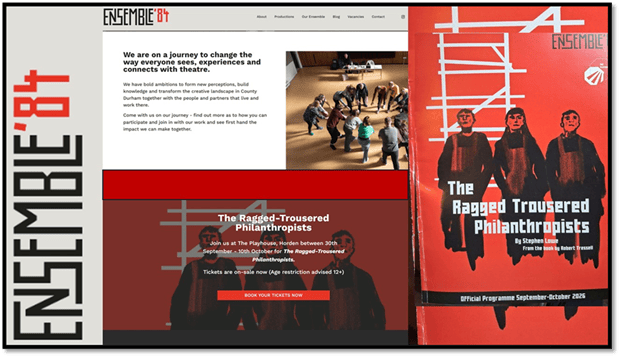
Collaged from images from the website and including the official programme cover
I have blogged my preparation for this piece in two previous blogs: the first on the personal memories the book raises about me and my father, a painter and decorator (linked here); the second, on the depiction of male relationships (linked here). After seeing the play I wonder if reading the book was wise. I note that the critic Mark Clegg from the Reviews Hub had not though feels he might, and I suspect that is a happy state. Since for me the reading clouded my appreciation of this ensemble piece, radical in theatre terms but less so (and I think mainly as a consequence of Stephen Lowe’s adaptation which I had not read before, but is certainly NOT a contemporary text, being written much earlier, as I discovered by borrowing the text from the Internet Archive, this text being that from 1983 published for the production at The Half Moon Theatre in London (see below).
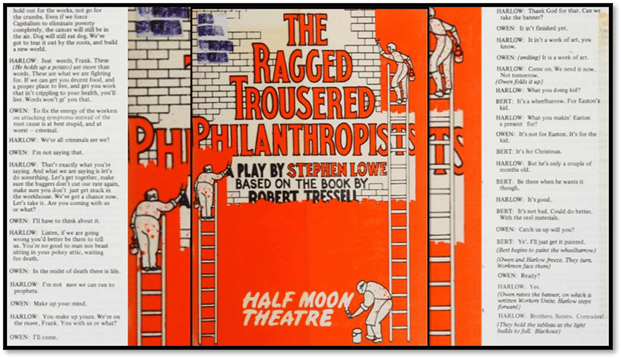
This was not the first production of his adaptation (there is a history of it in Wikipedia) which was first produced ‘by Joint Stock in Plymouth on 14 September 1978, directed by William Gaskill. The production then toured the country, with performances in London at Riverside Studios in October’. Did it play in the North East of England. That I don’t know! Though Stephen Lowe was a radical of his day born in Sneinton in Nottingham in 1947 (two years after the first and most radical reforming Labour Government – though not a Socialist one but by aspiration), and his play addressed a different way of situating Left politics than any that might hold water or be recognisable today, in Horden or anywhere else, which now has a large Reform Party vote that might not warm to the way book and play satirises the beliefs of those who blame political ills on ‘foreigners’ and ‘immigrants’.
If anything this is for me what leads to the smell of mothballs in this production – though the text does the work against prejudice against migrants . There are certainly not mothballs in the ensemble acting, the direction and the simple effective setting. However, the text is a powerful force, and, despite the Artistic Director, Mark Dornford May’s statement in the Official programme that ‘We are not interested in putting a museum piece on stage. We want to ask what Tressell’s ideas mean now, in 2026, in Horden, with this company and this audience’, it smells like Lear’s hand ‘of mortality’. The script, of course, bears little enough reference to Horden that matters (as one would expect) but the real problem is that the play lived upon a Socialist hope in the Labour Party that has since been mocked by reforming collusion with the harshest of neo-liberal economist thinking, notably the Blatcherism of Tony Blair’s New Labour, birthed out of the death of a Socialist Clause 4 of The Labour Party, and practically drowned in vomitous acid by the Starmer cult. Blair himself sapped the life from County Durham socialism sat like spider in Spennymoor spinning webs of deceit with process-led names like ‘level playing-field between private and public enterprise’, and the ‘third way’ from Giddens. In truth socialism had always been in Durham a minority force except in parts of the NUM.
Tony Benn says in the preface to the Wordsworth Classics edition of the book that Frank Owen in it probably failed to get through to workers, who were as hopelessly contented with the status quo as fearful of its threats to them and their families, because ‘the Labour Party had only just been founded’, leading to ‘despair and cynicism’ from them.[1] In the 1970s when I first joined the Labour Party as a socialist there was still hope for radical change and that must have fed the ending of the original playscript, still used in this production. Here is the end, wherein Frank Owen starts off by still holding out against piecemeal reform advocated even then by majorities in the Party and the Trades Union movement (for fairness at work, and, amongst other things, health and social care reform, things which Owen as a Socialist call ‘tinkering with symptoms rather than the eradication of Capitalism and its sustaining ideas of self; measured against exchange value rather than the use value of the goods necessary for, or an enhancement of life.
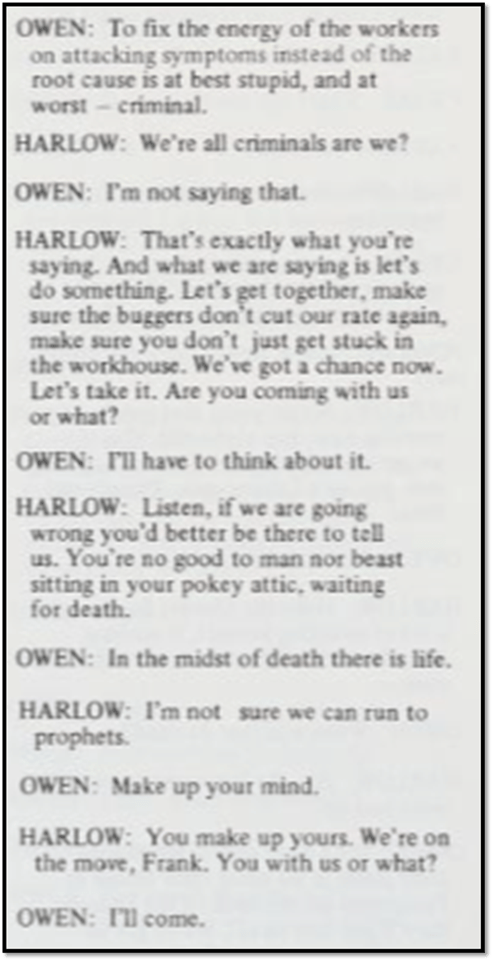
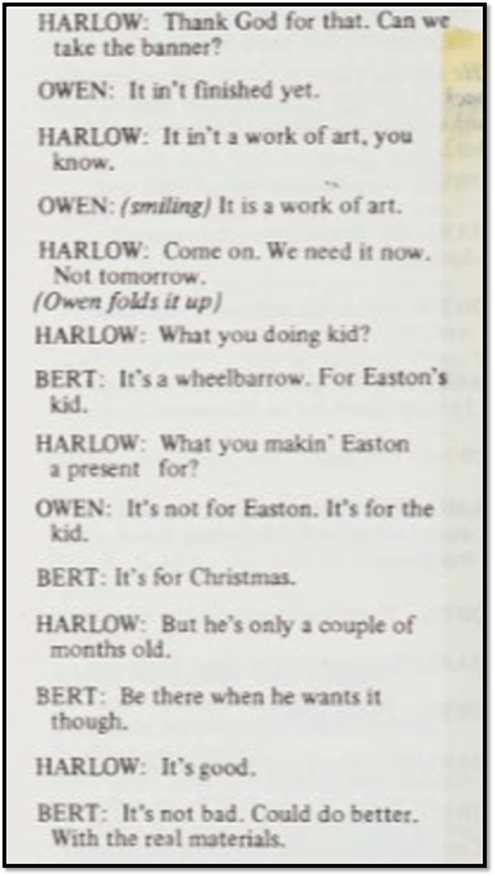
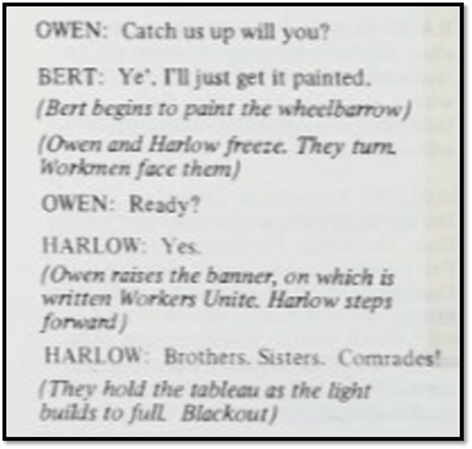
As others have said, Lowe concentrates the end of the play on theme of the good worker; those ideologies are in Tressell too but not in this form (they seem more like a reflection of William Morris’ predictive socialist analysis that fostered Guild Socialism as well as the Arts and Craft Movement. As always in Tressell and Lowe, Owen focuses upon work as an idea; the worker concentrated on perfection as in a ‘a work of art’ not an optimally worked product whose degree of finish was based on the relative scarcity of economic resources. This is genuinely like his politics, at least as I think Lowe sees them, as a work based on perfectionism where something made has to be in its finished and complete form. This was not Lowe realised the function of the Labour Movement which was aspirant and progressive but had to rely on the resources that were currently in and under their control. Owen has to learn to end Lowe’s play with his banner unfinished but in progress, and likewise the little red wheelbarrow made by Bert as a child’s plaything must bear in its finish the lesson to the worker that he ‘could do better, with better materials’. This was the basis of hope of the movement in the 1970s, in which solidarity between workers aimed at gaining the small gains it could with the current resources it held, whatever the failure to move to socialism it was ‘a start’ as Harlow says.
Harlow is made much more central in Lowe’s play than he is in Tressell – developed to deliver a speech that gets him sacked at the ‘Beano’ (more a picnic in Lowe), but not delivering the ‘Great Oration’, just the words of a man who has listened to Owen and draws from it was is in the interest of the working-classes but spoken out about only because he had too much to drink. Barrington the bourgeois socialist gave in the book. Barrington indeed, the class ‘double’ of Owen as a Socialist has disappeared to create Harlow who throughout the play tempers Owens flair for just work and a just society by a pinch of pragmatic realism. In the 1970s, up to the 1990s, Socialists were built in this fashion, including Tony Benn and Michael Foot, and it was a symbol of hope for a future however distant. This is not the case in 2026, despite Dornford-May’s contention that he is directing a play with a direct relevance to 2026 Horden. Nothing could be further from the truth of politics in this year and in that decayed coastal town, once a pit town but now a mere extension to the vast multi-class zoned estate that is Peterlee. In 2026, the Labour Party is not the ‘start’ towards anything, its version of hope not extending beyond the left margins of Blairism, from which the current Prime Minister derived. At its best it could reform Social Care in a more just way but it does not aim for the end of capitalism as a means of organising human beings in the same way it organises other resources in economic cycles of glut and scarcity.
Owen was played by Joseph Hammal, who was such a superlative Hamlet (see my blog on this here). See him below as he performs the ‘Great Money-Trick’ lecture. Mark Clegg describes him in role well enough for me:
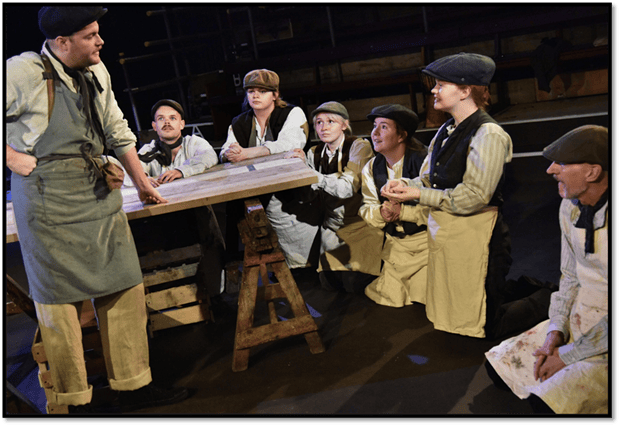
Photograph Keith Pattison from REVIEW: The Ragged-Trousered Philanthropists in https://www.culturednortheast.co.uk/p/review-the-ragged-trousered-philanthropists
Joseph Hammal plays Owen, the socialist member of the group whose philosophy is slowly taken on board by others in the team, but whose ideals threaten to leave him isolated from taking action. Hammal is an excellent presence and manages to display enough charm to balance his character’s prickly political proclivities. The highlight of the entire show is “The Great Money Trick”, a visual demonstration that Hammal’s Owen brilliantly performs to illustrate the problem with capitalism and how it relies on the exploitation of the common man.[2]
This is good because, Clegg though innocent of having read Tressell, both proclaims Hammal’s brilliance in this play in its own right and the way in which the role is softened from that of Tressell’s socialist hero. Owen, hammered down by capital, tuberculosis (also in the play but taken nowhere) and his lack of the bourgeois-educated facility of Barrington, although he too is not accepted by the workers he works amongst in Tressell either. But Lowe’s Owen is put in his place by Harlow as a representative of the common working man, with no room for theory or things that look like perfection or art for their own sake, as the symbol of th Post-War Labour Party, the first start of whose hope id for a juster mixed economy between capital and labour. Here again Clegg is good, but reveals the thing that concerned me – that Owen has to be made to see that he cannot but be a representation of a passing phase in the march of economic and social justice – the idealist whom no-one has time to understand. This is what Clegg says:
Working against Owen’s ideals are Stephen Lister’s gloriously officious general manager Hunter and the Wendy Hindmarsh’s duplicitous foreman Bob – both providing rounded interpretations of what could easily be stock villainous characters. Meanwhile, as the main members of the labour force, Keith Irons is the pragmatic Philpott and Brodie Jobson is the explosive Harlow, a nicely contrasting pair whose great individual performances beautifully complement each other. The rest of the cast is equally impressive, and the frequent acapella choral work from the full company is as melodious as it is dramatically relevant.2
I would heighten the praise of Hindmarsh’s Bob Crass in particular, for this character, constantly acting his other is possibly the reality of what social performance in what Sartre called ‘bad faith’ actually is, the creation of a monstrous self forever acting its rise in a scale of values that depends on the exploitation of others and maintains the glass ceiling for everyone beneath it including themselves, even one’s ‘superiors’ on the scale under the ceiling, like the luckless tortured Hunter in this play. But Brodie Johnson really excels, unfortunately for the message of the play in 2026, lauding the Labour Party as a start on the path to Socialism. He shows brilliantly the weakness of the play for the present day in manifesting his strength as a team actor. Below we see his Harlow in the confrontation at the ‘Beano’ (note the wonderful – sparse but evocative – background flats creating the mise-en-scene) confronting Crass, with Philpott at his back. But let not the singling out of actors get the tone wrong – these actors work as individuals because they work so well as an ensemble (a concept in theatre I thought we had lost).
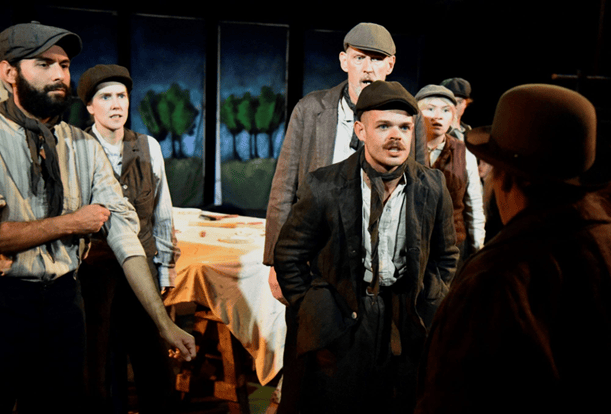
Photograph, Mark Pattinson, available at https://www.thereviewshub.com/the-ragged-trousered-philanthropists-horden-playhouse/#google_vignette
And, as an ensemble, the play is well served, for it too celebrates team work. This is a concept not really present, in Tressell’s book, and is a product of twentieth century forces from Fordism, at its worst assembly line form, to co-operative production in a range of work situations, even the production of works of rt, and at its best a model of socialist production. Its image are the scenes of painting ‘The Cave’, Sweater’s house, represented by a series of doors (see below).
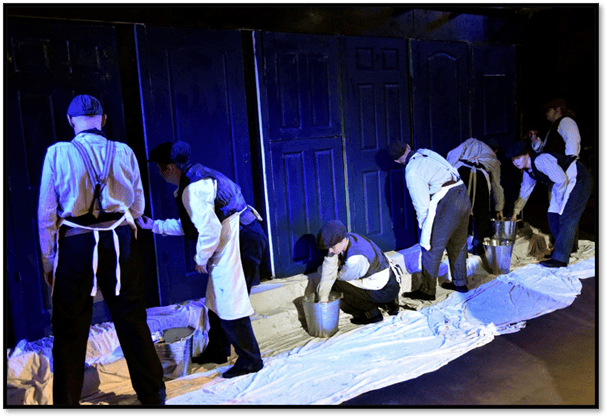
Photograph, Mark Pattinson, available at https://www.thereviewshub.com/the-ragged-trousered-philanthropists-horden-playhouse/#google_vignette
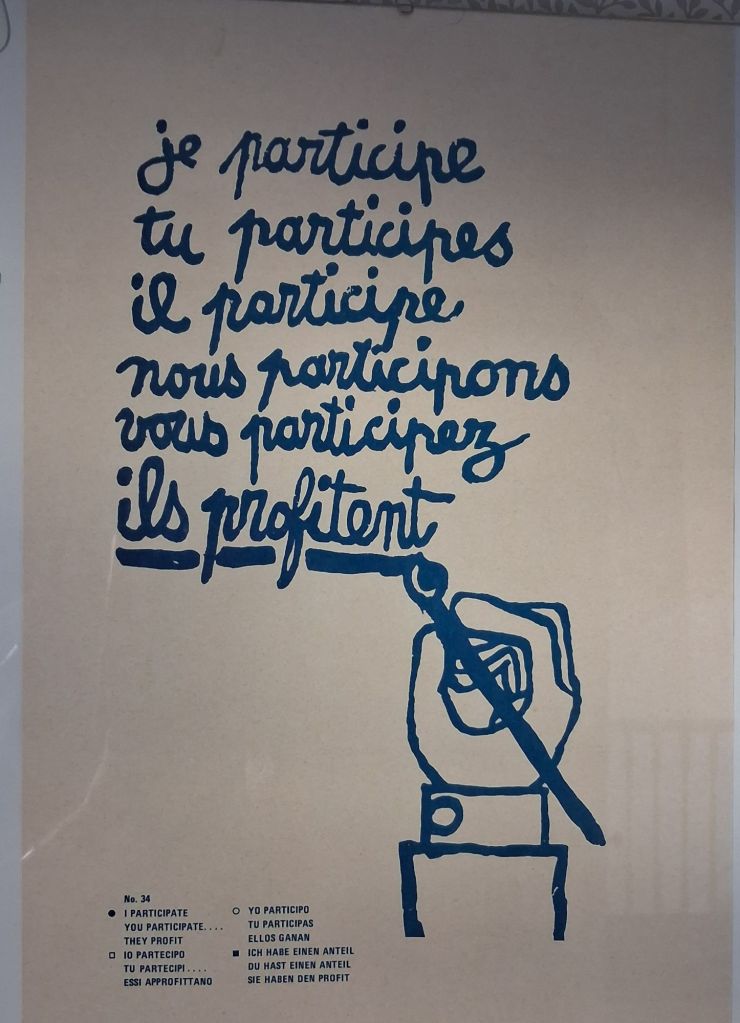
There is however yet another contradiction, however that I felt so strongly in watching the play. Ensemble 84 is co-operative theatre, providing opportunity for actors that might not get it in the commodity led theatre of our day, and it is a wonderful act of team participation in which individuals too thrive and give of their best for the rest, but it also a concept that has been stolen by the few to apply only to the many – for there is no ‘I’ in team, only because the ‘I’ entitled are all still taking profit from the labour of the team in the work of non-subsidised production. It reminds me of a poster in May 1968 France (see below for my non-original copy) – everyone participates (they were referring to General de Gaulle’s use of that word, but only they, above the glass ceiling including De Gaulle, PROFIT from the participation in labour.
I sneaked a photo of the cast who assemble in ensemble on the stage around the properties that become the set. The team always assemble thus before performance, as they did in Hamlet. It is a strong image of their ideal before the action that realizes that ideal with all its distinctions and nuance. And a word for the set and the stage ‘properties / props’. So many original vintage trestles appear (as if a ghost of Tressell himself) and do their bit, even being assembled as they should to enact supper tables or pasting tables (as seen in the press photos above), and any number of imagined scenes. In my photograph the ensemble wander around them piled in the middle of the floor – wherein workers cooperate with their flexible tools – their product, a kind of magic. Here it served the sham of Labourism in a world where that very ideology has done more in recent history to prop up injustice than fight it back to the decaying mud of history in which it belongs. But the team are lovely,
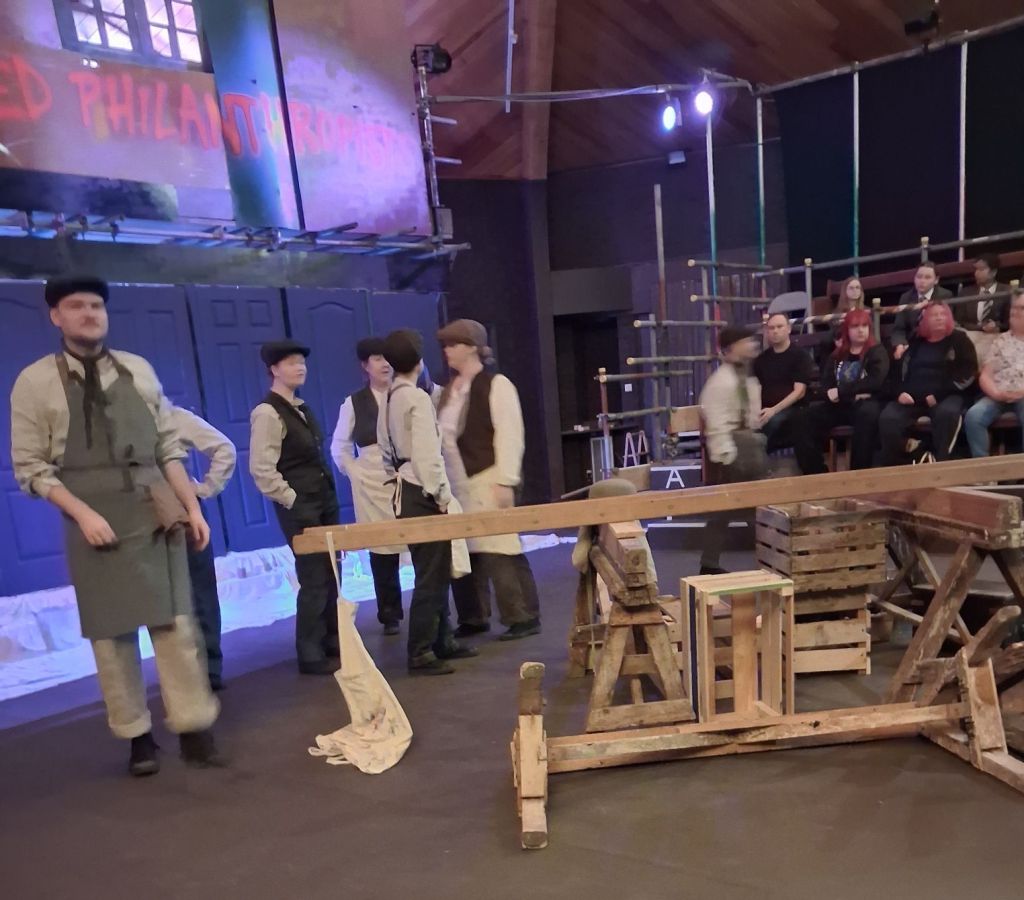
My photograph, 8th October 2026, 2.28 p.m.
Do see the play if you can. Perhaps you won’t feel the torture of my own political history which bore so down on its use of Lowe’s script. The team added a moment where I felt they should have down more to return to Tressell as they did in this, for his smell of the museum is less inappropriate from Lowe’s in the last decades of the twentieth century. Jeff Brown in his Cutlured North East review points to it:
There’s music (the whole piece opened by a beautiful rendition of Danny Boy by Willow Pearson’s Bert), dancing (most notably on a table-top by Brodie Johnson’s Harlow, one of Frank’s few converts), clever use of a sparse set (lots of trestles and a few planks) and actual painting (I’m guessing the colour scheme changes with every performance?).[3]
What Jeff misses is that Willow Pearson at that point, stood at a garret window in the upper scaffolding in the set, first enacts Katheen Noonan (or Tressel) if you prefer, the daughter Robert brought up and loved. She tells us she will play Bert, after she sings Danny Boy, which is sung again at the end. Its elegiac feel of a battle yet to be fought is where I was at with this glorious team in a glorious production of a museum-piece adaptation.
Much love
Steven xxxxxx
[1] Tony Benn (2012: 7) ‘Foreword’ in Robert Tressele (ed. Lionel Kelly) The Ragged Trousered Philanthropists Ware, Wordsworth Editions, 7- 8.
[2] Mark Clegg The Ragged Trousered Philanthropists – Horden Playhouse – The Reviews Hub https://www.thereviewshub.com/the-ragged-trousered-philanthropists-horden-playhouse/#google_vignette
[3] Jeff Brown i(2026) REVIEW: The Ragged-Trousered Philanthropists in https://www.culturednortheast.co.uk/p/review-the-ragged-trousered-philanthropists

