


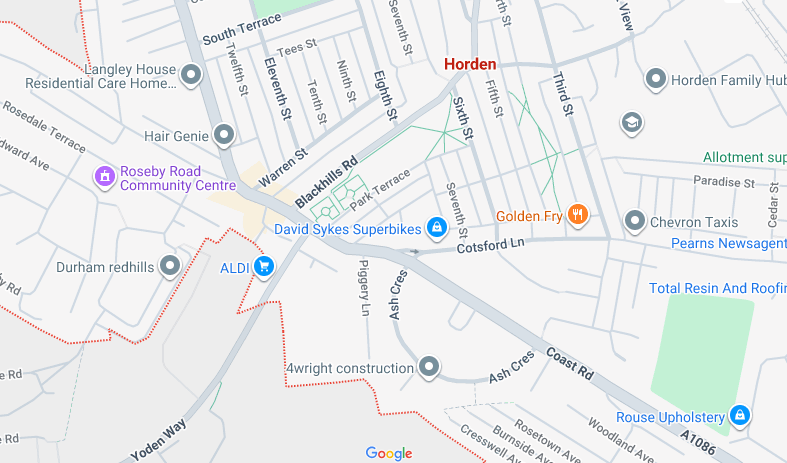
The walk was short but I didn’t know that when I parked up on Warren Street between Twelfth Street and Eleventh Street (pit villages and towns oft have numbered streets, lined on each sides by redbrick terraces, rather than names – perhaps to emphasise the fact that they housed such numbers of men, in the eyes of the pit managers and housing providers for the pit). My Satnav abandoned me without quite getting me to South Street, but, as you see above, it is is but a blink away.
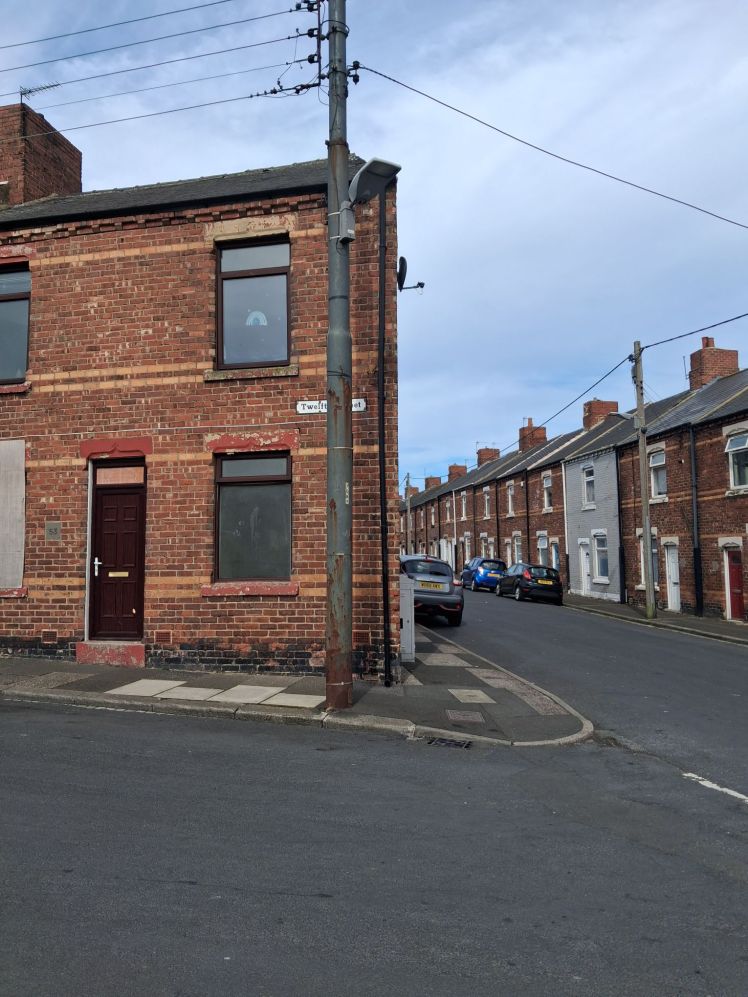
As I walked I looked back from Twelfth Street – across from a house with blanked downstairs windows but perhaps lived in above – to the parked car (blue Micra) down Warren Street. I was lost (not having that map above) and asked at a hairdressers on the top of Warren Street just above and across from the road at Twelfth Street where the theatre was – ‘just up the Coast Road, you can’t miss i’t’, cheery ladies told me:
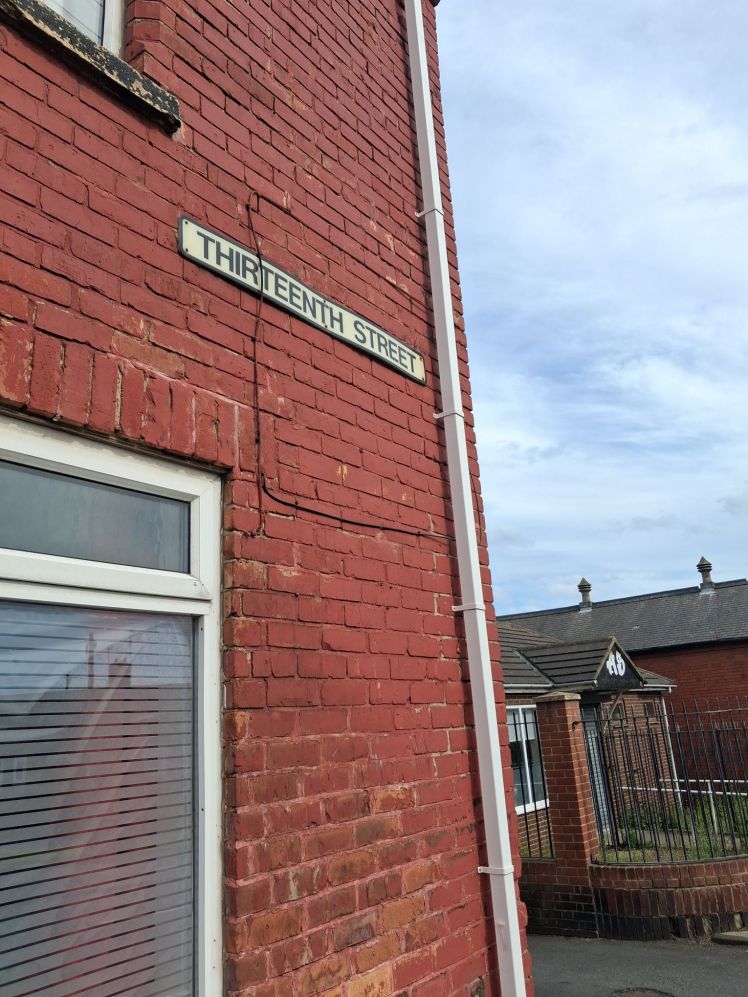
Back at the Coast Road, I found the inset houses still bearing the anonymous street names (Thirteenth Street rather than Coast Road numbers). I asked a gent outside one house if he knew where the theatre was, a converted church. He knew of no theatre – yet it was only six doors further down the road.
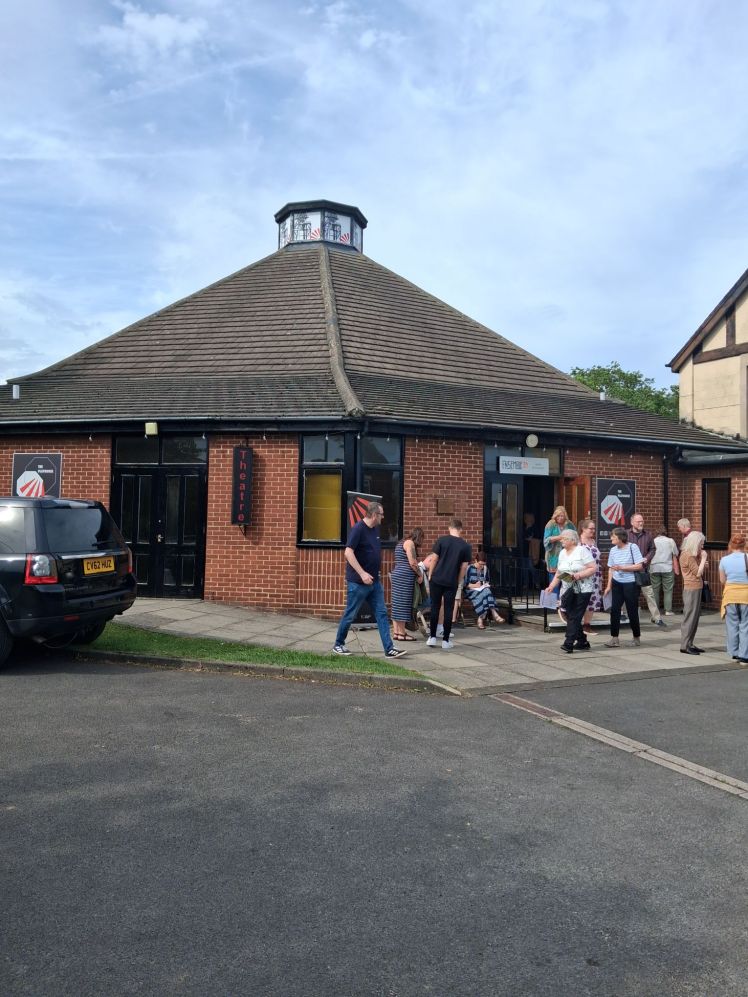
The Playhouse is on the corner of South Street and the continuing Coast Road – on its way to Easington Colliery. I hadn’t been in that area since I was a Social Work Assistant at East Durham Social Services in Peterlee (just up Yoden Way) but that was such an age ago. The Playhouse was like a world set back:
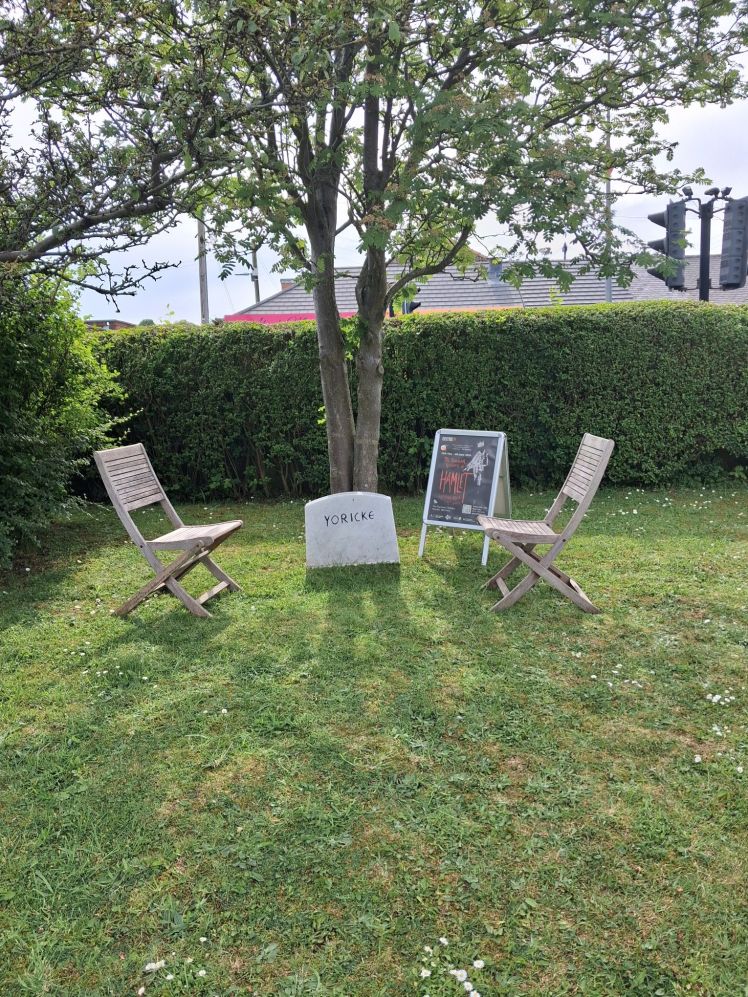
It’s garden braved a joke about its current production – the grave of Yoricke spelled as in First Quarto:
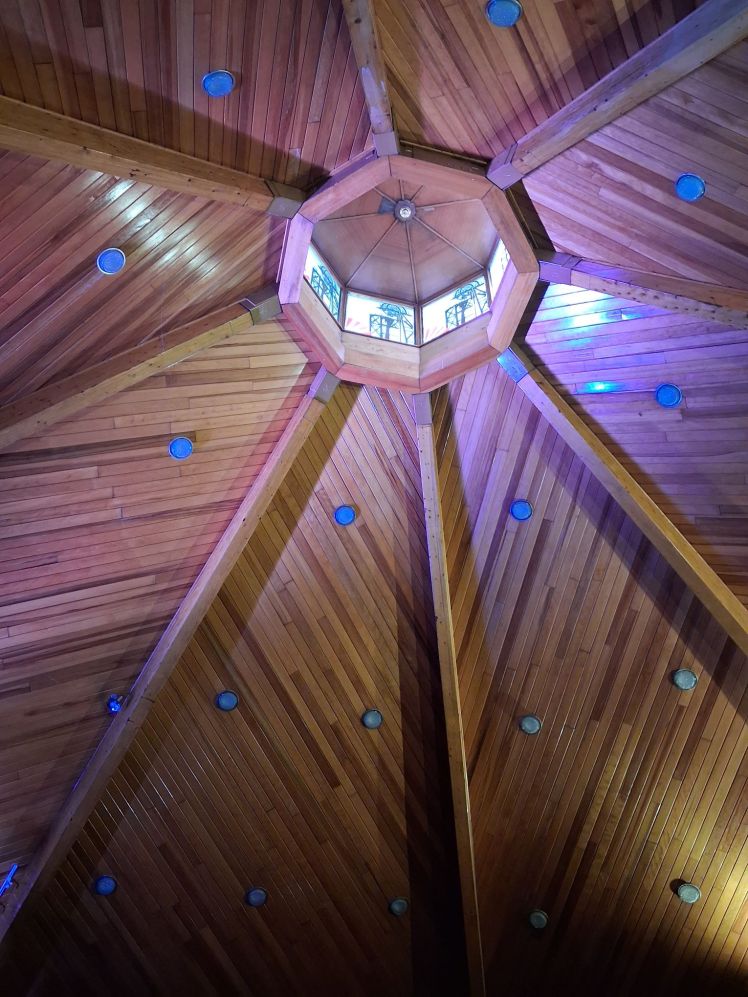
The converted modern Catholic Church was magical within. I felt I needed pictures before the production as signs of my short walk. Here they are, starting with the upward look to the source of natural light for the church – a kind of method only usually employed in Catholic Churches, with its ring of the basilica and its cupola with light shed from above:
Below the acting space surrounded by seating constructed simply and tiered on gantries made of scaffold was full of a milling barefoot cast with modern casual tops on before the performance proper. On the north side is a slight raised proscenium and above it a raised platform for scenes on battlements or as a space where characters go to ‘overhear’ others in the acting space. It was highly effective in this play, so full of over-hearings and mishearing.
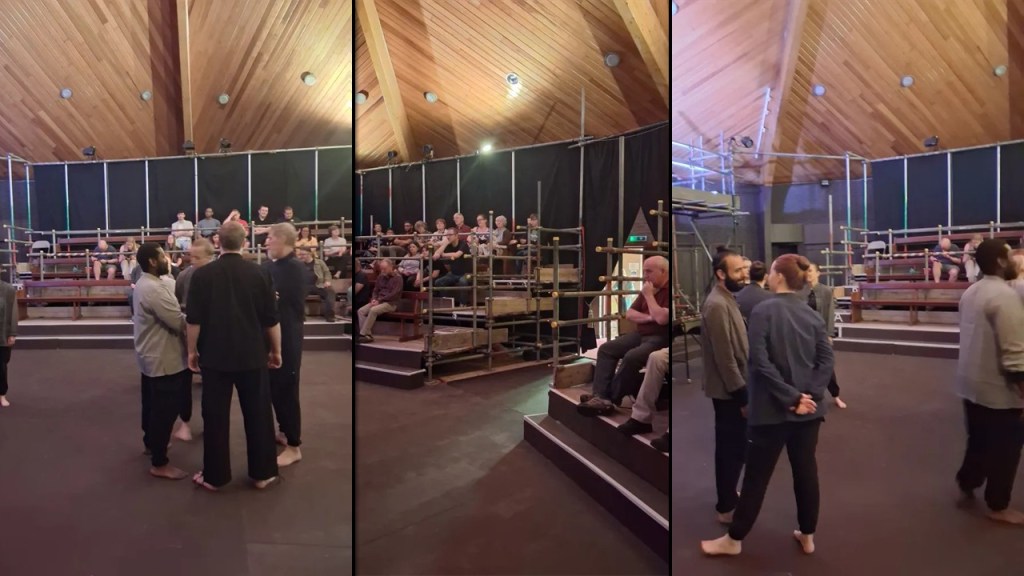
And then the photo opportunity was spoiled. A lady who got up to speak to say that she was not getting up to lecture or anything but to ‘house-keep’ also said we can’t take photographs – saying she had seen someone doing so but admitting that no-one had previously said. Moi, I think. The rest was about mobile phones – ‘must be off not just on silent’. It set the wrong tone – officious whilst claiming not to be and literally hectoring in nature, complaing about the fact that the matinee was not full in the audience section but ought to have been. I agree though – except the ladies rattling sweeties next to me, whom I could have hectored at myself.
But I took the hint and took no photographs at the end.
The production deserved better. I blogged recently on my expectations (see this link). True ensemble theatre, the pace hid great subtleties along the way. The text wasn’t confined to Quarto 1, especially in parts of Hamlet soliloquies – where ‘ay, there’s the rub’ was re-imported, rather than the homely phrase in Quarto 1 quoted in my last blog on preparation for this play, from the 2nd Quarto, though the first line of that soliloquy remained as in the First Quarto – ‘ay, thaer’s the point rather than ‘that is the question’.
The use of mumming costumes in the players section- and those parts not supposedly given to them by Hamlet being acted in Spanish – was novel and wonderful, capturing the otherness of a play with a play. Likewise the playing of the Ghost by the same actor as gave us Claudius was fascinating – played in shamanic style, half sung, chanted and danced, the Ghost was so othered that it spoke only in a tongue that I didn’t recognise but was possibly an African continental language, and Claudius played the role like a King should.
IF Hamlet was superb, Gertred and Ofelia (sic.) were also wonderful – the best ‘mad scene’ ever was by her – as was every other role from Laertes (who played athletically so many other roles) to the Gravedigger, who was also the ‘Polonius’ character. Horatio nailed his role. And the music! The whole production I could see again now. I loved it that Hamlet and Gertred acted the bed-room scene behind a curtain held up by other characters so that we saw it through the gestures of Polonius hidden behind it, until the curtain screen collapsed on him allowing Hamlet to dispatch him as if he were Claudius without having seen his mistake. This was ingenious.
So the walk back couldn’t truly be seen as a walk, but I did get photographs in and walked the play as I have never seen it before. And this was in Horden.
With love
Steven xxxxxxxxxxx


Nice walk and thanks for sharing. It is these walks that I enjoy the most!
LikeLiked by 1 person