


There is no such thing as an unlimited budget that is not paradoxically limited by its duration (as it is in this question for 24 hours) but the whole point is that budgets that are swollen are essential to the magical thinking of self-interest that is supposed to be the driver to capitalist economies. The feeling of the magic bulge of growth in the National Theatre’s ‘The Playboy of the Western World‘ seen yesterday night.
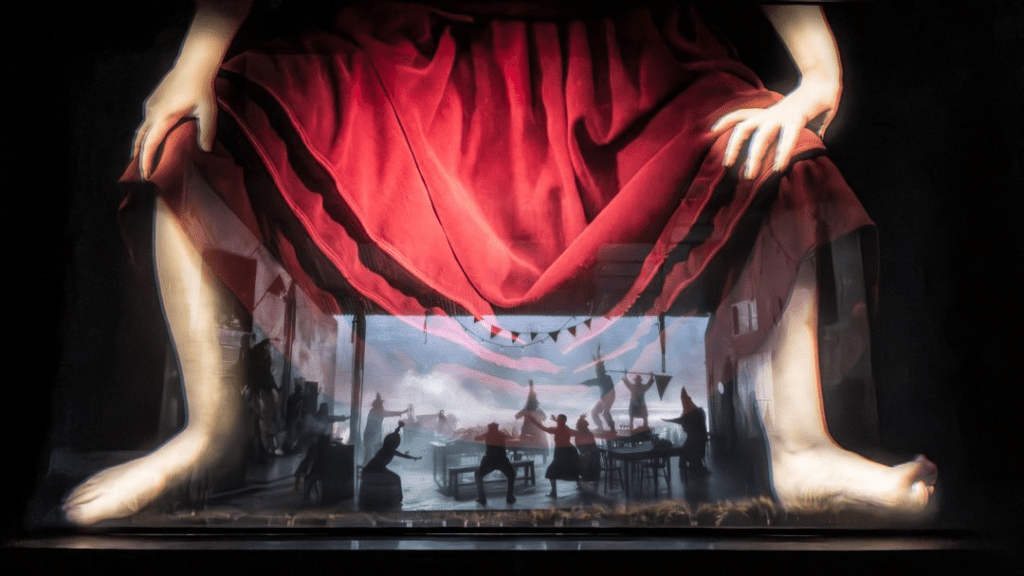
I wrote about this play before I saw it – use this link to see that blog too if you wish. But now having seen it streamed live, you need to imagine the Lyttleton Theatre proscenium at the National Theatre (or look above at the still from the production) swamped by a huge projected image of what appear s to be a woman’s legs bared by the lifted folds of their red skirt and held there by their hands, such as the opening scene of chaotic partying to the accompaniment of a mummer’s musical event in a simple setting but open to the sky behind, such that the lower folds of the front bulge of the red dress seem like red sky at night warnings in the sky for storms that must come. This is captured brilliantly in the screening of Synge’s The Playboy of the Western World, which I saw, with hubby Geoff, last night at the Reel Cinema in Bishop Auckland. Yet are the feet and hands feminine at all?
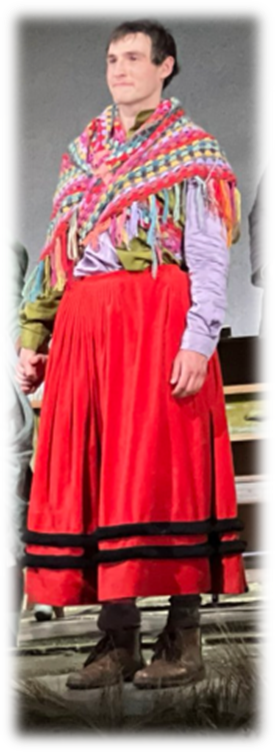
We need to ask this because this mode of sitting will be seen in the play only in Act 3, when performed by Christy Mahon, the itinerant male poet-labourer, in a scene wherein he is dressed up as a woman in voluminous red dress and woollen multi-coloured shawl on top in order to escape justice for killing his Father a second time (or the vengeance of a disappointed community whose swollen hopes had been invested in him because he had killed his father in their and his belief but finding disappointment when Old Mahon (Declan Conlan) his father is found still alive.
People may yearn for a Messiah or a ‘wonder of the Western world’. The scene between the proscenium figure’s legs above, and as we eatch contains all the ele.enyts added to tne plY in tbis production, including a whole set of fantasy figures from the Irish tradition of the mumming play and its accompaniment of fiddlers saying rural .music. in the programme note in the National Theatre, reproduced in photocopy by Reel Cinema, they company say:
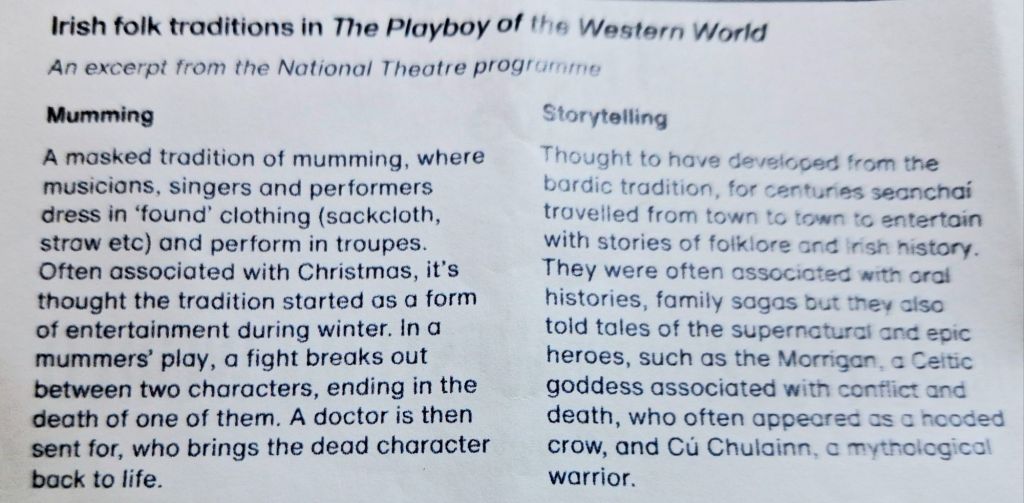
Clearly thus production from Catriona McLoughlin has truck with those traditions, somewhat mangled into the plot already by Synge: the itinerant poet storyteller which Christy (despite himself until his final speech) becomes and the theme of magical death and renewal by resurrection of the mumming tradition.
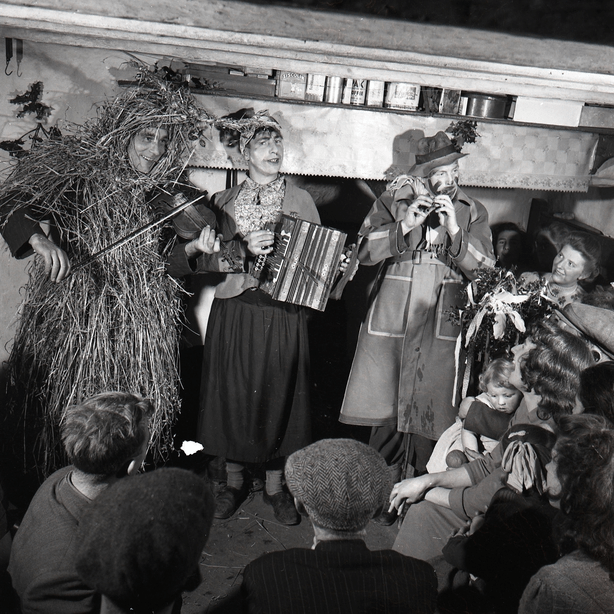
Photograph of a strawboy and two wren boys playing the fiddle accordion and tin whistle at Lios Bui Kilnamartry Macroom Co Cork. Photo: University of Galway, available at: A short history of mummers, straw boys and Wren Boys. Below a strawman fiddler from this production.
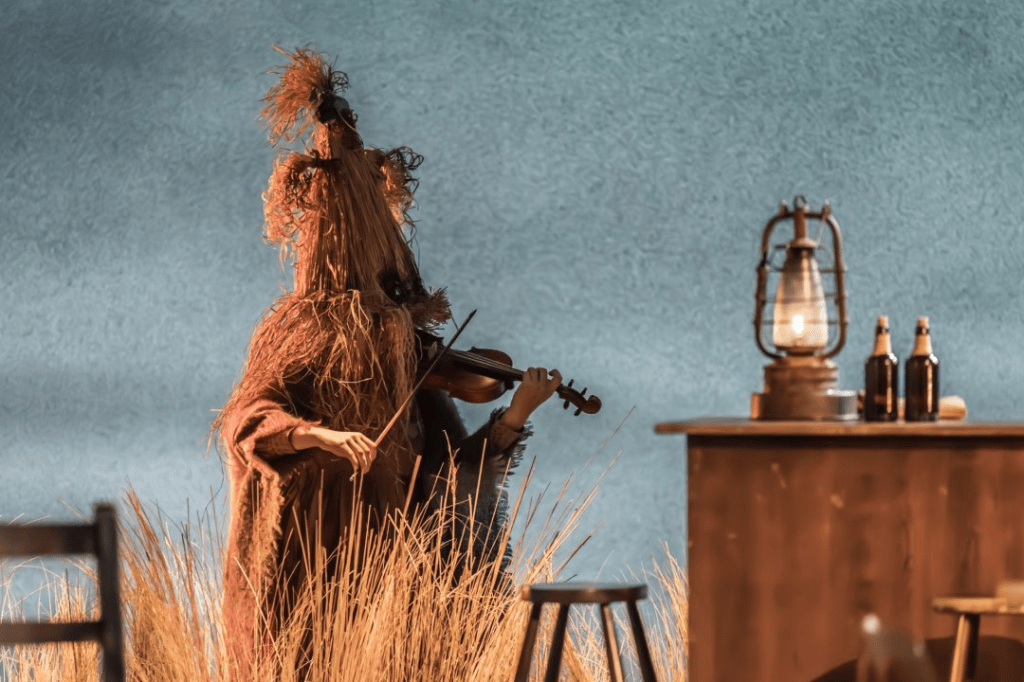
Both mumming and the tradition of the itinerant storyteller evoke community desire for sustained and fertile ongoing life and the desperation and famine that comes without them. There are hints enough of that promise magic saviours bring too communities and the deadly feelings that follow their a community’s disapointment in him in the life-giver NOT being what they needed him to be.
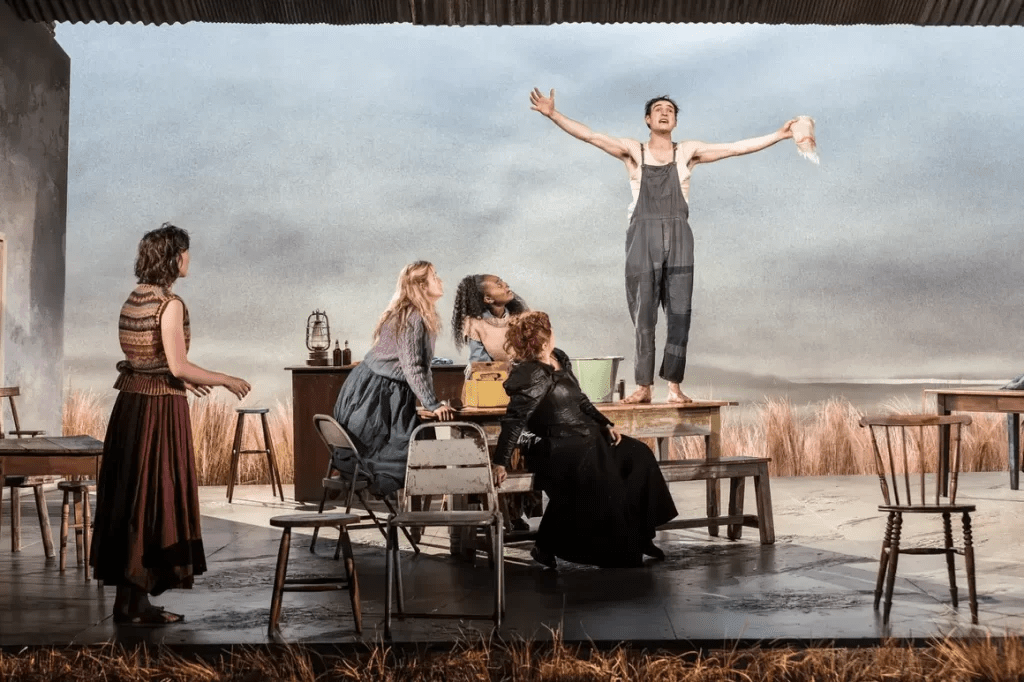
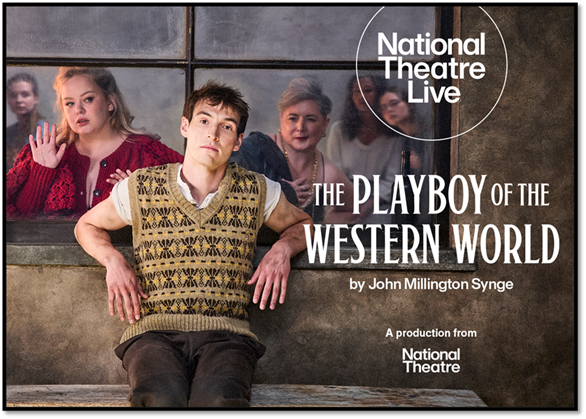
Christy (Ėanna Hardwicke) performs male redeemer with baggy frontage to the chorus of girls led (from left) by Honor Blake (Fionnuala Gygax)but guided by the superior experience of a woman who has survived destroying her husband and has a sufficient smallholding of her own, but might like a new man to fulfil her, Widow Quin ( in black of course but brilliantly nuanced by Siobhán McSweeney). Yet the main contender are those staring at him through a window on either side in the publicity photograph: Widow Quin *right) and Pegeen Mike (Nicola Coughlan) left.
Christy’s reputation as a ‘wonder’ and a legend in story comes from him revealing that he has killed his Father. However, as indicated already, the fact that Old Mahon is still by the end of Act 3 alive, despite being killed twice by his son Christy with a loy, a spade specialised for Irish potato cultivation, is the least of the disappointment. That is because the community treat him as already suggested as a revealed supernatural ‘wonder’: the truth of the folk-myth of the itinerant wandering poet clan. Yet with a father living (perhaps, as Christy might too become if not the ‘wonder they think he is, a dispossessed and homeless madman, entirely alienated from community) the society sees itself in an unflattering mirror – the opposite to that used by Christy to view his handsomeness on his first morning as pot-boy to the Flaherty shebeen.
When Widow Quin wants rid of Old Mahon, the better to keep the myth of Christy as a father killer alive, she cuts to the chase, calling the itinerant what she, as a realist, thinks he is, ‘a sniggering maniac, a child could see’. Suddenly we understand that madmen too can be the ‘Wonder of the Western World’. The effect on Mahon couldn’t be predicted, for the workhouses are the sole place the dispossessed are safe from communities:
Mahon (getting up more cheerfully): Then I’d best be going to the union beyond, there’ll be a welcome before me, I tell you (with great pride), and I a terrible and fearful case, the way that there I was one time, screeching in a straightened waistcoat, with seven doctors writing out my sayings in a printed book. Would you believe that?
Widow Quin: If you’re a wonder itself, you’d best be hasty, for them lads caught a maniac one time and pelted the poor creature till he ran out, raving and foaming, and was drowned in the sea.
Mahon (with philosophy) It’s true mankind is the divil when your head’s astray. Let me out now and I’ll slip down the boreen, and not see them so. … He runs off.
Mahon’s trip to the ‘union beyond’ sounds redemptive, yet the note to those words makes it clear that is in fact a reference to the next neighbouring union (unit of national social ‘care’): ‘one of 163 unions across the island, each with their own workhouse. Workhouses often operated as makeshift psychiatric hospitals. Entrance to the workhouse was a social shame, partly because the workhouse system only encouraged vagrants like the Mahons‘. It is a chillingly comic portrayal of a hard reality of life for those with their ‘head’s astray’. Later, with two wounds on his head (now at the end of the play) from Christy’s loy, he is ready ts ready to be killed a third time by his son (the joke in his the text: ‘Are you coming to be killed a third time, or what ails you now?’)
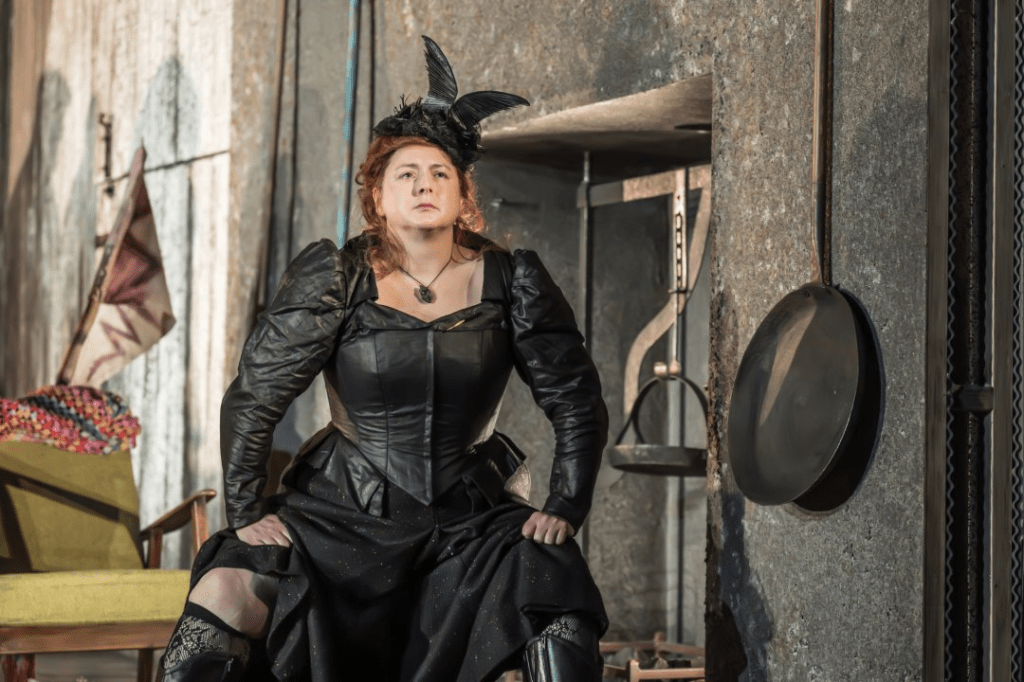
This indeterminacy of being in character, who can be more than one mind symbolic fertility figures from the mummers tradition of winter plays and realistic examples of a real poverty of national dispossession yet treated with high comedy is characteristic of the play. In Act 3 therefore we see Christy in female attire, exactly like the opening proscenium with legs spread wide, to suggest the wonder hidden between them. That hidden wonder is his fertility and theirs – for all the gutsy women of the play want to marry him, even the ones amongst the chorus of local girls who can’t have him but who yet stay loyal to him – enough to supply him with the feminine garb with which to escape their men’s vengeance. The choric women are quite unlike Margaret the daughter of publican Michael Flaherty, hence Pegeen Mike (Peg the little one of Michael), who wants vengeance too and who literally brands him with a hot iron when he is most exposed. However, the spread-legged look is a non-binary one mocked in Christy, sitting wide legged as a man sits but dressed as a woman, but also a pose a ‘masculine’ woman like Widow Quin can take, whose black garb becomes the suit of a Valkyrie (armed and breast-plated), winged at the helmet:
But I think it is time I cam clean about my response to the play and the associations it sparked to make it suitable for this question. The play is about rural economies like Ireland in the beginning of the nineteenth century, and long after, with dreadful folk memories (still) of Potato Famine – hence the import in the play of the loy – it smells of the earth dug to plant a potato crop, that hope of renewal from the burial of the old tuber. But have you ever thought about the word ‘budget’? Did you know that it comes from same root as the word ‘bulge’ and ultimately from the Proto Indo-European (PIE) root for the verb ‘to swell’. If not, here is the evidence from the Online Etymological Dictionary:
budget (n.): early 15c., bouget, “leather pouch, small bag or sack,” from Old French bougette, diminutive of bouge “leather bag, wallet, pouch,” from Latin bulga “leather bag,” a word of Gaulish origin (compare Old Irish bolg “bag,” Breton bolc’h “flax pod”), from PIE *bhelgh- “to swell,” extended form of root *bhel- (2) “to blow, swell.” / The modern financial meaning “statement of probable expenditures and revenues” (1733) is from the notion of the treasury minister keeping his fiscal plans in a wallet.
bulge (n.) c. 1200, “a wallet, leather bag,” from Old French bouge, boulge “wallet, pouch, leather bag,” or directly from Latin bulga “leather sack,” from PIE *bhelgh- “to swell,” extended form of root *bhel- (2) “to blow, swell.” Transferred sense of “a swelling, a rounded protuberance” is recorded by 1620s.
It would seem that we all like to think of our budget control magically as a bag that swells to meet need. Consider the case of Margaret Thatcher before she first came to power (and in the photograph below also before she had her teeth regulated) holding up a swollen bag of what the Tory pound once bought and what it buys under Labour fiscal controls over economic growth, in her view as a monetarist. She holds the swollen bulging bag up prominently, as a promise of what life might be like under her governance: a swollen bag of promises of sustenance (for some).
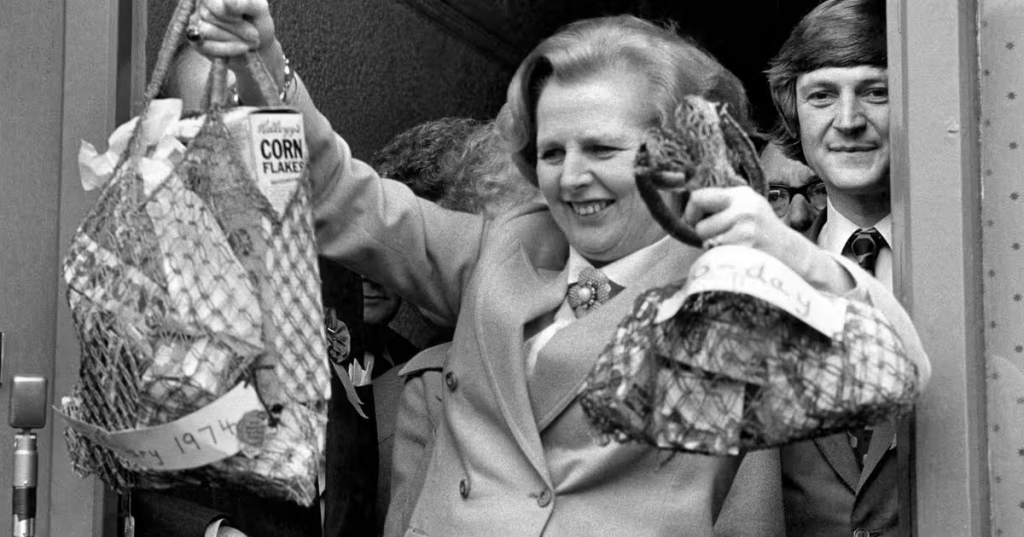
The comparison of national economies to the handling of domestic budgets was critiqued at the time but I think this potent image meant more than this to Tory potentates and Thatcher. Promising the electorate a swollen bag connects it to our folk belief in fertile swellings of purses (for that was what budgets were and not necessarily or primarily those of women) that seem to operate by magic or so the folkmyth goes. But to Pegeen Mike, Christy is that man which her afficianced, Shawn Keogh (wonderfully prissily played by Marty Rea), is not – who needs a parchment from the Holy See before he can even think of sex with Pegeen, or even being in the same building at nightime. He tires highly sexed women, who are as financially successful as he, like Widow Quin
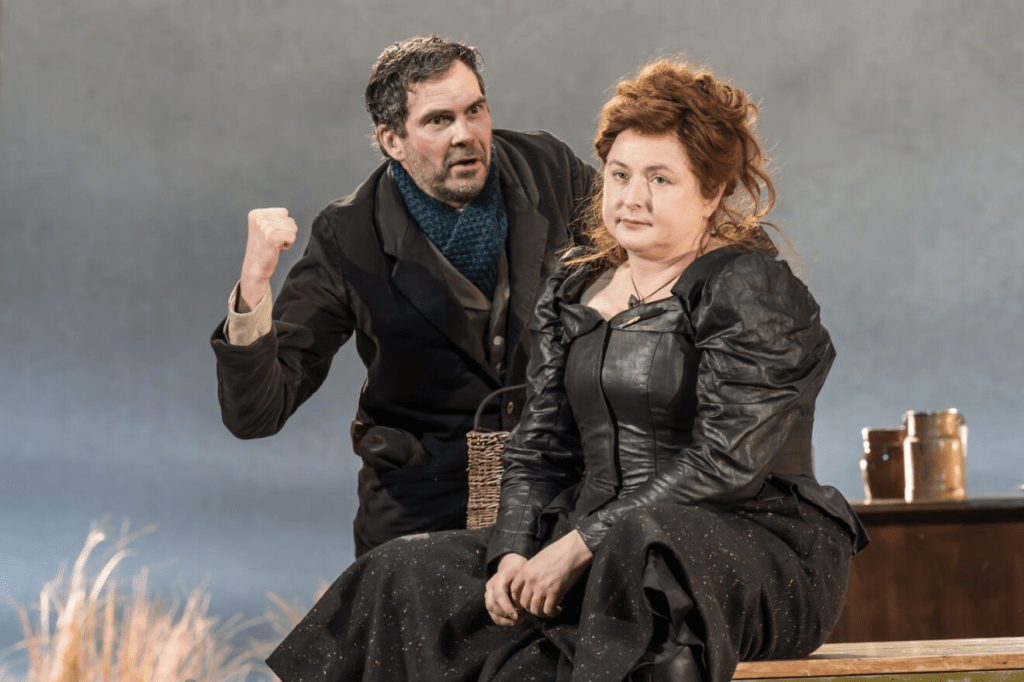
Shawn Keogh (wonderfully prissily played by Marty Rea) with Widow Quin – bored by his lack of many front
From Scene 2 and the night after Christy sleeps in the shebeen, he is transformed from neurotic to man with an eye for himself and his loy-carrying muscles. Women want him. When Pegeen retires to her own room leaving Christy to his bed, he sees in himself what will inspire new ways of looking, talking and appearing in the morning, with much gazing in a gl;ass at himself and a pull to women, once he has seen the evidence of his mythical front as a father-killer, and the language itself is mythically poetic as Christy contemplates not only his luck but that it has come ‘in the end of time’:
(She shuts the door behind her. He settles his bed slowly, feeling the quilt with immense satisfaction.) Well, it’s a clean bed and soft with it, and it’s great luck and company I’ve won me in the end of time – two fine women fighting for the likes of me – till I’m thinking this night wasn’t I a foolish fellow not to kill my father in the years gone by.
When he wakes, he sees in himself in a finer kind of mirror than he ever used before the ideal that women’s eyes have caused him to believe in with some evidence beyond his own magical thinking:
When he wakes:
(He takes the looking-glass from the wall and puts it on the back of a chair; then sits down in front of it and begins washing his face.) Didn’t I know rightly, I was handsome, though it was the divil’s own mirror we had beyond, would twist a squint across an angel’s brow; and I’ll be growing fine from this day, the way I’ll have a soft lovely skin on me and won’t be the like of the clumsy young fellows do be ploughing all times in the earth and dung.
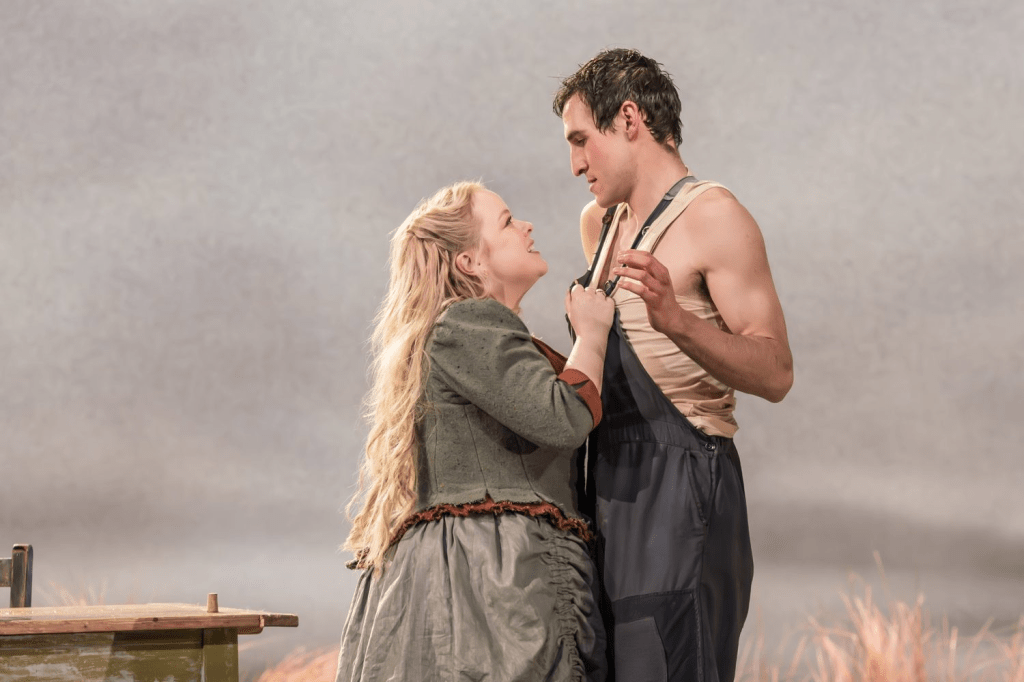
This is the man whose gaze on himself invites looks from others and even intense jealousies. But is it all not magical thinking – as a leather bag is swollen with what fills it in our desire, and sometimes in self-fulfilling prophecy, which is the mechanism this play emphasises in Christy’s fate (as below in which Pegeen jealously takes him back from the eyes of the chorus of girls who further fed his nearcissistic magic as a ‘wonder’:
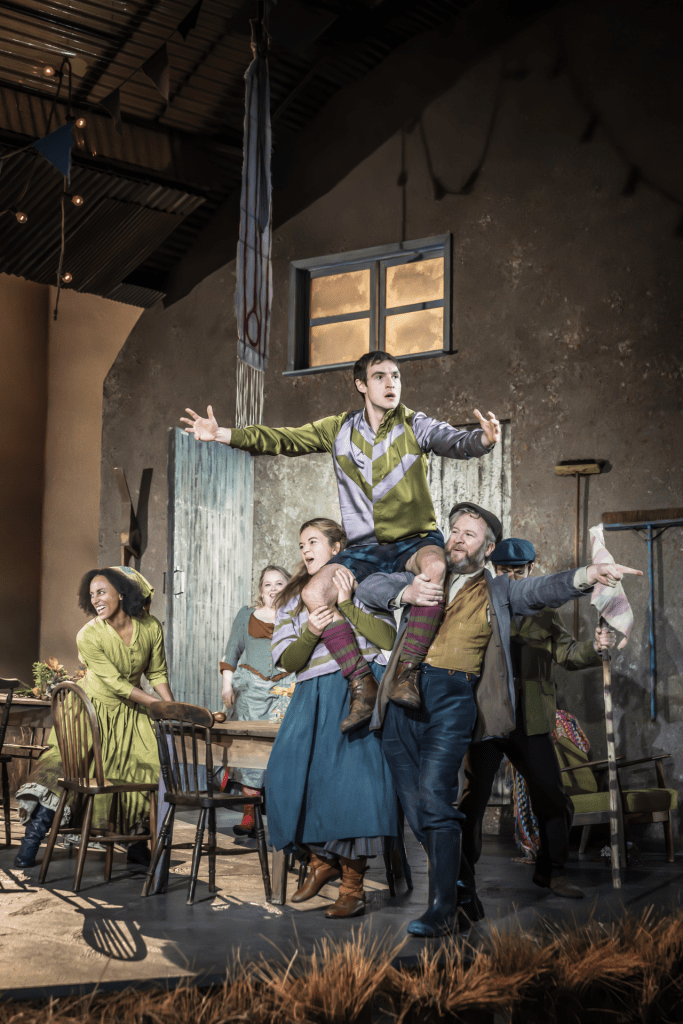
Christy goes on to perform in the local games until dressed in the colours, presumably of the community, as their possession, raised high on the shoulders of both men and women, and from there measuring out his swollen pride and riches of communal gifts:
Yet when he disappoints, he becomes ripe for sacrifice too – hanged, if not by the ‘polis’ but by the drunken community, with even Pegeen ready to share in the murder backed by Shawn, bold only in the validation that comes from the fall of a wonder that once outshone him:
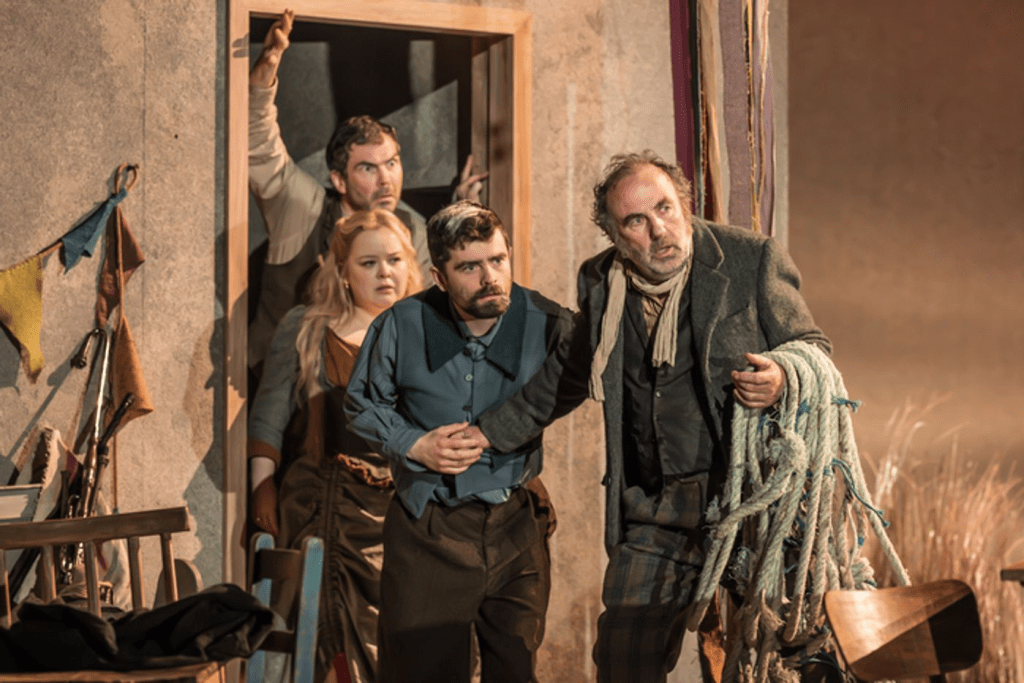
The whole point of Christy’s experience is that he wins a power of spending that seems unlimited. It starts with offers of a job, easy work, goes onto bribes to go West from Shawn, unsubtle offers of sexual company, as well as friendship and then to prizes in the local games. Everything seems unlimited, where ‘want’ of any kind is banished:
Widow Quin: You’ll have time and plenty for to seek Pegeen, and you heard me saying at the fall of night the two of us should be great company.
Christy: From this out I’ll have no want of company when all sorts is bringing me their food and clothing (he swaggers to the door, tightening his belt), the way they’d set their eyes upon a gallant orphan cleft his father with one blow to the breeches belt.
But an unlimited budget must fail you, it will collapse like all swollen magical dreams:
Christy (in low and intense voice) Shut your yelling, for if you’re after making a mighty man of me this day by the power of a lie, you’re setting me now to think if it’s a poor thing to be lonesome it’s worse, maybe, go mixing with the fools of earth.
Christy falls back into the fate of his father from whom he too he is now alienated, each crazy again. When I read the play (and wrote about it in the last blog on the play) I felt Christy venerated at the end but on stage – a lean lanky man shrouded in female attire, his victory is entirely about magical thinking, but the real loss is Pegeen’s, who ends the play in the desolation of a poor man if a rich person such as Shawn and a community of drunks to service. She suddenly sees herself as tragic – though my hubby Geoff could not foirgive her for giving up on the dream of Christy:
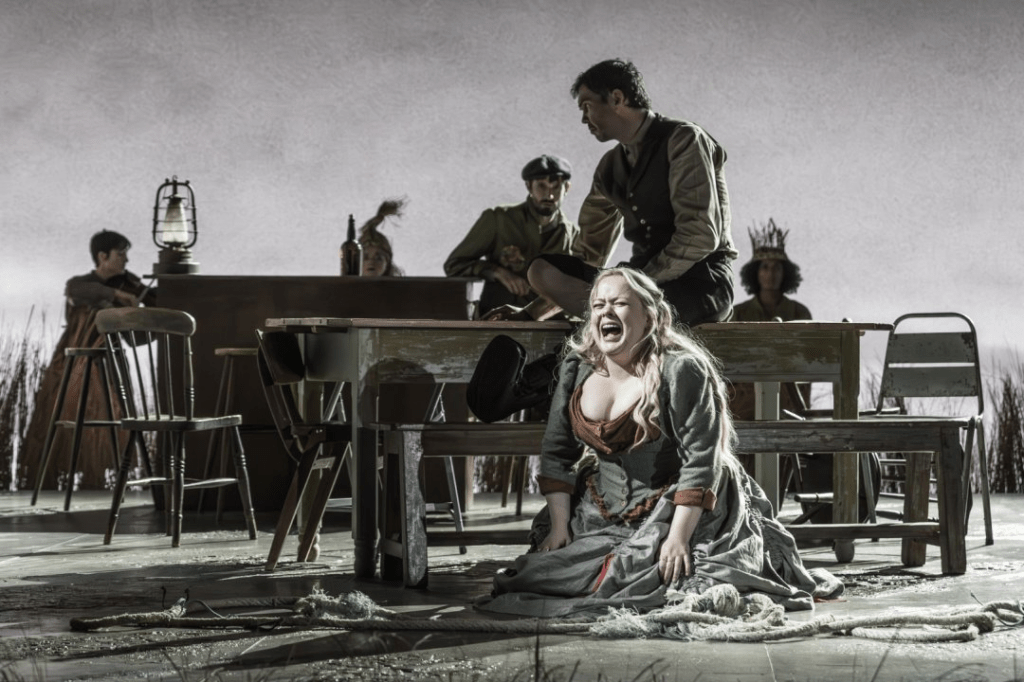
As for Christy, read that speech again:
Christy Ten thousand blessings upon all that’s here, for you’ve turned me a likely gaffer in the end of all, the way I’ll go romancing through a romping lifetime from this hour to the dawning of the Judgment Day.
Romancing and romping is the recognition that our unlimited swollen budgets all show themselves as puffs of air in the end – wishful magical thinking that are eternal (they last to the ‘end of time’ or ‘Judgement Day’, phrases that characterise Christy). And shorn of such romance of a romping lifetime, we can but, like Pegeen fall down in tragic tears at the scale of the loss we have suffered, or like the men of the community, get drunker and drunker on the poteen provided at wakes for the lucky dead. Death haunts this production in funeral marches as well as in dark bird-like shapes that return frequently, often around the Widow Quin, and more at the end. The Mummers have not exorcised our fear of our purse running dry at all. The ‘bulge’ has turned into something of mere padding after all.
Bye for now
Steven xxxxxxxxxxxxx
 Steve_Bamlett_blog