


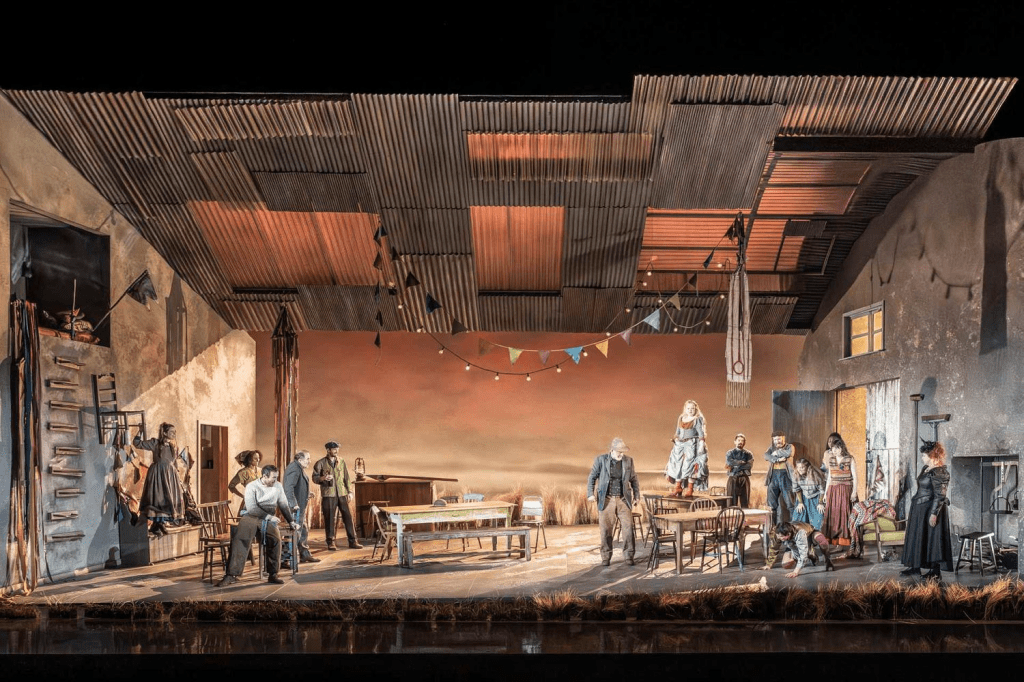
I doubt I would I be the ‘playboy’? At the end of John Millington Synge’s The Playboy of the Western World, the so-styled playboy, Christy Mahon, realises that he has been transformed into an incarnated idea destined forever to represent a life of constant playtime and being the object of ‘game’ and joy in the world for the women of Western Ireland and further west; saying to the assembled cast that ‘for you’ve turned me a likely gaffer in the end of all, the way I’ll go romancing through a romping lifetime from this hour to the dawning of the Judgment Day’. This blog is my preparation to see the National Theatre streamed version of the play at the Reel Cinema, Bishop Auckland on Thursday 28th May.
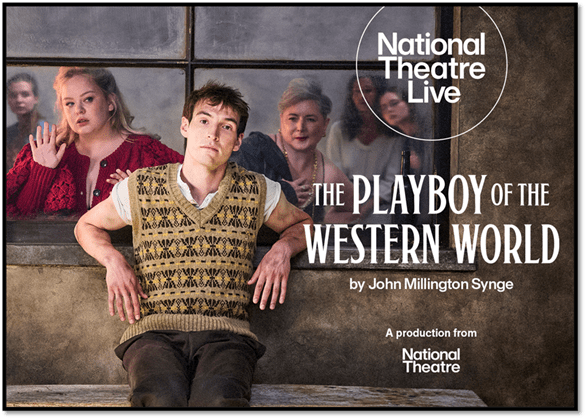
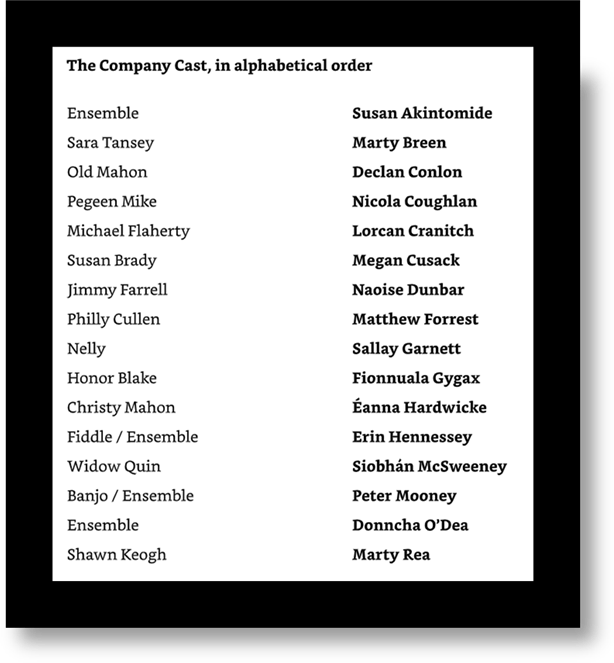
I need to come clean. I have never before read a play by John Millington Synge, let alone seen one, though when tramping through the Wicklow Mountains with a friend when I was in the 6th form, I did stay at the house once lived in by Synge, then (and possibily still) a youth hostel, in which, a delicate youth within, I felt intimidated by some noisily drunk Irish lads who stayed in the same dormitory of bunk beds and seemed intent on making English boys know that they would stand for no hoity-toity behaviours from the sons of the Empire on which the sun had already set. I rose early and dragged my friend out and we set off back to Dublin. Since then, I have been a confirmed Irish Republican Catholic in sympathies, if not in religious belief. But I have decided I must see at least this play and have now just finished reading it. Its language is a joy and its comedy rich, as you might expect from the comedy-perfect cast – though the one member I knew best is Siobhan McSweeney, and that from the recent spin Traitors series: Traitors Ireland. Here is the cast list:
I read it and now look forward to a romp of romance comedy in supposed Irish ‘folk’ style. One thing that has always rather disturbed me about Synge is the memory of that now collapsed sign of a landowner Protestant gentry that Synge represented and his pursuit of folk and folksy Irishness (with the stamp of approval from Lady Gregory, W.B. Yeats and the Abbey Theatre and the serious verse drama versions of the same quest) with its funny ‘peasants’ and funnier priests, even when the latter are not represented in embodied fashion on stage as Father Reilly is in this play, with his mission to Rome to secure a wedding for Pegeen Mike , a raucous peasant barmaid in an illegal shebeen selling gallons of poteen and lusting after romance with a playboy. There is a lot of ambivalence in Synge’s attitude, as this piece of praise below to the sadness perehaps in the hearts of landowning classes as well as the oppressed of the Ireland of his time shows (see the source here: pages 48-49):
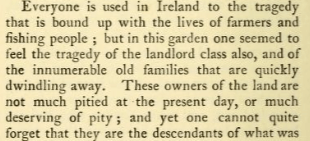
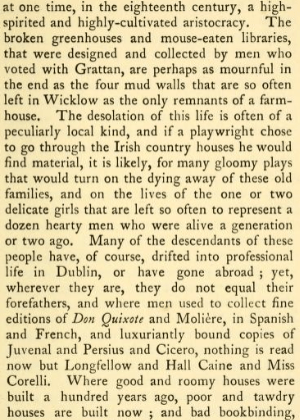
The ambivalence here feels stranger when it turns to folk satire of a people you love, as Synge did the Irish handless classes, and yet a people to which you could not in full belong to, though Synge’s Irish identity remains well earned, despite that Anglo-Irish descent. What kind of Ireland comes from reading tbis play. First, of course, is the absorption of the man in a language he considered not only archaic and queer but also beautiful. Take this from the play’s preface by tne author, wherein he renounced European naturalism (Ibsen and Zola) for something more of both joy and ‘wildness’. With folk art however the idea of the ‘wild’ is not unlike that of the ‘primitive’, an idea beloved by Picasso. Anyway, here is Synge in 1907 on his aims in art, which starts with rejecting Ibsen and Zola ‘dealing with the reality of life in joyless and pallid works’:
On the stage one must have reality, and one must have joy; and that is why the intellectual modern drama has failed, and people have grown sick of the false joy of the musical comedy, that has been given them in place of the rich joy found only in what is superb and wild in reality. In a good play every speech should be as fully flavoured as a nut or apple, and such speeches cannot be written by any one who works among people who have shut their lips on poetry. In Ireland, for a few years more, we have a popular imagination that is fiery, and magnificent, and tender; so that those of us who wish to write start with a chance that is not given to writers in places where the springtime of the local life has been forgotten, and the harvest is a memory only, and the straw has been turned into bricks.
The confidence of Synge lies in the culture he adopted but also in a non-elitist version of art where authority is not the possession of educated individuals but individuals. He also says in that Preface:
All art is a collaboration; and there is little doubt that in the happy ages of literature, striking and beautiful phrases were as ready to the story-teller’s or the playwright’s hand, as the rich cloaks and dresses of his time.
In both of these extracts Synge invokes the feel of an early culture or, at least, still having ties to the culture of the ‘happy ages’ or ‘springtime ‘, a colourful poverty that precedes an age obsessessed with finery and riches of less of a more easily monetised kind. And, as popular as it was to invoke such times of happiness linked to the simple and the natural, it was then, as now, a lie more easily promulgated who chose it as an ideology of life, whilst not needing to, than those forced into its strictures. In those times we find a romantic playboy too free of the bonds of an overly repressive church with its surplus of priestly Fathers.
In this play people reach back to those amoral times, except perhaps people like the hapless backless Shawn Keogh, as afraid of young men who might beat him even when lying groaning in the shadows, perhaps the shadows of his self, and doubly afraid of priests like Father Reilly discovering his sexual desires for women and condemning him. Moreover, he always a priest, a spiritual Father to make him afraid of even sleeping in tne same shebeen as his affianced Pegeen Mike.
What upset the Irish, Protestants and Catholics alike, and even Sinn Féin, was the man who would become Shawn’s rival for Pegeen Mike, the name means Little Margaret daughter of Michael, Christy Mahon, whose attraction lay in the eyes of the young women in having murdered his father. In fact he he hasn’t murdered him – his father had received a head-wound from being beaten by Christy’s ‘loy‘, a long thin bladed shovel used in Ireland,but had not died – but this isn’t revealed until Act Two, to Widow Quin – who also has a sexual fancy for Christy and uses this information in her own interests.
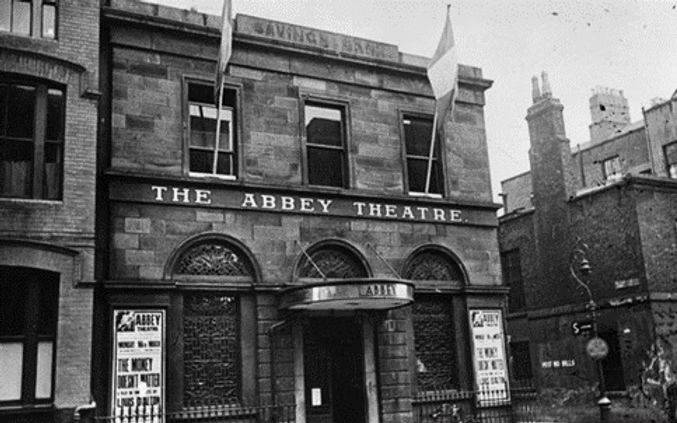
So upset were Irish Nationalists and the Catholic alike by the inference that Irish young people would honour ‘heroes’ who were patricides, they rioted outside The Abbey Theatre where the play was performed in Dublin. The reasons are very confused: for instance Irish rebels against British rule considered the reference to this supposed tendency of Irish youth was meant to represent the significance those ‘rebels’ gave to Cuchulainn as an Irish hero, who was a parricide, but not a patricide – for the hero unwittingly killed his son. It is likely, of course, that Synge intended the honouring of patricide to reference primitive myths about killing of the old father (or king) by the young inheriting their powers as in the Fisher King myth referenced in other works such as the later The Waste Land by T.S. Eliot, but here is how the Liverpool Irish Centre tells the tale:
On the very surface, it’s easy to see why the play might’ve been problematic. The Catholic majority would not approve of the portrayal of the Church as a coercive influence on the lives of parishioners, the sexual proclivity of Pegeen, or the mythologisation of Christy’s patricide which borders on Pagan. But more interestingly, performances of the play were shot down by nationalists. Arthur Griffith, Sinn Féin leader, condemned Synge’s work as “a vile and inhuman story told in the foulest language we have ever listened to from a public platform”. Nationalists were worried that Synge’s play threatened the ideal version of the Irish peasant that had been fetishized for so long amongst Nationalists. More interestingly, however, was a single line that parodied the primary hero and figurehead of the Irish literary revival, Cuchulainn.
But anyone who knows anything of the play’s existence probably knows it because of those riots. But it feels puzzling to watch now not because it is disgusting and disrespectful to any form of patriarchal ideal – after all, all the Fathers in this play, biological and ideological, are fools – the women its heroes – but because we can’t get our head around – or find any objective correlative – for the sexual desire that a story of patricide brings about. I want to see how I feel in the streamed production mainly around this issue. Of course from the very start Pegeen Mike finds her own father tiresome and little short of useless, but her issue is with the Papa, the Holy Father in Rome, and Shwn’s need to pander to him if all he wants is a woman like herself. it is clear she is no father figure’s posession to give away:
It’s a wonder, Shaneen, the Holy Father’d be taking notice of the likes of you; for if I was him I wouldn’t bother with this place where you’ll meet none but Red Linahan, has a squint in his eye, and Patcheen is lame in his heel, or the mad Mulrannies were driven from California and they lost in their wits. We’re a queer lot these times to go troubling the Holy Father on his sacred seat.
But both Pegeen, Mother Quin (the ‘girls’, though the latter of advanced age, that both compete for Christy to bed them) and the girls, who act as a Greek chorus around her seem to see the taste for heroes in the Irish oppressed as a symptom of the way English rule has distorted the value of Irish claims to heroism so that it refers to any kind of behaviour outside the law, especially English law, which is laughed at. One of the girls, Sara, in Act 2 says to Christie amidst the full company:
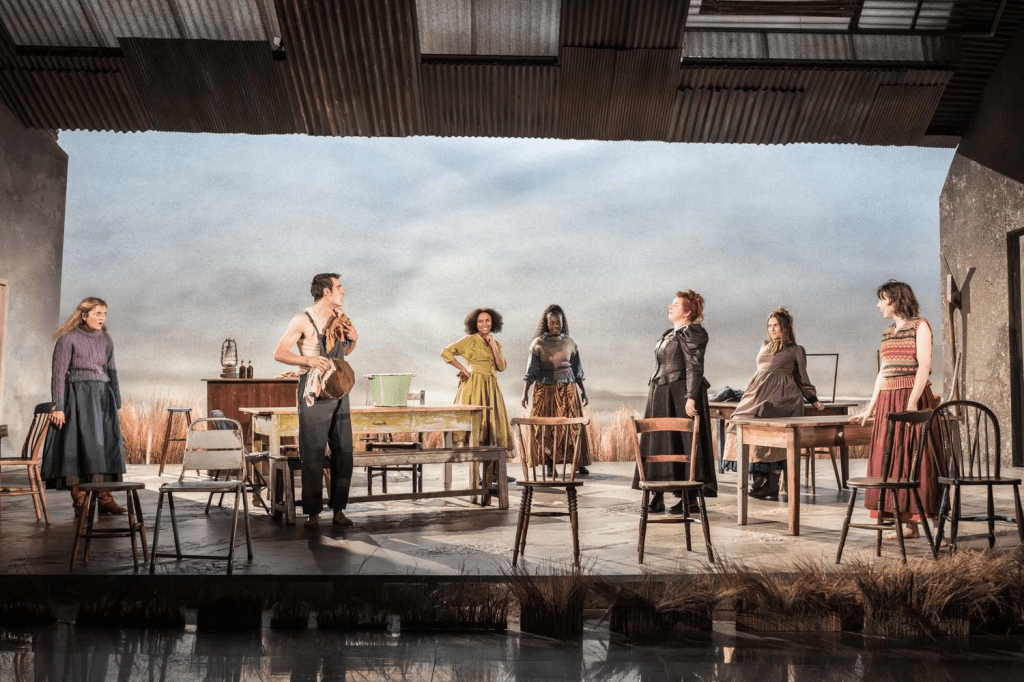
You’re heroes, surely, and let you drink a supeen with your arms linked like the outlandish lovers in the sailor’s song. (She links their arms and gives them the glasses.) There now. Drink a health to the wonders of the western world, the pirates, preachers, poteen-makers, with the jobbing jockies; parching peelers, and the juries fill their stomachs selling judgments of the English law. (Brandishing the bottle.)
There may be an important ambiguity revealed here about a play which, in the end is a play about how the most unlikely person might become a hero, and yet have nought to recommend them. My own feeling is that play satirises male vanity, a thing that might have been obvious in the revival in which Cillian Murphy played the long-necked hero. In Act 2, Christy finds a mirror when he wakes in the shebeen and uses it to radiate vanity , as if it were the ‘divil’s own mirror’.
Didn’t I know rightly, I was handsome, though it was the divil’s own mirror we had beyond, would twist a squint across an angel’s brow; and I’ll be growing fine from this day, the way I’ll have a soft lovely skin on me and won’t be the like of the clumsy young fellows do be ploughing all times in the earth and dung. (He starts) Is she coming again? (He looks out.) Stranger girls. God help me, where’ll I hide myself away and my long neck naked to the world?
A peasant ploughman here apes the fashion and idleness of the rich. He hides his long neck that some see as a folk tradition of ugliness, although in context it’s surely the erection that the approaching peasant girls cause in him. That this is so should make us think again about the role of both Widow Quin, who after all makes it plain that the kind of ‘playboy’ she wants is a toy boy for her lonely bed.
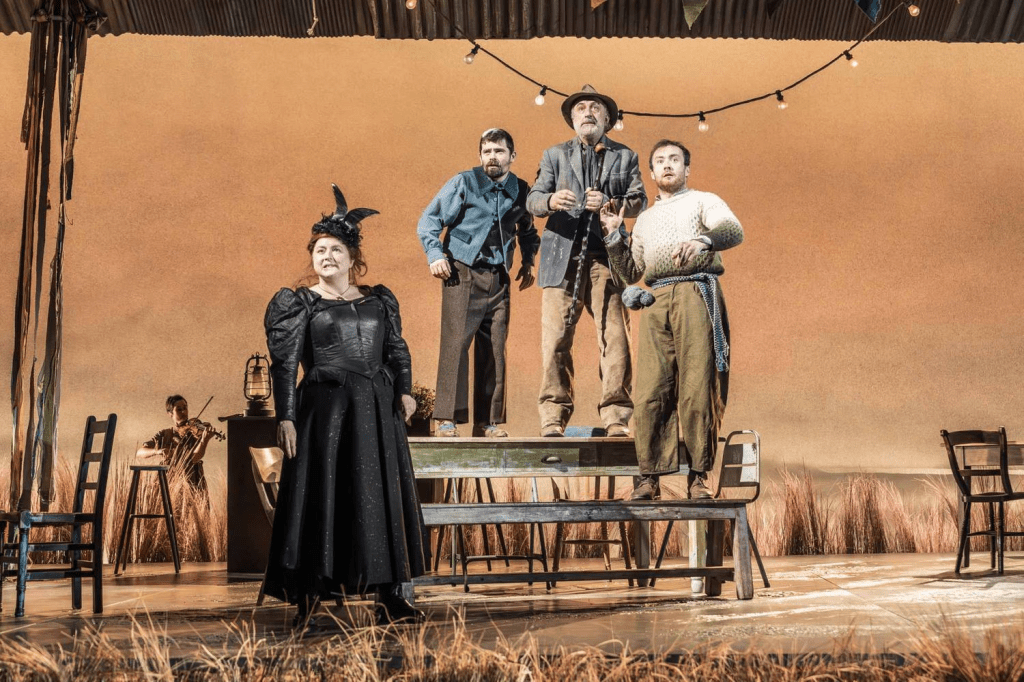
It is rather different with Pegeen, who makes a ‘game’ of everything and everyone, not least Christy. Synge gives it away in a stage direction. Pegeen is taunting Christy about that ‘neck’ of his and how it might make death by hanging more painful:
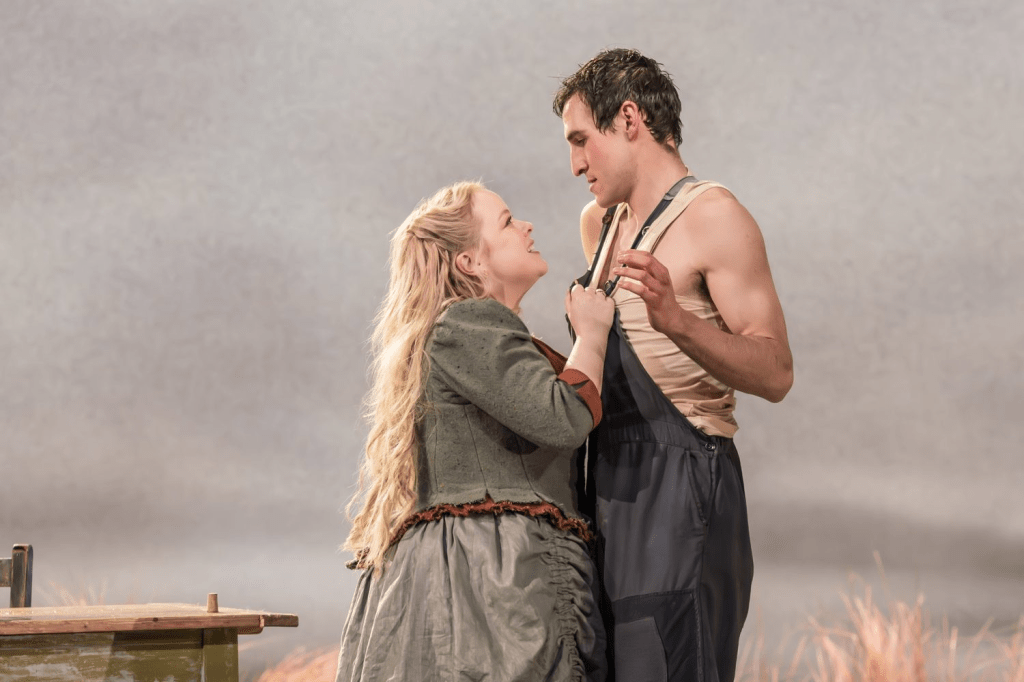
Pegeen It’s queer joys they have, and who knows the thing they’d do, if it’d make the green stones cry itself to think of you swaying and swinging at the butt of a rope, and you with a fine, stout neck, God bless you! the way you’d be a half an hour, in great anguish, getting your death.
Christy (getting his boots and putting them on) If there’s that terror of them, it’d be best, maybe, I went on wandering like Esau or Cain and Abel on the sides of Neifin or the Erris plain.
Pegeen (beginning to play with him) It would, maybe, for I’ve heard the circuit judges this place is a heartless crew.
Christy (bitterly) It’s more than judges this place is a heartless crew. (Looking up at her.) And isn’t it a poor thing to be starting again, and I a lonesome fellow will be looking out on women and girls the way the needy fallen spirits do be looking on the Lord?
Christy sees himself as a Judaeo-Christian anti-hero (Esau or Cain and Abel), a wanderer – the Wandering Jew archetype is suggested – and he soon casts himself as even more an outcast, a ‘needy fallen spirit’ like Lucifer looking at girls as a goal from which he is as estranged as Lucifer from God, yet to whom he must ‘look up’ from below. But the stage direction (‘beginning to play with him’) resounds with words as well as actions in the play as Christy is both made a gamer and played with in that and other roles. The word ‘game’ or ‘making game’ comes up at least ten times in the play, as people accuse others of making fun of them, and that clearly is the spirit of the whole.
And yet art, when it plays with things, sometimes makes of them things they once were not. Is this what Christy means when he refers to what the community have done to him – not to say his father, for both of them we learn have spent long periods in parish asylums.
Shut your yelling, for if you’re after making a mighty man of me this day by the power of a lie, you’re setting me now to think if it’s a poor thing to be lonesome it’s worse, maybe, go mixing with the fools of earth.
If the play is about – indeed if plays are – ‘the power of a lie’, there is something interesting to notice about How cHristy plays his end, as he runs from the community into the freedom of the Western world – will he end in an asylum, or will he become a kind of legend that lives forever, a Cuchulain indeed. As he sends off his father who says (and I find this moving) ‘I am crazy again’, christy says to the community of himself and what they’ve ‘turned me’ to:
Christy Ten thousand blessings upon all that’s here, for you’ve turned me a likely gaffer in the end of all, the way I’ll go romancing through a romping lifetime from this hour to the dawning of the Judgment Day.
That invocation of the Last Judgement I find compelling in Christy. It is about the making of myths. Is in fact Synge playing games with the tendency of the Irish nationalist rebels to revive ancient myths and make them out of very little in recent history if they can’t find them. If he is we can understand why Sinn Féin found the play ideologically suspect. However, there may be a case for saying that the idea of mythologizing a ‘romping lifetime’ has been a long time coming, when other myths are either martial or spiritual and deadly serious. Pegeen’s final lines could sound like a quick turn to true tragedy:
Quit my sight. (Putting her shawl over her head and breaking out into wild lamentations.) Oh, my grief, I’ve lost him surely. I’ve lost the only Playboy of the Western World.
It’s a grand idea. A god you can play with. I will report back on seeing the production if I have anything more to say.
With love
Steven xxxxx


2 thoughts on “I doubt I would I be the ‘playboy’? This blog is my preparation to see the National Theatre streamed version of the play at the Reel Cinema, Bishop Auckland on Thursday 28th May.”