


What is ‘local’ and what is ‘custom’: selecting for preservation is the practice of dominance not community. But who selects and who interprets what it means?
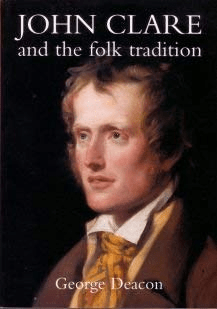
Probably Wordsworth is the primary poet who turned his back as an individual artistic sensibility, and he, of course, was called the Egoistical Sublime by Keats, on global trends, in the Northern Occident alone of course, of the primacy of city life, trade, commodification, profeessionalised specialism, and the concentration of power in the hands of a few. He turn to focus on a small spatial area in Cumbria and demonstrating a local life there, attended with behaviour that might be called ‘custom‘, though clearly behaviour that is dying away like leech gathering.
However, in its etymology entry for ‘custom’, etymology.com cited John Clare, who used the word in its now honoured sense of so.ething old that is threatened by the new, as evoked by our prompt question. Here is what they cite:
Old customs! Oh! I love the sound,
 However simple they may be:
Whate'er with time has sanction found,
 Is welcome, and is dear to me.
Pride grows above simplicity,
 And spurns it from her haughty mind,
And soon the poet's song will be
 The only refuge they can find.

[from "December," John Clare, 1827 cited in etymology.com on the word 'custom']
But Clare is still a lomg way,as Wordsworth is, from being a simple witness to simple behavioural customs, admitting that the shift in history to the traditions and customs of the rich and their artifice will soon make the only place local to those simple customs of the increasingly marginalised poor, a place within ‘the poet’s song’ alone, and that a place of ‘refuge’of hiding and escape rather than of promoted public notice. But Clare is far from a well known poet these days. He and his songs have become absentee from public knowledge as much as the ‘old customs’ they sing of, precisely because they are no longer offered sanction by ‘Time’. To be forgotten is to be as cancelled as either a custom or a poet’s work can be.
And there is a other problem with those who claim to be the witness of the old and historic in behaviour. Clare clai.s thr sanction of Time and memory for old customs but equally could have, for all we know, entirely invented the custom, or been the dupe of an invention made recently by someone with the supposed authority of knowing that fact whilst promulgating a lie, consciously or not. Let’s take an example from colonial history in Africa from John Iliffe, summarised in the slide below. The slide has a slippery title for it is uncertain where the conscious ‘manipulation’ of facts about Africal social life in The then Tangyanika comes from:
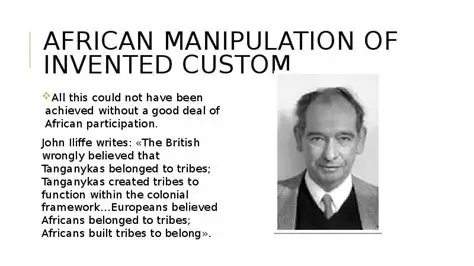
If Iliffe is right there was no universally prescribed custom of tribal living in Tangyanika, but only a belief in British colonial ideology that this was tne fact,which belief became to be believed by the people whose custom of life in it was meant to be. Tribal life then is a modern invention by the people who live that life after the time of naming of the supposed fact and based on no or minimal historical time-honoured social behaviour at all. Clearly one reason poets claim to love simple life is because they want to claim external sanction for an idea of what life is, or should normatively, be about that is more their own, or that of their social class than a pre-existing behaviour independent of their witness of it.
With this doubt in mind, one of best starts we can make on this topic is to look at one popular attempt to define ‘local custom’ in the abstract, as a phenomenon that admits that there are problems from the start in delimiting the referred content of both of the words naming the concept: ‘local’ and ‘custom’. The term ‘local’ has an easily traceable etymology, but etymology.com, still has an interesting take on its early usage, thus:
local (adj.): late 14c., “pertaining to position,” originally medical: “confined to a particular part of the body;” from Old French local “local” (13c.) and directly from Late Latin localis “pertaining to a place,” from Latin locus “a place, spot” (see locus). / The meaning “limited to a particular place” is from c. 1500.
We might be surprised in this explanation by the small size of the area or ‘place’; at which tbe word ‘local’ was first directed in usage (before 1500 it is suggested) – to a specific body part or place. However, it ought not to surprise us perhaps, for a ‘place’ is a space we have already put boundaries of limitation around even in order to name it, often ones that might, with more less immediately evident knowledge, turn out to be inaccurate. For instance, how often does what appears as a local inflammation or growth, such as tbose found in cancer, in a part of the body actually betray systemic but unseen links to other places internal to the body and only later spreading to other locations in and on the body more generally. We selectively attend to a place only because we choose to focus our attention thus, not because it existed as ‘place’ before it was noticed, by anybody. Place names themselves are customs applied to ‘the local’, that in naming it it, create it and its potential aim of being.
The term ‘custom has similar surprises not least the relation of the term in etymology to the word ‘costume’, by which we indicate the local dress of a people. Yet it increasingly abstracts itself from the physical to matters of observable behaviour alone – habits were also on the cusp of being behaviours and the dress the behaviour is performed in.
custom (n.): c. 1200, custume, “habitual practice,” either of an individual or a nation or community, from Old French costume “custom, habit, practice; clothes, dress” (12c., Modern French coutume), from Vulgar Latin *consuetumen, from Latin consuetudinem (nominative consuetudo) “habit, usage, way, practice, tradition, familiarity,” from consuetus, past participle of consuescere “accustom,” from com-, intensive prefix (see com-), + suescere “become used to, accustom oneself,” related to sui, genitive of suus “oneself,” from PIE *swe- “oneself” (see idiom). / Custom implies continued volition, the choice to keep doing what one has done; as compared with manner and fashion, it implies a good deal of permanence. [Century Dictionary] / A doublet of costume. An Old English word for it was þeaw. Meaning “the practice of buying goods at some particular place” is from 1590s.
All this makes sense, I suppose, for action and behaviour are perhaps irreducible from their setting and staging. In modern heritage studies there has however been a drift to separate them in the term ‘intangible cultural heritage’, in which being ‘intangible (untouchable) is what makes this area of the traditional and customary in some localities vulnerable to loss. Yet given the chance to illustrate the intangible, the first chosen by the Wikipedia compilers is a Viennese (the local place) coffee-house (where coffee and cake are customarily consumed). Here is the evidence:
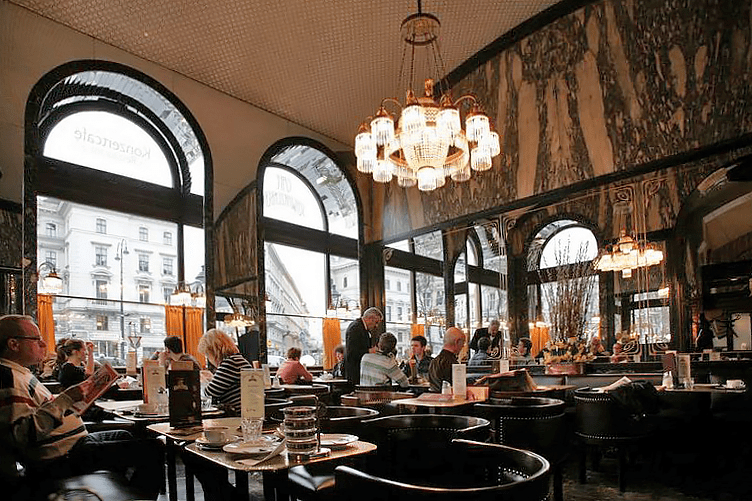
The Viennese coffee house culture, a special form of cultural heritage by Andreas Poeschek, viennaphoto.at – Own work, CC BY-SA 2.0 at, https://commons.wikimedia.org/w/index.php?curid=1888173
A photograph is not intangible but neither are its focal contents. Purporting to show a ‘culture’ that is intangible in the form that coffe and cake is taken in Vienna, the intangible is inseparable from very tagible things in the setting, mise-en-scene, style and decor of the tangible place and its assets – not just the intangible customary actions are implied of the Viennese but the tangible things that make it appear Viennes. In fact, it was never Viennes as such but amodelled on a particular way of behaving of an elite class in Vienna and now more the place of tourists buying that aura of local culture and custom.The making of the scene is highly selective in the choice and ordering of elements (tangible and intangible) and fictive (note the way both Baroque and Art Deco fake each other). There are better examples perhaps – Balinese dancing perhaps but many of the same issues will apply. The purpose of defining Intangible cultural heritage has always been to keep a selective set of behaviours in their accustemed settings alive – though what is meant by living here is perhaps up for grabs and may indicate in some of its form is ‘life’ that only lives in the tourist season and is otherwise and other times, if not dead, undead like a vampire. Here is the Wikipedia basics in extract:
Intangible cultural heritage (ICH)—as opposed to a place’s tangible cultural heritage, cultural properties such as historic sites, monuments, and artifacts—comprises manifestations of intellectual wealth such as customs, beliefs, traditions, folklore, language, and knowledge, as expressed in particular through craftsmanship and performance.
Responding to the perceived over-representation of Western Europe among World Heritage Sites, to help valorize cultural diversity, and following on from earlier related measures in Japan (1950) and in South Korea (1962), in 2001, UNESCO made a survey[among states and NGOs to try to agree on a definition, and the Convention for the Safeguarding of the Intangible Cultural Heritage was drafted in 2003 for its protection and promotion.
Definition: The Convention for the Safeguarding of the Intangible Cultural Heritage[defines the intangible cultural heritage as the practices, representations, expressions, as well as the knowledge and skills (including instruments, objects, artifacts, cultural spaces), that communities, groups, and, in some cases, individuals, recognize as part of their cultural heritage. It is sometimes called living cultural heritage, and is manifested in the following domains, among others:
- Oral traditions and expressions, including language as a vehicle of the intangible cultural heritage;
- Performing arts;
- Social practices, rituals and festive events;
- Knowledge and practices concerning nature and the universe;
- Traditional craftsmanship
It is worth noting that the aim here is not to typify a local culture but represent its diversity. However, the example of the Vienne coffee habit does not truly show diversity, rather it stereotypes the culture – leading, for the example, to the genesis of many homogeneous Cafe Mozart diners in Britain to typify Baroque Hapsburg Culture, or our thin ideas thereof. It matters however in language preservation as in the preservation of ‘localised’ languages from the Celtic fringe remnants in the UK and Ireland, but how many errors are made and simplifications of true diversity in doing so. Gaelic may be the basis of the language we call Welsh but it is decried as an attempt to pass it off as the language of Scotland, when it is a variant language in many place, and that claims are made that Scots is a different language from those who want to call it either a dialect or Scots’ English. To truly preserve diversity, we need to keep multiplicity as our guiding principle not the typification of a local custom applying to everyone local to the area in which it is found. The largest danger of defining local custom is the lie that supposes that it is anything that describes prescriptively the actions of a people in a locality: they will vary and be better for doing so. Neither should they be exclusive.
I once went for a job in the Alzheimer’s Society in Consett. I live in the adjoining Wear Valley (15 miles away at most). One of the interviewing panel made great play of my probable ignorance of Consett folk (actually I had worked as a carers worker in Consett for a long time). To be fair the Chair of the panel said that the question should not have been asked but only after I had answered it by pointing out that my experience of the people of Consett and environs was not of a homogenous local culture but of a diversified one of variant types and alternative behavioural sets and that working with people depended on not making over-normalising assumptions. Of Course, I didn’t get the job. It went internally. I rather dislike the folksing of locality, although one must be at the least and most not against it but ambivalent about it, for it contains some truths. That’s a bit like the issues in Synge’s The Playboy of the Western World in my last blog (see it at this link). Synge knew that Local being in the Western World (of Island varied by place and time, was not determined by the unchanging character of the Irish peasantry of his time nor of the Irish legends and owed much to deformations of colonial type Anglo-Irish dominance (the source of his own background), hence there is ambivalence there about surprising local customs as in this speech of one of the female ‘chorus’ of the play, Sara
You’re heroes, surely, and let you drink a supeen with your arms linked like the outlandish lovers in the sailor’s song. (She links their arms and gives them the glasses.) There now. Drink a health to the wonders of the western world, the pirates, preachers, poteen-makers, with the jobbing jockies; parching peelers, and the juries fill their stomachs selling judgments of the English law. (Brandishing the bottle.)
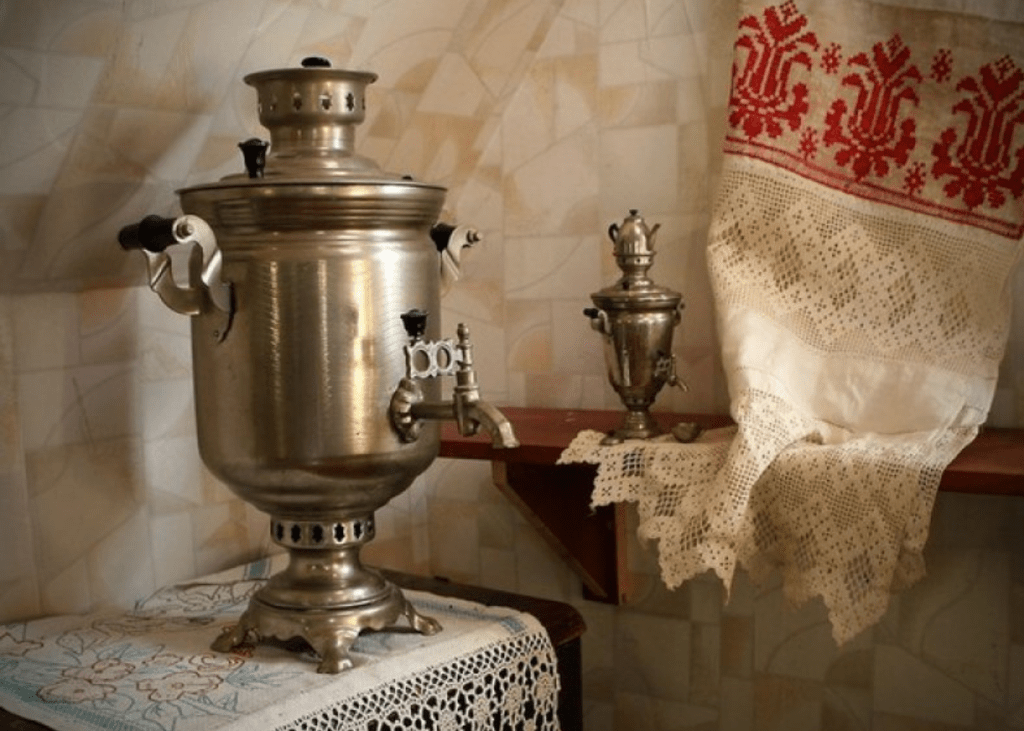
You don’t know an Irish Westerner by how much illegal whiskey they drink or how much they abuse a foreign system of ‘justice’ in their own interests, nor by making heroes of parricides. You have to keep listening to every man, woman or non-binary person for their sense of their place and the behaviours appropriate it and to do it expecting it could change sometimes. Probably the most interesting local custom I have encountered has now long changed. I do remembering taking tea from a samovar in an overnight train between Moscow and what was then Soviet Leningrad. But how much might have changed now.
With love
Steven xxxxxxxxxxxxxxxx

