


The phrase might be ‘a Prince of the Theatre’ used as if royalty alone gave value to things. Yet Ian McKellen is such a Prince because he played Prince Hamlet so many times – the last time in his recent older age. This blog is Part 2 of “The good and the bad in preparing to watch The Tragicall Historie of Hamlet performed by Ensemble 84 at their new theatre in Horden, from the text of the First Quarto publication, conventionally called by editors a ‘bad quarto’?” Part 2 –. a Prince of the Theatre shows yet again the need for a range of ‘Hamlets’, and also perhaps, of the scripted versions of Hamlet in which they appear
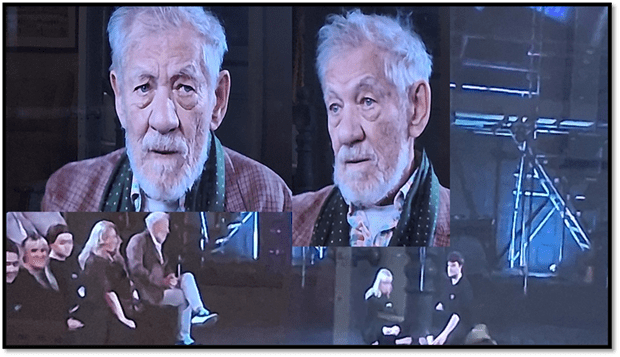
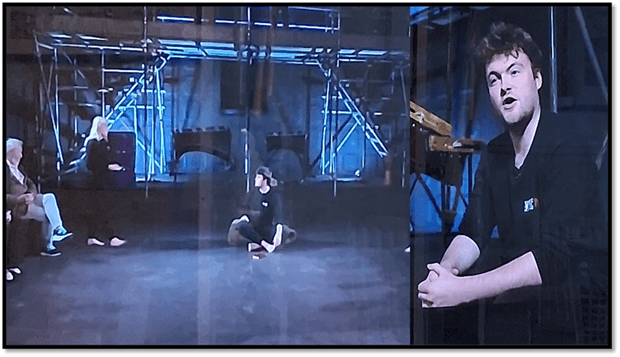
A collage of details of shots from the ITV (North East England) local news coverage from the evening of the 19th May 2026 of Ian McKellen visiting and previewing ‘The Tragicall Historie of Hamlet’ performed by Ensemble 84 at their new theatre in Horden. Below, is the show’s publicity.
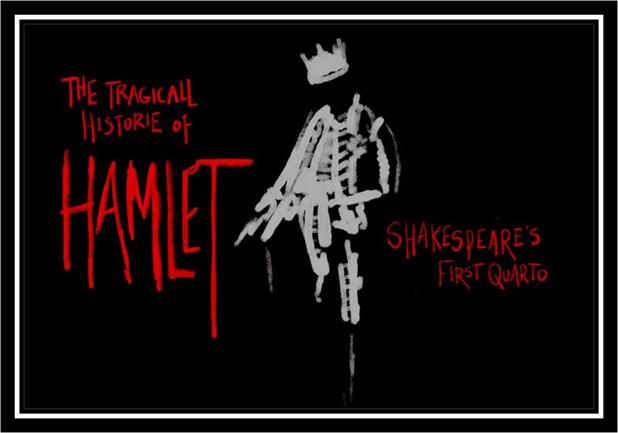
In Part I of this blog entitled ‘Part 1 – dealing with ‘fears and self-doubts’ (see this link to read), and about the famous ‘To be or not to be’ soliloquy as it appears in Quarto 1 (The Tragicall Historie of Hamlet) [Q1] compared to the version we know today, usually mainly edited from Quarto 2 (Q2) and the Folio (F) anthology of the complete plays (1623) with some changes authorised only by good guesses at what it is likely that Shakespeare actually wrote. I won’t explain these terms again here – it is all in the last blog. In this part, I explain how I got to know of this production, and the company producing it (Ensemble 84), and survey my expectations of what I might see, hear and feel.
In fact I got to know about on the midday news on the 19th May, where there was promise of wider coverage in the evening bulletin. My collages of this bulletin show why I was interested. Ian McKellen visited Hordern precisely to see the Q1 production and to praise the company, the only repertory company now in operation in England, and thus a rare chance for budding actors to become princes of the theatre too. At the end of this blog are the TV-distorted stills of McKellen on his visit explaining all this. The aim though is to laud the company, which has run in the past from a converted Methodist Chapel in the coastal pit town, now dominated by the new town Peterlee to its immediate west, and touching it. It was better known for local drama that celebrated the area, though it soon branched into a production of Mother Courage and Her Children by Bertholt Brecht. Clearly, the aim is to demystify theatre, alienate it from those bourgeois illusions Brecht found so damaging to the political tool theatre, and especially community theatre, ought to be. I suppose I am lucky finding it now, though I would have relished the Brecht, when the company revive its first play, Pits, People and Players – actually about th local pit and its political-social life. I have booked tickets for it.
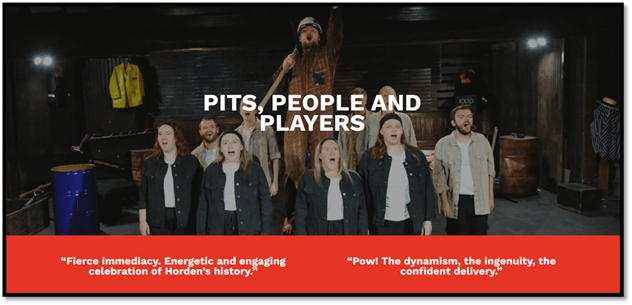
That detail of the production and its title shows much about the community of players Ensemble is meant to be, consciously a community and consciously ‘players’ showing us that they are not pretending to be real miners or miner’s families or employers but in truth performing the idea, emotions and senses that mean we are, by virtue of performance, aligned with miners in ideas, emotion, values and action – in community politics that is. No wonder McKellen saw the novelty for this for our period, when older versions like Hull Truck Theatre Company have had to bend to compromise and institutionalisation.
Hence forget going to Hamlet for period costume and setting – instead view a company in bare feet in black uni-clothing performing (words, song, and music on instruments) in front of structures that serve for, say, battlements and balconies whilst not trying to be them. We are not trying to be anything else but players, they might be saying, to soothe you with illusion of reality. Theatre has not been like this since the experimental 1960s.
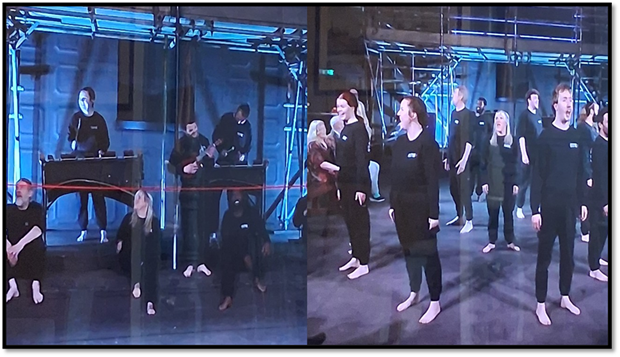
To perform, you make conscious performative shapes where insides and outsides are part of the social shapes – parts that in ‘reality’ get normalised and valorised as naturalised means of exclusion of those not privileged for inclusion. And see Hamlet below, watched by McKellen who made a screened Hamlet recently where he played the prince as the older man he is, not in pretence of youth.
Of course I can’t wait to see this production and will report back. But here I m trying to prepare myself to understand, why such a theatre group, in run-down Horden (I was a social work assistant there – it could be hard and cruel on its inhabitants, and yet it voted in Reform councillors last time all funded by the same cruel capital that closed down Horden’s pit – finally that in Easington Colliery just a few miles up the coast) should choose Q1 as their chosen version of Hamlet. Wikipedia has a useful summary of the differences of Q1 from Q2, although it isn’t justified to beg the question as it does by the use of descriptors like ‘oddities’, ‘unexplained bits of action’, ‘crude cutting’ (none of which even established texts of Shakespeare’s -or other English Renaissance plays – plays are fee from) which are, as I am sure Graham Holderness and Bryan Loughrey would argue from the evidence of their introduction to their modern edition of Q1, no more than loftily asserted editorial assumptions. Here is Wikipedia (use the link for fuller Wikipedia text on Q1):
In addition to the fact that Q1 is much shorter than both Q2 and the F1 version of the play, it has a number of unique characteristics. It contains rich stage directions, which may be survivals from early performances which were excluded from other printed editions. There are many oddities and unexplained bits of action, consistent with crude cutting of the text (how Hamlet escapes from the ship to England is unexplained, as is the arrival of the English ambassadors). Some scenes take place at a different point in the story – for example Hamlet’s “To be, or not to be” soliloquy occurs in Act Two, immediately after Polonius proposes to set up an “accidental” meeting between Hamlet and Ophelia.
Strikingly, the role of Gertrude is significantly different, since she becomes an accomplice of Hamlet in his plot against Claudius, insisting that she knew nothing of her first husband’s murder and agreeing to help her son. There is an entire scene between Horatio and Gertrude in which Horatio tells her that Hamlet has escaped from the ship after discovering Claudius’ plan to kill him. Gertrude says that she now recognises Claudius’ “villainy”, but she will “soothe and please him for a time” to lull him into a false sense of security.
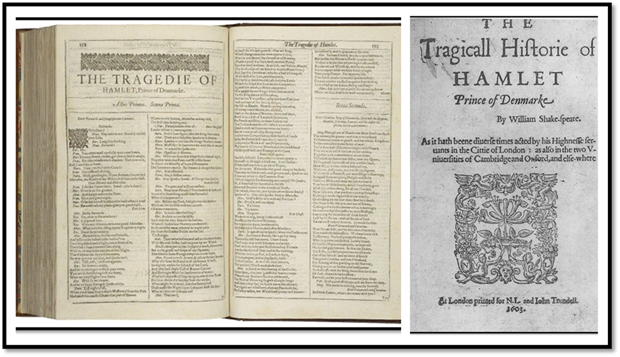
Another significant difference is that the character of Polonius is called “Corambis” while his servant Reynoldo is named “Montano”. Various suggestions have been made to explain this. According to one view, this may an accidental intrusion of details from the so-called Ur-Hamlet, in which the presumed reporting actor may have also played. G. R. Hibbard argues that these last changes were made because Q1 derives from a touring version of the play, which was intended to include a performance at Oxford University. Hibbard believes that the original names were too close to those of two famous Oxford scholars, the university’s founder Robert Polenius and the Puritan theologian John Rainolds. Since Polonius is a parody of a pompous pseudo-intellectual and his servant acts as a spy, the names might have been interpreted as deliberate insults. The title page of Q1 specifically states that the play was recently performed in “the Cittie of London: as also in the two Universities of Cambridge and Oxford, and else-where”.
Look again at the passage I quoted from Holderness and Loughrey in my last blog if you wish, but I quote again here their finely judged view of the matter:
The so-called Bad Quartos … are generally marginalised as piratically published versions based upon the memorial reconstructions of the plays by bit-part actors. But even if the theory of memorial reconstruction is correct (and it is considerably more controversial than is generally recognised), these quarto texts would provide a unique window on to the plays as they were originally performed and open up exciting opportunities for contemporary performance.
This is precisely the working document of a play approach I think will have attracted Ensemble 84 as well as the much shorter, undivided action (there are no Act and Scene divisions). The whole presumption of the document is not that of a ‘finished masterpiece’ of absolute psychological probity that some critics make the play Hamlet (based on clated editions of Q2 and F)seem to be (Samuel Taylor Coleridge for instance) but of collaborative ‘work in progress’, where even Hamlet himself is such a person trying to perform as he should without over-fancy poetic cognitive and affective machinery – a rather lesser philosopher and more of an ordinary Joe trying to work it out and create alliances well or badly.
Such a view does not prioritise Q1 over Q2 or later texts of Hamlet, it works out why text is as specifically is in performative terms. Good teachers might do this too. Here is the example of one such, Sarah Lehn in a blog contributed to The Folger Shakespeare website in 2014.[1] She takes a very brief exchange from the opening of two texts of Hamlet, namely:
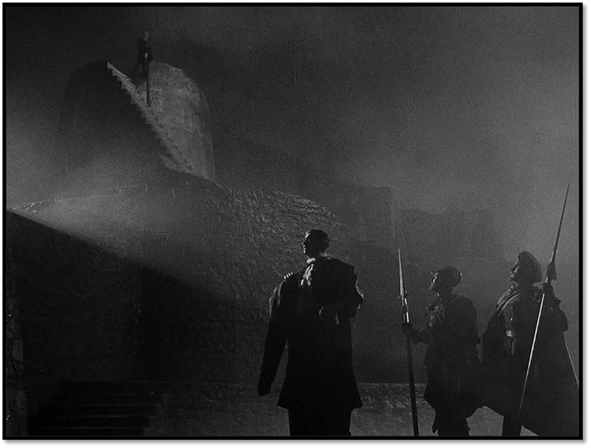
The 1948 film with Olivier as Hamlet, on the battlements meeting a ghost.
“Stand, who is that?”
“Tis I.”
From Q1
____
“Who’s there?”
“Nay, answer me.  Stand and unfold yourself.”
From Q2 & F
In both the stage is the setting for a dark night on the battlements of Elsinore’s royal castle, in which men on watch confront each other, as is their role, even if they have already recognised whom they see vaguely. Lehn gives these words to her learners. This is her summary of the results:
What is the difference between these two sets of lines? One discrepancy my students notice is that in [Q1], the second speaker quite simply proclaims himself with a direct “Tis I,” whereas in the folio version he responds cautiously, insisting that his compatriot be the first to identify. This can lead to questions of why Francisco refuses to identify himself, and how this builds a stronger sense of suspense and suspicion in the opening of the play.
From there, my students and I will go on to imagine the differences in the way these lines might be performed. What body language would Francisco and Barnardo exhibit with each set of lines? What atmospheric changes might be made to the set, lighting, or special effects? How might their vocal inflections change? Students can then pair off and come up with detailed performances or prompt book notations for each of these openings. After all, these lines say essentially the same thing… but then again, they don’t.[2]
The conclusion I draw from this are not only those drawn by Lehn that it makes it easier thus to ‘teach’ learners a syllabus that ‘asks students to “determine the meaning of words and phrases as they are used in the text, including figurative and connotative meanings; analyze the impact of specific word choices on meaning and tone.”’ But that meaning changes in performance. Lehn seems to think that her learners will find that Q1 is less psychologically incisive than Q1, but will they? So much will depend on other agencies in their improvised performances and direction of these scenes, including additions of gesture, tone, stance, motimn, proxemics, setting, staging and lighting … and perhaps other elements (learners are creative in such contexts). What they may find is that both texts offer potential. For instance – why is motion so unsettling in Q1 such that persons re asked to ‘Stand’.
I think if I ever dared ever to teach again – I won’t – I might try this with these comparative pieces from Q1 and Q2 from the scene in which Hamlet compares his feelings to that of the Players who will play on his direction The Murder of Gonzago to see if it rouses conscience in Claudius for killing his brother, Old King Hamlet.
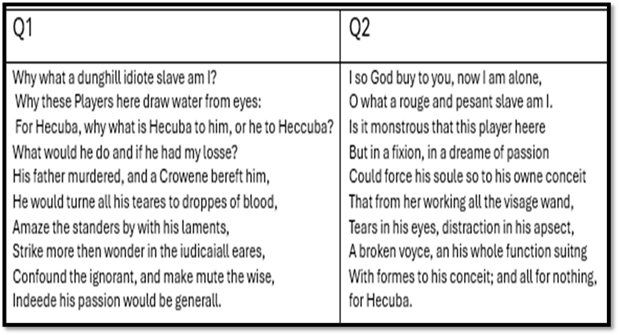
Now good young Courtney who I quoted in my earlier blog compares these speeches thus:
The first line in Q1 clearly shows a difference in name-calling himself in his grief. He asks what kind of “dunghill idiote slave am I?” He is more vicious and aggressive with this choice of words than he is in the other two versions. It creates an image of a Hamlet that is really hard on himself, rather than an introspective Hamlet that we encounter in the other two. In Q2, in “O what a rouge and pesant slave am I,” the question mark is dropped. It is now said as a sigh, as a fact. This may be less metadramatic, but also less rhetorical. Here he is identifying as a rouge pesant slave, (note the exclusion of “dunghill”), not asking if he is one. …Hamlet is impressed with the actor’s ability to connect with emotion that he doesn’t have. Hamlet thinks he can do better than the actor because he actually feels the emotion. He understands the pain, the heartache, and the desire for revenge. It is his essence and his being. Theater, as we have examined before, has a double meaning. Not only do Shakespeare’s actors act on stage, but they are also conscious of their role as actors as characters. Hamlet is aware of the power of theater as he watches theater. Hamlet believes in theater so much that he uses it as a tool to confirm Claudius’ guilt and the ghost’s truth. [In] Q2, there is more emphasis on the actor’s ability and the translation of true emotion. Hamlet spends a lot of time musing at how the actor can evoke such emotion, and how that true emotion is amplified by real circumstances instead of fiction. In the Q1 (bad quarto), Hamlet focuses on how much of a coward he feels, which was evoked by the performance. Rather than ruminating on the skill of the actor and how that can be used in theater, the Q1 focuses on Hamlet’s “lack of gall”. His decision to use The Mouse Trap as a device for seeking truth is barely addressed in the Q1.[3]
One can sense the presence of the mentor praising Courtney for so ably ‘proving’ the inferiority of Q1 to Q2 (and F which she also does but I omitted these parts). But it is not true that Q1 fails to shed an ‘emphasis on the actor’s ability and the translation of true emotion’, he just does it briefly and with an eye more on the quantity and generalisation of passion than on the distinction between sorrow for a person in ‘fixion’ as in in real life. Had we, like Lehn, set our learners a pair task in which one stage-directs the other as the actor speaking the soliloquy and then asking them to swap roles, perhaps more than once, I think it would not be to the disadvantage of Q1.
So now I wait to see the play on Saturday 30th May at 1.30 p.m. What I think I will watch for is how the team play the Gertrude that is unique to Q1, the one who informed of her first husband’s murder says:
Queene Hamlet,
…….. I vow by that majesty,
That knowes our thoughts, and lookes into our hearts,
I will conceale, consent, and doe my best,
What stratagem soe're thou shalt devise.
The stress on collaboration here between mother and son against patriarchal infamy is strikingly different from the Oedipal mother-son relationship modern psychodynamic criticism has derived from the fleshly poetry of Q2 and F’s interest in the details of the sex his mother and stepfather are into, as in this oddest of negations of action in speech by Hamlet to his mother when she asks him what she would do (from Act 3 Scene 4 line 203ff. of the Folger text):
Not this by no means that I bid you do:
Let the bloat king tempt you again to bed,
Pinch wanton on your cheek, call you his mouse,
And let him, for a pair of reechy kisses
Or paddling in your neck with his damned fingers,
Make you to ravel all this matter out
That I essentially am not in madness,
But mad in craft. ’
In fact, it is time for a politicised and community Hamlet again rather than a sexualised family romance Hamlet. In fact we need all these Hamlets in our culture.
I will, of course, report back from Horden.
For other Hamlet posts use the links here: on the recent National Theatre Live streamed Hamlet; on the Riz Ahmed film, on the concept of ‘playtime’, destiny in Hamlet, reading ‘To be or …’, on the film Hamnet.
With love
Steven xxxxxxxxxxxxx
[1] Sara Lehn teaches at Roslyn High School in Roslyn, New York, where she has worked with all grades from 6 through 12. She is an alumnus of the 2012 Teaching Shakespeare Institute at the Folger Shakespeare Library (note from blog).
[2] Sara Lehn (2014) ‘Quartos and Folios in the English Classroom’ In Folger Library blogs (Posted September 30, 2014) Available at Folger Shakespeare Library; https://www.folger.edu/blogs/teaching-shakespeare/quartos-and-folios-in-the-english-classroom/
[3] Courtney McCaw (2014) ‘textual differences between Hamlet Q1, Q2, and F’ Word Press (Posted on April 11, 2014, by courtneymccaw) at https://courtneymccaw.wordpress.com/2014/04/11/textual-differences-between-hamlet-q1-q2-and-f/
 Steve_Bamlett_blog
One thought on “The phrase might be ‘a Prince of the Theatre’ used as if royalty alone gave value to things. Yet Ian McKellen is such a Prince because he played Prince Hamlet so many times – the last time in his recent older age. This blog is Part 2 of “The good and the bad in preparing to watch The Tragicall Historie of Hamlet performed by Ensemble 84 at their new theatre in Horden, …”