


The good and the bad in preparing to watch The Tragicall Historie of Hamlet performed by Ensemble 84 at their new theatre in Horden, from the text of the First Quarto publication, conventionally called by editors a ‘bad quarto’? Part 1 – dealing with ‘fears and self-doubts.
I will be talking about my expectations of my visit to this play later. Here I want merely to look at the issue of how ‘fears and self-doubts in Hamlet’s most famous soliloquy are handled. That is because it is a key text for our culture on this idea of conjoined fear and self-doubt.
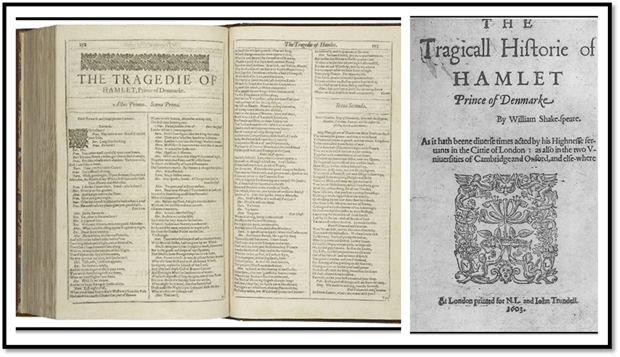
Let’s start at a distance even though, it seems to be considered a way of inducing sleep more effecive than counting sheep to talk about the textual issues of a Shakespeare play. When Durham University recovered its own unique copy of William Shakespeare’s First Folio (1623), I blogged on it: find that blog at this link if you need forty winks. The texts are usually edited from copies published in Quarto or Folio, those names being merely the name of the paper size in the published work, though that isn’t clear from seeing them side by side as in my collage below, where the play in the anthologised Folio edition (from the Folger Shakespeare Library) should be actually significantly larger than the Quarto. Some idea of the size difference is conveyed in the Wikipedia entry on Book Size.
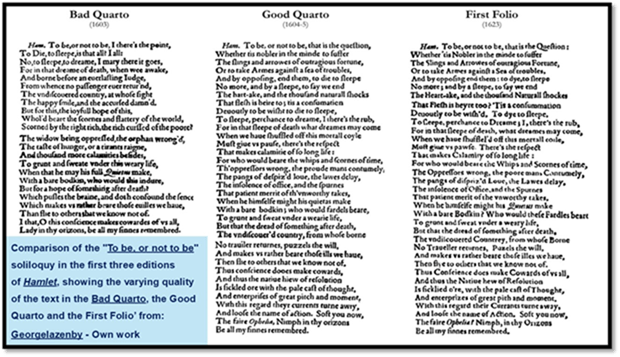
However, does size matter here? The editors of Shakespeare from the eighteenth century onward are more concerned with questions of authority, authorial attribution and authenticity, adjudged by comparison of pubishing that is in some way authorised – by dramatist and/or their theatre company, who before the days of copyright are as near as we get to the notion of ‘ownership’ of a play. In my blog on Durham’s folio, I illustrated the issue of textual comparison between available texts with a collage of the differences in the most famous speech in early texts of Hamlet. There are three such texts from which modern editions are cobbled. They are published in this order, the First Quarto (Q1), the Second Quarto (Q2) and the Folio (F). Most later editors have preferred not to consider the first Quarto in Hamlet’s case, calling it a ‘Bad Quarto’, as an indication of both its quality and its assumed ‘textual corruption’ by forces other than its scriptwriter or the scriptwriter as he refined the text with his theatre company. The reasons for calling it a ‘bad quarto’ can be considered from that speech alone – the speech being shorter, and in some views both harder to embody in action or speech and less ‘rich’ in language.
Rather than, however, looking at the academic editors’ opinions in their choices between versions in building their editions, there are already some thought through pieces on the web by people without such authority conventionally – ‘mere students’ as some academics might put it (without considering that they only have authority and income because of them), who may or may not be writing without reliance on these scholars but stating their views as if entirely authoritative of generalised thought on the matter current to them saying it. Take this from Courtney McCaw’s Word Press blog:
The differences between the three texts are very important in the readings of the plays. Q1 is inferior in comparison to the Q2 and F. The Q1 lacks the length, content and characterization that the Q2 and F provide. The Q1 standing alone does not provide enough of Hamlet’s thoughts and reasons for delay, which are the basis of the entire tragedy. The F is the best play, based on its length, content and complete characterization of Hamlet.[1]
This view had already been challenged by 2014 when Courtney wrote her useful blog, by the editors of a modern reprint of the First Quarto, in a series of ‘First Editions’ of Shakespeare plays first published in 1992 by Harvester Wheatsheaf Press. Graham Holderness and Bryan Loughrey say of the First Quarto, undermining the assumption it is a ‘Bad’ Quarto, and arguing that such arguments were based on assumptions that one scriptwriter alone authorises an edition of their works, rather than other theatrical agencies – such as theatre companies and roles within them, actors or publisher roles that we can no longer sustain:
Just as the scriptwriter cannot be privileged over all other influences, nor can any single script. It is becoming clear that within Elizabethan and Jacobean culture, around each ‘Shakespeare’ play there circulated a wide variety of texts, performing different theatrical functions and adopting different shapes in different contexts of production. Any of these contexts may be of interest to the modern reader. The so-called Bad Quartos, for example, are generally marginalised as piratically published versions based upon the memorial reconstructions of the plays by bit-part actors. But even if the theory of memorial reconstruction is correct (and it is considerably more controversial than is generally recognised), these quarto texts would provide a unique window on to the plays as they were originally performed and open up exciting opportunities for contemporary performance. They form part, that is, of a rich diversity of textual variation which is shrouded by those traditional editorial practices which have sought to impose a single, ‘ideal’ paradigm.[2]
I think this is indubitably the case. There are too many factors in patriarchal capitalism that have necessitated the rise of the notion of an individual product commodity, with copyright owned by one person and not networked communities of person to allow the idea of that a genuine play as Shakespeare intended it to be found. His plays were always the product of communal processes. And, although McCaw states the case still considered to be the ‘correct’, or at least the consensual view of the matter, there is no doubt it doesn’t justify the work that goes into dismissing the ‘bad’ quartos and justifying that name for them. Here is what she says about the speech in the First Quarto, quoted in full, with a photograph of the appearance of the text quoted in the First Folio added:
Soon thereafter Hamlet … delivers his famous soliloquy in 3.1. The Q1 again stands as inferior in length and content. Even more importantly, the famous first initial line is a statement, rather than the question we are familiar with. The beginning of the soliloquy reads,
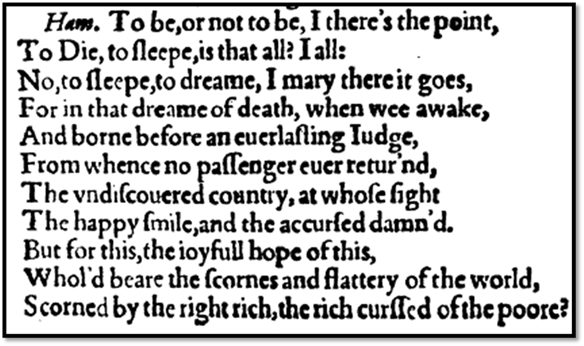
To be, or not to be, I there’s the point.
To die, to sleep, is that all? I all:
No, to sleep, to dreame, I mary there it goes,
For in that dream of death when we awake,
And borne before an everlasting judge,
From whence no passenger ever returned,
The undiscovered country, at whose sight
The happy smile, and the accursed damn’d.
But for this, the joyfull hope of this,
Whol’d bare the scornes and flattery of the world,
Scorned by the right rich, the rich curssed of the poore?
…, the biggest, most impactful difference is the statement of the first line. Instead of Hamlet asking, “is it better to be alive than dead,” Hamlet is saying he already knows which is better. In fact, he closes this soliloquy with “I that, O this conscience makes cowards of us all” (1735). He means that the fact that we all fear death so much makes us all cowards. Our fear of the afterlife makes us not act upon things in the current life. This could be why Hamlet delays, and why Claudius attempts to pray. Conversely, although this line is said in Q2 and F, it is not the end of the speech. Hamlet continues in the Q2 and the F, discussing the notion of hope-
And thus the native hue of resolution
Is sicklied o’er with the pale cast of thought
And enterprises of great pith and moment
With this regard their currents turn awry
And lose the name of action.
This alternative ending gives the audience a better understanding of Hamlet’s delay. In this last part not written into the Q1, Hamlet discusses that “the native hue of resolution,” which is the boldness and resilience of human life force is “sicklied” and “pale” with too much thinking. Enterprises, which to him means intention and action, that are supposed to be immediate and swift, don’t happen as they should (turn awry) when they get mucked-up with too much thought. The action becomes lost, drowned in thought. After Hamlet speaks with Ophelia, Polonius and Claudius understand that Hamlet is not sick in love, he is sick with grief, melancholy, and to Claudius’ dismay, revenge.
The fuller reading by McCaw here is a forceful defence of the superiority of this speech alone in Q2 and F, in the belief that Shakespeare had more say in the transcription of the play in Q2 than in Q1. The superiority lies in the coherence of plot, character and theme (not least that of action compared to passive reflection), she says, but all that depends on the ways in which the notion of ‘character’ is discoursed and which specified qualities of character societies validated and valorise. Q1’s ‘Hamlet’ in this speech is practical – it is not the unknown result of the judgement after death he fears and that therefore keeps him alive but ‘joyful hope’ that he, at least, is not part of the ‘accursed damned’.
Q2’s Hamlet stays alive because of the mere thought that the unknown MUST contain fears he does not know about yet except that he dare not face them yet. Freud and Ernest Jones, his British acolyte, had they known only Q1 would not have interpreted Hamlet as another run at the portrayal of the Oedipus complex and of the return of the repressed. Of course, I prefer the Q2 and F character but not to the detriment of this weirdly positive Hamlet of Q1.
So here’s my answer to this question about the ‘handling of fear and self-doubt’. I am not sure we can handle the numinous in ‘fear and self-doubt’ our culture’s love of Hamlet in Q2 causes to arise. We can however be more like him in Q1 and handle it (in a bit of my own more than blank verse):
As if it were a tool to open up
the black box necessity buries us
In certain knowledge of uncertainty.
More on my hopes in seeing Q1 Hamlet in my next and why I have embraced them to buy my ticket for the performance. Don’t expect, by the way, to escape ‘fear and self-doubt’. We all have to accept existential angst and live with it! Don’t we!
With love
Steven xxxxxxxxxxxxx
[1] Courtney McCaw (2014) ‘textual differences between Hamlet Q1, Q2, and F’ Word Press (Posted on April 11, 2014 by courtneymccaw) at https://courtneymccaw.wordpress.com/2014/04/11/textual-differences-between-hamlet-q1-q2-and-f/
[2] Graham Holderness and Bryan Loughrey (2014 first publ. 1992: 6-8) ‘Introduction’ in William Shakespeare [& Graham Holderness and Bryan Loughrey [eds.]] (2014) ‘The Tragicall Historie of Hamlet Prince of Denmarke’ London, Routledge. I once taught with Loughrey.


One thought on “The good and the bad in preparing to watch ‘The Tragicall Historie of Hamlet’ performed by Ensemble 84 at their new theatre in Horden, from the text of the First Quarto publication, conventionally called by editors a ‘bad quarto’? Part 1 – dealing with ‘fears and self-doubts.”