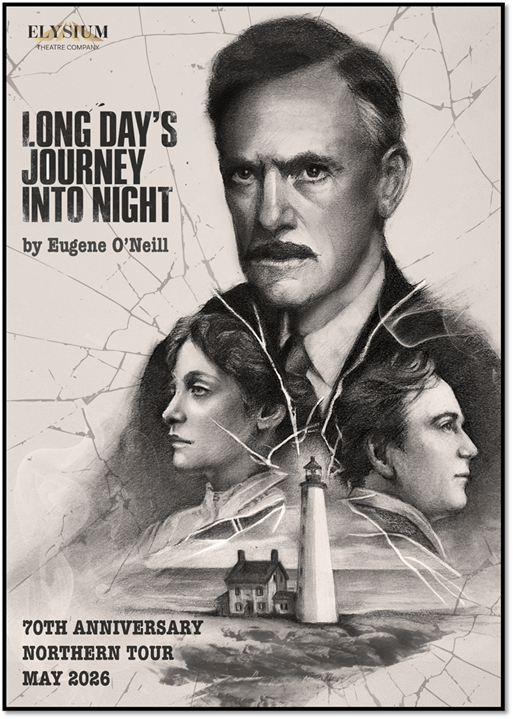
I blogged in preparation and noted that I had blogged on Elysium Theatre before, forgetting I saw their wondrous A Midsummer Night’s Dream (though, mainly because too elated, I didn’t blog on it – I remember thinking that Bottom was a real force in the play) thus:
I have seen Elysium Theatre before and blogged on their A Doll’s House (Ibsen – see this link) and Othello (see this link). If I get a surprise – either in the way of excellence or of falling short – I will blog after seeing the play.
This was their 70th Anniversary Tour. My expectations were thence high, and though the play was known to me by title only before, I read it with wonder (at the same blog above I recorded my reading – read it at this link).I even shelled out £3 for the programme, which contains this unfortunate fact about the play in production history, namely that its acting roles ‘are coveted by serious American actors in the way Shakespeare’s are in Britain. Actors line up to play Tyrone, Mary, Edmund and Jamie’. In the programme I noted with satisfaction the name of Danny Solomon as Jamie, whose acting I had seen before in this company and admired. But the joy stopped on opening the programme, where I read in an inserted slip that the ‘due to unforeseen circumstances’ the role of Mary was to be played by n actor reading from the play-script on stage. What happened to the use of ‘understudies’, I wondered?
Somewhat fearful we entered the theatre. The interval didn’t come until after the first three acts, but we should have left the theatre long before, for it does not, cannot work to have that glorious role reduced to a woman dressed appropriately for the period but holding a huge copy of the script, and able to make only the broadest of mood changes in that very complex role evident. Her encumbered appearance seemed to reflect on the rest of the cast. If possible Edmund Dehn played the role of Tyrone as if he had never thought of how actors appear in real life, in, for instance, their almost natural slippage into over-projection of voice and self, sometimes in long expected quotations. at one point Jamie talks about how Tyrone becomes the ‘Voice’ to enchant any audience available – it seems to be a bit of the script Dehn missed, since his character was not on stage at the time. there was ellegant wood on the stage, representing the table and chairs but Dehn’s wood was not even elegant. he adopted a Parkinsonian hand tremble, presumably to showed the effect of heroic whiskey drinking in Tyrone, but it faded into the overall effect of senility in the character of Tyrone, a man who defied such labels . He killed the role. I winced more than in the theatre to read that this actor had made especial study of King Lear as a male character, let me never see him play it.
Mary’s role is marked by her resistance to and need for ‘touch’, yet how could a son or a father, or someone playing such, eve enact the nuance of touch when the actor playing the reluctant-to-be-touched is holding a huge book, and looking down on it during the longer speeches. For Mary does not speak, she plays the roles of the multitudes within her, shifting between them with irritating speed: from being life’s victim to a savagery of blaming others for her addiction, although the blame is well-placed in part (on the private medical system and her miserly drunken husband – not so miserly with imported Irish whiskey), it is painful when we see it shaping her sons. But that night I saw it through remembering my reading of the play.
Daniel Bradford was a good Edmund and I regret that I missed the Acts to come after the interval seeing him. i could not however bear to think about how painful the scenes played by Mary and Tyrone in it would be. He played well with Jamie but the magic was already gone for this production
My honest opinion is that the company should have abandoned the production in these ‘unforeseen circumstance’, and failing that, the theatre manager at the Gala should have cancelled the production. The effect of the whole was to shed too much light on the poverty-stricken sets and the failure to stage the play appropriately for a proscenium the size of that of the Gala when unencumbered by setting. I suddenly remembered those long elegantly written stage directions, especially of the setting in it of two bookcases – one grandiose for Tyrone with sets of Shakespeare and the classics, another with modern European texts of existential angst for Edmund. there was one bookcase, housing stuff borrowed it seemed from a charity shop, and graced by an IKEA like modern touch lamp in Art-Deco style. The whole point of Mary’s dismissal of her part-time home as shoddy, when it is clearly large and magnificent, is missed, for the whole thing was shoddy, even the poorly painted framed (in a two dimensional painted frame) portrait of Shakespeare over the bookcase. it should have been larger – it is Tyrone’s ego on the wall.
A bad night at the theatre! No! Not just that! It enforced the truth that poor standards in theatre are acceptable only in the provincial far North of England, except in touring companies from the richer South. We deserve more. I felt for people who knowing less theatre might think this is what all theatre can be – for the audience was large.Are we doomed to be a region only ever ‘streamed’ to by ‘live’ theatre. I hope not.On its 70th anniversary, Elysium should be considering permanent retirement.
With love and sorrow
Steven xxxxxxxxxxxx

