


Perhaps the answer is ‘ a moment of anticipation’! A young man and his father are lost to the consumption of hoarded whiskey until the woman, who is their mother and wife respectively, enters pale as a ghost carrying her ancient wedding dress. At this point the youth’s ‘head jerks and his eyes open’, though his father clearly had already been found on the stage by the audience in a state of ‘wide awakeness and sober dread’. [1] What sobers men up so quickly is the image of their selves as having failed to sustain the dreams they once fostered in women, and perhaps deep in themselves, of warmth, love, security and hope. In the world of Eugene O’Neill’s most self-defining play, most men live on their own capital, afraid to spend their resources and yet finding a way to do it anyway and eking out the day longer than it might be. Yet they know that their resources will anyway eventually be consumed by something unimaginable in futurity, even if not by themselves, something that feels like the dark obscuring night. Why does time seem so endlessly extended in the long day’s journey into the night and the early sea fogs which are its shadow? This blog reflects on Eugene O’Neill (1956) A Long Day’s Journey Into Night in anticipation of seeing a production revived by Elysium Theatre Company at the Gala Theatre Durham on 19th May 2026.
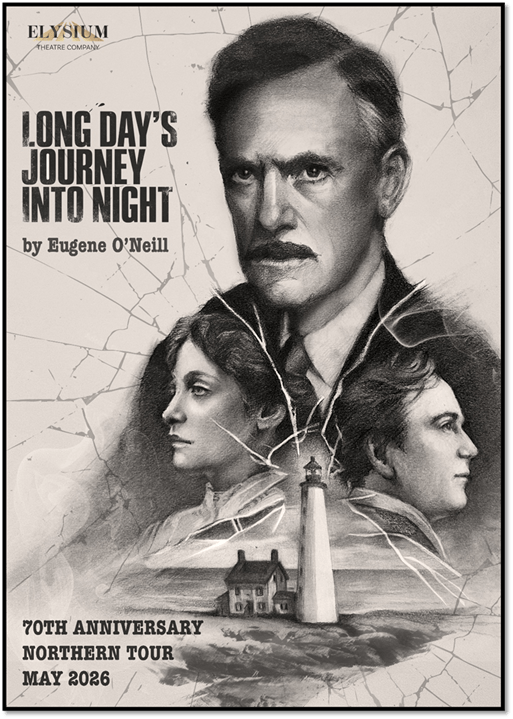
Mary Tyrone is supposed based on Eugene O’Neill’s mother, Ella, but she has much in her that suggests a source much more based in the stereotypical figure of the pale woman in European and American literature – a woman whose appetite is problematic and for some reason turned towards death rather than life, subject to a wasting of her body that may be a symptom or her disordered appetites and/or some other cause that secretly wastes her vitality, as if she belonged to a space remote from the present that is often located in the remote past, her own or that imagined by a culture for itself. But we know these states in Mary too from O’Neill’s stage directions, which make anyone wonder how an actor will interpret them: ‘Suddenly and startlingly one sees in her face the girl she had once been, not a ghost of the dead, but still a living part of her’.
But she is also metaphorically, and perhaps in other senses a ghost or being from the supernatural realm that can neither be touched nor in any other ways sensed as a living body in the present (the theme of noli mi tangere rings through certain sections – I will say more on this later). These motifs – of being supernatural and of the past – merge, especially in the mind and feeling of her third son born (the youngest) after her first major mental breakdown associated with her middle son, who died as a child: Edmund says as he hears her moving around in the upper floors of the Tyrone’s summer-house on the coast that;
EDMUND (dully). Yes. She’ll be nothing but a ghost haunting the past by this time. (He pauses — then miserably.) Back before I was born —’.[2]
We in the audience or reading, know by now, that Mary’s absences are a result in part of an addiction to morphine, taken to relieve the pain of her arthritic hands she claimed, but first prescribed by a doctor attempting to control her response to the trauma of her son’s death, a doctor appointed by Mary’s husband because he was cheap. Yet the ‘dope fiend’, she is sometimes called, is sometimes too a supernaturalised being, the other one mentioned being Dante Gabriel Rossetti, carrying with him all the associations of British Eighteen-Nineties Decadence, Oscar Wilde included.[3]
Edmund is conventionally thought to be a self-portrait of the author, although I wonder if he isn’t in part represent by Edmund’s elder brother, Jamie, too, rather than Jamie being merely a pen-portrait of his real brother. And then there is that dead child: his name is ‘Eugene’ Obviously, there is another ghost here – a child neglected and uncared for who dies, with no chance of a future at all. Aren’t all the men, in the novel, even the elder James Tyrone, often conventionally thought to be a picture of O’Neill’s actor father, versions of how masculinity varies across stereotypes, though lived ones – with nuance inbuilt.
Dope, the name given to morphine in the play, is even before we know for certain what it is given as the cause of Mary Cavan Tyrone’s ghost-like absences from life behaviourally and in appearance, once the appetite that she had regained, as we will learn from the fact that she has, as the play opens, some regained plumpness, after incarceration in a ‘sanatorium’, wanes and fails again replaced by that for the drug. As she retreats upstairs, the men know what she is doing:
TYRONE (harshly). Up to take more of that God-damned poison, is that it? You’ll be like a mad ghost before the night’s over!
MARY (starts to walk away — blankly). I don’t know what you’re talking about, James. You say such mean, bitter things when you’ve drunk too much. You’re as bad as Jamie or Edmund.[4]
The pattern of mutual attack of each other with claims of indulgent addiction (to whiskey mainly in the case of the men, though Mary drinks that too, alongside with her young Irish immigrant servants) occurs throughout, here with the hint of mutual suggestion of the causation of such addiction appears here and is oft repeated. What also appears is the attribution of such cruelty to the addiction itself, which as regularly is made the excuse for interactive anger, and profuse apologies that follow, until the next time. It is a pattern that gets built into the syndrome of professed care for each other, justifying control (even by overt or covert surveillance) or their absence in neglect (as with dead Eugene of course). Such behaviours mark not only ‘Jamie or Edmund’ (both drinkers but Edmund dangerously so because, as we suspect and as we and he will lean through he has tuberculosis, or ‘consumption’ as it is more appropriately called – a disease associated with thinness and an eating away of the vitals from within – and with nineteenth century pale ladies on the model of Dumas’ La Dame aux Camélias (The Lady of the Camelias) with its central story of ‘Marguerite Gautier, a demimondaine or courtesan suffering from consumption, and Armand Duval, a young bourgeois’ (Wikipedia).
We should be aware, of course, that in literature the theme of the pale lady, which emphasised the passivity and withdrawal imposed by a literary motif on the dangers of female sexuality that might become too active or incite such activity (the kind Jamie finds in himself through ‘whores and whiskey’. In Edmund, it is associated with his own supernatural and death-linked fantasies, and as with his mother the linked but antagonistic systems of fog (obscuring, hiding, distancing) and foghorn (alerting, warning, touching), as in this classic moment, where another English Nineties Decadent associated to American ‘gone with the wind’ death longing, Ernest Dowson, is quoted by him (my emphases):
EDMUND. I loved the fog. It was what I needed. (He sounds more tipsy and looks it.)
TYRONE. You should have more sense than to risk —
EDMUND. To hell with sense! We’re all crazy. What do we want with sense? (He quotes from Dowson sardonically.)
“They are not long, the weeping and the laughter,
Love and desire and hate:
I think they have no portion in us after
We pass the gate.
They are not long, the days of wine and roses:
Out of a misty dream
Our path emerges for a while, then closes
Within a dream.”
(Staring before him.) The fog was where I wanted to be. Halfway down the path you can’t see this house. You’d never know it was here. Or any of the other places down the avenue. I couldn’t see but a few feet ahead. I didn’t meet a soul. Everything looked and sounded unreal. Nothing was what it is. That’s what I wanted — to be alone with myself in another world where truth is untrue and life can hide from itself. Out beyond the harbour, where the road runs along the beach, I even lost the feeling of being on land. The fog and the sea seemed part of each other. It was like walking on the bottom of the sea. As if I had drowned long ago. As if I was a ghost belonging to the fog, and the fog was the ghost of the sea. It felt damned peaceful to be nothing more than a ghost within a ghost. (He sees his father staring at him with mingled worry and irritated disapproval. He grins mockingly.) Don’t look at me as if I’d gone nutty. I’m talking sense. Who wants to see life as it is, if they can help it? It’s the three Gorgons in one. You look in their faces and turn to stone. Or it’s Pan. You see him and you die — that is, inside you — and have to go on living as a ghost.TYRONE (impressed and at the same time revolted). You have a poet in you but it’s a damned morbid one! (112 -13)
The ‘damned morbidity’ of nineties decadence – with which through Wilde (and his folklore collecting mother, Lady Wilde) and W.B. Yeats it was often associated – was not noticed by James Tyrone alone, and it affects all the family and indeed, the play suggests the immigrant Irish – the foghorn to the servant girl Kathleen is a ‘banshee’.[5]
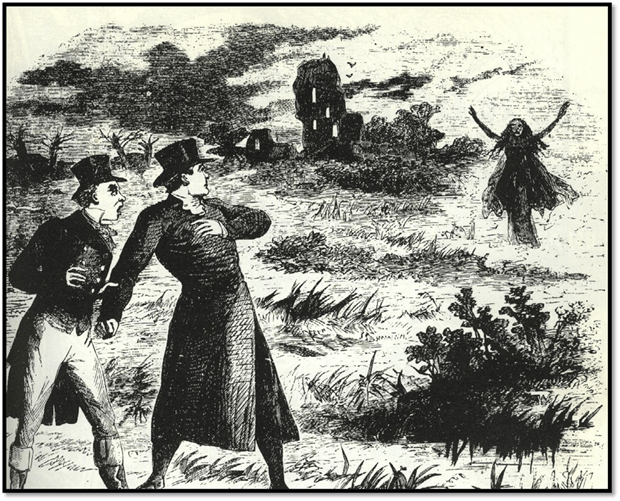
But the 1862 print above what stands out is the guarded horror of the gentlemen at the appearance of a banshee, as they stand back from the approach, and worse the ‘touch’ of the woman associated with their death as well as her own. Of course, death perhaps offers a place in which to live remotely – a place where life ought to be impossible and therefore simplified and beyond the binaries of life and death (and perhaps male and female), like that underwater world Edmund imagines where he lives unseen and untouched by reality. This is the world Edmund associates to his mother, and to femininity in crisis (the Baudelaire theme), and the fog too and being born as something other than a man. He suggests a ‘sea-gull’ or ‘fish’ but we know that he means a woman too – either a saint or whore/trollop (very Nineties English Decadent taking lead from French Symbolism. All this addiction to drink allows a man, and is tolerated (in a man), though being a ‘dope fiend’ is tolerated by no-one of anyone). Edmund jokes about the double meaning in his speak that means his mother moving ‘above and beyond’ is already in an atemporal space, which is also the past ignoring the fact that his perception and expression themselves owe a lot to being a drunk man sharing stories with drunk men:
(He reaches out and pours a drink. Tyrone starts to protest, then gives it up. Edmund drinks. He puts down the glass. His expression changes. When he speaks it is as if he were deliberately giving way to drunkenness and seeking to hide behind a maudlin manner.)
Yes, she moves above and beyond us, a ghost haunting the past, and here we sit pretending to forget, but straining our ears listening for the slightest sound, hearing the fog drip from the eaves like the uneven tick of a rundown, crazy clock — or like the dreary tears of a trollop spattering in a puddle of stale beer on a honky-tonk table top! (He laughs with maudlin appreciation.) Not so bad, that last, eh? Original, not Baudelaire. Give me credit! (Then with alcoholic talkativeness.) You’ve just told me some high spots in your memories. Want to hear mine? They’re all connected with the sea. Here’s one. When I was on the Squarehead square rigger, bound for Buenos Aires. Full moon in the Trades. The old hooker driving fourteen knots. I lay on the bowsprit, facing astern, with the water foaming into spume under me, the masts with every sail white in the moonlight, towering high above me. I became drunk with the beauty and singing rhythm of it, and for a moment I lost myself — actually lost my life. I was set free! I dissolved in the sea, became white sails and flying spray, became beauty and rhythm, became moonlight and the ship and the high dim-starred sky! I belonged, without past or future, within peace and unity and a wild joy, within something greater than my own life, or the life of Man, to Life itself! To God, if you want to put it that way. … And several other times in my life, when I was swimming far out, or lying alone on a beach, I have had the same experience. Became the sun, the hot sand, green seaweed anchored to a rock, swaying in the tide. Like a saint’s vision of beatitude. Like the veil of things as they seem drawn back by an unseen hand. For a second you see — and seeing the secret, are the secret. For a second there is meaning! Then the hand lets the veil fall and you are alone, lost in the fog again, and you stumble on toward nowhere, for no good reason! (He grins wryly.) It was a great mistake, my being born a man, I would have been much more successful as a sea-gull or a fish. As it is, I will always be a stranger who never feels at home, who does not really want and is not really wanted, who can never belong, who must always be a little in love with death![6]
Drink removes the responsibility of maintain life, even of taking food or ‘eating enough’, for neither Mary nor Edmund ‘touch anything’ but coffee – touch being here a synonym for taking sustenance.[7] In Edmund it taunts him to take on the ‘habit’ of poetical language that marks him not as a ‘poet’ (a trade of the spirit not flesh) but one of the ‘fog people’, as he explains to his father.
The makings of a poet. … I couldn’t touch what I tried to tell you just now. I just stammered. That’s the best I’ll ever do. I mean, if I live. Well, it will be faithful realism, at least. Stammering is the native eloquence of us fog people.[8]
But the real noli mi tangere theme – invoking the iconography of Christ refusing the touch of Mary when she finds him in the Garden of Gethsemane after his crucifixion in a state that is yet unclearly determined between flesh and spirit, reality and dream is associate with fog, that Mary ‘really’ loves, she says, because:
It hides you from the world and the world from you. You feel that everything has changed, and nothing is what it seemed to be. No one can find or touch you any more. 8
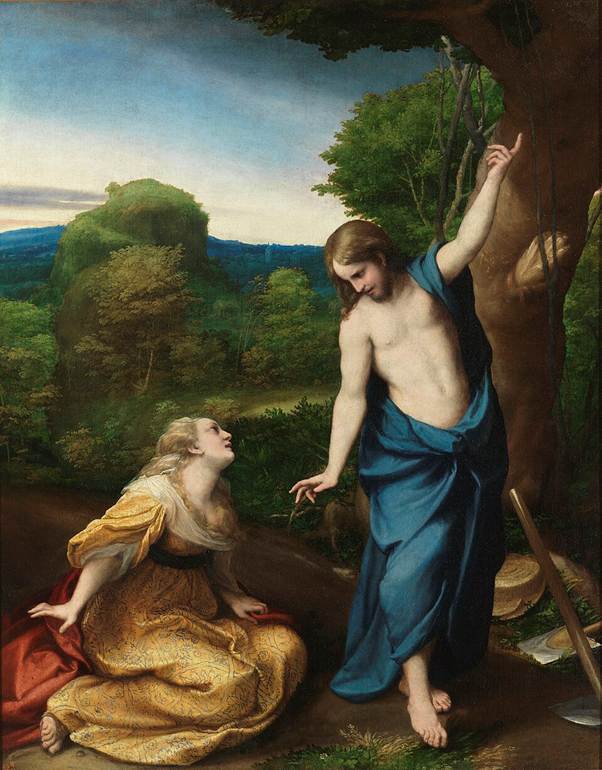
Noli me Tangere by Antonio da Correggio, c. 1525
Not to be touched nor to touch others is a theme of Christ’s transition, in Mary it relates to her resistance to sexual touch (even that of her husband), or the touch of warm human contact (even that of her sons) – both of which she may simultaneously desire, for she seeks isolation most when she feels most lonely. But it is also a place inside the self where externally triggered emotion has no hold of you – like that she felt on losing Eugene, or in the loss of Jamie to his wasteful life or the wasting life of Edmund’s consumption. In a sense, they both suffer from too much consumption – though only for one is it usually called an illness. Jamie spends money on whiskey and ‘whores’. To both of those son’s circumstances, Mary is in ‘denial’ (a thing constantly enacted through the play – not only by her but every character). If the fog helps denial in her and Edmund by obscuring people and reality, the foghorn is the voice of alert, that calls you back to reality, people and danger:
It’s the foghorn I hate. It won’t let you alone. It keeps reminding you, and warning you, and calling you back. (She smiles strangely.) But it can’t tonight. It’s just an ugly sound. It doesn’t remind me of anything. (She gives a teasing, girlish laugh.) Except, perhaps, Mr. Tyrone’s snores.[9]
When a woman speaks about not being ‘let alone’, she may refer to the sexual demands of her husband too. In this case I think she unconsciously does – why perhaps the sound recalls the now old man’s snores, rather than the young man who called her from service as a ‘nun’ to a warm bed in which he touched here too inwardly. Sons alert you too. The foghorn is a warning of danger but necessarily also a control put on circumstances, such as families often force on each other – in the matter of eating, drinking strong drink, or taking substances that can harm you despite being called ‘medication’ or ‘medicines.
It links to the fear of surveillance – of being over closely watched – in Mary, which we only later in the play realise is not as much an act of control as anything, for Mary’s habit has to be made conscious to her, especially when she denies it or represents it as beneficial, in order to ‘take care’ of her. Of course, all the family do this with each other – and rarely themselves – regarding levels of alcohol intake too, or in attempts to substitute that intake for the option of food, though even here there is surveillance of how ‘fat’ you might become in this play in the case of the supposedly recovering Mary as well as how ‘thin’, in the case of Edmund’s consumption, as that substance too takes off the edge of reality in its own delights.
Surveillance and reminding people of the risks they take that are based based on past failures in the care of self by self as well as others is at the core of both ‘taking care’ and – frankly – ‘controlling’ others in the play. Here is a fine dramatic passage, in which people deny their problems, refuse to be reminded of them and refuse care offered to them, which is at the same time using the problems as an excuse for continuing on the same path to danger, or forcing others to not give the right care or be wary of it.
EDMUND. Anyway, you’ve got to be fair, Mama. It may have been all his fault in the beginning, but you know that later on, even if he’d wanted to, we couldn’t have had people here — (He flounders guiltily.) I mean, you wouldn’t have wanted them.
MARY (wincing — her lips quivering pitifully). Don’t. I can’t bear having you remind me.
EDMUND. Don’t take it that way! Please, Mama! I’m trying to help. Because it’s bad for you to forget. The right way is to remember. So you’ll always be on your guard. You know what’s happened before. (Miserably.) God, Mama, you know I hate to remind you. I’m doing it because it’s been so wonderful having you home the way you’ve been, and it would be terrible —
MARY (strickenly). Please, dear. I know you mean it for the best, but — (A defensive uneasiness comes into her voice again.) I don’t understand why you should suddenly say such things. What put it in your mind this morning?
EDMUND (evasively). Nothing. Just because I feel rotten and blue, I suppose.
MARY. Tell me the truth. Why are you so suspicious all of a sudden?
EDMUND. I’m not!
MARY. Oh, yes you are. I can feel it. Your father and Jamie, too — particularly Jamie.
EDMUND. Now don’t start imagining things, Mama.
MARY (her hands fluttering). It makes it so much harder, living in this atmosphere of constant suspicion, knowing everyone is spying on me, and none of you believe in me, or trust me.
EDMUND. That’s crazy, Mama. We do trust you.
MARY. If there was only some place I could go to get away for a day, or even an afternoon, some woman friend I could talk to — not about anything serious, simply laugh and gossip and forget for a while — someone besides the servants — that stupid Cathleen!
It is difficult to like Mary, however much you pity her, for she is using denial in ways that shape and diminish the possibility of others genuinely caring for you. Her abuse of Cathleen (however true) is like the way she uses other entirely for her own purposes – to block out seeing her own responsibilities. Her wish to hide in fog is partly of course a wish not to be seen injecting morphine, even by herself, into herself, so that the habit can continues in continuing suffocating denial. Everyone else must feel guilty for that – her victim role is highly performative (as much the stuff of theatre as her husband’s play at parental, authority. But, of course, it is true too that Mary is the victim of men who rob her of even the role they pretend to give her – that of homebuilder. James Tyrone has never needed a ‘home’, but Mary is never allowed one – except to ‘summer’ in.
But Mary’s ambivalence as a character is not different from that of the men. Her habit is less validated by being less socialised and indeed was introduced to her by male neglect of women’s emotional lives – either out of self-delusion in them pretending to be what they are not or being too miserly to apply to medicine the resources it needs, as James does. Drinking is present throughout the play and always seen as acceptable – however bad it makes people act with each other, quite unlike morphine. I have mentioned earlier that the men in this play are all icons of masculinity – all dealing with that central ideology of being differently. Being a man gives you control, to the degree that your social and financial status allows, of money and the role and meaning of sexual action. The key metaphor of this play is CONSUMPTION, with its resonance in the realm of disease, appetite and economics. The three men are divided by their attitude to it. Jamie, who has little enough money or sexual control is dependent entirely on his father’s patronage as the paternal name-bearer. Hence when he blames his father for getting the cheapest doctor he could for his wife (leading to her addiction we will discover), the theme inevitably switches to the pittance his father allows him for bit-roles he plays in his father’s theatre enterprise. James senior however soon turns the table for Jamie is not only a poor actor, but he also spends all his resources on first getting any:
JAMES … You dare tell me what I can afford? You’ve never known the value of a dollar and never will! You’ve never saved a dollar in your life! At the end of each season you’re penniless! You’ve thrown your salary away every week on whores and whiskey!
JAMIE. My salary! Christ![10]
Jamie however makes an art of both financial expenditure and sex-seeking, which mirrors the romantic agony of Edmund’s life, and indeed attempts to suggest he made that life happen as it did, if in the realm of addiction to poetry and travel not drink and women, as he tells Edmund in Act IV:
JAMIE … Mama and Papa are right. I’ve been rotten bad influence. And worst of it is, I did it on purpose.
EDMUND (uneasily). Shut up! I don’t want to hear —
JAMIE. Nix, Kid! You listen! Did it on purpose to make a bum of you. Or part of me did. A big part. That part that’s been dead so long. That hates life. My putting you wise so you’d learn from my mistakes. Believed that myself at times, but it’s a fake. Made my mistakes look good. Made getting drunk romantic. Made whores fascinating vampires instead of poor, stupid, diseased slobs they really are. Made fun of work as sucker’s game. Never wanted you succeed and make me look even worse by comparison. Wanted you to fail. Always jealous of you. Mama’s baby, Papa’s pet! (He stares at Edmund with increasing enmity.) And it was your being born that started Mama on dope. I know that’s not your fault, but all the same, God damn you, I can’t help hating your guts —!
EDMUND (almost frightenedly). Jamie! Cut it out! You’re crazy!
Nineties Decadence in literature, as Mario Praz’s The Romantic Agony makes clear, was a thing of romantic intoxication, vampiric whores – or femme fatales – and pale women (its shadow lies on Bram Stoker’s Dracula), such that Jamie’s intent was to pass to Edmund as ‘fake’ a life as he had but that Edmund’s good looking mistakes, drinking and ‘fascinating vampires’ were more like those in nineteenth-century faking late romanticism.
The issue for both men is that CONSUME what they get, which is little enough, and lose every right to be the ideological men, they pretend to be. But their father James was only a ‘romantic nobleman’ who attracted Mary to be his wife and leave the convent because he was enacting that role when they met. His swagger is actually an act based on the fear of the loss of what manliness and money he has, which in everything, apart from dear imported Irish whiskey he keeps under lock and key, he marshals as a miser would, except in buying land that gives his Irish peasant soul the feel of belonging because he owns it. Not for him to be one of the ‘fog people’ like his son Edmund who when he ‘even lost the feeling of being on land’ became ‘a ghost belonging to the fog, and the fog was the ghost of the sea’. Edmund will be consumed – by disease and possibly so will Jamie, but James spends his life fearing being consumed.
Near the end of the play, aware that James will not even fork out to send him to a decent sanatorium to cure his consumption, Edmund calls him a ‘stinking old miser’. James response is long and angry and worth quoting at length, for it shows that James too is a spender, a consumer, whose hoarding and saving are symbols of the fear that he like his own father will spend his own life by suicide. Misers hold back life’s expenditure and the flow of suicidal blood (the bolding below is my own) but suicidality was in in his past in both father and his own son (although addiction to drink appears to provide excuse for it all):
JAMES … A stinking old miser. Well, maybe you’re right. Maybe I can’t help being, although all my life since I had anything I’ve thrown money over the bar to buy drinks for everyone in the house, or loaned money to sponges I knew would never pay it back — (With a loose-mouthed sneer of self-contempt.) But, of course, that was in bar-rooms, when I was full of whiskey. I can’t feel that way about it when I’m sober in my home. It was at home I first learned the value of a dollar and the fear of the poorhouse. I’ve never been able to believe in my luck since. I’ve always feared it would change and everything I had would be taken away. But still, the more property you own, the safer you think you are. That may not be logical, but it’s the way I have to feel. Banks fail, and your money’s gone, but you think you can keep land beneath your feet. (Abruptly his tone becomes scornfully superior.) You said you realized what I’d been up against as a boy. The hell you do! How could you? You’ve had everything — nurses, schools, college, though you didn’t stay there. You’ve had food, clothing. Oh, I know you had a fling of hard work with your back and hands, a bit of being homeless and penniless in a foreign land, and I respect you for it. But it was a game of romance and adventure to you. It was play.
EDMUND (dully sarcastic). Yes, particularly the time I tried to commit suicide at Jimmie the Priest’s, and almost did.
TYRONE. You weren’t in your right mind. No son of mine would ever — You were drunk.
EDMUND. I was stone cold sober. That was the trouble. I’d stopped to think too long.
TYRONE (with drunken peevishness). Don’t start your damned atheist morbidness again! I don’t care to listen. I was trying to make plain to you — (Scornfully.) What do you know of the value of a dollar? When I was ten my father deserted my mother and went back to Ireland to die. Which he did soon enough, and deserved to, and I hope he’s roasting in hell. He mistook rat poison for flour, or sugar, or something. There was gossip it wasn’t by mistake but that’s a lie. No one in my family ever —
The truth, of course, is that James’s life hangs on the same thread of vulnerability as everyone else in the play: as an assertion of manliness. But his weakness will not be made blameable as is his wife’s addiction and refusal to come to terms with the limitations life forces on her as a woman by men who ought – they really ought – to have known better.
This play is a masterly summary of its time. It’s acting will demand a high degree of subtlety, for its characters are actors whose masks constantly slip to show what other characters each person has beneath their appearance of the moment. It is a play where any falsity in the acting of drunkenness – and its variations in performativity – matter a great deal, and only the best actors can do this.
I have seen Elysium Theatre before and blogged on their A Doll’s House (Ibsen – see this link) and Othello (see this link). If I get a surprise – either in the way of excellence or of falling short – I will blog after seeing the play.
With love
Steven xxxxxxxxxxxxxxx
[1] Eugene O’Neill (Ebook edition 1956 edition: 150) A Long Day’s Journey Into Night London, Vintage Digital Books, Penguin Random House.
[2] Ibid: 118
[3] See ibid: 117
[4] Ibid: 107
[5] Ibid: 83
[6] Ibid: 133f. My bolding
[7] Ibid: 13
[8] Ibid: 135
[9] Ibid: 84
[10] Ibid: 26


2 thoughts on “Perhaps the answer is ‘ a moment of anticipation’! This blog reflects on Eugene O’Neill (1956) ‘A Long Day’s Journey Into Night’ in anticipation of seeing a production revived by Elysium Theatre Company at the Gala Theatre Durham on 19th May 2026.”