


Maybe life, at bottom, is quicksand! Comparing Henrietta Moraes’ life ‘to quicksand, deadly calm on the surface but inherently untrustworthy beneath’, Dom Moraes, her third husband is said by Darren Coffield to have ‘worshipped the shifting sand she walked on’.[1] That worship wasn’t quite that of a lasting religion and when it changed it disappeared from sight like a body sunken into quicksand does. However, Darren Coffield allows Henrietta Moraes to speak to us, if fitfully, again. This blog is a reflection on Darren Coffield (2026) Hen: Mistress of Mayhem Cheltenham, The History Press.
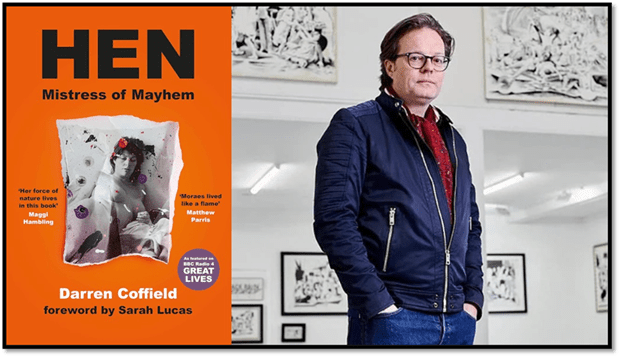
There is something unstable in every possible take on the life of Henrietta Moraes. As cited above, her third husband, the Indian poet Dom Moraes (she kept his name rather than others) compared her life ‘to quicksand, deadly calm on the surface but inherently untrustworthy beneath’, Darren Coffield tells us. He does so with regard to one incident when, having overshadowed her at a house party event celebrating the award to him of the prestigious Hawthornden prize for poetry in 1958, she, in a drunken state, asserted that he didn’t need her any more, locked herself in a bathroom and hacked away at her wrists with an available razor. Explaining the fact that, despite this, afterwards life went on for the couple in the manner of their own norms, apparently undisturbed by this event, Coffield says that this was because Dom (his full name was Dominic) ‘worshipped the shifting sand she walked on’.[2] There is an end-date on the verb ‘worshipped’ used here by Coffield. Faced by ruin and future penury, by his very rich Indian father’s insistence, Dom gave up on Hen in 1963 and left her to what Coffield calls her ‘Non-Dom’ experience where, for her, the sands continued to shift but not (yet) consume her into their depths. In his later autobiographical writing, Dom removed any mention of Henrietta from his written memoir and list of wives and partners.
I find the language used by Dom and Coffield interesting and wonder whether most people use metaphors like that of ‘shifting’ quicksand that implicitly stress both danger and impermanence to a person that claims a right to our visual attention but of which the reality represented in the metaphor would so finally consume the whole of a person’s body to the point of invisibility on the surface of the world. If we do talk like that, it might beg the question that what we entirely project onto another reflects the quality of what we fear to be our own end in life. Coffield later describes how Dom himself had the quality of quicksand in terms of the impression he allowed others to see that Henrietta had made on the surface of his life. When Dom fell back in, as some temporarily highly lauded poets do, into relative anonymity, he ensured that public perception of his own life and its events (or those while he was alive he allowed to remain in the public eye) had erased from them any sign of Henrietta.
This happened many times to Henrietta: who became a series of footnotes in ‘lives’ written to boost the significance of the life of greater people, certainly greater than Dom, like Lucian Freud and Francis Bacon. But a little more on these two significant painters later. In contrast to them though is Maggi Hambling, Hen’s last lover, who produced work that gave explicit and named status to the image of Henrietta, in her fine 2001 book of drawings (with an acute preface by John Berger) maggi & henrietta. I have a beautiful first edition of that signed by Hambling and dedicated to its first owner, whom she called ‘The Dame’ in its inscription. The name was one she gave to her friend, the queer novelist and literary figure, Paul Bailey.
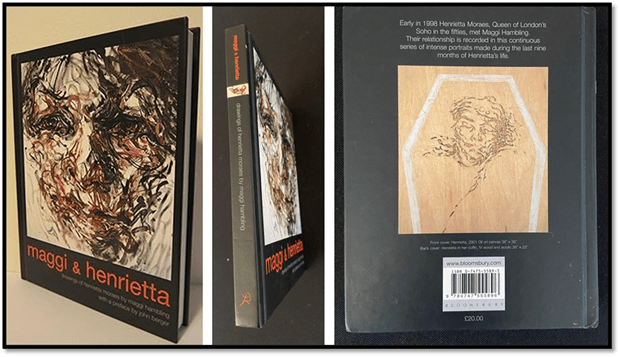
There is something assured in Hambling’s witness to Henrietta, which John Beger saw as a record of that in their loving relationship that was a ‘contract’ between them to endeavour to be together ‘with impatience, protected by fearlessness, to go further and further and faster and faster’. The contract is phrased thus by Berger on the basis of his observation:
…: whatever we do together, we’ll do it in such a way as to cheat life again and delay for another moment its cruelty; we’ll search together not for pleasure, but for consolation.[3]
It is easy to see how what Henrietta had to offer may have seemed to demand too high a price in recognition of vulnerability in some men (certainly men like Dom Moraes, Freud and Bacon), who, whatever their relative stature in ar,t felt others claims to spend life with them – and really spend, as Hen obsessively did – as a threat to their existence. This is not to say that Hambling did not see the threat too, as, perhaps readable in an artwork that Coffield points out to us in his book, a set of works not mentioned by Berger, including a white plaster piece called Henrietta Eating a Meringue, that stuck out to Coffield amongst other bronze sculptures featuring ‘Hen’s mouth, glugging a can of Special Brew, perched, teetering, on the edge of her voluptuous lips’. But Hambling saw the white plaster piece as the queen of these sculptures too, and as the way forward, after Hen’s death, to a new perception of ‘life’s cruelty’ in imagery of the sea: ‘the sea being like a great mouth. Eating the shingle, eating, eating, eating.’ Coffield cites Hambling’s explanation of its ‘voracious mouth munching’ something so sweet as meringue being a representation of how Hen responded to being ‘told she had diabetes’, that is ‘she tucked into cream cakes in a big way’.[4]
This explication of the sculpture and its capture of the eaten eating recalls to me the representation of Life Fallen in explicit Christian texts aiming to illustrate that the kind of life that Christ’s mission redeemed was one that otherwise was entirely consumed (in the sense being eaten continually) by death and death alone. In the existential twentieth century, Life after the fall becomes simply but not purely ‘life’s cruelty’. Milton in Christian terms pulled the issues together in the description of Eve, but could it be we see here Hambling’s Hen too, sensually eating the forbidden edible substance, where ambiguities crawl around the phrase that that she ‘knew not eating Death’, for she does not feel yet her body masticated in Death’s horny jaws, as Hen, though cared for by Hambling, did.
 …                              for Eve [ 785 ]
Intent now wholly on her taste, naught else
Regarded, such delight till then, as seemd,
In Fruit she never tasted, whether true
Or fansied so, through expectation high
Of knowledg, nor was God-head from her thought. [ 790 ]
Greedily she ingorg'd without restraint,
And knew not eating Death: Satiate at length,
And hight'nd as with Wine,

From Book 9, Paradise Lost
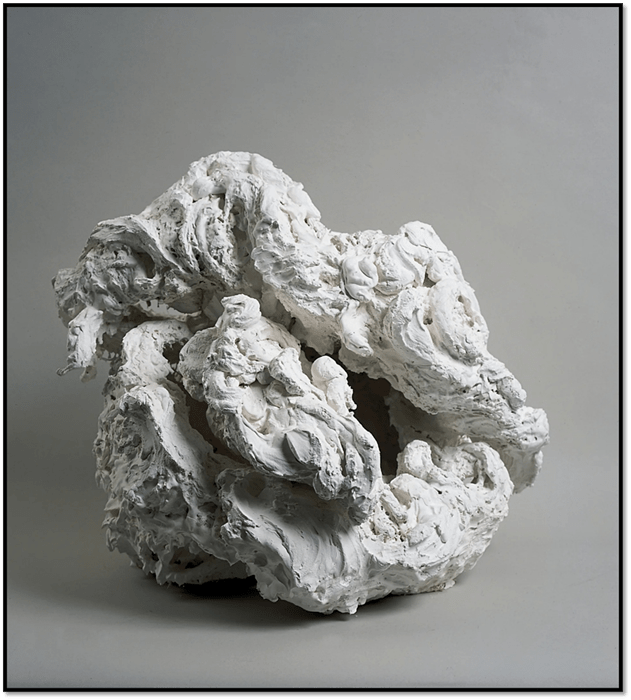
‘nor was God-head from her thought. [ 790 ] / Greedily she ingorg’d without restraint, / And knew not eating Death: …’ or ‘Henrietta Eating A Meringue’
This sculpture is as chilling as Milton’s verse, for it is impossible to disassociate what is eaten and what eating, what the action of the mouth is and those motives mouthed by, and in, that dynamic orifice. And, if the sea is present in all that opening and closing, eating and ingesting, a comment by Berger on the way Hambling draws mouths in her drawings of her lover is also relevant. Therein the sea of later paintings by Hambling can be theorised as a mediation on the experience of time, especially a lifetime in which birth and death are imponderables on its margins and at both ends, and the way in which drawing a loved face reveals that which time coaxes out of the mask (for, as Berger says too, it is love that helps remove masks not research. Masks are what faces are in lesser painters and in lesser-lived lives, resting in the arms of the merely conventional:
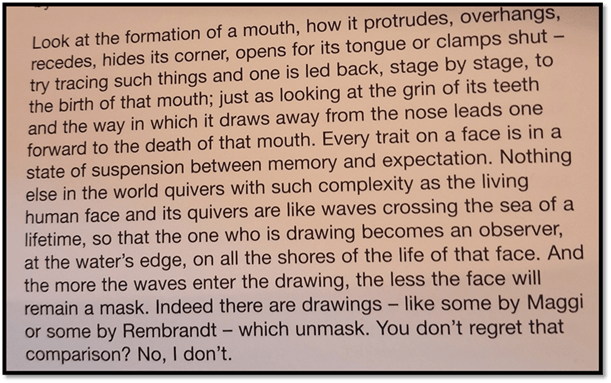
Does this help to view the mouths in the two drawings below, for instance. It certainly highlights how marks appear in drawing as waves that convey the moment of motion, into something on the cusp of a smile, or a bite. Berger calls these waves ‘caresses’:
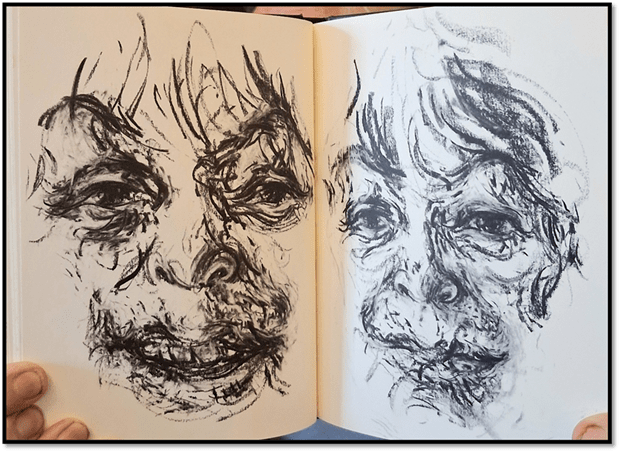
Now Berger on this subject writes beautifully indeed but does so largely in addressing the relation of Hambling to her art as it becomes a moment of relationship between maker and made in the art. At one point amongst the drawings is Hambling’s comment that she became Henrietta’s ‘subject’ rather than vice-versa. But that shows something that is not in Bacon or Freud. But before looking at this I want to say that re-reading Berger has made me more grateful that Coffield’s book now exists. When Berger says the drawings make him think of ‘angels’ like those in a painting by Antonello da Messina in the Prado, we inevitably think of Hambling as the main agency in the transformation of Hen to this in ‘this series of drawings recording the last days of a bohemian drunk’.
Somehow, even John Berger does not have the right, even in a passing irony, to reduce a life to that of ‘a bohemian drunk’, a more searing version of the action of quicksand. The reaction to this way of speaking about Hen is more than asserted in Coffield’s biography of someone who is neither an angel nor drunk devil, but a most amazing and iconic liver of a rich life, even in poverty, and during serial addictions and cat-burgling. It is this in Hen which speaks, I think, of ‘the meaning of life’ reduced to basics. And artists do not reduce ‘life’ to basics; they, in their own terms (with Christian ideological borrowings in Milton and existential angst in Hambling) ‘redeem’ it as their art. I would not use a redemption metaphor to describe what Coffield’s biography does to Hen’s ‘life’. Rather he separates from the artists who use it in their own way and makes it stand up again independently, itself alone and worthy in that way.
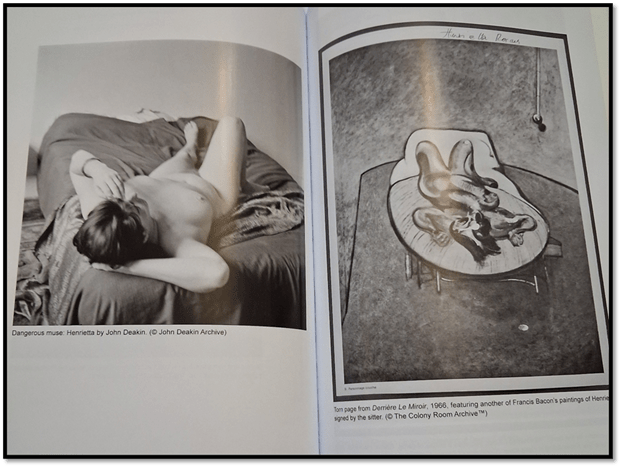
But maybe we need a word on what Francis Bacon did to her – and to Isabel Rawsthorne, more talented in the terms that the world adjudges this quality, though she had already been well done over by Giacometti and others. Hen once ran a coffee shop in Dave Archer’s London bookshop – the story of this queer man is as rich as hers and as tortured by life’s contradictions. Archer was a rich man eventually reduced to penury by his support for poets who used him and people who drifted beautifully through life like Hen, drawing poets and artists to her body – for multifarious purposes. Archer’s boyfriend was the queer working-class aspirant to art but known now as a photographer, John Deakin. He was commissioned by Bacon to take photographs of Hen, for Bacon to use as models for his well-know paintings of Hen – although the process was laborious. Deakin’s favoured positioning of Hen was not that favoured by Bacon who asked for them to be redone. Deacon, as it were, overshot his remit taking, according to Marianne Faithfull : producing ‘hundreds of close-up shots of her pussy’ which he took to West End drinking clubs ‘flogging them as dirty pictures to a bunch of sailors for ten bob a pop’. [5]
Now, in the world of art research, both Deakin’s photographs and Bacon’s paintings and studies are how we consume Hen’s body, maybe not pornographically (or not that only for some) as in the shots described by Faithfull. Bacon both tidies her up, for anatomical fragmentation on much more bounded and regular objects and frames in his work (as below in an opening from Coffield’s graphics pages). For him she was an avenue to the study of the pleasurable vulnerability of the flesh and fleshly appetite. Famously, Bacon added a hypodermic needle inserted into Hen’s body into a finished painting. To her, this proved Bacon a prophet, for at the time she had never heard of drug taking using needles, and the function of art to be prophecy (as Coffield tells us). Moreover, when Deakin came to photograph her she worried that he, as a ‘homosexual’, would be revolted by her voluminous flesh, which straight men famously salivated over. Hen clearly was someone for whom life had to be justified in her own terms, as Coffield (and Faithfull in her interviews by him in the book) try very brilliantly to do. Meanwhile, she is left exposed as artworks that make iconic reminders of artists (especially so in Lucian Freud, who did not even name her as many of the women he fucked, or fucked over in terms of his family, and used as models). Neither Deakin nor Bacon lusted over her for different reasons.
You ought to read this book, if you want an answer to the ‘meaning of life’ in ‘unaccomodated’ woman, even ‘unaccomodated’ person. Another reason might be however to see how she was inserted into life through various types of person in the external roles and inner fantasies. In that respect, her ‘life’ needs understanding in respect not only of these types, even when visual artists, scholars and poets but in itself in its own terms. One ‘type’ with which she was associated was, unpacked from ‘type – and stereotype which they were used in construct in the media of the day, but all socially marginalised (by class, race, sex/gender or all of the above – but notorious publicly as ‘monsters’) was that of young girls with which she became associated such as Christine Keeler and April Ashley. [6]
Others were that mix of upper class wasters and art connoisseurs, artists and intellectuals that even courted the role of being ‘Monsters’, a name associated with those who transitioned in the famous Pub, The French (variously named in fact), in Soho from the Shallow End of the Bar to the Deep End, as selected by the pub’s owner and manager. Coffield has already spoken about the other tank in which Monsters swum – the Colony Club (my blog on this is at this link). To be a Monster you didn’t need just to be annoying because to swim in the Deep End you needed to be, in Coffield’s words, ‘pretty special’ and ‘appear to be totally selfish and egocentric, only interested in one’s ‘own importance and often plotting for’ your ‘own gain’. [7]
Marginality was key to the lives therein collected: determined by sexuality, trans or cis status, class (sometimes), and attitude to and participation in crime, however defined and by whomever. This particularly related to drugs, legal (alcohol spoke hugely in these relationships and usually with less veritas than brutality of effect) or illegal (amphetamines like ‘purple hearts’ or cocaine) but also to trespass and theft (although Hen gained the name ‘Cat Bungler of Bohemia’, so awkward was her success as a burglar and so unsuccesful her attempts to ‘fence the loot’) [8]. If drugs segued into the world of petty crime, they also did into art that embraced marginal and down-and-out, if special, identities, such as those in the ‘Smart set’, named after expatriate Canadian Elizabeth Smart and the salon she ran with over-rated poet-lover, George Barker. [9]
Hen benefited too from the theft of love from others, Her second husband Norman Bowler, being the purloined resistant lover of John Minton.Into this set decant Norman Corso, Alan Ginsberg and William Burroughs and you come up with a movable feast of Transatlantic literary deconstruction and innovation in the arts of poetry and the novel.
Often the marginality was constituted by a definitively insanity based on wanting to be noticed. A great chapter is on the weird Richard Booth, sometime lover/friend of Marianne Faithful, who set up the National Welsh Border booktown in Hay-on-Wye and live in its delapidated castle as ‘King’ of Hay, with a retinue of party-making pop stars and social oddbods, as they were in their own understanding as well as in those who rejected them from ‘decent’ society. Hen tried to manage one of Booth’s bookshops but oft could be found drinking or even having sex behind a barrier of bookcases in a bookcased avenue [10]. As a visitor to Hay often, I knew none of this – but then I eschewed the popular press wherein the Hay making antics were reported with shock and relish.
Yet there was an element of these times anyone like me who lived in a small part of them misses, for then politics did not follow the straight lines of self-interest it does now, and had a discursive and ethical agency that didn’t require appropriate setting of character and circumstances. It surprised me to be reminded of the attendance of Hen, with husband Dom employed as a witness reporter to the Eichmann trial in Israel. The whole trial could to them seem to be rooted in contradiction in which Eichmann himself seemed a victim as well as horrific perpetrator of unthinkable crimes – so unthinkable Dom and Hen could not ‘connect the prisoner in the glass box with all the numerous crimes he had committed’. This is the only time however, as she listened to traumatised witnesses, according to Coffield, she ‘did not want to make herself the centre of attention’. [11]
That this was a time where politics rested on some kind of ethical choice is brought back to me as I remember attending, but not near enough to notice the action, the Grosvenor Square ‘riots’, also attended by the Smart set and Hen. Politics indeed rested on individual choices but the cause of freedom espoused was not particularly always unselfish. Social ranks and diverse types (of race not least – Hen was half Indian) mixed in the Colony Club that George Melly called a ‘salon of absolute freedom of expression’, although he also said that the Queen of the Colony Club, Muriel Belcher (whom Bacon and Hen both called ‘Mother’, although she only called Francis ‘Daughter’) was ‘asked if she’d started a club to help make the world a freer, more liberal place, she’d have said “fuck off”‘. [12] It is worth remembering that the laws that clubs like the Colony Club were set up to bypass were ‘ the ghastly English laws’, as Bacon called them, passed by the first Labour government to make alcohol drinking regulated for safety and preservation of health. [13]
If we want to know the meaning of life however, it is truly worth reading this book. Don’t read it for the answer, but read it for responses that recognize that there are no certain answers and that even the uncertain ones emphasise uncertainty more than meaning. Worlds like the one inhabited by Hen end. A beautiful structural thing in this book is that it begins in the London folklore sub-district of ‘World’s End’ named after the pub in Chelsea, and ends there too. It is near ‘Apollo Place’ where Hen lived with Michael Law, husband number one, and met Norman Bowler, number two, with Minton. Coffield describes it in the 1950s as the space (the ‘Worlds End’ area he means) ‘where the most extreme forms of anti-establishment counter-culture began to cluster. From artists, writers and poets to underground record shops and boutiques’. [14] The last appearance of ‘World’s End’is at Hen’s death, wherein she took a room in Edith Grove in Chelsea. Coffield makes the inevitable use of the ambiguity of the name of the place:
As if stuck in some terrible self-fulfilling prophecy. Henrietta appeared to be locked in a loop, unable to break free from her own inevitable world’s end. [15]
Coffield writes this book such that we see that her life had as much self-destructive agency in it as fate, and that she might have broken away had she wished at certain points of advantage. The nous she lacked to do so was partly because self-interest was not her main motive even when, as with the rest of her many sets of friends, it appeared to be the case. But these were different times – self-interest was not what we consulted first back then. It halts lives but only because we searched for its meaning to us as human beings connected to other human beings. That it ended for most in isolation is a tragedy, but Maggi Hambling helped Hen to escape it, if not entirely, in her own world’s end where she and the world eat themselves together as if they were a mouth and a meringue.
Do read the book!
Bye for now
Love
Steven xxxxxxxxxxxxx
[1] Darren Coffield (2026: 85) Hen: Mistress of Mayhem Cheltenham, The History Press.
[2] ibid: 85
[3] John Berger (2001) ‘Preface: “the 235 days”’ in Maggi Hambling maggi & henrietta: drawings of henrietta moraws by maggi hambling London, Bloomsbury Publishing PLC.
[4] Cited Darren Coffield op.cit: 224
[5] cited ibid: 124
[6] see, for example, ibid: 98f.
[7] ibid: 24
[8] ibid: 134f. in Ch. !0 ‘ The Cat Bungle of Bohemia’.
[9] See ibid: 89ff.
[10] See ibid: 180f, and rest of Chapter 13, ‘Making Hay’.
[11] ibid: 113
[12] ibid: 31
[13] ibid: 27
[14] ibid: 44
[15] ibid: 195

