‘crush, and snap its pale / Wrist’: Thought and image disturbed by thought. More on Kane Benjamin Crookes’ poems
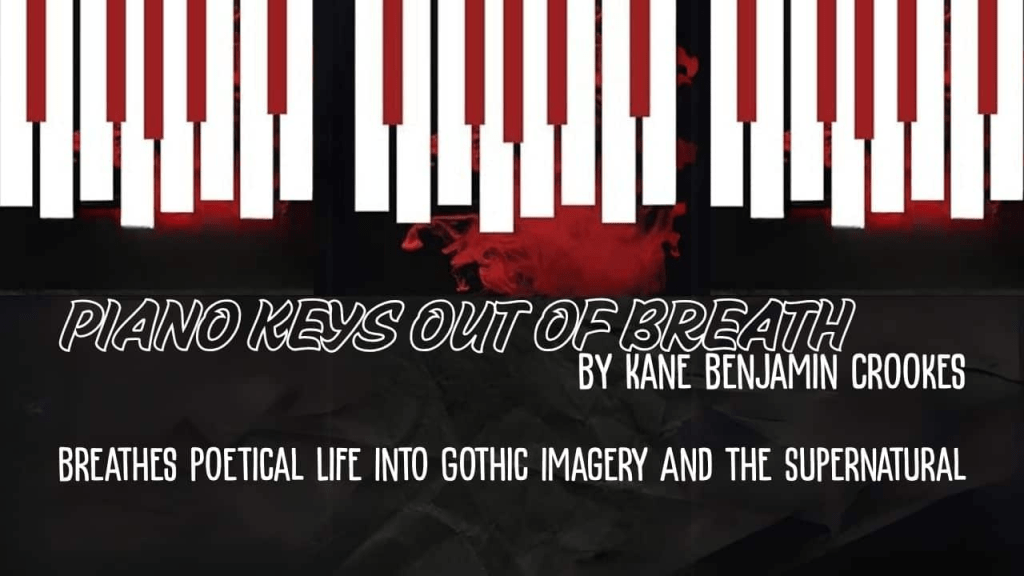
A little while ago I wrote naively about Kane Benjamin Crookes first volume Blooming Us (see the blog at this link). Promising then to return to it and his next volume at the time, I will keep this promise later, for I bought and read his second volume (published 2025) entitled Piano Keys Out of Breath: Running in the Wind only yesterday. It can be read for the first run through quickly; made up as it is entirely of short poems. Kane calls them a ‘series of free verse and haiku’. In contrast to the last volume, the poems are described as Gothic (though they are Gothic enough) based on ‘nature as something other or apparitional’ and focussed on autumn and wintertime. I felt a bit clearer about the imagist project in the condensed explanation here that is meant to ‘capture the mere essence and sensory details of nature, for there was more focus on thought and image rather than language’.
It helps me rather, even if it an unintended meaning to see imagism as less concerned with a perceptual or sense image, but more concerned with the relation of cognition and image, although only if thought is not divorced from emotion in the term cognition.
However, before I start thinking about the two volumes together I want to look at two poems: The Moon Tarnished and A Sick Hand. The latter is a poem of the more usual length of the series, its subject matter both Gothic and violent:
The moon is a bauble
Comes forth a sick hand
To crush, and snap its pale
Wrist presents the morning lands
I could not read this, without a memory from Chapter III of Wuthering Heights, that recalls the second of the lawyer Earnshaw’s dreams on the night of his visit to that manor house, the one in which he first has sense contact with the wraith of Catherine Linton – a status that it surprised him she appeared him s unrelated to Heathcliff – whom the novel has already introduced us too. Here is the passage at length:
This time, I remembered I was lying in the oak closet, and I heard distinctly the gusty wind, and the driving of the snow; I heard, also, the fir bough repeat its teasing sound, and ascribed it to the right cause: but it annoyed me so much, that I resolved to silence it, if possible; and, I thought, I rose and endeavoured to unhasp the casement. The hook was soldered into the staple: a circumstance observed by me when awake, but forgotten. “I must stop it, nevertheless!” I muttered, knocking my knuckles through the glass, and stretching an arm out to seize the importunate branch; instead of which, my fingers closed on the fingers of a little, ice-cold hand!
The intense horror of nightmare came over me: I tried to draw back my arm, but the hand clung to it, and a most melancholy voice sobbed,
“Let me in—let me in!”
“Who are you?” I asked, struggling, meanwhile, to disengage myself.
“Catherine Linton,” it replied, shiveringly (why did I think of Linton? I had read Earnshaw twenty times for Linton)—“I’m come home: I’d lost my way on the moor!”
As it spoke, I discerned, obscurely, a child’s face looking through the window. Terror made me cruel; and, finding it useless to attempt shaking the creature off, I pulled its wrist on to the broken pane, and rubbed it to and fro till the blood ran down and soaked the bedclothes: still it wailed, “Let me in!” and maintained its tenacious gripe, almost maddening me with fear.
The details aren’t enough to assure us of the intended echo: ‘a little ice-cold hand’ is both more and less than a ‘sick hand’. However, the hand’s pallor and vulnerability to snapping at the wrist (snapped apart from its adjective by the enjambement), like the fir-tree branch which Earnshaw thought prompted his dream. Maybe the echo relates to the success of the evocation of Gothic. But the poem works because of the fluidity in the image, from a round gem-like moon to a ‘sick hand’ that it become or projects from it ‘To crush’. Violent crushing or snapping is not the hand’s fate or purpose. Rather it is like a hand drawing a curtain to show that the horror of the night gives way to a ‘presentation’ of the ‘morning lands. Other works are referred to – some more obviously, like Wordsworth lyrics in other poems, but the effect is of a disordered flow of imagery, disordered by thoughts that cannot even themselves remain consistent. Do others as I do what to read the last two lines as:
To crush, and snap its pale
Wrist prevents the morning lands
The Moon Tarnished stands well before A Sick Hand in the volume, but it shares the ‘moon. And it shares the same sickness and violence, and adds (perhaps from memory of a Gothic Wuthering Heights) the flow of blood. It a flow that starts in the haiku like poem that precedes it, with its excess violence of hanging and cutting, Bleeding.
The moon’s blood vessels
Burst, and dressed himself
Blush red, like hell’s devil
On which clung, swung,
Like heaven’s child – a swing,
For he was dressed – bandages,
And the bed – healed, managed,
The wine spilled; the moon tarnished
What we might do with the supernatural characters like ‘hell’s devil’ and ‘heaven’s child’ I still do not know, but they resonate with the potential of a story of abuse endured by clinging dependence on some power that suits itself – literally, as in the play on ‘dressed’, as applied to either dressing nakedness or a wound with bandages. That bed disturbs of course with its tenacity to be managed into so many things – a place of sleep disturbed, of violence, of metonymic transformation to a altar that though supposed a curative is a space on which real blood flows, within the body blush or outside it.
I will return to the poems I hope.
Bye for now
Love
Steven xxxxxxxxxxxxx
 Steve_Bamlett_blog
❤️❤️❤️
LikeLike