


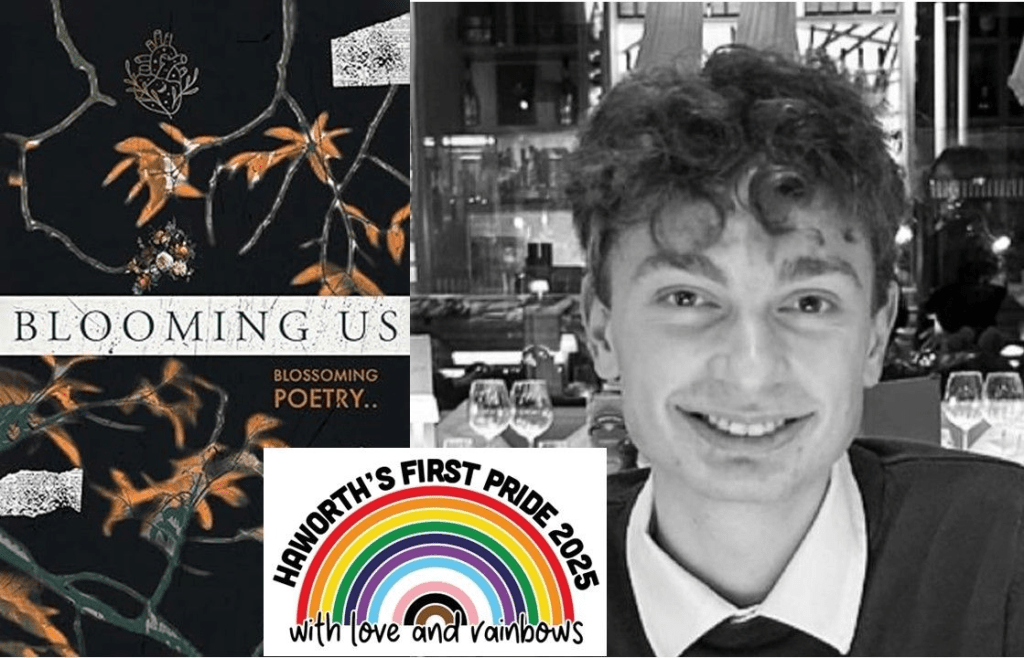
I met a poet in my favourite left bookshop yesterday, The People’s Bookshop in Durham City, and bought his book, Blooming Us. I was searching for more books by Bryher and he knew, as might be expected in someone intensely interested in the poetic movement called Imagism, of Bryher’s sometime lover, H.D. (Hilda Doolittle). I have never, I have to say, got my head around that thinking about poetry to which imagism claims to contribute, and in part, having read Crookes’ volume and prefatory prose, questions remain. Indeed, they do for the poet too. In his introduction are at least two statement made about Pound’s advice to imagist aspirant poets in relation to some of the poems in this volume.
First he writes how the poem Red Strawberry combines in its imagery associations to addiction to attachment, and other addictions, with the kickback that comes from the object you feel you need when it fails to reciprocate your feelings. Yet the vehicle of that complex of meaningful content is not only the evocation of pictures of fruit but its sensation and the sounds associated to feeling, just as Ezra Pound advocated an imagist poetry that sought the freedom of musical sound rather than metrical measured sound. Of course metrics in poetry work by inverting expectations in a pattern but what Crooks need in this poem is the beat of music, related to an experience in which larger patterns of musical beat occur also: ‘The art of free verse is what allowed me to express the beat, or experience, freely’. Note the hesitation here – is beat indicative of experience or vice-versa. Pound insisted we need free verse to rid ourselves of expected regularities, however varied in practice, in metre. Interestingly elsewhere, in the prefatory ‘Notes’ he derives that beat in that poem and its sexualised oral experience from Goblin Market by Christina Rossetti, a poem that does use metrics very skillfully as he most certainly knows.
In another paragraph in the ‘Notes’, Crookes deliberately stands against Pound’s advice on the use of metrics in haiku form, ignoring the great poet’s advice ‘to not rely on strict syllable counts in haiku when it comes to imagistic technique’. I have not read the poems enough to comment, though I find the queer sexuality of Strawberry Red quite uniquely resonant of a blend of polar binaries like pleasure with pain, associative meaning and freshness of conception, cold and heat, and attraction and repulsion. A poem that might evoke the apple from the Garden of Eden (without mentioning it, as Crookes does in other poems like ‘Meadow Blooms and Heddle Looms’; spoken about below) as Christina Rossetti certainly does. If it does so, it does it because he needs to show how experience often disables innocence of any kind, and makes even pleasure something to endure like pain, especially in this poem where the poet is passive to the beat of another’s pulses. And in such verse, I find precision of image often yielding to sensation and sound, through strong assonance and rhyme. And meaning brings in cognitive play, wherein ‘may’ be either a fruitful month or a possibly to be disappointed expectation of what may not happen, as well as what will, and hence ‘endured’ not enjoyed.
During the day
Enduring the may
Bless-ed by a uniquely juice
To be
Sucked and sucked and
Soiled and fucked
To the
Tangling depths of grass
Like a noose
Loose, of the choked neck
After a bite or two to rot
Brightly lightly green
Only the line ‘Bless-ed by a uniquely juice’ troubles me here. May be I expect help by how decriptors and nouns differentiate here. Perhaps they don’t and my demand is oppressive. I have more thinking to do.
Let’s stay here a moment before moving on with one of the poems I like absolutely, though it too plays havoc with fixed grammatical expectations. I want to know if ‘the passé’ can be a concrete noun, as concrete at least as a ‘heddle loom’, which is precise even about the function of a weaving loom for the heddle holds the function that alone enables the marriage of warp and weft (a good metaphor for a West Yorkshire poet). But does Crookes know something about the term passé, as a noun, that I don’t, from that tradition – some facet from past of his great-grandmother, Daisy, whom I believe to be evoked in this poem. Except what I might know (but daren’t assert this that whilst) ‘The grass in spring’ and ‘the meadow bloom’ may be passé as images, ‘heddle looms’ are not.
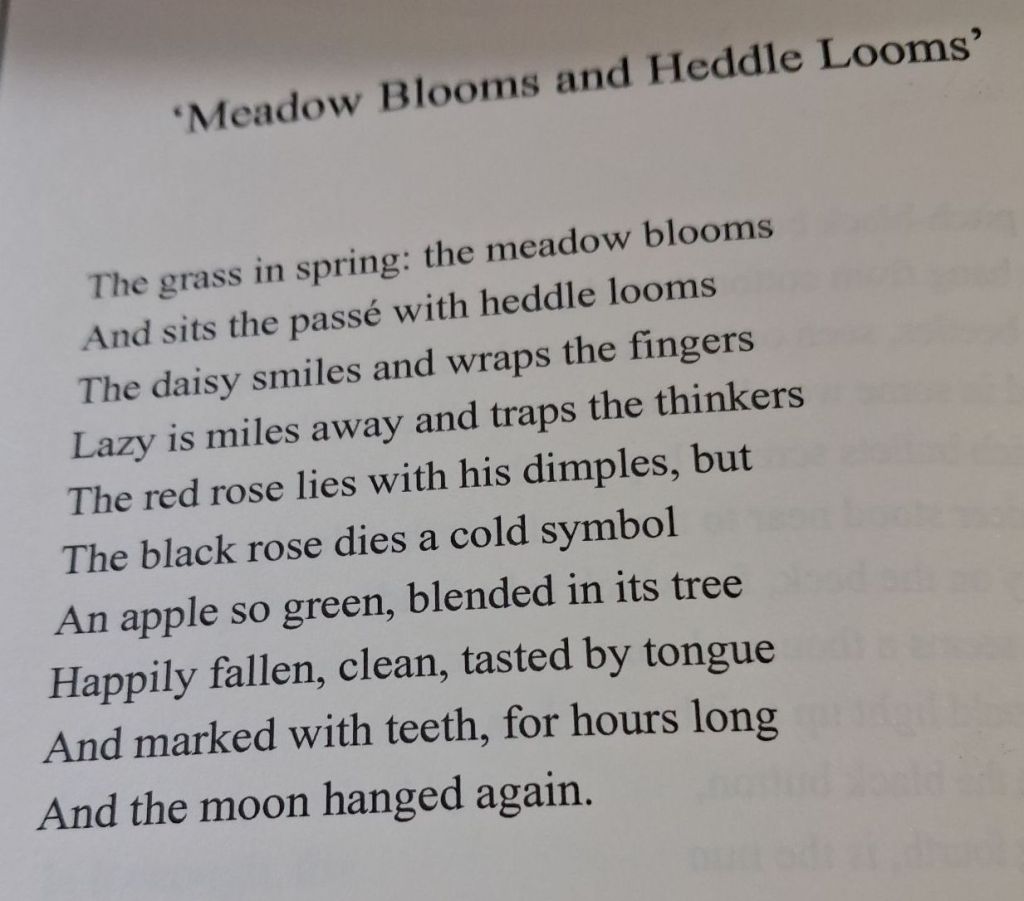
Otherwise, there is intertextual imagery between this poem and Strawberry Red and possible sado-masochistic reference to biting and choking: the Edenic apple of the Fall is in its glory but the sensations of tasting too here also merge with the sensation of being choked, or hanged by the neck. I need longer even with this poem I think but I am pleased I met Kane. He is a poet deeply and intensely living in his innovarive language usage. I will buy his other volume, also on sale at The People’s Bookshop, next time I go. For now I will resist making even analytic commentary on this poem, not yet being capable thereof.
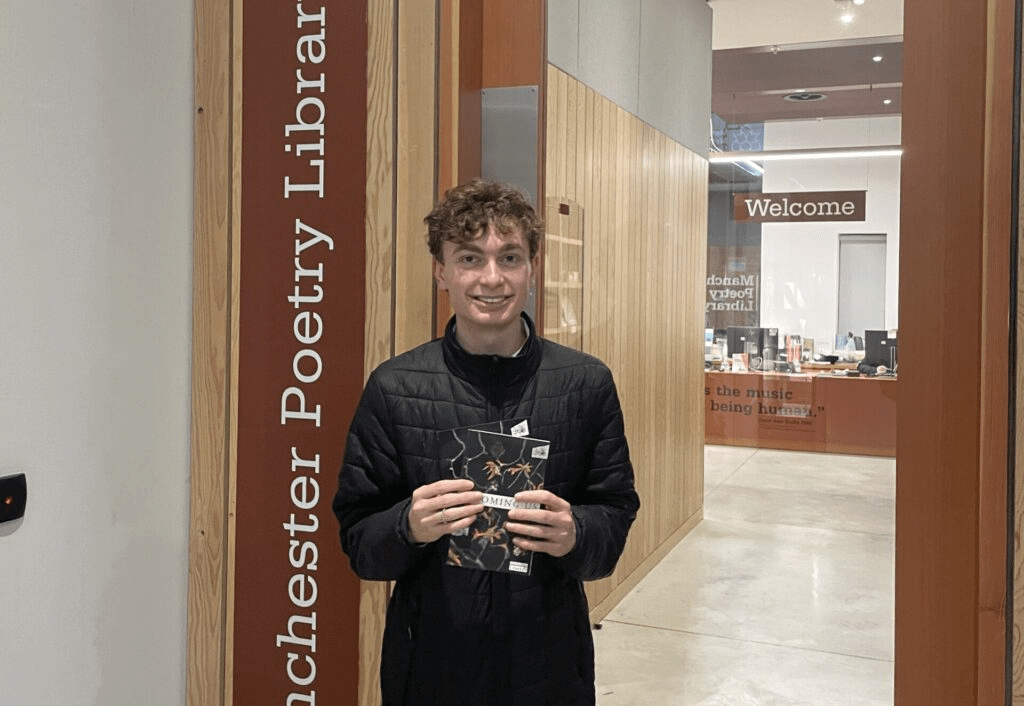
The poems were written before Kane finished his degree at Manchester Metropolitan University (see this link).
What spins in my head are the multiplicity in the poems of ‘fingers’, the double assonance with ‘finger’ and ‘linger’ in the poem that make both luxiourously ‘longer’ when half-rhymed with ‘linger’ in ‘Dandelions‘, and half-rhymes of ‘fingers’ with ‘thinkers’
What’s simple about how language works and the effects it makes?
With love
Steven xxxx
Perhaps I’ll return to this poet.


One thought on “I know what ‘gives pleasure’ can never be simple. Let’s consider how we react to the effect of words working together to evoke vision, sound, sensation and tangled meanings.”