


‘People stared at the narrow limits in front of them, until they neither saw nor heard the rumours at their own border’.[1] Historical novels invent our interest in underrated lives; the likes of which might once have been lived by someone now forgotten, nevertheless. Is Bryher a neglected novelist in part for that reason? A case study based on their novel Roman Wall (1955) and the borders of the ‘historical’ novel.
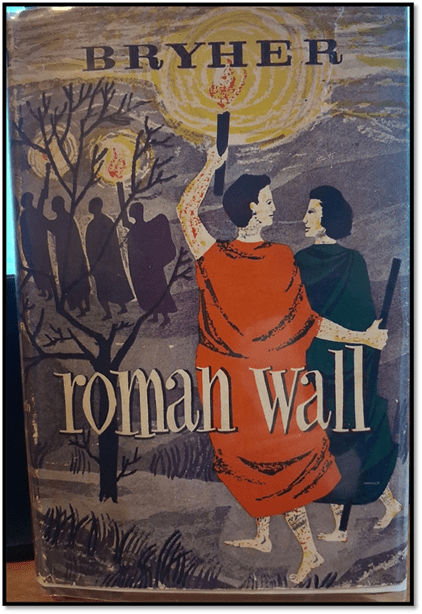
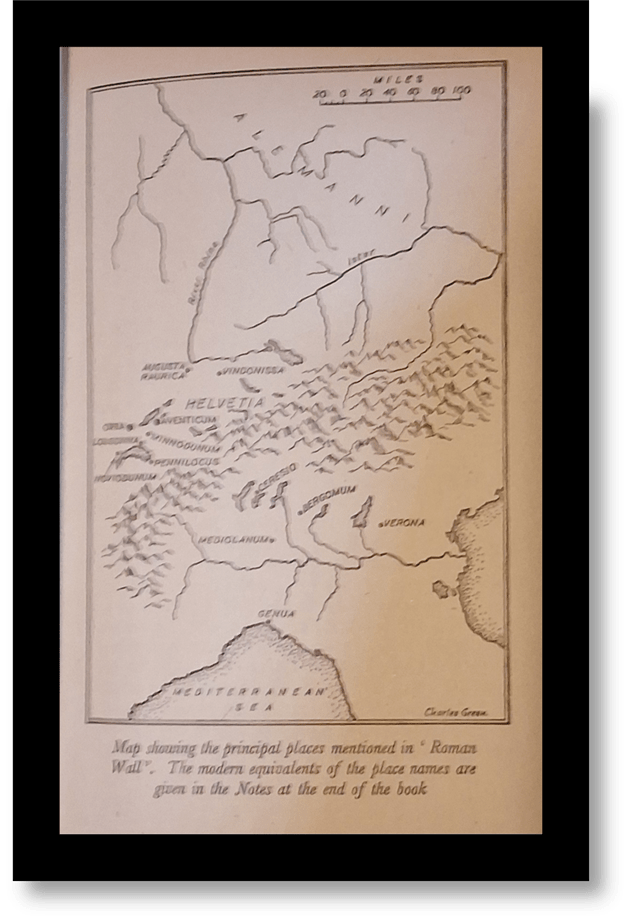
When I get the chance I read novels by Bryher. I have already blogged about their best known novel, The Player’s Boy (see this link) and also reflected on the concept of ‘borderlines’, which were so important to them, with the help of Susan McCabe’s H.D. & Bryher: An Untold Love Story of Modernism (2021) New York, Oxford University Press (see that blog at this link). In many ways the themes explored in those blogs matter in Roman Wall too, a novel named after a borderline that was shifting during the period at which it was set (AD 265) and focusing particularly in terms of the grand narratives of history. Those include the invasion of the tribes of the Alemanni of Helvetia (roughly the area of modern Switzerland – the place Bryher made her home and where in the war years she helped in expatriating people opposed to the Nazis in Germany), and the crossing of that ‘wall’ we call the Alps by some of the Romans and itinerant people dependent on its wealth and stability, as that wealth and supposed stability was actually crumbling and burning. The map provided by the book below shows the time-space of the novel, marking things like rivers and mountain ranges in it that act as reported natural or political boundaries:
The only literal Roman wall in the book is the city wall of Aventicum (modern Avenches in Switzerland) which only has a major role in the late chapter VIII. In that chapter, a minor character, a Roman legionnaire called Plinius, witnesses the fall of the city, whilst hiding in the wall, the death of the Governor Vinodius, whilst his own mind is entirely on the loss of his friend, Gallio, a man who became an artist and married but whose relationship to Plinius is complex, especially on Plinius’s side. As the Alemanni warriors sweep over the wall, he hides on the temple roof abutting the wall, murmuring “Gallio”, ‘the one familiar thing he had left’, as he falls asleep exhausted by fighting a war he barely comprehends, beyond it being about the way things were and how those norms were changing. [2]
Plinius and his story might have been at the centre of some modern novels: he is a man who barely comprehends the world he lives in, other than that it, and the structures of power that sustain it, are all that exists for him in his time. That is his attitude to the mechanisms in which his clearly defined love of Gallio in the novel survives too, despite Gallio’s choice to marry a wife he chooses not to consult as he intends to set out South to become a jobbing craftsman of trinket boxes for rich Roman wives in lieu of having failed as an artist in a more major way. Plinius is not only not consulted – he barely crosses Gallio’s mind.
But then the novel too has little time for him (or Gallio or the latter’s wife Sabina), let alone the characters who are its major focal interest, of whose lives he inhabits the forgettable margin (in the consciousness of the characters and, guided by these focal characters and points of view, the reader). One of those major characters, the aging Roman imperial official, Valerius, living in the vast villa at Orba (modern Orbes) with his sister, Domina Julia (a retired priestess of Apollo) and her ward, Veria seems to be the consciousness receiving and mediating the news of the fall of the capital of Helvetia, in which Plinius is merely a news-bearing cypher of the novel’s plot to him, one of a ‘few survivors’ that had ‘straggled in’, marked out to Valerius only in that he had ‘seen Vinodius die, and the city go up in flames’. This account collated in Valerius’ consciousnesd soon moves on to events not witnessed by Plinius provided by other unnamed stragglers and survivors. [3]
This sense that history is made up of, like contemporary life, with things happening to or felt by nameless and even named figures whose lives are unimportant to that developing history is central to Bryher’s novels, and that in it lie dramas also neglected by history, like the love Plinius feels for Gallio, that gets forgotten with the characters once the novel’s main structure is comprehended. Even the witness to events is merely partial of some characters, easily a misunderstanding of history therefore. In the end however, the reason for this is that, in the historical novel, even the major characters are invented (an idea as applicable to Waverley in Sir Walter Scott’s Waverley or Brooke fighting the elections in the 1830s Midlands in George Eliot’s Middlemarch) or elaborated fictionally rather than factually.
The structure of the book, apart from its diversions into minor character’s subplots that barely influence events other than as minor witness to the times, hangs first, around Valerius, already described above, a minor figure in the hierarchy of Empire but nevertheless a Roman citizen, and secondly, around a Greek trader in goods (serving the rich mainly in the Empire as he traverses its boundaries and roads – avoiding tolls to the Empire where possible for use of roads they built – Demetrius. Demetrius, from a subaltern nation of the Empire at this period, Greece, though once the hub of a greater if differently structure Empire, has friends too, who have to find a space that fits them in the Empire, like the wonderful queer character, Thallus, the secretary to Governor Vinodius at Aventicum, with his play-boy, Aristo (simply ‘the best’). Another reasons you might notice for the import of these minor characters such as Thallus, Plinius and Gallio, is to illustrate the porous nature of the boundaries and borders of sexual and romantic love and political alliance involved in history before the strictures on those boundaries and borders in the mid twentieth century, that impinged on the lives of even Bryher and her primary lover, the storyteller and poet, H.D. (Hilda Dolittle).
The nature of things in the world, which people only desire to think solid and stable, actually shifts in history, Bryher thought (I think I prefer the verb ‘knew’ here) and boundaries to those things or entities shift in space-time. Even natural boundaries like the Rhine for the Alemanni or the Alps for both Valerius and Demetrius change nature when we think of them as crossable rather than as a barrier in one way or another. Thallus, as well as queer (and camp) secretary to Vinodius, is also expert in Greek philosophy, though it gives him no access to power such as Plato might have imagined his right in The Republic except as lickspittle to a vulgar man, Vinodius (even his name is horrid in vomitous associations of stale wine) and his vain but vulnerable wife, Tullia).
Demetrius deliberately takes a role that is about boundary-crossing; it is the nature of his role as a merchant (he enters the novel by avoiding the toll roads administered by Valerius in Orba). Although, it is a given that the novel assumes that Rome was in decline mainly because it had lost its values to the objects of exchange and trade (to which the triumph of Christianity also evidenced beginning in the novel is a side issue), it is only set at the beginnings of the Empire’s fall and the serial invasions from central Europe that will in the event fully destroy the Roman Empire and show the Alps far from impregnable a home border (a thing Bryher also investigated in her Hannibal stories) than imagined by them.
Yet Demetrius knows his philosophy too, being an educated Greek, as well as Thallus does and my favourite passage in the novel is that in which he invokes his knowledge of Greek philosophy prior to Plato, a philosophy much friendlier to democracy than that in the later dominance of Plato and Aristotle. This is a passage from which I use a citation in my title, and which can be seen, with a little of its contextual lead-up in the photograph below. The paragraph is preceded by the observations of Valerius, shifting to those of Demetrius, concerning the fall of Helvetia as a colonial province of Rome. What they see is the end of the minor commerce that Roman cities and roads served; market stalls closing up, which event is seen as an ‘ending’ yet more cataclysmic for the Empire’s margins. Whilst this occurs, manpower is wasted on useless defence of the city by Vinodius rather than making for the still open ‘passes’ through the Alpine boundaries. Valerius’s thoughts cue into those of Demetrius, whose mind cites Heracleitus: “Everything moves”.
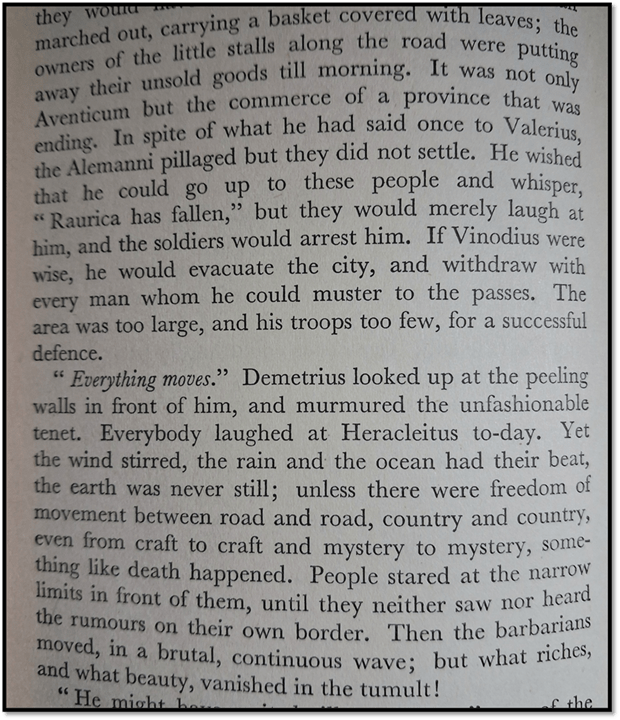
My photograph of Bryher (1955: 136) Roman Wall London, Collins.
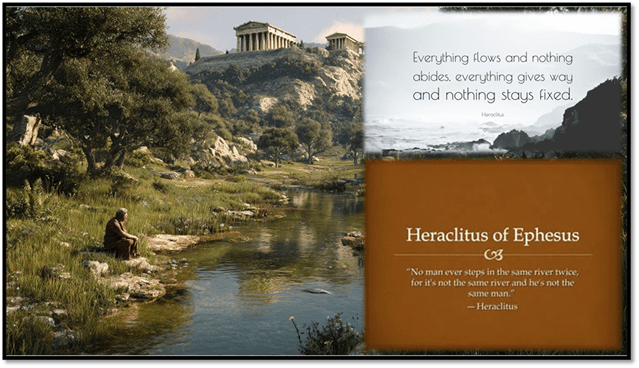
The reference to that pre-Platonic philosopher is to a passage well known to history because it is, in a sense, a precursor of the meaning of all historiography, of which the more famed idea is that of ‘never being able to step in the same river twice’ (because once done the you who make the step has changed as has, since it flows onward, the river changed). Below even the favoured transliteration of the Greek name of the philosopher has changed, for instance, to ‘Heraclitus’, as simpler, if showing less attempt to capture the sound of the Greek characters, the purpose of Bryher’s choice of transliteration.
Let’s focus down on the beautiful telling paragraph, which emphasises that philosophy is itself subject to change or to shifts in ‘fashion’ over time:
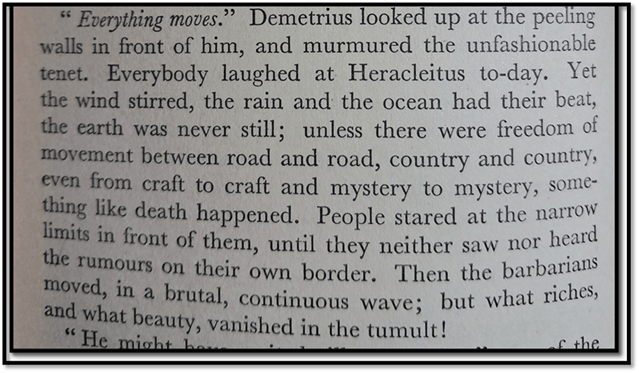
Going on to rewrite the ‘tenet’ of Heracleitus in his own mind, Demetrius consults facts of slow moving time in nature and applies this idea to the things related to human praxis, such as the nature of trade and politics, even to the issue of ‘freedom of movement’, a very European idea in the 1950s and onward as is its opposition from the grim Fascist ideologies of the twentieth century (and now flowing back to us in the twenty-first century in the UK under the mask of being common sense about immigration). This idea is also related to the work in transporting German Jewish ‘dissidents’ in the war by Bryher. But the function of creation and recreation also applies to human creation (crafts – even art as we see in Gallio’s case) as well in a way that that assumes that creation and recreation are modes of opposing the acceptance of ‘something like death’ as the only model of change we have. Re-creation is a principle that allow for boundary-crossing changes in entities in the self and in the world.
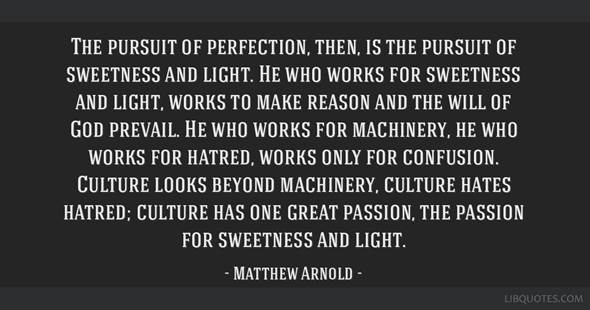
And therein lies the interpretation of the idea of persons ignoring ‘the rumours on their own border’ as the simplifications of a people who accept over-restrictive boundaries as a definition of what and who they are (presumably with MAGA (Make America Great Again) or MGBGA slogans to sustain this retrogressive idea). It is a difficult philosophy. Sometimes it means accepting the change made by ‘Barbarians’ (the word takes suggestion from its use by Matthew Arnold to name those who condemn and decry the culture of ‘sweetness and light’) need not hate ‘the riches and the beauty’ that their invasions of ‘tumult’ into current civilization cause to vanish, for in a sense their motion in history is as natural in some readings of historical crisis as is a destructive tsunami caused by some avalanche or undersea geological event.
The problem in Roman Wall is that people use walls to look within and to ignore the fact that that border defences restrict them as much as those outside them from passages across them. Barriers lock us into weakening stasis and absurd magnifications of outside threat to which the answer is defence – often absurd military defence that every knows will fail but the deluded Governor Vinodius, and his wife Tullia. To the latter, time is threatening for she has nothing but the importance of feminine beauty, and cosmetics bought from tradesmen whose claims that they mitigate or ‘change’ the reality of passing time by magical thinking. That is how a supposed ‘powerful’ woman is constituted in the Roman Empire, as sustained only as a Roman wife (or daughter) of a powerful man. The decay of the Empire has begun to stop access to the best Egyptian ointments, hence, ‘How tiresome it was that the Empire was so unsettled!’[4] Yet the problem for Tullia is that time moves on in the fate of women, hence, especially making vulnerable those women married to men posted to the outposts that get forgotten by Powers that be in central Rome, as it does with all ancient Empires and their overspread powers. Soon after that vain opinion is spoken by Tullia, her thoughts turn to the proximity of her older age, only to find that stepping in the same mirror twice is a bit like stepping into the ‘same’ river twice:
Simply because nobody remembered them in this backwater, they were wasting their lives; presently they would be old. She picked her mirror up idly, and gasped. Instead of a pyramid of curls above a pair of smooth cheeks, a wrinkled face was staring at her, with hollow eyes, and the bitter, weather-eaten lines of a mask of the Fates. [5]
Thus circumstance reflects that related to the unsaleable art of Gallio and the luxuries traded by Demetrius: all past both use and fashion for the age. Thus too, the only usage Thallus gets out of his learning. Devastated after the invasion of Aventicum, he claims that the Barbarians have destroyed ‘his life’s work‘. It is a grandiose term and Demetrius reflects that that Thallus’s life’s work was a poor time-bound thing, just a secretary’s ‘accounts’ of an Imperial outpost city’s finances and events; the value of such a ‘life’s work’ dies with the city-state that alone needed those accounts. [6]
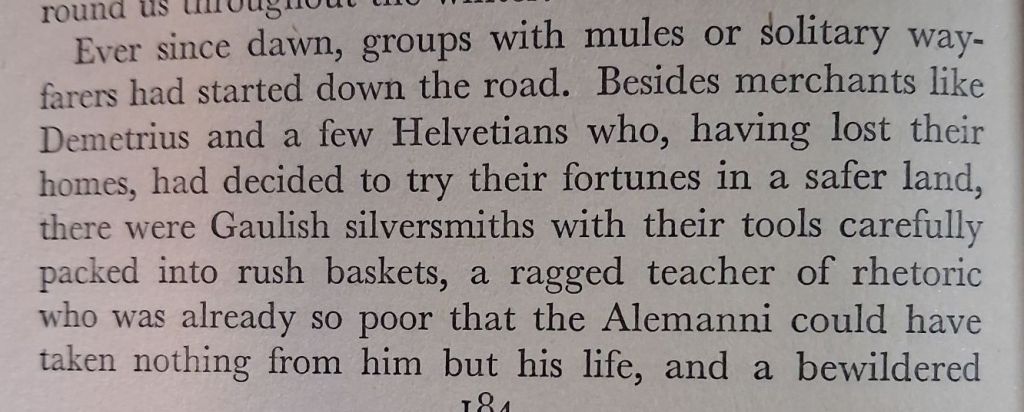
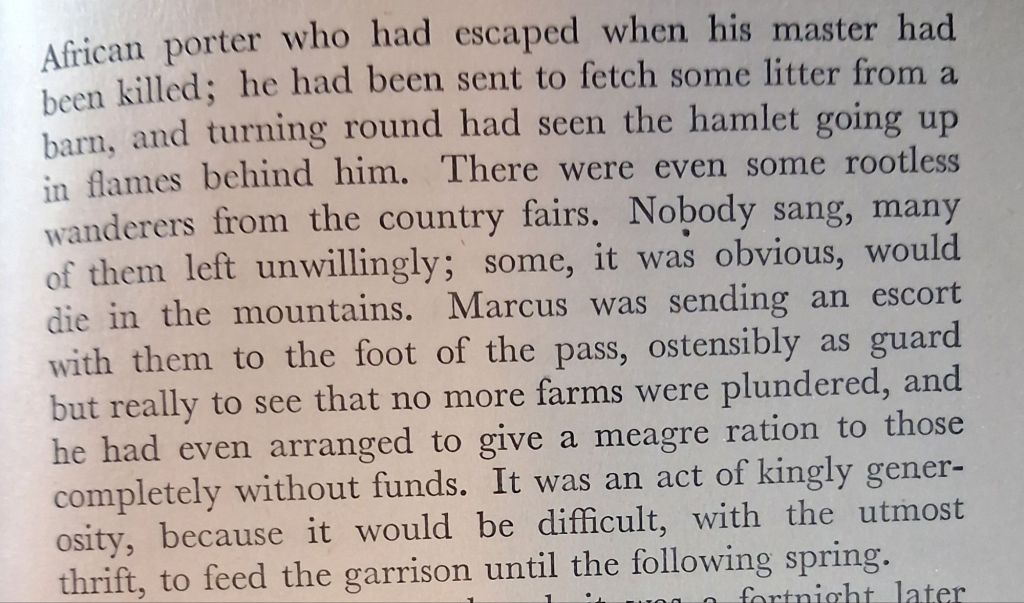
Endings, or even just change, are not the only reality however, for acts of creation and recreation, whether as play or revision of an original idea, accommodate change within ‘continuity’; a state even earlier narrative art named the quality (in Edmund Spenser’s words) ‘Eterne in mutabilitie’ (suggesting how infinity might fit within what changes in time). At the end of Roman Wall, Valerius, having left his estate in Orba for the city of his origins as a high born Roman citizen and aristocrat over the Alps, Ceresio (modern Lugano), now leaves his midway stop at Pennilocus (Villeneuve) and thinks to himself, ‘Things ended, and yet they were continuous, …’. [7] There is special relevance of this phrase in the kind of light the history of crisis and endings, like the wane of the Roman Empire itself, sheds on our contemporary lives especially the role of cultural and population transmigration. Preceding that phrase is a picture of transnational migrations caused by historical temporal-spatial crisis: [8]
But it’s my belief that the issue of boundary crossing, as explored in an earlier blog, already linked to above but now here again at this link, often touches in the work of Bryher, and H.D., on the continua of mixes of the polar identities which fascinated Bryher and the female poet she loved. Bryher themself stood within that continua. The issue of boundary porosity is set in this novel within a complex of networks related to the sexual history of Valerius, one of the most likely – the other being Demetrius of course – avatars of Bryher’s masculine self-identification. These different men stand in their duality for her more complexly than the identification she had with Hannibal in early memoirs. In this novel, this is especially important in the light of Susan McCabe’s belief that the most important lover in Valerius’ past history, Fabula, represents Bryher’s pen-picture of her beloved. McCabe refers to Bryher ‘scripting H.D. as Fabula in Roman Wall who taught “immortality” as “a state of seeing.” [9]
Of course Fabula is a much more interesting thing in the novel than just a picture of H.D., or even immortality as ‘a state of seeing’, as important and numinous as this is. This is so even if McCabe is entirely correct in her supposition, which is all that comment appears to be since the biographer references only the novel itself rather than some supporting correspondence to support it – fine with me but not usually fine for academic standards. As a filmmaker, married to another such, there is no doubt in my mind that Bryher knew that since the early twentieth century the term Fabula was defined by Vladimir Propp, in his Morphology of the Folk Tale (1928) in a way that was important to the the narrative theory of the Russian Formalists and film narrative descriptions (although not translated into English until 1958 so it is possible I may be stretching a point – although not because Bryher did not have access to Russian culture and Soviet thought).
The term Fabula was used to distinguish the story or fable, as a continuous serial primal narrative, told sequentially in the same order as the events of which it told, from the Russian term syuzhet, the story as told in more technically adventurous ways (as Roman Wall is, as well as Bryher’s film Borderline) with its cuts between consciousnesses and narrative timelines. The character Fabula appears as little as does any consecutive series of events that might be the named the primal story, and her name is given abstract significance near the end of the novel as if it were the object of a quest for that kind of story that never gets told in our modernist sophistication and obsession with discreet consciousnesses, when in Demetrius’ one meeting with her, rather than Valerius’ many such including some sexual encounters told of earlier. She was not ‘a woman but a goddess’, who seemed to have access to every man’s inner thoughts and is called by him the Greek term, Maia (not a term the Roman Valerius would use and in Greek mythology the mother of Hermes, Demetrius’ most revered of Gods and thought of as the God of merchants – and thieves – like Demetrius). Fabula speaks to him in Greek, not the Latin she presumably uses with Valerius, He proses an encomium to her, before saying (in a dream and not listening to Thallus’s misogynistic words in the dialogue: ‘I should not have wanted to sleep with her. I am mortal enough to prefer things that I understand’. A goddess then, but also an ideal and an abstraction – the truth of a story that never gets told except through mortal incomprehension:
Fabula, a fable, the flower that sends us wandering, and looking for something that we can never find, and I wonder why it only happened to me. [10]
To Valerius, Fabula is a human enough story. As he boats in Ceresio with his sister, herself a priestess of Apollo, their boat enters the precints of his commander’s garden, where, set to dive for a flower by Julia, he re-emerges from the water to see a vision of the commander’s wife who seemed ‘a goddess coming down the path’, or, at least, ‘something beyond us mortals’. Yet he sees not her meaning but the ‘outline of the body under her transparent tunic’, on her way to bathe too in the river. There is much sexualised banter between the pair newly met, leading to the setting of a second meeting in more privacy on the morrow. To Julia, who heard the pair talking, he says; ‘I pretended that I had merely spoken to a girl who was mending nets. I suspect now she never believed my story, …’. Though Fabula then here too is associated with secreted story, her role in stories may be understandably ‘mortal,’ when it is told by a body obsessed man lie Valerius. She somewhat changes from the goddess in the latter’s tale from the fabula into a more compromised thing in the sex-hungry Valerius’ syuzhet.
Valerius is perhaps not implicated in Fabula’s divorce, but it seems so since Fabula’s husband’s gardener spies on their sexual trysts, in order to inform Valerius’s commander, known as ‘The Tiger’. It is clear, at least, that Fabula has sex with him, and joins the list of many others thus ‘privileged’ by Valerius. She is different however, says Valerius, because she ‘had an intelligence of the body as well as the mind’. Though they ‘used to talk of immortality, …. it had nothing to do with duty’. it is clear that this immortality was not unlike the little death of orgasm that can’t be described to a child like Veria, to whom he is telling all these stories: ‘a sensation that went beyond happiness into an unendurable beauty that if prolonged would have seemed like dying’: it is a very end-stopped immortality unlike that Demetrius’ knowledge of Fabula. Veria, by the way puts Valerius right: she has known and cared for animals long enough not to know what sex is. [11]
Yet for both male witnesses in the story, Fabula resurrects feelings of youth in self and world. Fabula was an experience of sexual ‘newness’ for Valerius. He was only once to feel this recreated again in him, using the common trope of the recreation of snakes as new bodies when they cast their skins in order to grow, after some experience of his as an older man with ‘during that July’ (so recently in the extant time of the story) ‘the boy whom he met by chance along the road was a messenger of the Muses, the dusty Roman Empire was to cast its skin, everything was to be young again’. [12] Sex – irrespective of binaries of age and sex/gender characterise Valerius and we will see this matter with his relationship to Veria, of which I will speak later. In Demetrius too there is a hint of the non-binary and/or hermaphroditic in the meaning of Fabula, not the careful use and absence of pronominals in the following, and the fact that flowers have both male and female sexual parts:
The body was that of a youth, the skin hardly bronzed, and not lined, yet I knew that I was in the presence of something ancient and timeless, a flower, if you will, from the youth of the world. [13]
The end of this novel is a puzzle in which Veria is essential. Early in the novel, Valerius is lost in sensual memories such that in his drowsy state the use of a phrase by Veria once used by Fabula and lick on the hands from his dog, Old Grumbler, makes him come back to consciousness expecting to see the latter but:
… the creature looking at him was not Fabula; it was neither boy nor girl but a bit of moving landscape, with a tunic looped up above dirty knees and burrs clinging to its uncombed hair. [14]
The neuter version of Veria, an ‘it’, is not defined by sex/gender specificity but generalised into their mise-en-scene, setting, movement within that setting and dirty marks on its flesh from that setting. Like Julia she is, according to Julia, a thing of freedom, and should not marry – except if she married Valerius, a man old enough to be her father. [15] But Veria here is a symbol. She recalls Fabula, the oiginal story, whilst being a new story not yet told. Her name alone suggests something primal about a story – not unlike the formalists ‘fabula’, Veria. One source defines the name thus:
The name “Veria” is of Greek origin and is derived from the Greek word “veros,” meaning “true” or “genuine.” It is a feminine name that signifies authenticity, truthfulness, and sincerity. People named Veria are often seen as honest, trustworthy, and reliable individuals who value integrity and strive to be genuine in their actions and relationships.
As Valerius returns to Ceresio, he proposes Veria stay with him there unless she wants to leave of her own will. The assumption of the last sentence he utters, and of the novel is that she will stay of her own free will knowing that she is free to leave:
“The pass is open; and, if the gods will, we shall reach Ceresio and end our lives there together.” [16]
There is much in this. The stress on openings through boundaries that allow freedom of movement, the ambiguity in a unity of free will determination, and the meaning of Gods and Goddesses is vital. Perhaps also is that constant question that applies to motion throughout this narrative and the conflict of interests that stops and starts motion, like those motivated between self-interest and loyalty in Felix, the Christian slave wondering why he does not leave the service of pagan Demetrius, despite risk to his Christian life of persecution:
I want to go, I ought to stay. Felix shuddered because he had seen men branded. I want to go. He got up and stared at the darkness.[17]
Of course, despite everything, he stays until dismissed in the end by the authority of Rome and Apollo in Domina Julia, to Demetrius’ distress. [18] ‘Everything moves‘, says Heraclitus, but not always in the same way. Some water flows in eddies around a single spot, at least sometimes, until drawn and pushed forward by a greater force of historical current, some flows against the current. Moving back to our youth is also a moving forward in the magic of art and some religions of redemption or of value systems that stress continuities of humanity rather than the paltry life of one individual. ‘Things ended and yet were continuous’, as I have quoted before. This is not a soft philosophy but a true one, dependent on hope in migration and chance escapes from oppression like the:
…bewildered African porter who had escaped when his master had been killed; he had been sent to fetch some litter from a barn, and turning round had seen the hamlet going up in flames behind him. [19]
I’d like to close this piece by returning to my original title quotation: ‘‘People stared at the narrow limits in front of them, until they neither saw nor heard the rumours at their own border’. This is, on the surface a description of the politics of the capital of Helvetia, Aventicum. People stayed too much in the city, bounded by its walls and this limited their perception of the Empire’s fate, that situation made worse by ensuring all routes of communication – the province’s roads, bore high toll taxes. Hence signs of stress of the Empire and its outlying cities – the massing, for instance of the Alemanni on the Rhine, the evidence of scouts circling the borders of the province to detect weakness. were treated all as mere ‘rumour’ not facts for reflexive action. Hence the citizens’ thoughts became as narrowed as their perception bound by a Roman city wall, their sense of risk and opportunity held within ‘narrow limits’. But Bryher has other fish to fry here, too, in pointing this out in that wondrous sentence. People can narrow their vision far too much to the ‘narrow limits’ of conventional thinking, even with regard to identity markers like sex/gender, status, nationality, race and class, looking only within their own kind for support. The porosity of our borders as a fact not speculation gets ignored. That has two effects. First, it makes our narrowness within vulnerable to being overturned. Second, it neglects the opportunities of porous borders, the sense of freedom of motion between entities of identity and being. It sometimes takes an invasion from outside us of troublesome facts to force us to embrace the opportunities that lie in change, the fact, which we cannot change, that ‘everything moves’. We can only stay together by accepting change in the outside world, the inner world and porosity is the means of gauging the balance of the changes. Bryher knew this only too well.
All for now
With Love
Steven xxxxxxxxx
[1] Bryher (1955: 136) Roman Wall London, Collins
[2] Ibid: 175
[3] Ibid: 180
[4] Ibid: 79
[5] Ibid: 80
[6] ibid: 171 – 172.
[7] ibid; 185
[8] below are my photographs of ibid: pp. 184 & 185
[9] Susan McCabe (2021: 298) H.D. & Bryher: An Untold Love Story of Modernism (2021) New York, Oxford University Press
[10] Bryher, op.cit: 169 – 171.
[11] ibid: 43 – 47
[12] ibid: 46
[13] ibid: 170
[14] ibid: 20
[15] See pp. 12f.
[16] ibid: 189
[17] ibid: 146
[18] ibid: 186
[19] ibid: 184f.


One thought on “‘People stared at the narrow limits in front of them, until they neither saw nor heard the rumours at their own border’. Historical novels invent our interest in underrated lives; the likes of which might once have been lived by someone now forgotten, nevertheless. Is Bryher a neglected novelist in part for that reason? A case study based on their novel ‘Roman Wall’ (1955) and the borders of the ‘historical’ novel.”