


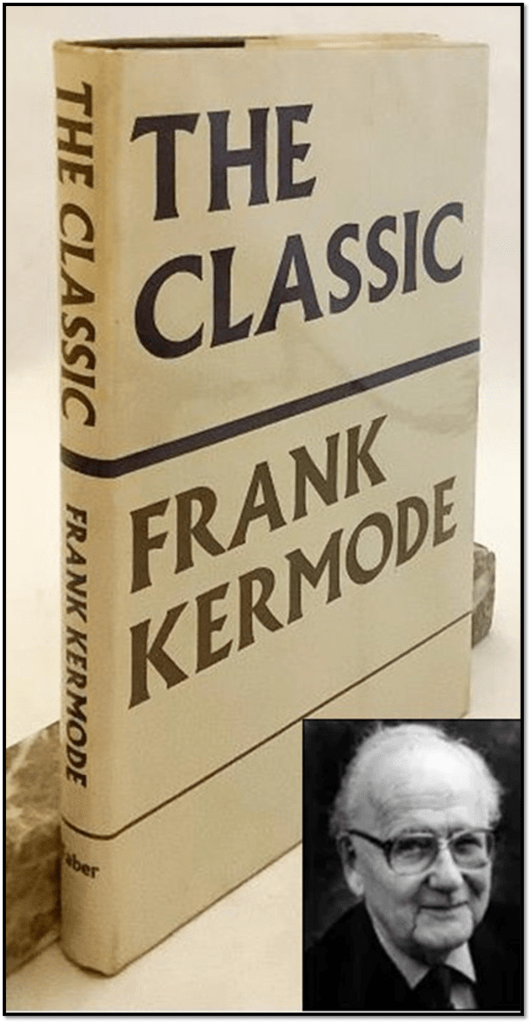
This questions prompts something less than an answer to it from me and something more than the kind of cool response, opinion seeking prompts are won’t to expect. First of all, the assumption that anyone and everyone will agree on what is a ‘classic book’, or even what ‘classic’ means in this respect just doesn’t hold water for me
Since its rupture from the descriptive term ‘classical’, which varies as well in its usage anyway across academic disciplines and common usage, a classic seems to be indicated by different markers. Once, it mean longevity of survival amongst a literary elite, the definition of it in practice at least when I was leaving sixth form at Oxford University, where any text less than a hubdred years old from.its year of publication, and whether in print or not, could be believed to be vindicated in quality by years of critical commentary that kept it in mind, or in certain minds at least. Or was a matter of tested quality, whose landmarks were seen as settled in elite opinion.
For others being ‘in print’ matters and, yo some degree this matched the commodity value of the term in a publisher’s selection of them as saleable thus, thoigh often because in demand in University English Departments and in the secondary academies teaching literature qualifications. Penguin Classics held great sway for me then, especially with their virtuous academoc introductions, full of spoilers of course because one didn’t, did one, read classic literature for the ‘story’ or to be surprised by plot turns or identification of a surprise quality in a character, like being the unguessed murderer.
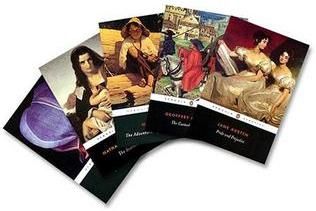
2002 covers of the series: source is https://en.wikipedia.org/wiki/Penguin_Classics
I think the sense in which a book is a ‘classic’ has slipped somewhat since. In the 1970s, views of the matter were dominated by the academy and no-one then seriously advocated the word to describe novels by popular novelists in any genre, except for those having passed the time test: hence the status of books sometimes thought of as romantic fiction like Jane Eyre.
My own indoctrination into a view of the classic was entirely tje mind-product of the particular outsider in literary academia, Frank Kermode, who devised for the English course in University College London (UCL), where I did my degree just before he went to become a sadder man as the Northcliffe Professor of English at King’s College Cambridge. In a kind of obituary written on the Saturday of the week of Kermode’s death on the Tuesday by John Sutherland, who also taught me at UCL, there is a full explanation of how, now in charge of a prestigious university course, Kermode was intent in proving that the acumen to detect a classic from other works could be taught. One criteria for the classic he thought was the intrinsic difficulties in texts that mattered in history and critical discourse, a criteria I now understand as one I completely internalised. Sutherland writes of the first year course I studied and he taught, though mainly relating to his own speciality in the nineteenth century novel:
When, at University College London, Kermode was given a whole department to play with, he created a syllabus which was the curricular embodiment of his belief in the primacy of the difficult. The first undergraduate year required of the student a full reading of Donne (not just the “Songs and Sonnets” – but tougher nuts, like the “Anniversaries“), the whole of The Faerie Queene (including the intractable Book V), the whole of Paradise Lost and Paradise Regained, the whole of Chaucer (including Troilus and Criseyde) and the less familiar plays of Shakespeare. They were all dragons at the gate – but Kermode never believed in easy access for those who wanted to engage seriously with the subject. [1]

University College London. In fact the English Department was in rooms that looked like a converted warehouse to the right and downstairs from this grandeur.
In fact, though the great epic genre pieces mentioned here did predominate for Spenser and Milton, it was necessary in the course to see them in context of other genres too, so that coming to Donne at the end of the course (Chaucer and Shakespeare had courses entirely to themselves) meant more having read Spenser’s pastorals (how I laboured over Colin Clout’s various laments) love lyrics, and sonnets, as well as a great deal of other Elizabethan guests, like Sir Walter Raleigh, an addition ro the course promoted by A. S. Byatt (Mrs Duffy, as we knew her), who was wrirting her major review of Renaissance classicism at the time in her, The Virgin in the Garden, a book that could itself act as a commentary on that first year of the UCL course.
Contemporary dislike for instance of Byatt’s novels often hangs on the sens that they labour difficulties. Though an opinion expressed by many, and quietly by her sister, Margaret Drabble, my reason for wanting to query this prompt question is precisely because many critics coveted up their unwillingness to cope with difficult texts by saying Byatt’s novels were ‘overrated’ attempts at classicism. There is no doubt, however, that the question of how complexity influenced a notion of the quality of reading experience was taught and how singular it was. I am almost in tears of gratitude now for what was taught and how it was taught. Kermode never stopped. To me there is no doubt that Byatt’s are ‘classic’novels – and essays – because of their complexity and many faceted nature (see my blogs at the linked titles: on The Djinn in the Nightingale’s Eye and the film thereof, on Ragnarök and its issues, On Portraits in Fiction).
As for Kermode as a writer himself, Sutherland takes on the topic of his ‘best’ book, and comes to the conclusion it is The Sense of An Ending. Indeed it is a ‘classic’ (in my eyes and framework of definition, but I prefer The Genesis of Secrecy as an explanation of what narrative feels like and why ( starting with Homer and the Bible but mainly the Bible) – and why, for instance, it is possible to ‘spoil’ some narratives for some readers in your critiques. Nevertheless no-one can omit his last book, for its entitled The Classic. Of the issues of ‘best’ book in general and it in particular, Sutherland says:
There will be disagreement about which is Kermode’s best book. His most Kermodian is The Classic, first delivered as the Eliot lectures at Kent in 1975. Kermode’s starting point is, dutifully enough, TS Eliot’s lecture entitled “What Is a Classic?” given as an address to the Virgil Society in 1944. While accepting Eliot’s main contention that a classic is the mature cultural product of a mature civilisation, Kermode adds a typically complicating spin. If Shakespeare (to take the least disputable example) is a classic, why does every age interpret Shakespeare differently? Is Dr Johnson’s interpretation less right than Coleridge’s, or Coleridge’s than William Empson’s, or Empson’s than Stephen Greenblatt’s? If one interpretation is more right than the others, why do we still equally revere all those Shakespearians? Put another way, why – with the passage of centuries – don’t we get cleverer at making sense of our classic texts? [1]
It is not hard to see that this spin off from T.S. Eliot’s definition of the ‘classic’ is the reason why complexity matters – why a work matters in the richest contemporary context of its production and its reception through latter ages and civilisations. If a work can legitimately mean different things to different ways of seeing it and yet still be the same work, it must be complex. And this applies to works whose significance appears in very few peoples ‘canon’ of literature or list of classics, but which are richly complex like those novels of the now forgotten Bryher, whom I have blogged upon recently: on Roman Wall and The Player’s Boy. Yet I do not know that I like them because they are ‘classics’, or underrated (they certainly aren’t ‘overrated’, except by me in some views) but I do know that their complexity can lend itself to readings situated in entirely different contexts.
And in describing The Classic, Sutherland articulates this view of Kermode’s message in it: one that took me by surprise when I read it today, for it is exactly what I thought but never articulated or, in truth, understood that clearly, as I do now reading the piece:
In a brilliant critical move Kermode argues that it is the very pliability of the classic, its unfixed quality, that is its essence. It “accommodates” – makes itself at home – wherever and whenever it finds itself. It is the classic’s ability to be both antique, yet modern, its infinite – but never anarchic – plurality that categorises it as classic. A work such as King Lear, Kermode argues, “subsists in change, by being patient of interpretation”. The word is beautifully chosen. Every generation will read, or understand, King Lear differently insofar as every generation is different from its predecessors. No final version, or interpretation, of the play can be achieved. But every generation will find its own satisfactory interpretation. And the classic is tolerant of each and every different explanation of itself. [1 – my bolding]
I cannot say I agree with the phrase that that the work that is a classic ‘is tolerant of each and every different explanation of itself‘. Surely some explanations are unsustainable, as is clear from Biblical criticism and interpretation as examined by Kermode in The Genesis of Secrecy.And, if that phrase were true, it would make nonsense of Kermode’s view, recognised by Sutherland, that to know a work truly is to ‘master’ its tendency to transmogrify under your every eyes – becoming as an essence different in different contexts of good reading (or vicious reading as Kermode called it) but staying the same materially – in its basic pre-read materials. Sutherland taught me the Victorian novel (and Hardy was squeaked into that time category as was the more contentious H.G. Wells). It is with Kermode’s blind spot (or is it?) with Thomas Hardy – at least as a novelist if not as a poet – that Sutherland finds room to critique whether could spot some ‘classics’ at all. In defining the need to be complex, Sutherland shows how Hardy and Wallace Stevens compared in Kermode’s detection of classicism and what might be ‘overrated’ in his view: like the novels of Hardy, and, as a chance saying in one of his essays reveals, the poetry of Robert Browning, who only (to Kermode) looks difficult but really is not.
The literature he himself liked best to play against, and master, was complex. He had little time, for example, for Thomas Hardy. Why? Because he felt Hardy gave up his meanings too easily. The modern poet Kermode most respected was Wallace Stevens – never a writer who yields to the reader without a struggle.[1]
Yet he appointed teachers of Victorian poetry (A.S. Byatt was one), who did show me that to truly ‘master’ (I don’t like that patriarchal word) Tennyson and Browning was a matter of understanding complexities and concealed potential meaning, both in its in historical context and in later readings. I sometimes wonder how he maintained the cheery debates he staged with his fellow Professor at the time at UCL, Stephen Spender, who is not particularly known for adoration of ‘complexity’ as poet, novelist or critic (and he was all three). I will never forget the seminar on he Four Quartets of T.S. Eliot where Spender elaborated the poem by recounting anecdotes of the lady he knew who used to dance with Eliot at the Hammersmith Palais.
Yet if Eliot’s (or Yeats’s) poems are not overrated classics, it is because their complexity, not of terminology or appearance of being versified philosophy but because of ‘its unfixed quality, that is its essence. It “accommodates” – makes itself at home – wherever and whenever it finds itself’. There is a sense in which words that ought to be precise in meaning become unstabilised in the music of their voicing, like the voice of a meaning you can’t follow and hence that is why it echoes ‘Thus, in your mind‘. It is a poem that turns other kinds of complexity into what feels like nonsense- so that the search for underlying singular meaning seems a shallow project,such as searching for analogy in the philosophy of Bradley. Instead what we feel is haunted by other things about the nature of temporal experience in memory and desire (as in The Waste Land). Spender was teaching the passage I refer to, quoted below, when he told us what the dancer at the Hammersmith Palais reported. What was it? It was that the lines at the end of this passage referred to Kipling’s Gothic short story They. I think this helps and I would rather reread that story and Eliot and think of why that echoo in his mind mattered to Eliot. Better than reading F. H. Bradley, however much we know about Eliot’s study of him.
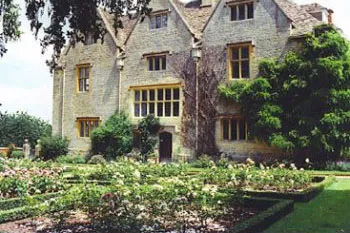
Burnt Norton House with the rose garden as Eliot knew it
Time present and time past
Are both perhaps present in time future,
And time future contained in time past.
If all time is eternally present
All time is unredeemable.
What might have been is an abstraction
Remaining a perpetual possibility
Only in a world of speculation.
What might have been and what has been
Point to one end, which is always present.
Footfalls echo in the memory
Down the passage which we did not take
Towards the door we never opened
Into the rose-garden. My words echo
Thus, in your mind.
                       But to what purpose
Disturbing the dust on a bowl of rose-leaves
I do not know.
                      Other echoes
Inhabit the garden. Shall we follow?
Quick, said the bird, find them, find them,
Round the corner. Through the first gate,
Into our first world, shall we follow
The deception of the thrush? Into our first world.
There they were, dignified, invisible,
Moving without pressure, over the dead leaves,
In the autumn heat, through the vibrant air,
And the bird called, in response to
The unheard music hidden in the shrubbery,
And the unseen eyebeam crossed, for the roses
Had the look of flowers that are looked at.
There they were as our guests, accepted and accepting.
So we moved, and they, in a formal pattern,
Along the empty alley, into the box circle,
To look down into the drained pool.
Dry the pool, dry concrete, brown edged,
And the pool was filled with water out of sunlight,
And the lotos rose, quietly, quietly,
The surface glittered out of heart of light,
And they were behind us, reflected in the pool.
Then a cloud passed, and the pool was empty.
Go, said the bird, for the leaves were full of children,
Hidden excitedly, containing laughter.
Go, go, go, said the bird: human kind
Cannot bear very much reality.
Time past and time future
What might have been and what has been
Point to one end, which is always present.
The meaning here is inseparable from the ‘unseen music’ that is its theme and lives in sound, rhythm and stress as much as in semantics and reference to external sources. Its purpose is to ‘haunt’ and it has always done that for me through different stages of finding a temporary meaning with which to rest with before someone, sometimes me, went ‘Disturbing the dust on a bowl of rose-leaves’ or page leaves un-turned for quite some years. We only do it because and when it disturbs us that we were satisfied too easily into a knowledge of that poem that is no knowledge at all, after a while. Perhaps we do not have to ‘know’ why? We just need to understand, and that the uncertainty of the ‘I do not know’ in these lines is at much a knowledge as a trite answer to a question about what The Four Quartets is about. Yet, as with many things, we do not know, it addresses the nature of our desire – the greed and the need – and the difficulty of locating where memories inhere in our thoughts and feelings and vice-versa. It is no answer to cite Kipling when we ask who ‘they’ are in these lines, but for Stephen Spender it had meaning and psychological and practical reality to locate it in an echo of a writer, Eliot himself (and Spender for different reasons) had done much to discredit.
                 Into our first world.
There they were, dignified, invisible,
Moving without pressure, over the dead leaves,
In the autumn heat, through the vibrant air,
...
There they were as our guests, accepted and accepting.
So we moved, and they, in a formal pattern,
Along the empty alley, into the box circle,
To look down into the drained pool.
Dry the pool, dry concrete, brown edged,
And the pool was filled with water out of sunlight,
And the lotos rose, quietly, quietly,
The surface glittered out of heart of light,
And they were behind us, reflected in the pool.
Then a cloud passed, and the pool was empty.
Go, said the bird, for the leaves were full of children,
Hidden excitedly, containing laughter.
I have seen interpretations of this that invoked Eliot’s ideas about tradition and the role of ancestors in families and nations that are plausible and supportable, and suggest that tradition is a vulnerable thing in ways Eliot didn’t think it was in its High Anglican Church days, those contemporary to the poem. Others say it is about lost loves – male, female and fantastic mixes of the same. It is all plausible too, not least the fullness in remembered love that turns in another view to emptiness. Sometimes it is, aother reading says, about sterility and the absence of longed for ‘children’ or some symbolic future hope they represent to some. For others it is straight application of Bradley’s Appearance and Reality, which complicates the relationship of these two supposedly opposed categories, only to find they are both facets of truth.
I don’t get the feeling that this poem is taught though today, as it was to me in the 6th form at school. or interpretations were poor but it set the poem echoing in my mind, where it echoes still – often getting deeper as space of uncertauinty opens up the possibility that my mind is an ’empty pool’. Will working class boys like me have those echoes still in their eighties as I do now. No. It will be the subject of a staff meeting in schools wehere someone says: ‘All this modernist classic stuff: it’s so overrated!!!!!’
Bye for now! With love
Steven xxxxxxxxxxxxxxxxx
_________________________________
[1] John Sutherland (2010) Fierce reading: an obituary statement in The Guardian (Sat 21 Aug 2010 00.22 BST) available at: https://www.theguardian.com/books/2010/aug/21/frank-kermode-tribute-john-sutherland

