


How to ‘finish’ a book. Is it the same thing as ‘reading’ a book.
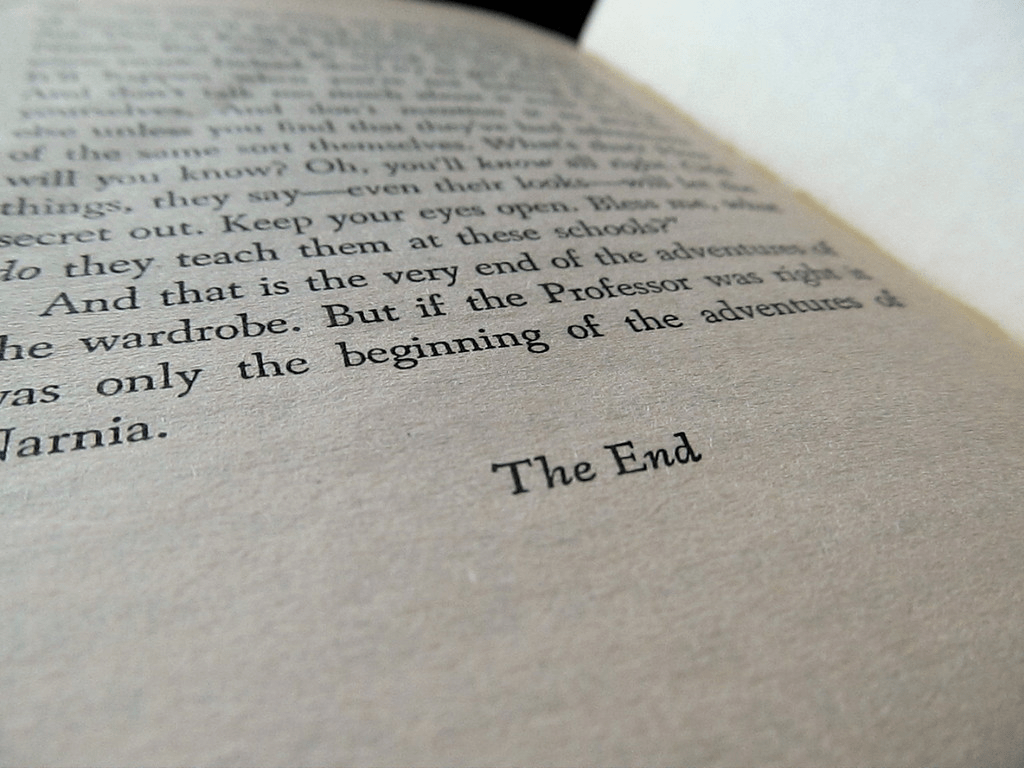
When I was a child, I was obsessed with having to finish a book. It was a measure of the endurance, fortitude or passion (with varying degrees of drive and amounts of compulsion enforced from some internalised diktat or standard) to read it from cover to cover without missing a word, skipping a few pages or, worse, merely skimming the text. Anything less than completeness of reading seemed to my overactive conscience, or super-ego more possibly, like an admission of weakness or worse – some kind of deficit of earnestness or integrity in a fragile ego, to given to succumbing to pleasure alone. How I introjected that value system, I do not know, for I was not a child much given to anything to uncloyed pleasure anyway: but perhaps that is the point! If all pleasures are either guilty, as giving up on things that require effort might be or tinged with shame at their ease of gaining them, then what we have left is the need to be seen achieving something that doesn’t get achieved without some pain or cost – for even books read passionately are at a remove from the passion they simulate and at the cost of ,at least, learning to read – an effort for all children.
It is to novels themselves we often go to find out what reading might mean. Lots of novels attend to the idea that most readings are incomplete because based on shoddy materials – the two most notable being Jane Austen’s attack on silly novelists like Mrs Radcliffe in Northanger Abbey, or Flaubert’s despair at shallow readings of shallow novels in Madame Bovary.
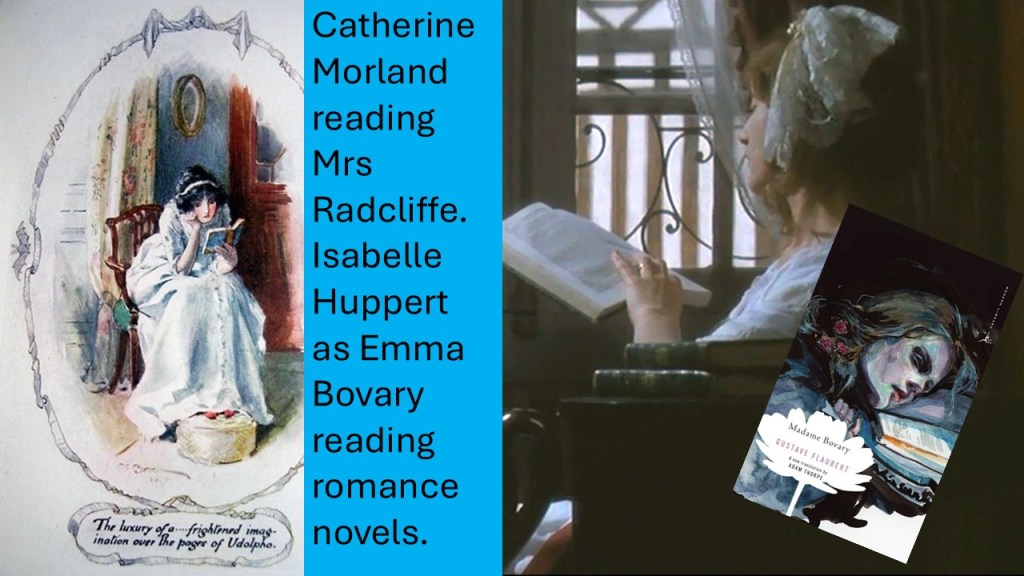
But Jane Eyre is my favourite glimpse into the psycho-dynamics of incomplete reading, where a child might get pleasure from the bits of a book, or its illustrations, they can translate into meaningful but partial terms as far as the purpose of the whole book is concerned. Jane is excluded from the way the Reed family that she lives with use time in static undemanding pleasure. However, she also needs to escape from the pain of being reminded that to that world of leisure and pleasure she is an outcast, and a means of it using its excess energies in bullying her. The sense of being excluded, outcast and preferring that to more active pain leads to her seeking secret places for such substitute pleasures that make no noise to betray one:
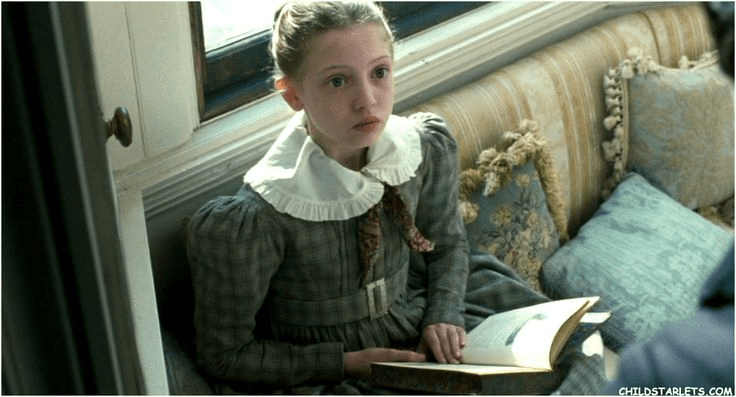
A breakfast-room adjoined the drawing-room, I slipped in there. It contained a bookcase: I soon possessed myself of a volume, taking care that it should be one stored with pictures. I mounted into the window-seat: gathering up my feet, I sat cross-legged, like a Turk; and, having drawn the red moreen curtain nearly close, I was shrined in double retirement.
Folds of scarlet drapery shut in my view to the right hand; to the left were the clear panes of glass, protecting, but not separating me from the drear November day. At intervals, while turning over the leaves of my book, I studied the aspect of that winter afternoon. Afar, it offered a pale blank of mist and cloud; near a scene of wet lawn and storm-beat shrub, with ceaseless rain sweeping away wildly before a long and lamentable blast.
I returned to my book—Bewick’s History of British Birds: the letterpress thereof I cared little for, generally speaking; and yet there were certain introductory pages that, child as I was, I could not pass quite as a blank. They were those which treat of the haunts of sea-fowl; of “the solitary rocks and promontories” by them only inhabited; of the coast of Norway, studded with isles from its southern extremity, the Lindeness, or Naze, to the North Cape—
“Where the Northern Ocean, in vast whirls,
Boils round the naked, melancholy isles
Of farthest Thule; and the Atlantic surge
Pours in among the stormy Hebrides.”
Nor could I pass unnoticed the suggestion of the bleak shores of Lapland, Siberia, Spitzbergen, Nova Zembla, Iceland, Greenland, with “the vast sweep of the Arctic Zone, and those forlorn regions of dreary space,—that reservoir of frost and snow, where firm fields of ice, the accumulation of centuries of winters, glazed in Alpine heights above heights, surround the pole, and concentre the multiplied rigours of extreme cold.” Of these death-white realms I formed an idea of my own: shadowy, like all the half-comprehended notions that float dim through children’s brains, but strangely impressive. The words in these introductory pages connected themselves with the succeeding vignettes, and gave significance to the rock standing up alone in a sea of billow and spray; to the broken boat stranded on a desolate coast; to the cold and ghastly moon glancing through bars of cloud at a wreck just sinking.
I cannot tell what sentiment haunted the quite solitary churchyard, with its inscribed headstone; its gate, its two trees, its low horizon, girdled by a broken wall, and its newly-risen crescent, attesting the hour of eventide.
The two ships becalmed on a torpid sea, I believed to be marine phantoms.
The fiend pinning down the thief’s pack behind him, I passed over quickly: it was an object of terror.
So was the black horned thing seated aloof on a rock, surveying a distant crowd surrounding a gallows.
Each picture told a story; mysterious often to my undeveloped understanding and imperfect feelings, yet ever profoundly interesting: as interesting as the tales Bessie sometimes narrated on winter evenings, when she chanced to be in good humour; and when, having brought her ironing-table to the nursery hearth, she allowed us to sit about it, and while she got up Mrs. Reed’s lace frills, and crimped her nightcap borders, fed our eager attention with passages of love and adventure taken from old fairy tales and other ballads; or (as at a later period I discovered) from the pages of Pamela, and Henry, Earl of Moreland.
With Bewick on my knee, I was then happy: happy at least in my way. I feared nothing but interruption, and that came too soon.
Happy?’: ‘at least in my own way’ describes a means of substitutive satisfaction, at best but, at worst, a kind of self-protective life stimulated in and by fragments of thoughts, feelings and sensation into imaginative pictures of states of unpleasure that cannot harm in reality, for their fictive, imaginative and distant nature is openly accepted. The stories dreamed from fragments or, by narrated by Bessy, from the few pages or highlights of a novel like Pamela, are happy in their incompletion, and, in terms of ‘finishing’ a novel, non-finito character. It was never intended by Jane that she ‘finished’ the book of birds illustrated by Thomas Bewick, rather that she revelled in the ease of romancing mentally on its parts.
I cannot remember a state such as that in my own childhood. I read in public all the time, even walking the streets, such that people on our council estate would, in the working men’s club, inform my parents that I must be very odd; a belief they were inclined to believe. If I read a book, I finished it; whatever pains it cost me. There is an exception. My Mum sourced her reading from the travelling library van which stopped weekly on the estate. I remember finding there an Annotated Bible, heavier and bulkier than any book I had ever seen. I intended to read it from cover to cover and would take the tome up to bed with me. I remember that the book actually indicated parts of itself that could be omitted – usually lists of So-and-So begat So-and-So, that were repeated what seemed ad infinitum. I remember the distress I felt at trying to take advice not to read these, and on one occasion going downstairs where my parents had friends -heavy drinkers already into states of intoxication that caused loud singing of dirty songs about female genitals. Into this company, in Rupert Pajamas, I introduced my problem. Was it wrong not to read a book incompletely, by omitting parts and not driving to its finish. My Dad took me upstairs. He explained that people who read the Bible from cover to cover exposed themselves to madness.
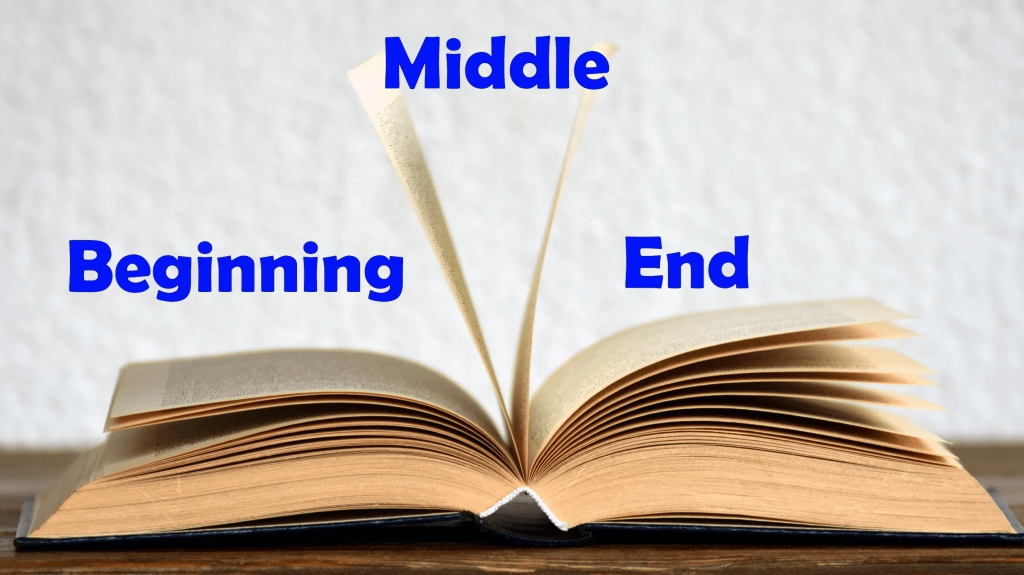
I loved my Dad. The annotated Bible went back to the Library van on the next Tuesday, replaced by a book I could read seriously in all its part from beginning to end. Little did I realise that most Bible readers go ‘mad’ not because they rush to the end but that they eventually realise that its contents are disputed in almost every possible way – both in terms of what it ought to contain – each book in it had to pass various tests for being canonical (a true and authoritative member of the group) and textually free of error. As we shall see – it is ‘middles’ that pose the problem in books for readers not getting to the ‘finish’ line. Consider, for instance, why the graphic below is so misleading for the experience of book reading despite not being erroneous in literal terms! In my view the graphic misleads in that it pictures middles as a thin part of a book, beginning and ends as primary and the densest part of a book. They just are not in experiential termsbut ways in intervolving oddly place new (or old remembered) beginnings and ends, that continually run into and complicate each other!
Finishing a book meant taking it seriously in all its parts and then working to understand the patterns these parts made to create a sense of the book comprehended in as rich, relevant or objective a means as possible (any of these three is acceptable in my view) of the whole thing. In this way is a book ‘finished’ or’read. Only a finished book could be thus understood, and that understanding was synonymous with what ‘reading’ a book was. Of course, I read my fill of Enid Blyton (only the Secret Seven, for by the time I should have graduated to the Famous Five, I was aware of Blyton’s ever so pernicious racism and sexism).
But I have no memory of reading like Jane Eyre does in her eponymous book, or even of reading that book as folk tend to do as if it were a romantic or feminist tract. For me, it is a highly intelligent book about the nature of self-making and of the necessity to people in powerless situations of hiding or ‘cover’. Mrs Reed says that she has never seen a girl with ‘so much ‘cover’, and to an extent she is correct, even though Mrs Reed is a major factor that necessitates orphan girls on the margins of comfortable society ‘covering’ the true thoughts and feelings that constitute the lives of dependent girls .
When I read Frank Kermode’s brilliant book The Sense of an Ending, he convinced me that people so much want structures that begin and end that they even hear the sound of a ticking click not as ‘tick-tick‘ but ‘tick-tock‘, in order to have a beginning and end to a time-based story. But Aristotle insists on a ‘middle’ too and it is the ‘middle’ with its tendency to duration that must be endured that oft puts people off reading a book. We have to work to get through the thick mud of some middles like that, or those, in Tolstoy’s War and Peace, or George Eliot’s Middlemarch. Moreover, middles are the other factor in stories that also begin and end: the source of patterned complications that enable us to see some grandeur in life other than that it just begins and ends.
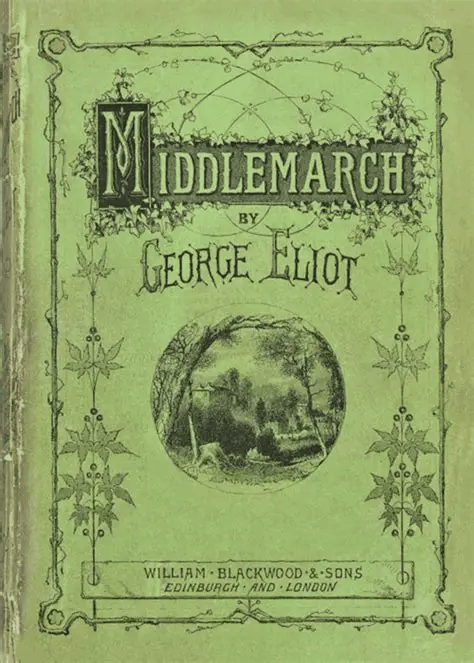
These middles, and Middlemarch is a good example, are where the webs are spun in which we interpret the interconnection of all things and non-things (the latter include things that pass before they have a name – complications of feeling, sensation, thought and of value: things live on and are in fact dead, things that die but live on for good or ill – an amazing section of the book is called ‘The Dead Hand’ and is about the writing of wills. So my favoured question is: ‘Into which book did you first get the significance (to you or to others, for any reasons) of a book’s middle?’ Middlemarch already knows that you need to think about this. Although the term ‘march’ may link to the progression in the pace of historical time in the book, it is also the name of a boundary, such as a city-state or nation (like the Welsh Marches), yet this town is more ‘middle’ than ‘march’ (partly because it honoured the Midlands towns known to Marianne Evans (George Eliot) in youth but also because it focused upon that which cannot be focused upon to the exclusion of all other foci – the uncertain durations of people and events between the beginning and ends of stories.
Bye for now, Love
Steven xxxxxxxxxxxxx
 Steve_Bamlett_blog