


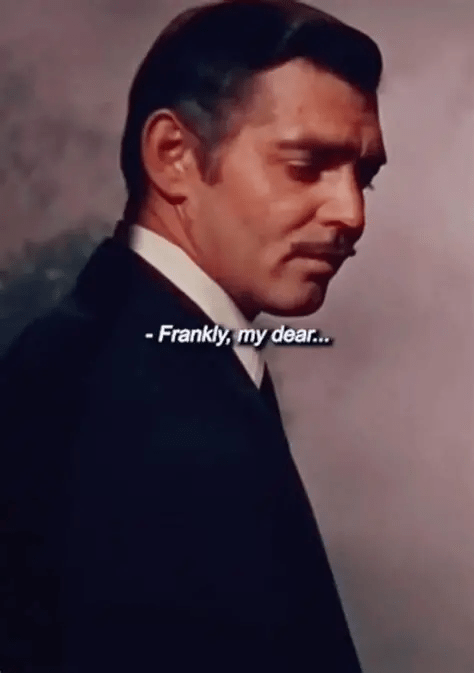
We all remember the scene from the film Gone With the Wind, even if not the details. The shallow life of Scarlett O’Hara, played by Vivien Leigh, is revealed when she is in weeds of mourning with her home, Tara (the paradisal halls of Tara in Irish mythology are enwrapped herein), compromised by the loss of the war by the Confederate South and is about to be deserted by the man with whom she has relearned passion, Rhett Butler (Clark Gable of course). Knowing Rhett will leave her she rushes all in black in a flowing mourning gown down a grand staircase to the hall of Tara, knowing people know her treachery but full of the something like instinct self-dramatisation always awards her, full of the tragedy of being about to lose the one person she loves and, on whose ill-gained riches from the trade that war created she might depend for economic survival.
The pain is painted in thick melodrama on Leigh’s face but this doesn’t stop Rhett moving towards the grand doorway. Her last chance is to enact her despair. In tears she says (directly from the melodrama of Margaret Mitchell’s elegy to the racist South of the USA Gone With the Wind), “Where shall I go? What shall I do?”. The dilemma is real. Without a man and his source of money and power, will Scarlett (the ‘Scarlet Woman’ of Revelations embodied) ‘survive’. In the book, Rhett answers: ‘My dear, I don’t give a damn’. In fact more damning because starting with an endearment contradicted by its context, this line was not good enough for the film or Clark Gable who give us: ”Frankly, my dear, I don’t give a damn,” employing all the stuffy self-importance of that filler world ‘frankly’, but in doing so taking on a mock politeness rather than a mock inversion of endearment, or paradise, lost.
We know that Scarlett is as consummate an actor as Vivien Leigh. In a moment later, she reveals her deep relationship to the hero of Thackeray’s Vanity Fair, Becky Sharp, with an ongoing and unstoppable resilience (which is encoded in both books (and the film of Mitchell’s) by the contrast of the female survivor to the pale femininity of a foil in mousy pale truly dependent women (Melanie Hamilton in Gone With the Wind) and Amelia Sedley in Vanity Fair) she will end the film recognising that: ‘Tomorrow, is another day’. Moreover, it is a day in which self-interest like theirs may yet socially redeem self-interested actors hungry for personal power – even women, for whom this aim is a much more difficult one than for men. In the book. But this aside this moment in the movies lives because of Clark Gable. Wikipedia tells us (at this link specific to this line) that the most noted Stanislavskian Method Actor of his period, Marlon Brando ‘was critical of Gable’s delivery of the line, ‘Frankly, my dear, I don’t give a damn’:
commenting—in the audio recordings distributed by Listen to Me Marlon (2015)—that “When an actor takes a little too long as he’s walking to the door, you know he’s gonna stop and turn around and say, ‘Frankly, my dear, I don’t give a damn.’
Method actors felt that the over-theatricalisation of emotion was always a fault, a sin to the ‘naturalism’ to which they aspired. Emotional effect that was created by theatrical trickery in staging proxemics and over-projection of one’s enactment was a predictable actor lyrics behaviour divorced from what emotion truly was, which is internal and given away in body language that had subtlety and nuance. Indeed a sense, what Butler is saying to Scarlety is ‘time off it – you are just acting despair not feeling it and I will not let it affect me’. But Brando felt that Gable too used too predictable and actorly a manner, enacting a role not being the person who would say this thing without premeditated of dramatic effect.
Method acting falls down perhaps though when what is performed is precisely the manifestation of personal control in response to shows of not being in control, whether sincerely felt or not. The point is that Scarlett must be made to feel that she is no longer in control of her variant audiences, unable to perform her own redemption, and that she has chosen the worst possible way of acting in front of a person who has indeed every ounce of power requisite for control available.
I don’t know how people will answer this prompt question, but to me, it recalls those moments when either I or another have played a scene for its dramatic effect, as in a movie (sometimes one of little or no value, to secure their own interest or for gaining the focal attention of others. Children over 2-3, begin learn a repertoire of goal-directed and self-motivated behaviour together with a theory of mind (ToM) the knowledge that people see differently. It is defined thus in Simply Psychology’s website:
Theory of mind is our ability to recognize that other people have thoughts, feelings, and perspectives that may be different from our own. It’s a key social skill that usually develops in early childhood, helping us predict behavior, show empathy, and navigate relationships.
The definitions always seem to stress the role of ToM in the development of emotional, cognitive and moral empathy but it is far more easily perceived in the function it gives to deception. If I know that someone cannot really guess my motives or feelings, I can perform the signs of these things and get what rewards performing them sincerely usually gains – from focused attention on onelf to means of placating your feelings by giving you what you want. The evidence is that even primates learn these behaviours early. it can be deceived by signs of emotion. They can therefore be conscious enactments – everyone has seen them in children and moral narcissists generally. Such enactments of emotion that seem over-the-top may be far from well-grounded in real interpersonal feeling, and much more in intrapersonal ones, are not always consciously planned versions of the theatre of everyday life. Psycho-dynamic theory speaks of persons acting out, without overt consciousness of doing this, of deep seated scripts based on traumatic memories, where a person has felt overwhelmed. Many of these memories derive from childhood for the child has not yet built the infrastructure to process multiple sources of stress at once nor to construct a cognitive-behavioural machinery to deal with them internally rather than externally.
I do not believe there is anyone who has ever introspected fully who cannot see these features in their life development and perhaps even in facets of everyday behaviour, when behavioural regulation features of our personal and interpersonal psychology are depleted. People may be particularly prone to this behaviour when they fall ill or suffer massive loss, losing interest in any goal that this not one centred on their symptomatic presentation.
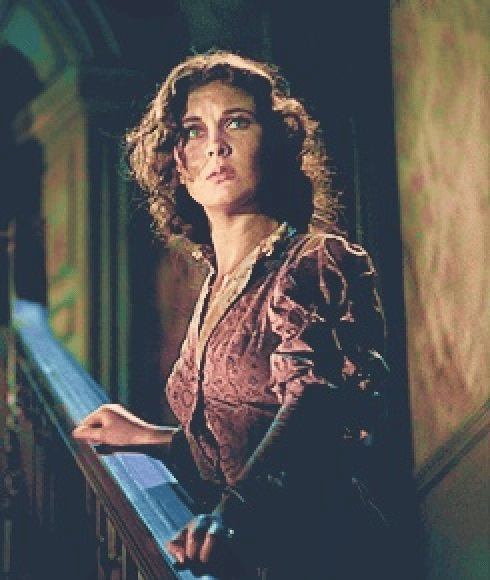
Thus Scarlet O’Hara amidst the ruins of the life of a Southern belle, though her behaviour throughout is that of a narcissistic child during the development of a ToM, and intent to use in goal-directed ways to achieve those goals that match her own evaluation of self-desert. She is, we are to believe, to be treated as a victim of forces beyond herself, and pleads for some external saviour or redeemer – Rhett, of course. That is why it is so effective for the chief part of the audience of her role as resource-less victim is so effective in choosing the line: ‘Frankly, my dear, I don’t give a damn‘.
Thus bereft, the actor loses the point of their role-play; as people are supposed to do in Rogerian encounter groups when their ‘masks’ used to get through life inauthentically are shattered and they must act authentically and sincerely, as humanist psychology sees authenticity and sincerity. To be authentic is to own your own feelings and take responsibility for them, even when there is a case for saying your feelings are the product of trauma inflicted upon you by others. But ownership of one’s own feelings is not a talent in Scarlett unless those feelings have the show of evidence that positive gains from them are possible. She will never learn what Creon must at the close of Sophocles’ play Antigone:
CREON
Away with me, a worthless wretch who slew
Unwitting thee, my son, thy mother too.
Whither to turn I know now; every way
Leads but astray,
And on my head I feel the heavy weight
Of crushing Fate.

CHORUS
Of happiness the chiefest part
Is a wise heart:
And to defraud the gods in aught
With peril's fraught.
Swelling words of high-flown might
Mightily the gods do smite.
Chastisement for errors past
Wisdom brings to age at last.
Movies do not close with the wisdom of a chorus telling mighty actors that they can act out no more – for all must bear the consequences of their actions, for this is their human responsibility. But remember how Gone With The Wind ends, and with whose voice:
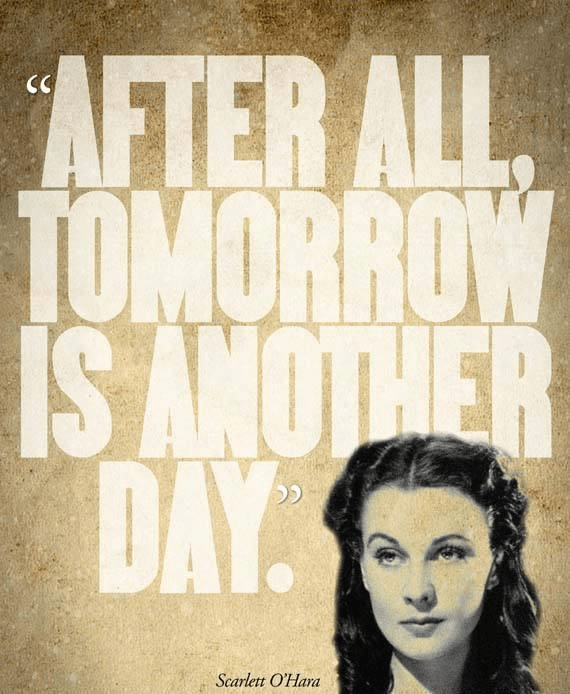
When Creon says: ‘Whither to turn I know now; every way / Leads but astray’, it is not unlike Scarlett’s “Where shall I go? What shall I do?”, but for Creon ‘Tomorrow will not be another day in which to outperform the naysayers (whether authentically or not and there are those who say Scarlett does indeed become authentic at the end) who say that, though it is NOT all your own fault that this has happened, it is your responsibility to deal with it’. To think that positivity and resilience will be enough is to fool yourself:
Yet exploring one’s own negativity too can be a problem. I wrote a blank verse piece not long ago (read it at this link), and though triggered by the loss of a female friend who I had demanded too much of (and whom it turned out I really didn’t know at all. It really referred back to the loss of another person, a male (and a coal-miner in my imagination only), and was about the degree of acting out in my own behaviour at the time much longer ago, when everything about my own sense of masculinity was temporarily shattered. I know this was so because of the mining imagery (it comes from the implied term undermined)- always the way I explore maleness vis-a-vis myself, though no-one in my family was a miner. Here is the verse:
Shadowed by woods, I noticed too late
the fractures in the path we'd trod so long,
still thinking I was held upright by them
who claim that in their thoughts you would feel strong.
The breaking foundations of that dark path
soon gapes so wide that a crack becomes the wall
of some dark  hole, like coal-black pits God's wrath
Opens for sinners for their fated fall.

You chose to cut the bond you tied so tight
That my expected fall would be my fate
alone: cut bonds are what you use to fight
responsibility of late.

After you left , I fragmented a bit.
but not for long, I had misread the signs
that should have been foreseen; avid the pit
for blood, I will not go inbye the mines ,
as often said up North.

                        Without a fault
there's never any solid ground.In ways
A friend is said to be of earth, the salt
mixed in with dirt. What Zarathrustra says
Is not to want your friends be only good,
'Beware those friends drinking only pure blood'.
It is about myself only this in my mind but I accept I may not be correct – the wood though is clearly that in Dante’s Inferno – the opening – and the ‘we’ (based on Virgil and Dante) really versions of myself, one claiming to be the protector of the other, the more vulnerable ‘me’. It is that stronger guide who rails against the other for ‘cutting bonds’ and losing a friend, and tells the weak one in his error that (I am no poet – perhaps this conceit does not work in practice – I was too absorbed in counting syllables in each line, especially the last below):
You chose to cut the bond you tied so tight
That my expected fall would be my fate
alone: cut bonds are what you use to fight
responsibility of late.
This dramatic statement (a conversation between ‘you’ and ‘I’, consciously using the fact that we sometimes refer to ourselves in the second person) of a stronger self to a weaker one (as in Tennyson’s The Two Voices) tells the latter that he needed to be less reactive and more ready to accept responsibility rather than cast it off by ‘casting’ others in the role of villains to my victim-hood, and blamed for my fate implicitly. Deeply self-critical when the friend lost last wrote to my husband to claim that I was behaving badly. Maybe I should have foreseen this misinterpretation, but I was not to know that the person was still subscribing to my blog. I apologise if she still is – though our friendship is now thoroughly over for the good of us both – just in case she is reading this, and again feels it be ‘one-sided’.
Scarlett, c’est moi! I hope it is only SOMETIMES!!!!!!
Bye for now
With love, Steven xxxxxxxxxxxxxxxxxx

