


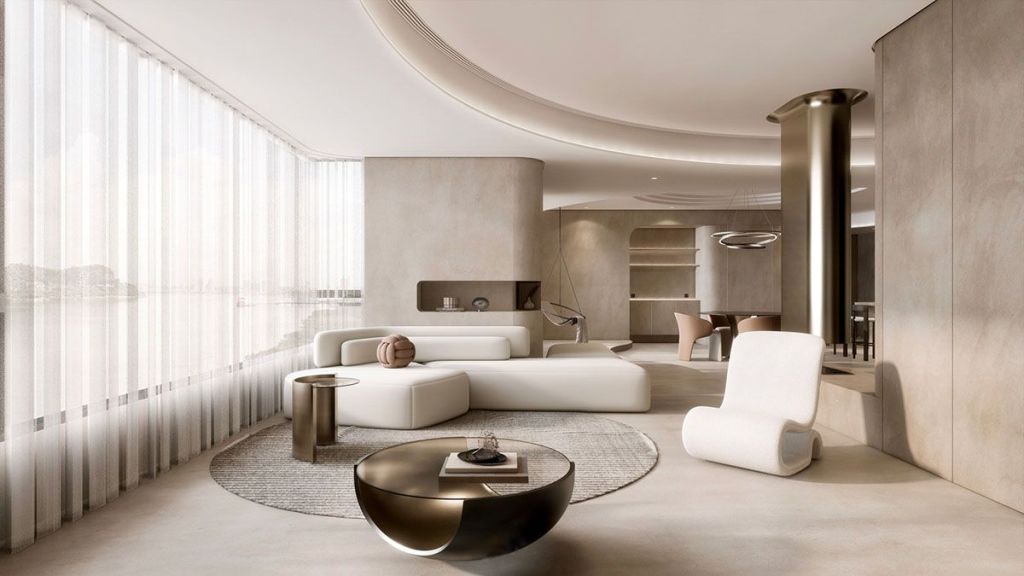
When minimalism becomes the sign,not of simplicity of life, but of opulence of style and materials.
Minimalism has to ‘disambiguated’ by a long list in Wikipedia, for it has a specialist meaning in specific domains and sub-domains of knowledge. My suspicions that most might answer this question in terms of it being about one or two of those domains; the two being related. The first and primary livelihoods by reference to an attitude to the manner of living life simply both in conduct of the acquisition and consumption of the means of life (shelter, food and so on) and in the conduct of life tasks. Such answers will evoke self-images based on the lifestyle of Mahatma Gandhi perhaps. The second is that attitude expressed entirely as an attitude to the display of personal lifestyle, to choices in fashion of decor and appearance of the home, person or mode of entertaining others. The second option feedsoff the appearance of the values of the first but is something quite other – simplicity of style .just advertise as a choice that refuses the display of riches whilst still making it clear the tne choice was voluntary, that the person living in tbis style could have chosen a more opulent style of living had they so chosen. In many ways .I ilalism becomes an kind of inverse display of opulence, a show of austerity only in appearance and achieved by expense of the materials and design expertise required for this ‘look’.
However, I want to take the idea of minimalism from out of only one one its specialist uses in Art History, specifically the history of modernist sculpture. My method is genuinely minimalist for my knowledge of this area is poor to say the most. All I know of Robert Morris as a minimalist in sculptural art is from Internet resources, yet these resources will allow me to aim at my main object; which is a reflection on the pitfalls of declaring for minimalist as a self-description.
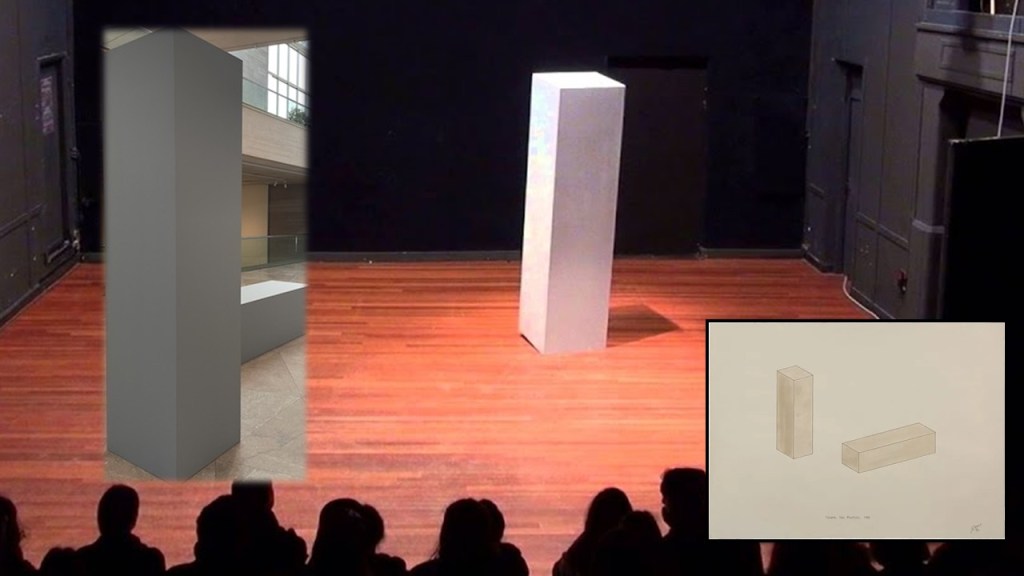
Indeed, let’s get more minimalist than ever and concentrate on one series of cross-genre artworks by Morris entitled Column. The concept is represented in the collage below. Morris starts the adventure of the Column in art by designing a cuboid Column in simple white, which he stood on a stage, s represented in the background picture below. It stood there for a few minutes before toppling and remaining in this position, transformed, as it were, in performance. The collage also two other representations of this two-state Column, but with each state represented simultaneously in two objects intended to be identical but in different positions. On the right the two state columns are on show with other geometric pieces in an American sculpture gallery, on the left they appear as a hand-drawn two-dimensional sketch, in which depths are by necessity a matter of illusion and with no background.
Wikipedia provides a useful summary of the most famous critique of sculptural minimalism by Michael Fried, as follows
The most notable critique of minimalism was produced by Michael Fried, a formalist critic, who objected to the work on the basis of its “theatricality“. In “Art and Objecthood”, published in Artforum in June 1967, he declared that the minimal work of art, particularly minimal sculpture, was based on an engagement with the physicality of the spectator. He argued that work like Robert Morris’s transformed the act of viewing into a type of spectacle, in which the artifice of the act of observation and the viewer’s participation in the work were unveiled. Fried saw this displacement of the viewer’s experience from an aesthetic engagement within, to an event outside of the artwork as a failure of minimal art. Fried’s essay was immediately challenged by postminimalist and earth artist Robert Smithson in a letter to the editor in the October issue of Artforum. Smithson stated: “what Fried fears most is the consciousness of what he is doing – namely being himself theatrical”.
I do not want to engage here with what Fried actually said and will take this summary of his views on its own terms as sufficient for my purposes. The implicit insistence in the passage is that Fried reduces the value of the art of Morris by reference to its physicality, theatricality and lack of internal relations that are assumed to be aesthetic qualities that define a true art work’s autonomous qualities as if they existed within it and can be theorised and felt within the viewer’s internal processing of what it does to them. To Fried everything about Morris Column is external – apprehensible as a physical object alone without any need of a numinous quality evoked internally and attributable to its essence. Moreover that physicality is not only in the description of its physical dimensions but of the physical relation of the viewer’s body and body senses to that physical object. It is not only that these external physical relations are ultimately all measurable quantitatively (though the task would be impractical to say the least because of relative dynamics, but that they are largely those of modes of external observation not of reflection. The assumption that turning the relation of art object and audience to one of theatrical performance does not tp my mind exclude a reflective relationship, and Fried may not intend to say this. Yet Smithson is probably correct in saying that there is no absolute difference between aesthetic reflective viewing and that of viewing a theatrical performance. It is then possible that Fried fears acknowledging that aesthetic reflection is also theatrical and perhaps that lesser form of drama, self-dramatisatioin.
In the end, the story I tell above does not bring us to any conclusion about the issues it raises. It does however show that aspiration to minimalism is far from a straightforward aim for anyone. Does it seek to strip out the unnecessary elements from the essence of something of human value – an artwork, philosophical truth or life itself, for example. In Morris’ case this may be something to do with the nature of aesthetic space across genres in relation to the varying stances of the viewer of art, Some might argue it is not about anything essential at all but rather a matter of ‘style’, that most complex thing to define but often used regardless of that refinement, to indicate something that people only know if they are predestined to know it. I think if you ask people if they believe in minimalism you may learn a lot about the person but not much about what minimalism is.Obviously I am puzzled. Bye for now.
With love
Steven xxxxxxxxxxxx

