What’s the weirdest movie you’ve ever watched?
View all responses
The uncertainty of reading (and reading Harper too) in Cinéma Un-vérité. A blog on the Michael Showalter’s film ‘Verity‘.
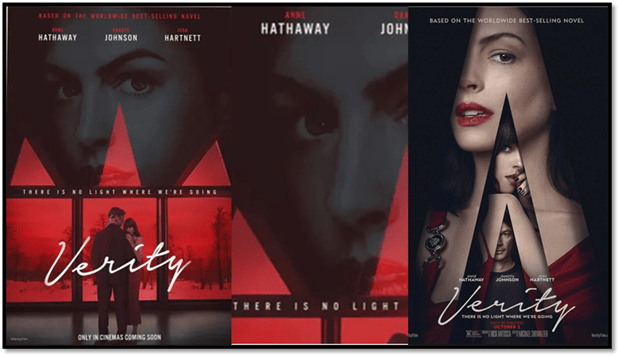
We decided (Geoff and I) that we might like Michael Showalter’s Verity. For me, that was after hearing one line and no more of Mark Kermode’s take on it, summarised as a ‘B-Movie with an A-Movie’ cast and director’ (or something like that). In my childhood and youth a B-movie was a secondary film feature in a picture house showing of a main film feature (or A-movie) – now it is a word indicative of either or both quality and wide but undiscerning audience pull factors where filmic art is very much secondary. Is this why too it has so many critical detractors in the press, and in some reviews on Rotten Tomatoes? I wonder?
Certainly Paul Tassi of Forbes might suggest that by pointing to the cleft between critical reviewer opinion of adaptions from Colleen Hoovwr adaptations and indeed tne novels tnemselves: from their non-professional audiences. Whilst the former hate the novels and their adaptations, the latter love them, attending in masses. He says of the film Verity, up the date of his article (10th October) that it appears that non-professional audiences:
… may be of a different mind than professional reviews. The gap is wide, with critics giving Verity a 33% Rotten Tomatoes score, while fans have scored it a 69% — 36 percentage points higher. Does that track with other Hoover adaptations? … / Yes, …. There is not a single Hoover adaptation with less than a 31-point gap between critics and audiences on Rotten Tomatoes, in favor of audiences. So when critics and their poor Rotten Tomatoes score tell you to stay away, at least for this class of adaptations, that is probably the wrong call, especially if you’re a fan of the source material. [1]
But I am not sure, had I read Tassi before seeing the film, he would have been a positive influence on me in seeing it, and even he says that Verity audience figures have so far been slightly lower over than other Hoover adaptations at the same point. Truth to say, I was at one of tbose moments when I longed for an entertaining story when I thought we should see it, however far-fetched the stories that B- movies based on popular murder-thriller-writers sometimes provide and I was attracted by the fact that A-list artists had themselves been attracted to the film project. Moreover, rumour had it that the screenplay had itself gone through various upgrades related to the production, direction and casting processes. Here is how Wikipedia tells the tale:
A film adaptation of Colleen Hoover‘s 2018 novel Verity was being developed by Nick Antosca, Alex Hedlund, and Eat the Cat. They had hired April Maguire and Will Honley to write the screenplay before November 2020 for the then-named Amazon MGM Studios. In May 2024, Hilary Seitz was hired to rewrite the film’s screenplay. After additional draft work from Angela LaManna, Antosca was finalizing the screenplay himself in November 2024 when Michael Showalter had signed on to direct the film and Anne Hathaway agreed to lead the film as Verity Crawford. The next month, Josh Hartnett and Dakota Johnson joined the cast for the film.
I was prepared to see that as a possible quality indicator a bit more refined than popularity, though I know none of the detail that would validate that. But the actual trigger this should have pulled is that this is a film where writing, reading and re-reading of that writing matters a great deal. Not that this appeased the critics, as witness Keith Bradshaw in The Guardian, who summarises the plot premise of the film thu, starting with Dakota Johnson’s character:
Lowen, a struggling writer mysteriously approached by a legal team working for Verity Crawford, played by Anne Hathaway, a mega-bestselling author whose recent indisposition means that she is unable to finish her hugely lucrative novel series. Crawford’s people ask Lowen if she might be willing, in exchange for several shedloads of money, secretly to ghostwrite the rest of Crawford’s darkly saucy page-turners. Lowen agrees, largely because she is strangely drawn to Verity’s handsome, sensitive husband Jeremy, played by Josh Hartnett. She has to go and stay in their gorgeous Vermont home where she is upset to find that Verity is now immobile, using a wheelchair, and cannot speak. And she is even more upset to discover a certain manuscript by Verity which hints at a terrifying situation of which the world has no clue.
So far, so silly and so entertaining, surely? There are cheeky hints of Daphne du Maurier and Brian De Palma that promise a good time. But we are entitled to wonder why Lowen doesn’t ask someone, anyone, how exactly Verity came to be in this unhappy situation. Perhaps she might be tempted to ask the sinister nurse (Irina Dvorovenko) but this character soon simply and bafflingly disappears. After a sensational opening sequence, the film gradually unwinds, and the entirety of the third act disintegrates into a shower of small substandard plot points that don’t convince. The narrative structure seems to rest on Lowen finding not one but two manuscripts, and we are finally asked to accept a lamely unresolved situation as something fascinatingly ambiguous. This needed a new draft. [2]
For Bradshaw to find the writing still at fault is interesting, given its history, although clearly there must be a problem for in an earlier cut the film ends with the supposed corpse of Verity opening her eyes again as she sinks through the water in which she was supposed to have been deposited in. The issue is whether you accept that the ending is ‘lamely unresolved’ or whether you accept that there is something ‘fascinatingly ambiguous’ about the will of readers and viewers to accept that written stories need to end with certainty or something less, something as disturbingly open as a coffin lid or a ‘cold case’ in police files. Bradshaw often needs to watch more carefully, for it is entirely plausible that a writer making her career more solid would not probe the horror of finding just how disabled Verity Crawford has become, or apparently so. What she does is entirely psychologically plausible. She searches the internet and reads what comes up on the screen. We see her doing it in a way that enables us to read with her the story of Verity’s car accident with all of its ommissions. That newspapers tell the half-truths they are fed by powerful people shouldn’t really surprise a Guardian reporter, such that we accept the truth on the ground will be different from what we read in very specific details – such as the degree of injury supposedly sustained by Verity.
Moreover, the echoes of the cinemtic language of earler films on books is more interesting than Bradshaw allows. Even his term to describe what Lowen is asked to do, ‘ghostwrite’, carries potential – for underneath the convention ghosts are an elent of supernatural fiction that aren’t exactly what Lowen is to Verity. She is instead that other elemt of the Gothic – the double, or doppelgänger (or doppelgängerin perhaps if German gendering of nouns is followed) The film couldn’t make that more obvious with Lowen saying to the supposedly catatonic Verity – I will take over everything – your books, your writing, your home and your husband children (or words to that effect) just as doubles are in legend meant to do. Moreover, that element of the film explains some of the usage of plot reminiscence from earlier films, promising things not fulfilled as they are in the original. Thus several shower scenes mime the view from the showerhead in Psycho, where an innocent young woman faces a man who keeps a woman of sorts locked in a Gothic cellar. But they are small fry to the use of Daphne du Maurier’s classic Rebecca, in which a young woman (unnamed in the novel) is brought to a Gothic mansion-house by a desirable older man (Max de Winter) and forced by circumstances, her guesses about the man’s past and a formidable androgynous housekeeper (Mrs – ‘Danny’ – Danvers) to take on aspects of Max’s first wife’s character whilst she searches its secrets, suppressed by everyone including Danny and Max. The Vermont home of the Crawfords is not the Cornish manor Manderley by the sea but has a more sinister modernist take on Gothic castles with ensdless narrow dark corridors to feel along inside, like thiose Catherine Morland imagines ough to be in Norhanger Abbey, if diminished by the dark wintry wood outside it and a frozen lake, soon to warm to its sinister fluid past.
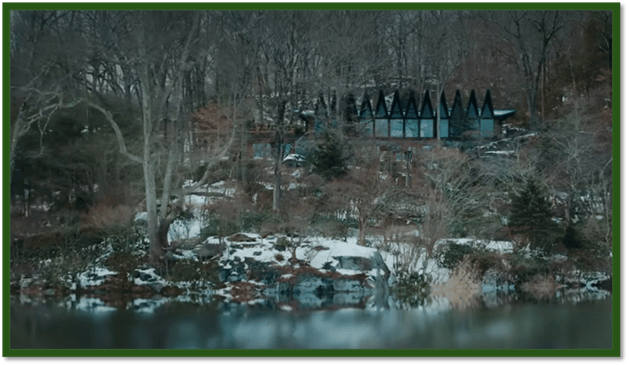
Now this film does not go all the way with Rebecca, and not only because the marriage to Verity’s hisband Jeremy (Josh Hartnett) comes much later, and that ever element of the Verity story is a shadow merely of Rebecca. For a reader of female thrillers though it is a haunting presence feeding expectation that it won’t fulfil, like a dream of sexual fulfilment. Verity has an issue with boats the opposite of Rebecca de Winter – she was forced by her children into a much smaller version, and it is not her (yet) who drowns but her daughter Harper. There is a Mrs Danvers, who throughout promises menace – Bradshaw calls her ‘the sinister nurse (Irina Dvorovenko) but this character soon simply and bafflingly disappears’. That she disappears is part of the ironic recall – a view / reader’s expectations of her performative sinister nature leads to nothing like the role played by Danny, though the lesbian suggestivity remains to disturn the norms. Most important in the recall is the plot in which the writer-narrator of Rebecca is inveigled by Danny to wear a dress once worn by Rebecca to drastic effect. Again this is a shadow of that moment – the dress being that which Verity wore when they met – suggestive of the Scarlet Woman type of film and literature.
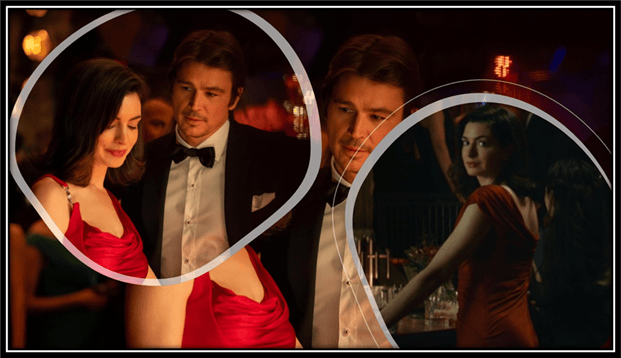
Verity in the Rebecca dress – in a glass of memory darkly
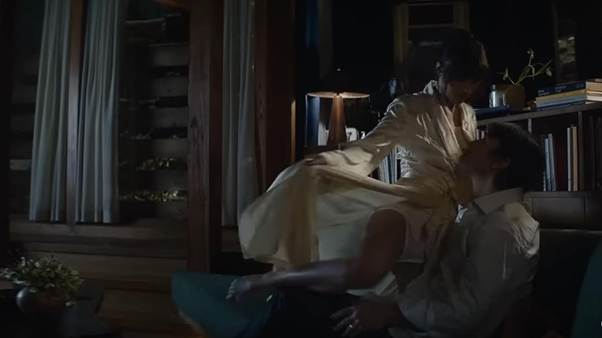
However, the upshot is the apparent illusory (or not) return of Verity to normality in ghostly white and to a later sex scene in which Lowen fits her teeth into the same holes as that made by Verity’s teethmarks as she rides Jeremy’s phallic, pride wearing a ghostly white veil of a nightdress, just as passionately and actively as Verity did when she first made the teethmarks. The scene below is similar but a sofa and no-one and nothing gets bitten as far as we know.
Let’s imagine however that suddenly the writers, and directors, took on the weight promised by the film’s title, Verity, including the fact that Lowen is the double, or candidate-thus-to-be of Verity. This to me makes the manner in which the film’s ending concentrates on the need to be less fixed to the demand for certainty in the truths you hold and more open to uncertainty and where uncertainty might take you. For as we know ‘verity’ is a word closely related to assessment of truth values, as in tbis from the Online Etymology Dictionary:
Verity (n.): late 14c., from Anglo-French and Old French verite “truth, sincerity, loyalty” (12c.), from Latin veritatem (nominative veritas) “truth, truthfulness,” from verus “true” (from PIE root *were-o- “true, trustworthy”).
Modern French vérité, literally “truth,” was borrowed into English 1966 as a term for naturalism or realism in film, etc. (Cinéma vérité is in English by 1963; also compare verism).
Could it be that tne name of the figure around whom the plot revolved, Verity Crawford, had things to say about the attainment of artistic truth? Or perhaps that the claims of true-to-life realism in the theory novel and cinéma vérité in film theory were being tested by such artworks? That, at the least was one of tne ways my enjoyment of this film was heightened, in enjoyment of the film’s artistic play with fantasy and Gothic features, not least the post-modern Gothic (more gables than ever aeen before) house in that remote Vermont lakeside forest. The primary reason why Verity engaged me so thoroughly is that the film is itself about writing and reading, and not just in its associations of ‘readings’ of past filmic texts-adapted-from-books.
And that absorbs its Gothic interests too. Bram Stoker’s Dracula is about the complilation of texts that can be read in ways that catch the monster within it, but the trope is in Mrs Radcliffe (and satirised by Jane Austen) and relates to the search for the plausible character instinct with dark motivation which drives Verity Crawford (and is her downfall if her story of the origins of that search are true or bear verity). It is clear fromthe very premise of the plot of the film that reading takes up quite a large part of it, not least because Lowen Ashleigh, the lesser-known writer (in the same genre) commissioned to finish Verity Crawford’s current novel, following her car accident, and to assist with the next two, has to read her novels first, as well as the notes and partial writing for the current one, before she can write as if her, as her writing double.
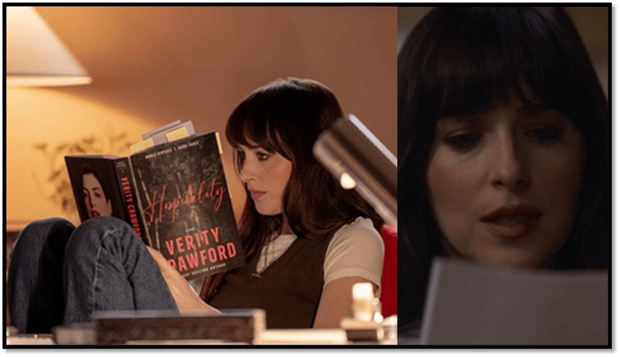
The vérité of the film lies entirely in its fixation of the business surrounding the production of writing and its readers, from publishing houses with their deal-making in a commodity downwards. It is an extensive industry even extending to the need to forensically examine what makes a writer’s imagination capable of writing what it does and what cravings in the imagination make people readers. One way of representing that is to use real people on the margins of the business, hence, as IDMB words it the fact (with appropriate links) that ”Alex Cooper and Sean Evans appear as themselves, in Verity’s fictional appearances on Call Her Daddy and Hot Ones, respectively’. This is as vérité as the fantasy-laden business of publishing can get, but it sets the standard for a cinema that has to invite the artifice of fantasy, Gothic and dreams in just in order to be cinéma vérité at all. The root of this is the forensic attitude taken to the writing provess: ‘All writers have their own processes’, says Jeremy to Lowen with the emphasis unstressed ”o” in process, as in the New York manner. What Lowen has to do is reconstruct Verity’s process, using her notecards for chapter headings and other bits of muddled documents spread over her luscious sitting-room-office, and this she does as if piecung together a text from fragments that no longer preserve their order of writing nor the sequence in which they might be intended to be to enable writing to begin. Such a lot of reading goes into reconstruction:
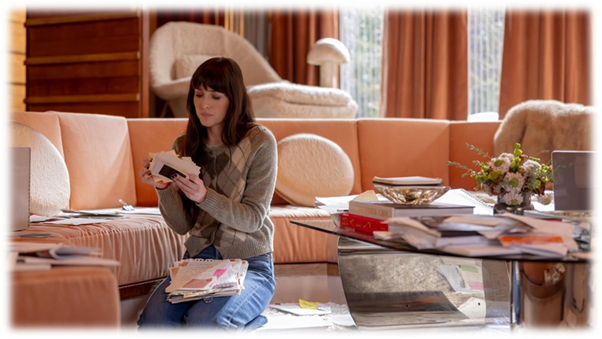
Some bits of the texts are secreted, or kept in places that for the writer (but for them alone) an aide memoire. In a pack of cigraettes secreted un the office desk drawer is secreted a USB stick that containd another typescript that Bradshaw refered to as ‘Lowen finding not one but two manuscripts’, in his usual fairly inaccurate manner, for there is nothing suggesting the second document, an unprinted typescript, only printed out by Loren and read by her in shocked fragments between other work, is labelled not by a novel’s title but as ‘Autobiography’. The status of that document relative to the novel’s manuscript fragments is never really solved, and eventually there are at least two explanations of what it might be – either a genuine record of the feelings that accompanied events in Verity’s life in her own words or a writing exercise in which the first person viewpoint is that of a fictive Verity not the true one – one the direct opposite of her in fact, as a fantasy ‘double’ sometimes is – as in James Hogg’s The Private Memoir and Confessions of A Justified Sinner, another novel of found manuscripts reappearing from places where they were lost or hidden.
Only at the end do we realise another secret – that Jeremy too had read this document – as another one, a manuscript letter telling the story of the typescript and its readings by different people, that letter being ‘hidden’ in a very obvious irregularly-shaped plank lid in the floor of the woodland Vermont house where Crew Crawgord (the boy child of Verity and her confidant while she enacts catatonia), also kep his secret stash of toys. Of course, that is silly but it entirely within the conventions of Gothic fantasy, and does represent fairly interestingly the many options open to writers in their planning of events on an art work based on storytelling. Crew, played so well by Brady Wagner, is often seen spying through door cracks or is hrd to see in the main film frame (usually dominated by the eye-drawing Josh Hartnett, and his qualities, even the ability to swim, unknown to his parents. When Lowen comes to the door he hides behind his Dad, who, nevertheless, is the main person from whom he keeps secrets only told to him by Verity, the supposed catatonic.
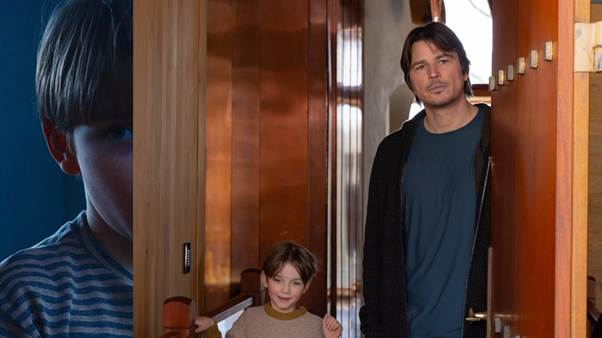
But if he is hard to read, or makes himself so much more so is his sister, Harper, drowned before the film begins and seen only in flashbacks and then in some cunning uses of blurred background to shots focused on the ordinary, like a chairback. Below Crew is a little more in focus.
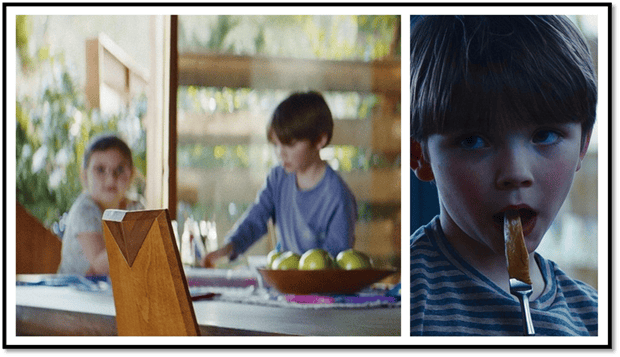
The unreadable is probably the most astonishing in the scene where, having given away that he believes his mother talks to him to Lowen, the knife he is sucking peanut butter from cuts his tongue, as a means of getting transient non-response to his further interrogation by Lowen, usinf a method that looks likje the excision of a tongue like that of Philomel so that he might stay silent forever. The most repressed incident is the one seen in ways interpretable in the two ways given when it is seen (from the two versions written by Verity – only one of which is, in truth, oughr to be verifiable although in real life such binaries are very unlikely – the canoe trip in which Harper is drowned:

When Jeremy tells Lowen of his ability to parent Harper better than Verity did, he says that he could ‘read’ Harper better. But this hides a lot. The Verity of the typescript ‘autobiography’ hated both children but Harper most – because of her demands on her mother’s time even as a baby whilst Crew was a silent baby and a reserved child as he remains, whilst the Verity of the manuscript letter and the one Jeremy hoped she was until he read the ‘autobiography’ was merely just an awkward mother who did not take easily to dividing her time with her children and hence knew little about them, reading them very little and with less comprehension. But how did she get the name ‘Harper’. One suspects this name was derived from the American classic novelist Harper Lee. But who read her? We get the impression Jeremy is no reader but it is he, not Verity (despite Jeremy’s lie to the contrary) we later learn who read Lowen’s first novel and determined that she would be the one to become Verity’s double.
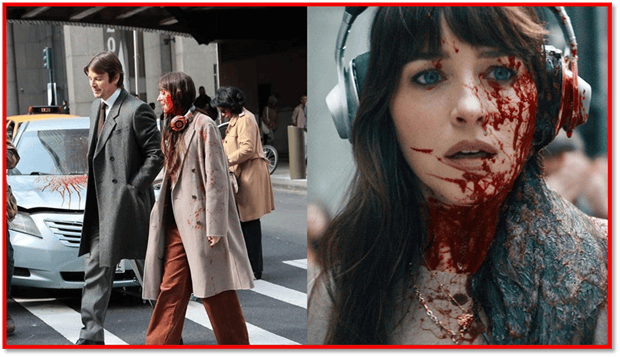
When we first meet him, he and Lowen aciidentally (or was it) meet together and are both splattered by the blood from the victim of a road accident. He cleans her up in the men’s toilet of a nearby store and dresses her in his shirt before they both set out to respective meetings – which turn out to be the same meeting, where he is setting out to commission her at the very real publishing firm, Hachette. Coincidence or plan – no matter whatever, an obvious plot device in fantasy fiction, that stains each with the blood, their bloodless murder will unite them when they kill Verity. To kill the Truth – is that what this is about? Or is ot kill the idea that truth is a unitary thing, not compromised by coincidence and the random, that only writing and reading can muddy with binary absolutes but can also, in acknowleding that it is only fiction thus wash clean with uncertainty.
The way Wikipedia tell the story of the film ends with uncertainty as a condition of the new Crawford family, with Lowen now the verity of the writer Lowen Crawford but in a life of doubt: ‘Lowen decides not to tell Jeremy about the letter and continue her new life with Jeremy, Crew, and her daughter, no longer sure whether to believe Verity or Jeremy’s account of what happened’. But it isn’t a film about ‘what happened’ essentially, which is why Bradshaw is wrong to see the end as us bing viewers who read (for much of the mise-en-scene turns to visible, and apparently lisible text (even whilst it is read out to us) as so often in the film where we sit and read the screen of the cinema or ‘through it’ the screen of a computer with the character, that screen offering sometimes a WYSIWYG picture of the original meium of the writing – as with the newspapers Lowen reads to gain knowledge of Verity’s past (for remember, she hadn’t read Verity Crawford before in any way, though she claims she had in her own interests).
So reader I saw it. I loved it. It conquered me. It may you if you don’t go and see it looking for the ridiculousness of theconventions only, but it is a reader’s film.
With love
Steven xxxxxxxxxx
___________________
[1] Paul Tassi, [2026) ‘Don’t Listen To Critics Or Rotten Tomatoes About ‘Verity’’ in Forbes [online] (10th Oct.) available at: https://www.forbes.com/sites/paultassi/2026/10/04/dont-listen-to-critics-or-rotten-tomatoes-about-verity/
[2] Peter Bradshaw (2026) ‘Review: Verity review – erotic thriller leaves teethmarks as Dakota Johnson goes back to Fifty Shades territory’ (Wed 30 Sep 2026 14.00 BST Last modified on Fri 2 Oct 2026 11.26 BST) available at: https://www.theguardian.com/film/2026/sep/30/verity-review-dakota-johnson-anne-hathaway-josh-hartnett

