What’s the most underrated life skill?
View all responses
How can a drama be created out of the fate of a boy who ‘acquired a knowledge of decorative painting and design, and graining and signwriting’ from the fag-end of a remnant of pre-capitalist values, and the sad shadows of that system that followed it. Some personal and otherwise reflections on reading Robert Tressell before seeing the Ensemble ’84 production of ‘The Ragged Trousered Philanthropists‘. Part One,being ‘My Dad’.
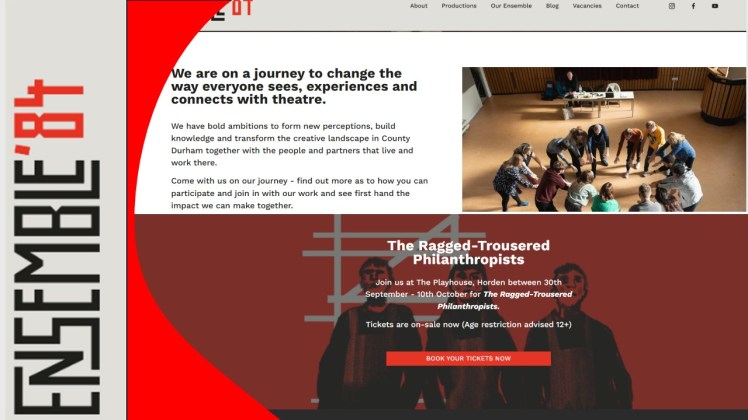
It is my habit to read and prepare to see theatre in order to increase the learning it affords me, whilst hoping that the pre-learning does not obstruct the new learning to be got from the experience I am preparing for. I can only hope this is so, for on reading The Ragged-Trousered Philanthropists again, probably for the first time right through, I am aware of much personal baggage it dredges out of my personal, and perhaps political life.
I entitled this blog in recognition of a major one of these relating to the ‘fate of a boy who “acquired a knowledge of decorative painting and design, and graining and signwriting” from the fag-end of a remnant of pre-capitalist values’ It is best that I deal with this first and so this blog is solely about the deeply personal memories this book stirred in me. That is because the ‘boy’ I think of, and whom I will try to keep my focus on in this part, is one that has layered into the character of Frank Owen (himself named after Tressel’s heroic model from Rnglish socialism, Robert Owen): my beloved Dad.
He, Douglas Bamlett by name, ran a one man painting and decorating business, originally started as a partnership named Booth and Bamlett, and named himself, though this did not apply to Mr. Booth, after his certificated registration, a ‘Master Painter and Decorator‘ and was skilled in methods not frequently used. These are the self-same skills, based on learned knowledge also, as those of Owen in Tressell’s book and of Tressell himself, though the latter was strictly designated at first a ‘signwriter’. As a Master, he employed and took seriously various apprentices who were tasked with learning but supervision, teaching and practising the basic skills of tje trade followed by those additional craft requirements.
Mainly the jobs he was hired for were high end and in luded lots of ladies who used to call the house and ask for ‘Dog’, or so it sounded to me. Being keen to preserve the dignity I felt to reside in him, I used to resist this, as I did my Dad’s proud desire to show off their listed house, Cannon Hall, to me, a devorator’s dram with its high cornices and ceiling flowers holding the lighting and reflecting the paintwork the owner allowed him to illuminate with colour.
He never became rich and died with little to his name but this book has revived some memories that scorch me now. It is a book filled with ‘Masters’, usually bastardised forms of the type with low standards and values, named, for example, Sweater, Pushem and Sloggem, Dodger and Scapit, Snatcham and Graball, Smeeriton and Leaveit, whose aim was to ‘scamp‘ jobs, engage in counterfeit trade standards and promote low quality work determined by the price sustainable in a capitalist market. Lionel Kelly in his Introduction to the Wordsworth Calassics edition (p. 12) actually reminds us that though the main caopitalist master decorator and undertaker’s realistic sounding name, Rushton, is actully also a give-away of his firm’s scamping by rushing work byvariant devious means, including the role of Nimrod the ‘Hunter’. He doesn’t go in for the obvious that I will allow myself to do: that Rushton sounds like ‘Rushed On’, the unspoken logo of the Rushton firm’s actual work practice(implement by Hunter the boss’s agent) if not of its prior claims to quality. There was increasingly no room in my Dad’s time for a master decorators skills and he hated the rushed jobs he would eventually take to keep his family together, nor for the apprentice relationship based on the passage down of the higher quality skills.
But this was the case in Tressell’s time too. The shift from the notion of master craftsmen is a theme in the book indeed. People oft point to the auto iographical aspects of Tressell’s depiction of Frank Owen. He too was trained as a master craftsmen and endured the apprenticeship system , but at its best. Those aspects of Owen’s life are described early in the book, where we learn that:
When Frank was thirteen he went to work for a master decorator who was a man of a type that has now almost disappeared, being not merely an employer but a craftsman of a high order. He was an old man when Frank Owen went to work for him. At one time he had had a good business in the town, and used to boast that he had always done good work, had found pleasure in doing it and had been well paid for it. But of late years the number of his customers had dwindled considerably, for there had arisen a new generation which cared nothing about craftsmanship or art, and everything for cheapness and profit. From this man and by laborious study and practice in his spare time, aided by a certain measure of natural ability, the boy acquired a knowledge of decorative painting and design, and graining and signwriting. (p. 85)
That is the boy that could have been an idealised vetsion of my Dad as it is of Tressell, if in a rather different way. For Tressell was not born in poverty as Dad was nor was his formal education thus stunted at thirteen as Dad’s was. Tressell named himself after the trestle tables used by decorators and spelt it phonetically, not Tressal, as his earlier publishers insisted in order to enamel the author with what they believed was borrowed class: the same publishers but as much of the explanations and promotion for Socialism for a similar reason. Tressell’s origins were from metropolitan middle class Dublin, though an illegitimate son of a married man who left his wife for Robert’s mother, Mary Noonan. It is clear that feelings of exclusion from norms went alongside this history and emerge in the domestic marriage and adultery plot of this novel – the story of Ruth Easton and the unbearable hypocrite Christian rapist, Slyme.
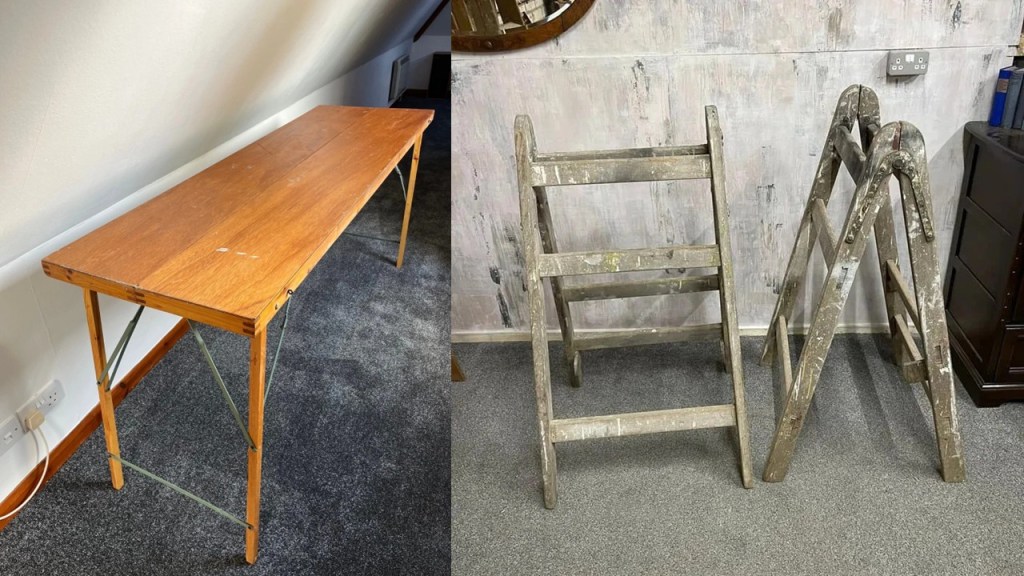
My Dad began to call the foldable pasting table a trestle table, although originally such a table was improvised by laying plank wood across standing treatles as illustrated on the left. The tables created could be used for any decorator’s task – pasting wallpaper and so on.
I will look at some of the aspects of the novel I point to earlier in later parts of this blog series (although possibly only a series running to number 2). Here I want to show that Tressell wanted to feature the idea of the degradation of the master craftsmen through the historical rise of capitalism and proletarianisation. I needed to show that Tressell did not just represent himself only in the ideal worker, Frank Owen, but his Socialist mentor – the remarkably restrained Barrington. A writer from the International Communist writes in a blog (see the link):
Barrington rather than Owen presents the full socialist case. This happens soon after Barrington “comes out” as a Socialist after a local capitalist taunts and derides the Socialists at the summer “beano” – a works outing. Fortunately, it is beyond our current remit to muse on any significance that it is not Owen, a skilled artisan, but Barrington, by birth a (petty?) bourgeois, who Tressell allows to deliver the “Great Oration”.
Let’s allow ourselves to reflect on the choice of Barrington to fulfil the mission that Frank Owen only starts. Though I am necessarily speculative, it seems to me that this reflects a kind of doubleness in Tressell’s consciousness between the artisan he invented in himself in order to marry who he wanted and reject the bourgeois style of his parents, and his awareness of his own ambivalent heritage in the bourgeoisie as a boy who came to think in Socialist rather than capitalist terms. Barrington delivers a Great Oration in the dining room of Sweater’s house in preparation, The Refuge. Here is the leaflet got up by the workers – a vast joke, but showing that even working men who supported the capitalist system knew the double standards of capitalist society and its ideological support in the Church. That they mispell their graniosing play with calling the Refuge’s kitchen an ‘Imperial Bankquet Hall’ may indicate theie inability to spell conventionally but politically it ties the Hastings (the twon Mugsborough truly was) bourgeoise to both banking capital and adventurist imperialism:
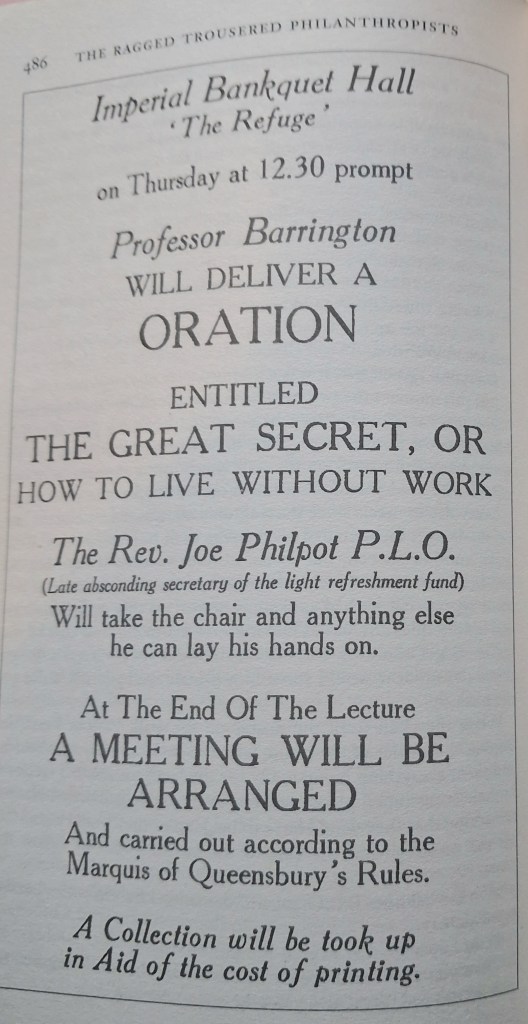
Robert Tressell (2012 edition: 486) The Ragged Trousered Philanthropists Ware, Wordsworth Editions Limited (using the 1955 Lawrence & Wishart edition using the author’s manuscript – owned by the TUC to add the elements expunged from earlier editions from 1914 – after the author’s death).
Barrington I suggest is the ghost in the creation of the ideal journeyman Owen of the Noonan boy who, had he chose so to do could have inherited the adbvantages of a bourgeois upbringing which better fit the abstruse political research that allows Barrington to flesh out the ‘Great Money Trick’ of capitalism explained by Owen, more fully and comprehesively. And amongst that fuller explanation is the history of the origins of capitalism as a means of distrivuting economic and political resources, embedded in which is a history of masters and apprentice relationships as they oughtto be:
‘When we arrive at the system that displaced Feudalism, we find that the condition of the workers was better in every way than it is at present. The instruments of production–the primitive machinery and the tools necessary for the creation of wealth–belonged to the skilled workers who used them, and the things they produced were also the property of those who made them. ‘In those days a master painter, a master shoemaker, a master saddler, or any other master tradesmen, was really a skilled artisan working on his own account. He usually had one or two apprentices, who were socially his equals, eating at the same table and associating with the other members of his family. … In those days to be a “master” tradesman meant to be master of the trade, not merely of some underpaid drudges in one’s employment. The apprentices were there to master the trade, qualifying themselves to become master workers themselves; not mere sweaters and exploiters of the labour of others, but useful members of society. In those days, because there was no labour-saving machinery the community was dependent for its existence on the productions of hand labour. Consequently the majority of the people were employed in some kind of productive work, and the workers were honoured and respected citizens, living in comfort on the fruits of their labour. They were not rich as we understand wealth now, but they did not starve and they were not regarded with contempt, as are their successors of today.
Is this historical moonshine? I think not! Indeed, the fact that the London School ofEconomics could gather together historians to look at a concept of master-apprentice relationships that were superseded by proletarianisation of the Many and capitalism (see this link) is itself indicative that the issue was alive in 2019 at least. But if these apprentice-master relationship did not die out with proletarianisation, at least in the liminal margins of trade and craft businesses, they can be explained in their marginal role in Tressell’s novel speaking of the first decade of the twentieth-century (which Lionely Kelly attempts in his Introduction to the Wordsworth edition – p. 14), and of my father’s education as a Master Painter in the 1940s, and his attempts to maintain the patriarchap apprentice tradition with apprentices up to the 1960s. Raymond Williams in Culture and Society and The Long Revolution has sufficiently explained that social cultures in work do not change wholesale as new socio-econonic configurations grow up. Cultur at any time mixes the dominant or hegemonic cultural type with elements of residual culture from the past and emergent culture of possible futures. Thus The Ragged Trousered Philanthropists, and thus my Dad, who was never a vain man and embraced ‘mastery’ as a gift to pass on, despite the fact his son wanted nothing to do with him naming his company when Booth dropped out, Bamlett and Son.
He had apprentices. Some went ont to be Masters, others to sell themselves cheaper – one would get drunk during the peeriod in which all we heard was of fortunes to be made associated with the Poseidon Bubble. He intended he said in his cups to stop listening to my Dad and take himself off to ‘Poise – Don’ as he pronounced it and make himself rich. After that Dad had no apprentice, that one turning to drink and losing his council house in the same estate as ours. The master-apprentice relationship stays a dream in Tressell’s novel. Bert White in the novel pays an apprentice’s indentures to Rushton but is used merely as cheap labour, picking up what learning he can in joy with Frank Owen. At the end of the novel, Owen’s credentials are validated solely on the way in which he ensures that Bert is not merely exploited by Rushton and forced to work in conditions that are a certain means of decreasing both his health and safety. but it is a shadow remnant of the old master-apprentice relation, that sings through the novel nevertheless, often because it shows up the deficits in the relation of other ways of expressing the employee -employer relationship (gaffer and hands, for instance).
But we might return to working conditions. My main reason for not finishing yet is that sometimes I fall into tears thinking of my Dad as a political person. Certinly I never heard him blame ‘foreigners’ for the state of the British economy and the condition of the white working classes, as is the sole resource of some current political parties and, unfortunately, the last Labour Prime Minister, Keir Starmer. But Dad;s politics did resemble those of Joe Philpot in the novel rather than Frank Owen and Barrington. He lookedaskance when I joined the Labour Party at 17, and the other way when I later went further Left than that. There was in him a kind of passivity that meant, though he saw injustices as the workers do in the novel, he felt powerless to have impact upon them, and felt that political anger was a misplaced one. When I think of the difficulties of staging things in the novel, such as some of the issues above, I also think of the issues raised by the title of the novel for that, properly understood, shows that the real enemy to the cause of socialism, often pondered openly to other workers by Owen, though not by Barrington until the terrible election campaign at the end, where the Socialists are not strong enough yet to stand, is the working-class itself. They are the ‘ragged-trousered philantropists, and that is not a good thing:
All through the summer the crowd of ragged-trousered philanthropists continued to toil and sweat at their noble and unselfish task of making money for Mr Rushton.
Painting the outsides of houses and shops, washing off and distempering ceilings, stripping old paper off walls, painting and papering rooms and staircases, building new rooms or other additions to old houses or business premises, digging up old drains, repairing leaky roofs and broken windows.
Their zeal and enthusiasm in the good cause was unbounded. They were supposed to start work at six o’clock, but most of them were usually to be found waiting outside the job at about a quarter to that hour, sitting on the kerbstones or the doorstep. (p. 408)
The workers are zealous not in the ’cause’ that is in their own interests but in the interests of those who will seek to exploit them. Their work is not that thing of nobility that Barrington’s Oration praises but one that sustains only the rotten caves and refuges of the thieves of social decency – the masters of capitalist society. And that is in part because they are decent people – for so we are shown that they are with the exception of those named not to be – Hunter, Crass and Slyme notably – especially the Lindens and Joe Philpot. Parts of the novel forgive them for their decency and we see them as glorious – how is that ambivalence to be represented (or is it to be represented at all) on stage at Horden. And one of the issues is that doing things unselfishly – and that was my Dad to a T – is itself a failing of the working class who are not Socialists, though terrible in one that was (like Barrington’s nemesis in the man who turned to support the Liberals as the best of two bad options but knew their perfidy).
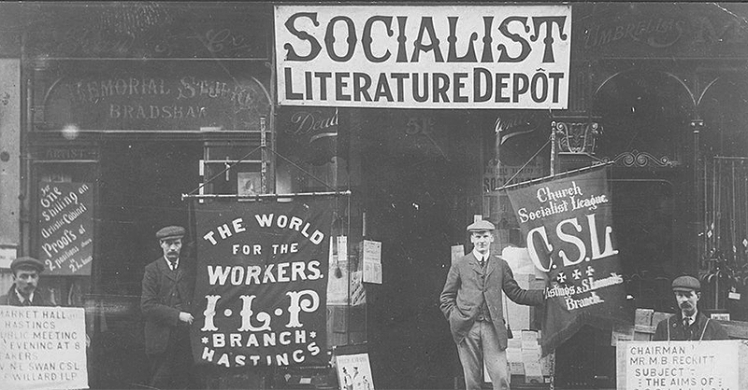
Barrington makes it clear that decency and unselfishness are not the roots of socialism and neither is philanthropy, which in the Masters is ridiculed, and in the working-class despised, for always geared to sustaining only the status quo. Here is hat he says about what Socialism is not:
‘It is not a wild dream of Superhuman Unselfishness. No one will be asked to sacrifice himself for the benefit of others or to love his neighbours better than himself as is the case under the present system, which demands that the majority shall unselfishly be content to labour and live in wretchedness for the benefit of a few. There is no such principle of Philanthropy in Socialism, which simply means that even as all industries are now owned by shareholders, and organized and directed by committees and officers elected by the shareholders, so shall they in future belong to the State, that is, the whole people–and they shall be organized and directed by committees and officers elected by the community.
To make drama of this is hard, as is the insistence in the novel that working people’s decency stops short of caring truly for their own children, a pointthat comes up so often it is hard to ignore, as the worst way to blame working class apathy is to show that it ensures the knowing passage of misery from parent to child. Here a fine example that still makes me cringe as it would my sensitive Dad:
It was a pathetic and wonderful and at the same time a despicable spectacle. Pathetic that human beings should be condemned to spend the greater part of their lives amid such surroundings, because it must be remembered that most of their time was spent on some job or other. …Wonderful, because although they knew that they did more than their fair share of the great work of producing the necessaries and comforts of life, they did not think they were entitled to a fair share of the good things they helped to create! And despicable, because although they saw their children condemned to the same life of degradation, hard labour and privation, yet they refused to help to bring about a better state of affairs. Most of them thought that what had been good enough for themselves was good enough for their children. (p. 227)
My Dad was neither the person represented as the majority here nor a Frank Owen, who had things sorted. IHe still felt there was a difference between the better-off ans the ‘likes of us’ in quality not just ‘quantity of reserved resources’ and he put up with being called ‘Dog’ by the Lady of the High Cornices – though he laughed and hated herstory that she had fled South Africa afraid of loss of capital andbecause, though she liked having servants there, she could never trust them with any food like an uncooked salad, which ‘thet touched with their black hands’.
Puzzles and sadness in this pat-blog then. I wonder if I will ever get to Part Two, which is about the homosocial and marriage in the book. Let’s see!
Bye for now
With love
Steven xxxxxxxxxx


6 thoughts on “How can a drama be created out of the fate of a boy who ‘acquired a knowledge of decorative painting and design, and graining and signwriting’ from the fag-end of a remnant of pre-capitalist values, and the sad shadows of that system that followed it. Some personal and otherwise reflection on reading Robert Tressell before seeing the Ensemble ’84 production of ‘The Ragged Trousered Philanthropists’: Part One,being ‘My Dad’.”