What’s a moment in your life that made you feel truly alive?
View all responses
There is a puzzle in this question in this prompt question that makes me ask if I find ‘a moment’ where I might be said to be ‘truly alive’, how should I describe my state in the remant of the times I scanned – falsely alive or truly dead. One of the issues in binary thinking is the search for some kind of opposite state to that being described, its binary ‘other’, although in a phrase where there there are two elements that have binary ‘others’, we cannot be sure that both are implied in its opposite – in brief if the antonym of truly is falsely, of alive is dead, then it is not the obvious case that the antonym of ‘truly alive’ is ‘falsely dead’, for indeed, in most readings to be ‘falsely dead’ is the same thing as being ‘truly alive’;not its opposite but its complement.
Moreover, it has long been an issue in art quis question: whether related to whether in possible apocryphal stories of whether Zeuxis could paint grapes that convinced birds that they were alive and a food-source of life for them, to Pygmalion who wanted his sexual partner ‘s life so dependent on him that he painted her in that ideal to find her later ‘truly alive’. There are stronger examples of artists showing that the question of whether we know ‘when one is dead and when one lives’, matters to us all sometimes. The last phrase is Lear’s claim of supposed certainty in King Lear‘s final scene. The passage he speaks starts with a certainty of his daughter being ‘truly dead’, to flash into a state where his mind, feelings and senses doubt their own certainties and look for physical evidence that she is only falsely dead, that she indeed ‘truly ives’
..... She’s gone forever.
I know when one is dead and when one lives.
She’s dead as earth.—Lend me a looking glass.
If that her breath will mist or stain the stone,
Why, then she lives.
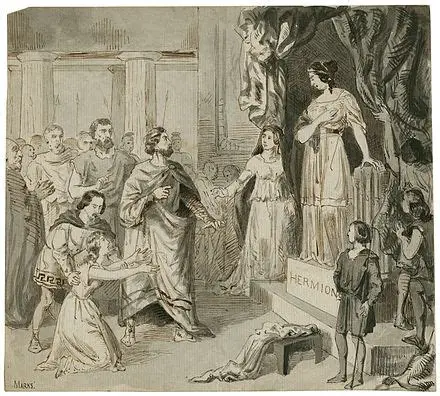
Shakespeare in King Lear does not make this a reflection on art, rather he makes his art live by achieving a moment so definitive of how life is defined by its passionate observer: as a thing of varying certainty and doubt (whether that doubt is descriptive of the thing seen, where we wish to see life, or of oneself as a life sustainable only by the certainty of life in the other). By the end of his creative life, as far as our quesses about it can be sustained, the question does become one definitive of how an artist’s art feels one sometimes with the darkest ‘arts’ of necromancy: conjuring the dead alive, most dramatically in The Tempest but most notably in The Winter’s Tale. In the final scene, the faithful courtier Paulina reveals to King Leontes, whose Othello-like jealousy led to his wife Hermione’s supposed death, that she had kept Hermione apart in a secret life until Leontes truly repented of his self-murdering passion. But she does it by pretending that she had carved a life-like representation of Hermione in a polychrome statue (how often productions misread this) – the marks of life being painted on the stone. This is Leontes’ reaction:
LEONTES
The fixture of her eye has motion in ’t,
As we are mocked with art.
PAULINA  I’ll draw the curtain.
My lord’s almost so far transported that
He’ll think anon it lives.
LEONTES  O sweet Paulina,
Make me to think so twenty years together!
No settled senses of the world can match
The pleasure of that madness. Let ’t alone.
The point could not be clearer. Art may ‘mock’ the living by appearing to be ‘alive’, but the transport of being ‘truly alive’ is in the observer, whose feeling of true life within themselves is the ‘pleasure of that madness’, that lasts too short a time in Lear to be other than tragic, where ‘the settled senses of the world’ are unsettled and made delightfully and rampantly alive! Therbare so many strange expressions of this in this magical play – insights that suggest magic is not supernatural but visceral, a clawing need for food. It takes time to like the vicious verses of The Winter’s Tale, as I discovered so long ago when studying it for A-Level English, as you find when you try to enjoy this exchange and its earthy verse, wherein Paulina speaks first, drawing leontes to bodily contact with an older who now wants him in body more than he knows he wants her:
.... Nay, present your hand.
When she was young, you wooed her; now in age
Is she become the suitor?
LEONTES  O, she’s warm!
If this be magic, let it be an art
Lawful as eating.
POLIXENES  She embraces him.
CAMILLO  She hangs about his neck.
If she pertain to life, let her speak too.
‘An art / Lawful as eating’! Doesn’t that grasp you by the vitals, as Leontes half-imagines consuming that warm flesh presented to him, though yet only making similes to show his thoughs , feelings and sensations. The cold distance of the artful verse makes tbe image more visceral to my imagination.
Now I write this because today Geoff and I are visiting The Middlesbrough Institute of Modern Art (MIMA) to see this year’s Turner Prize exhibition. In preparation I read Jonathon Jones’ rathwr good review in The Guardian (somehow they inveigled the curmudgeon to travel the ‘desarts’ of artless ‘vast Eternitie’, between Watford Gap and Edinburgh). He speaks therein of the best way to see Turner Prize exhibition, whilst still throwing in a patronising reference to the population of Northern towns, by ensuring that:
… you passionately support one of the artists and want to convince everyone she’s a genius. In this year’s show at Middlesbrough Institute of Modern Art, I felt that thrill so strongly, I want to get a T-shirt made to support my artist like the Boro scarves and banners you see around here. [1]
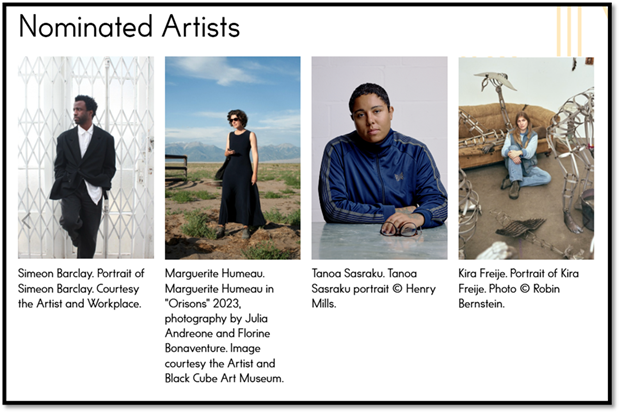
One reason for this approach is Jones’ well-advertised antipathy to some Modern artists who dislike competition as a source of value in art, but let’s say that his motives are more generous than that and glory in his whole- hearted support for his artist, for that support is voiced in ways that recall my prologue to tbis blog, as we shall see.There are, however, four nominated artists for the pri,e named in the rxcept from the MIMA website below:
He says of his choice:
Kira Freije has her own floor, separated by a tall flight of stairs from the three other shortlisted artists, because apparently the fine watery mist in her installation could damage their fragile materials. Yet setting her apart seems like a statement and it’s justified. She shows 33 lifesize statues of tragicomic steampunk cyborgs, individual works but gathered in a vaporous apocalyptic wasteland, with an impact and resonance that’s on a level of its own.
Our faces and hands, Freije understands, are what make us human: these are the only fully human thing left about her figures, as if a rogue AI has replaced the rest. They have hollow frames for bodies, hard metal replacements for flesh, bone and soul but with life-cast faces soliciting empathy. You walk among them, come close to gaze into an anguished visage or at a fallen figure desperately clutching at another’s steel ankle. This is a pathetic world where humanity is holding on as a ghost in the machine.
It’s coarse, passionate stuff, with rusty buckets of fetid liquid and a mangy sofa in the bronze steamy glow undercutting any sense of shiny futurism. This is not the future. It’s the way we live now. Freije’s cyborgs touch one another tenderly, offer support, cuddle steel-framed pets. The only surviving things that matters, says this stunning installation, are love and compassion. [1]
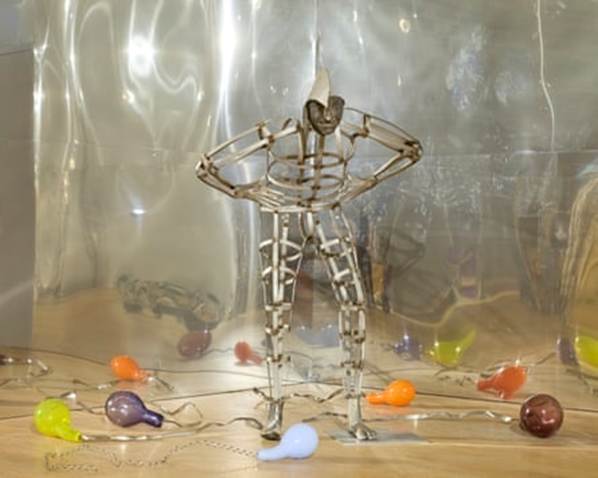
‘A pathetic world where humanity is holding on’ … a figure by Kira Freije. Photograph: David Levene/The Guardian
What makes a cyborg live? It is not the same question as what makes art live, but it is nearly so? In a world where biological mechanism is treated as mere mechanism that might as well be machine then there is more weight to Lear’s syatement that he ‘knows when one is dead and ehen one lives. Perhaps the issue with art has always been the search for ‘ the ghost in the machine’, not because we want our art to be a dark magic but because we need convincing that we are ‘truly alive’ and not only in possibly delusory moments? Is it enough to live a placid life, passively accepting the evidence of it in our ‘settled senses’ when we can feel the joy of mad revelry where our senses are not obly madly disordered but frenzied, the art of Dionysus not Apollo.
I will test that out when we arrive – we are on the way there now. In truth I was grateful for Jones review and he says, after the stuff cited above that he is ‘sorry for rushing straight to my favourite’ and that he ‘will try to do the others justice’. For me, thinking about Jones has filled my morning, but what I rite herafter will be based on my own impressions of the show while citing bits I wrote beforehand and making it clear that this is what they are. Imagine a break in time in the writing here:
______________________________________________
As I return to writing Geoff and me have see all of the exhibits but let’s start with that we saw sealed in the upstairs gallery (sealed for even the atmosphere of the gallery is curated and is part of the atwork including a pervasive damp warm mist, for this gallery as a whole containg works by Kira Freije that could be separated was in itself the nominated artwork, called Unspeak the Chorus. Titles, like much else in Freije’s work, xccoprding to her words in the tiny catalogue (an essential booklet to buy at only £3), is based opn the collection and assemblages of works sculpted, found or reproduced including the words that name the whole work and each element of it. The issue at the hear are those very words in my view after seeing – curation and assembly, with an emphasis on both the material objects that art assembles and curates and the more human meanings of assembly as community and curation as enacted caring between members of such communities. The sculpted materials include lighting effects that collate and spearate, as well as the effect of shadows that nuance the pieces in their togetherness and in their reflection on the walls that are of dull mirrors of the room’s contents. In the college below the place at which I took the severed arm sculture that hung there on the reflective wall to the right of me was where I stoosd and turned to take the other pictures that spanned the width of this part of the L-Shaped gallery:
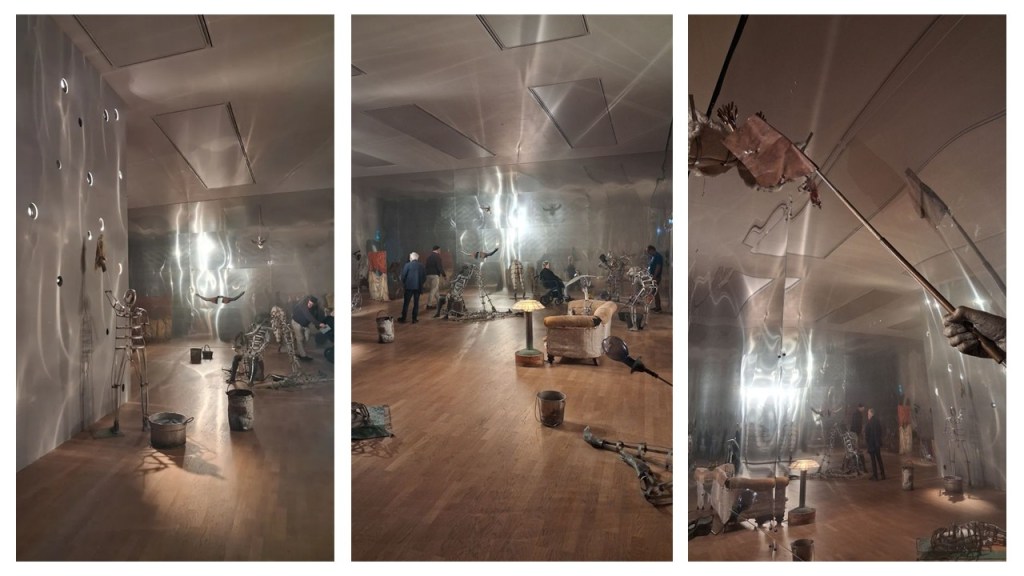
Light caught in space and the flat of the reflective walls is also refracted in the room’s mist. The unevenness doispersal creates shadows that influence our apprehensions of the sixe and vume of the figures and fill the spaces between them; sometimes to sepoarate, sometimes to cause them to cohere. This is beautiful and causes the figures sometimes to appear to be in motion, as does the fact that their assembly is from open frames and plaster casts if likelike hands, feet and faces.
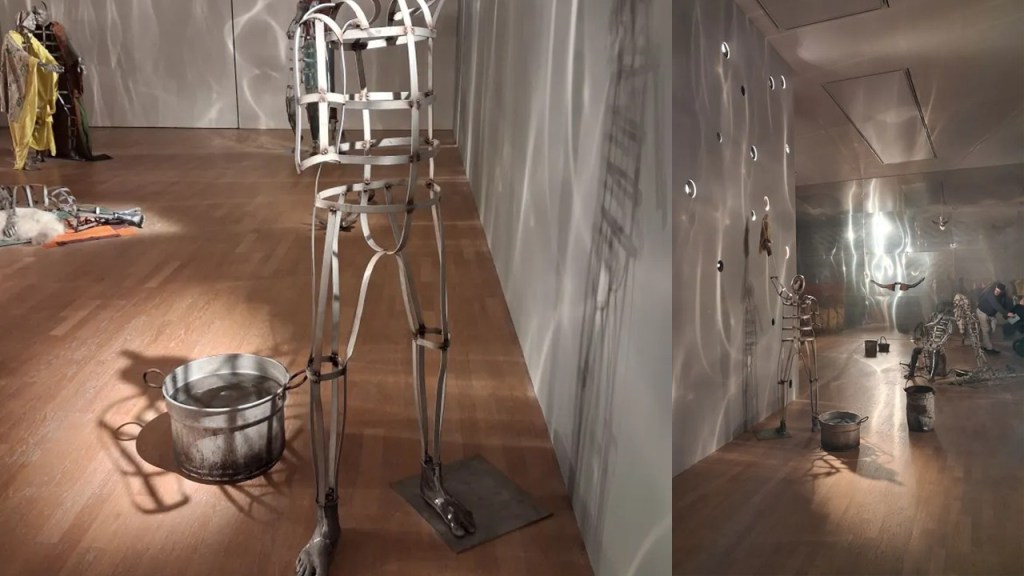
Take the figure from the left panel of the collage above. Seen from this angle he appears to be in process of washing the walls, windows or other veryical surface, aided by the bucket behind him, but see him from another perspective as you walk around him, his shadow emphasises the mechanical construction of his body space and the deadness of the flattened object to which it transforms him, here seen without the face cast which does change things as one’s eye is elevated to it.
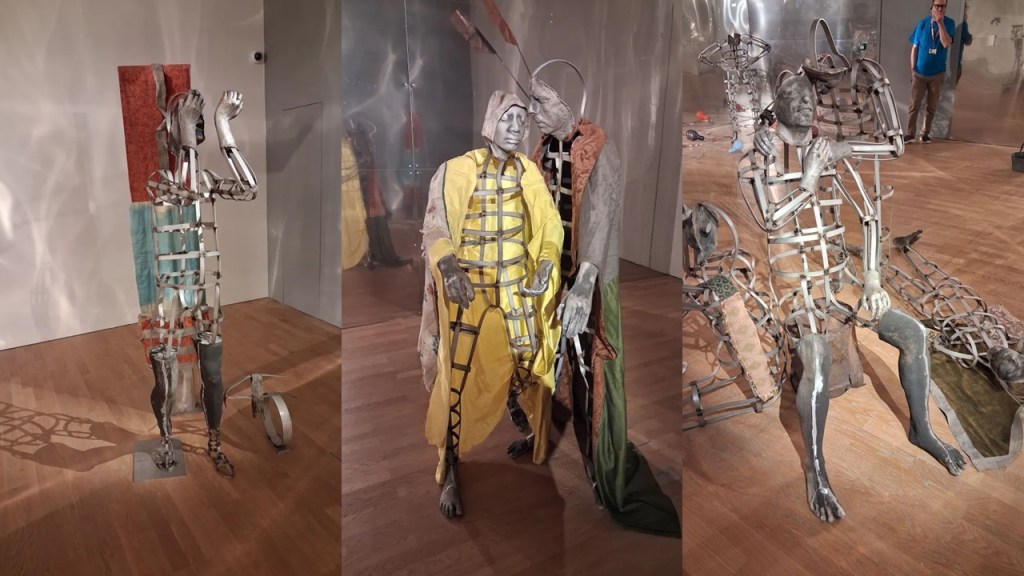
Other figure (see below) are placed next to made objects whose representational function is less certain than they, with different parts of the body being cast, as if the process of being enfleshed, or the falling off of flesah were in process. Different kinds of proximity between grouped figures suggest different meanings, often grotesque ones but sometimes the gestures of warm, loving and caring relationships.
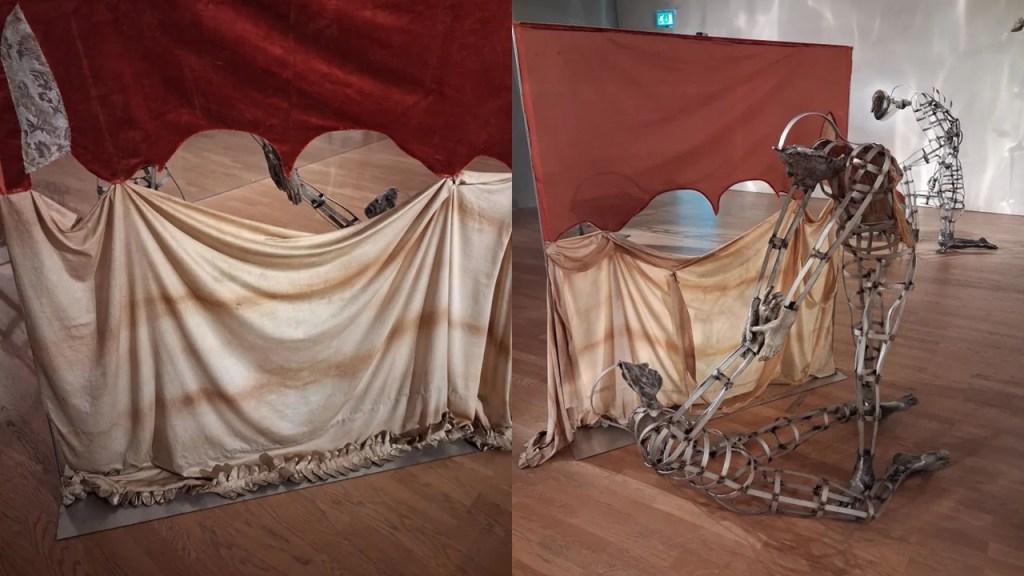
Fabrics, whether representing clothing or a peculiarity of a distinct sub-setting, sometimes hides actions, in shame or other covert purpose, but can also reveal in differing degrees of partiality and the interpretations of the represented interactions suppose. Take the bi-coloured curtain with a hole in the piece below:
At other times human and animal figures (and permanently inanimate objects like furniture) interact in a manner that betokes love or cruelty, selfish control or commonality of desired assembly.
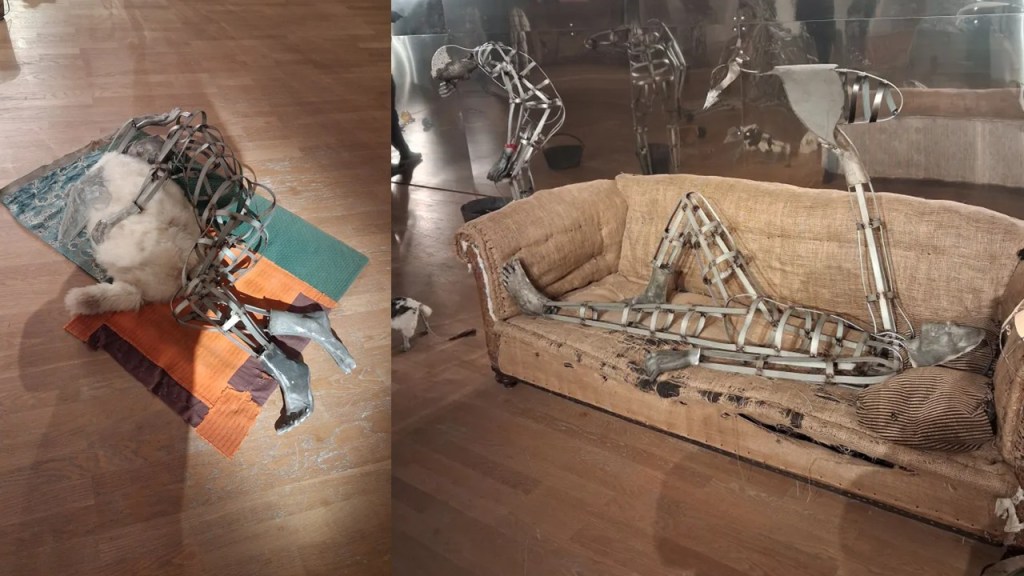
However to find only ‘love and compassion’ here as Jones does is to simplify the objects of what it is to be ‘truly alive’, which is not only a beneficent relationship between people but sometimes one of exploitation. The whole is one frenzy nevertheless, for isn’t life itself. But let’s return to some text I wrote before I saw he show – that about the three artists in the rooms on the ground floor at MIMA. Of these, before I got there, Isaid the ‘I was more or less convinced that these artists were new to me until I saw the exhibit depicted in his review of the bioform sculpture by Marguerite Humeau, for I had seen that one work before at an exhibition of ‘when forms come alive’ in the Hayward Gallery on the Southbank (see my blog on the exhibition at this link). This was the same piece that appealed to my senses and threatened its life for mine, The Holder of Wasp Venom. Yet I want to see it so much in its fabricated flesh again‘:
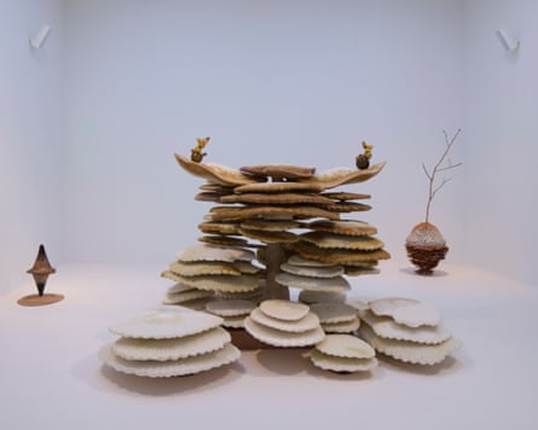
No feel of the materials … The Holder of Wasp Venom by Marguerite Humeau. Photograph: David Levene/The Guardian
I continued again before seeing the piece again thus: ‘This is despite Jones telling me that Humeau is ‘all baroque form and zero content’. He names the artwork above, still alive in my memory from that former exhibition her ‘sprawling sculpture The Holder of Wasp Venom’, ignoring its use of pre-existing forms and materials, such as “natural beeswax, microcrystalline wax, pigments, 150-year-old walnut (cause of death: unknown), handblown glass and wasp venom”, in order to find all that irrelevant gesturing to ecological cange and asserting that ‘it still looks to me like a stack of giant biscuits’ with ‘no feel of the materials, none of that intense presence of felt or fat you get in the genuinely alchemical art of Joseph Beuys‘.
There is certainly waspish venom, just as much as the sculpture itself contained material we know as wasp venom within the vials on its upper part-forms, in Jones’ summation of it. What he says lacks any appeal to the work other than to his dislike of it. That he sees it as ‘a stack of giant biscuits’ is not so much a point of view on the work but a misperception, for there is too much sense of life in this piece, if the life of a fungus or animal-life eating plant, particularly in its felt porosity and use of enclosure that seems as if it might trp what hides within it. I collaged pictures of fetails to honour it, for no-one looks at such a work from the classical perspective of David Leven’s capture of it. There is life here, if not life we want necessarily to embrace. Nevertheless, Humeau’s other work and their soundscapes failed to appeal as much as this one did then when I saw it before at the Haywardand. I disliked a piece representing a fantasy elephant with three tusks, also modelled as of a musical instrument carved from, as it looked if not in reality, the ivory that cost the elephant its life.
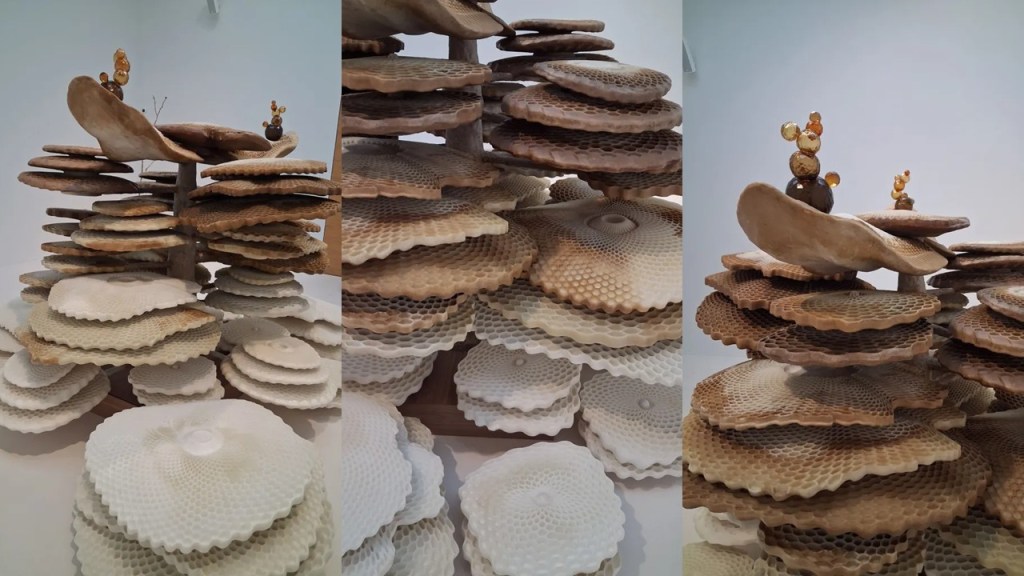
Of the last piece I will merely repeat what I said of it in the blog on the Hayward exhibition, for it is what I still think and is relevant to my theme of life, death and the agency of art:
I didn’t feel as engaged with these but behind their reflective guards which multiply them are strange works in which life-forms, biomorphic and sometimes zoomorphic, contrast vulnerable body materials with hard castings used in traditional sculpture like … Marguerite Humeau’s fantasy made of dead organic materials – woods labelled as being ‘150 years old (cause of death unknown)’, Life and death here enter not just in the sculpted soft appearances of hard artificial materials (processed metals and plastics) but in the materials themselves – some of these are impossible to see, such as the wasp venom (and even beeswax is hard to recognise as a material – especially that specifically collected in Bermondsey) Humeau uses. This notion of poison in a life-form also engages us with how some life-forms get wrongly labelled as ‘dangerous’ or ‘toxic’, when the logic of their lives is merely different. ‘Venom’ is not a word, no doubt, a wasp would use of its secretions. The beautiful work known as The Holder of Wasp Venom is surely impossible to comprehend other in its mutations to the sight. It is yet again a work where its outsides curve into interiors hiding secret dark spaces that sometimes invitingly open. What would it be to enter this ‘holder’ or ‘container’. What secrets does it keep and for how long – remember that OLD wood.
It may be that Jones merely writes waspishly as a reflection, he believes, of an ojective hyper-ctiticality but it did no favours to one’s desire to see a new artist like Tanoa Sasraku, of whose work he writes in description of them being:
like the big, brown abstract agglomeration of textures hanging at one end of Tanoa Sasraku’s room. A roomful might have been sublime. Instead Sasraku also shows a table top covered with little glass paperweights. These all hold tiny bulbous bottles and bubbles containing a dark viscous liquid – more alchemy, but this time it’s about the oil industry. I don’t want to make it sound more interesting than it is. You can only get close enough to make sense of objects at the edges of the space-hogging installation and their tininess precludes emotional or intellectual impact beyond an “a-ha!”. Once you get that Sasraku is protesting against big oil you’ve got all the satisfaction her work offers. She is by far the least giving artist here.
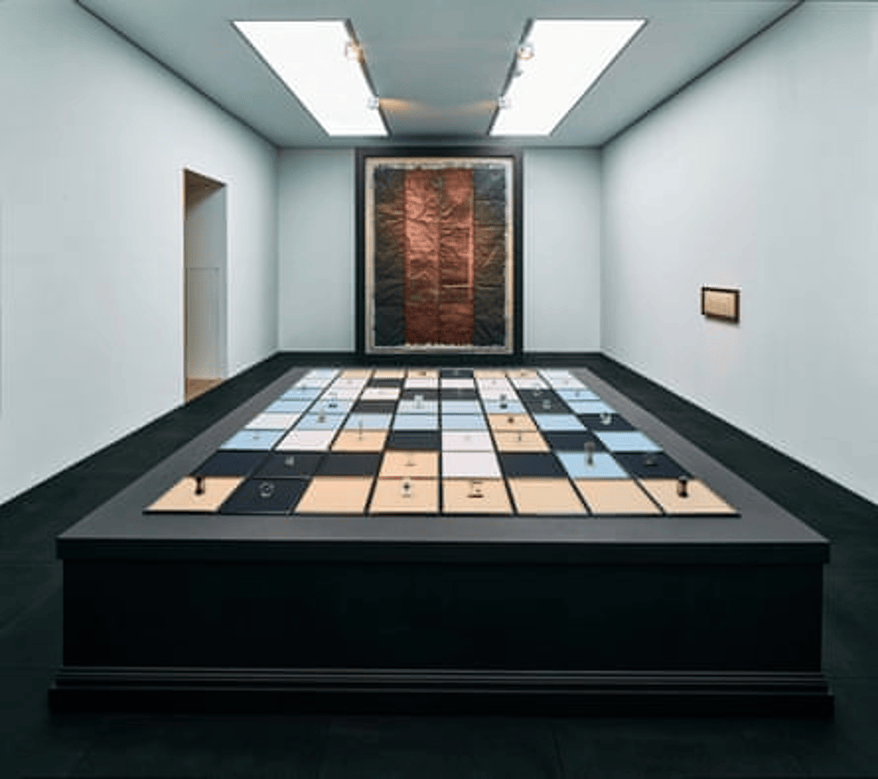
The least giving artist here … Tanoa Sasraku’s room. Photograph: David Levene/The Guardian
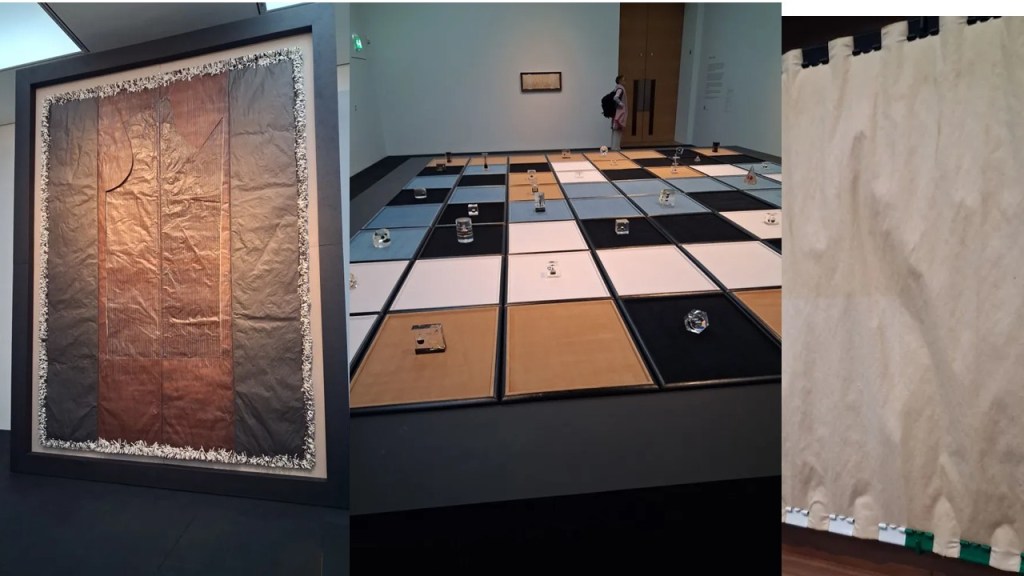
The picture above may justiofy the description but only if language is considered as a weapon used to enforce certain negative associations. I don’t think of the piece on the far wall in the picture above as a ‘big, brown abstract agglomeration of textures’, for that is to rob it of all meaning except that of and assembled mess. Texture matters in this paper as does the landscape of crease formations in the materials (actually paper in their first state) which seem soft and but are quite hard and resistant to revision when seen up close, in for instance the detail on the right below. In speaking of them the artist says they balance ideas fragility and the heavy presence of added materials that claim to protect the fragile, like the frames of the works but also the hardening solutions on the surface of softer materials. This is all very cerebral and perhaps not to my taste but worth more than the insults Jones throws around.
Of Simeon Barclay Jones is kinder and rather likes the created interior room in his gallery and its audio effects, whilst wanting more of a defined story. I can’t see that art and storytelling clarity really are necessary companions. Jones describes his room as:
…. a dramatic tableau, reminiscent of immersive theatre company Punchdrunk, that leads you past giant photographs of a man reading a tabloid newspaper – “Leave ’em to die” blares the headline – and a glowing melancholy landscape, ..
Barclay’s recorded voice declaims poetry denouncing a northern, working-class man – his father? – who lost his way in hardened, selfish masculinity. It’s visceral and haunting but a little disparate, the connection between elements loose. What exactly has the father figure done wrong, what is the specific loss Barclay laments? Maybe he should work it up into a more precise memoir or novel.
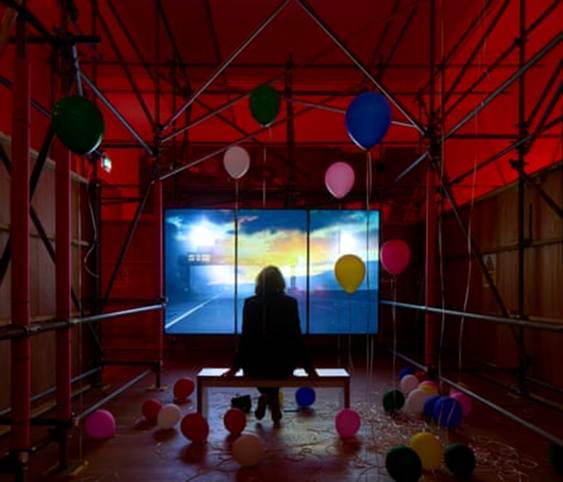
Glowing melancholy landscape … inside Simeon Barclay’s room. Photograph: David Levene/The Guardian
The accompanying picture above will mislead if you expect balloons, and Jones talks of the experience as more mobile than it is, though the room made of scaffolding where you watch the film backing Barclay’s reading of his poem about him and his father growing up in West Yorkshire, with a sub-theme of the building of the M62 across the Pennines in my living memory – I was in primary school and speakers came to tell of the engineering marvels – the stuff Barclay’s poem equates with Harold Wilson’s demand for the ‘white heat of technology’ to come to energise Britain. Jones’ description of the poem’s narrative is way off mark – identities are not singular but speak of Northern black manhood in ways that cross generations and roles. For me it was moving. The most of the film starts with a young man oin a sofa and shots of the room with its mess or ornamentation – a snow-storm piece of New York for instance, or the cheap patterned painted-over anaglypta wallpaper.
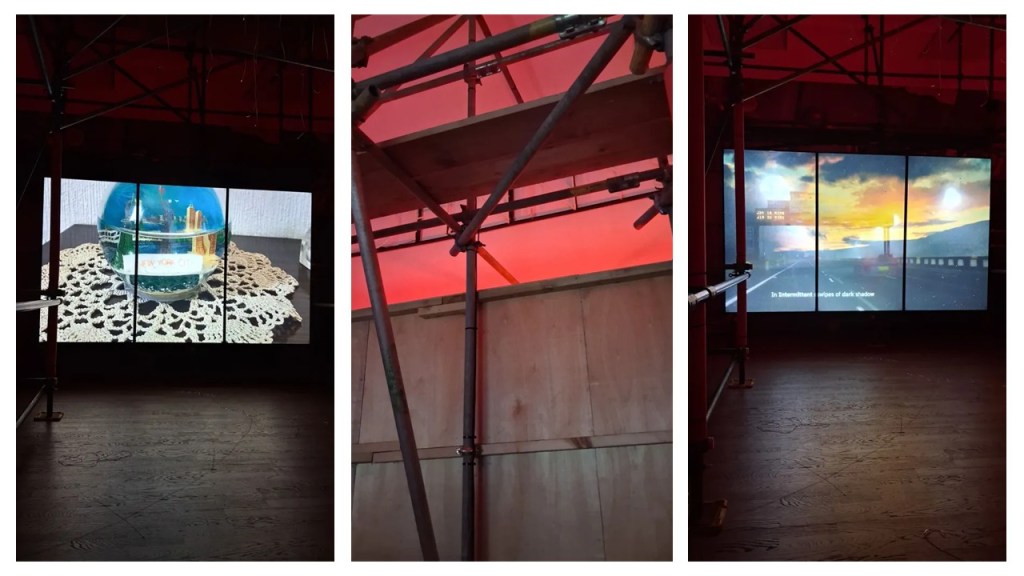
The work being adjudged is actual the original performance piece of The Ruin where Barclay reads the poem alongside the film’s scenes. The interior room has an outside where neon flashes the name Johnny’s, the name of the Huddersfield night club I still remember, and one that as young black man, Simeon Barclay was excluded. As the Johnny’s sign flashes, it does from as somethinh that is effectively excluding you as you sit in a room made of scaffolding watching the life or death of a fimed room and a landscape that may be a ‘glowing melancholy landscape’ but to me is recognisably the scene on a wet blowing night on the A62 where mud and dirt blows from the moors and closes its lanes. I could wish Simeon might win despite hating art competitions. I have to admit this is in part because Huddersfield & Marsden need their place in the multicultural world, which isn’t quite provided by Simon Armitage.
In truth the London based artist Freije is the most likely winner and I think not only because she is more easily described as in a mainstream tradition, for these works moved me immensely. See though how Jones makes them classic, saying: ‘Her gathering of lost souls could be in Dante’s Inferno: you want to speak to these tormented figures, ask them how they came to be here. And if there’s an echo of Dante, there’s also an affinity for Rodin whose Gates of Hell the medieval author inspired‘. In fact those analogies, especially that of the Gates of Hell are not very telling, even though I do agree woith Jones that ‘way of saying that ‘Freije makes art about the desperate nature of being human‘. But this is unjust if we see the statement as inapplicable to the othwer artists – they just either demand more (Humeau and Sasraku) or insist ( Simeon Barclay) that the viewer has the empathy to follow a story from a perspective outside the mainstream – the long destiny of the Windrush generation.
In the end the winner matters not at all, just because these are works that revive debate about what art is and what it is for, including how art makes us ‘truly alive’. But like Shakespeare be sure that the placid and the calm are not that in wehich one will ever be ‘truly alive’, only when in looking at the works before you they and you prove that:
No settled senses of the world can match
The pleasure of that madness
And that madness is where life is disrupted in pleasure and in pain.
_________________
[1] Jonathan Jones (2026) ‘Turner prize review – soulful cyborgs go into battle with a stack of massive Hobnobs’ at Mima, Middlesbrough in The Guardian (Thu 24 Sep 2026 12.30 BST Last modified on Thu 24 Sep 2026 17.30 BST) available at: https://www.theguardian.com/artanddesign/2026/sep/24/turner-prize-review-mima-middlesbrough-kira-freije

