What’s a personal mantra or philosophy you live by?
View all responses
Load every rift with ore, whatever the subject!
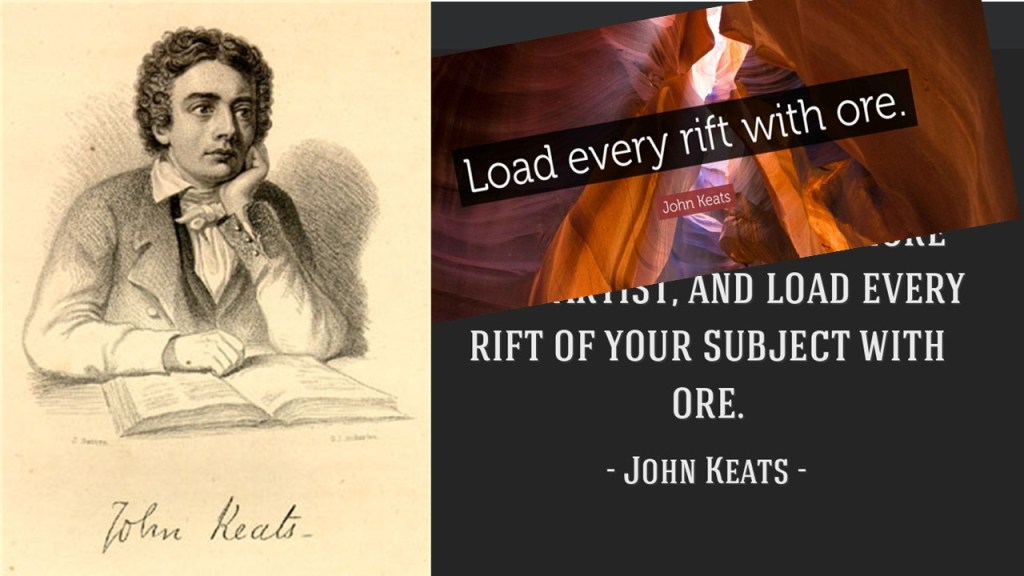
Strange! How I turn to John Keats quite a lot for guidance, though there is a lot in him with which I take issue. When Shelley, who offered Keats many kindness which he refused (a stay for instance in the poet’s Italian villa), sent him a copy of his drama The Cenci, Keats replied with fairly severe criticism of the tendency to focus on the politics of humanity and not on his art, saying: “You might curb your magnanimity, and be more of an artist, and load every rift of your subject with ore.” (Letter to Percy Bysshe Shelley – August 1820). This phrase is usually interpreted as Keats saying to a much better known poet at the time: “Turn down the left politics, concentrate on the richness of your poetic language”, and then translated into an early statement of what later English artists and scholars would call ‘Art for Art’s sake!’.
But it might not have meant that. What if Keats were actually saying that what wanted restraining or curbing was not magnaminous thought but the equation of that with Shelley’s voice – the stress in the phrase at the sentences’s beginning falling on ‘your’ not any other term- “You might curb your magnanimity, …”. And although richness might be implied by the word ‘ore’ , there are more precious meanings for the’ore’ found in rock by geologists who research it and miners who work at it, is an unrefined source of richness not the richness itself. Here is the Online Etymology Dictionary on it:
ore (n.): “a metalliferous mineral or rock,” especially one worth mining, 12c., a merger of Old English ora “ore, unworked metal” (related to eorþe “earth;” see earth (n.); and cognate with Low German ur “iron-containing ore,” Dutch oer, Old Norse aurr “gravel”); and Old English ar “brass, copper, bronze,” from Proto-Germanic *ajiz- (source also of Old Norse eir “brass, copper,” German ehern “brazen,” Gothic aiz “bronze”), from PIE root *aus- (2) “gold” (see aureate). The two words were not fully assimilated till 17c.; what emerged has the regular modern form of ar but the meaning of ora.
If Keats were being precise, he would be comparing Shelly as a poet to the maker of a natural world packing into every vcleft and gap in the earth’s upper crust, stuff that once worked upon by readers – who in truth ought more to be underground miners than skimming over the surface of the world for the sake of the beautiful feelings, thoughts and sensations with which they were rewarded, almost without effort. that is, after all, how Keats’ best poetry work – readers refine gold out of its mixtures. If this were what Keats meant – and he was a generous soul, if shy of richer more socially verbose men like Byron and Shelley – then he was also saying that humanity is served better by uneathing ore from your works and refining it in themselves – he was arguing that those who need care in the world would better get it if it came from yourselves not from the voice of a spokesperson showing the magnaminity of his thoughts, feelings and calls for action. It was a long time since I read The Cenci, but it is rather better in my memory than Keats suggests even in this generous reading of him as a critic of Shelley.
Indeed, what I get from the phrase, as a ‘mantra’ or ‘philosophy’, is that we need to look on art, perhaps even life, not for its rifts, gaps ans absences but for the ‘ore’ that could be imagined to have been put there for my benefit if I were prepared to work on it and extract from it the gold of what makes art, not merely beautiful but magnamimous. In a recent blog I mourned the deficits of Durham as a city that ought to be richer in culture than it is. But soon I have a part-week that might redemme the city, if you allow it to include its rich county, rich old in traditions that grew out of poverty and struggle. I have constructed a little festival for Geoff and myself to visit and will blog on preparation for its parts and after seeing them if the ore they yield is workable.
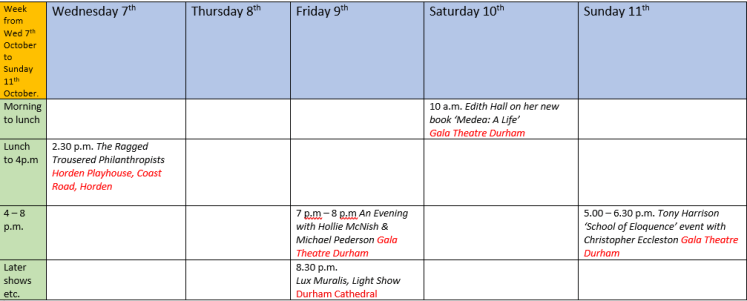
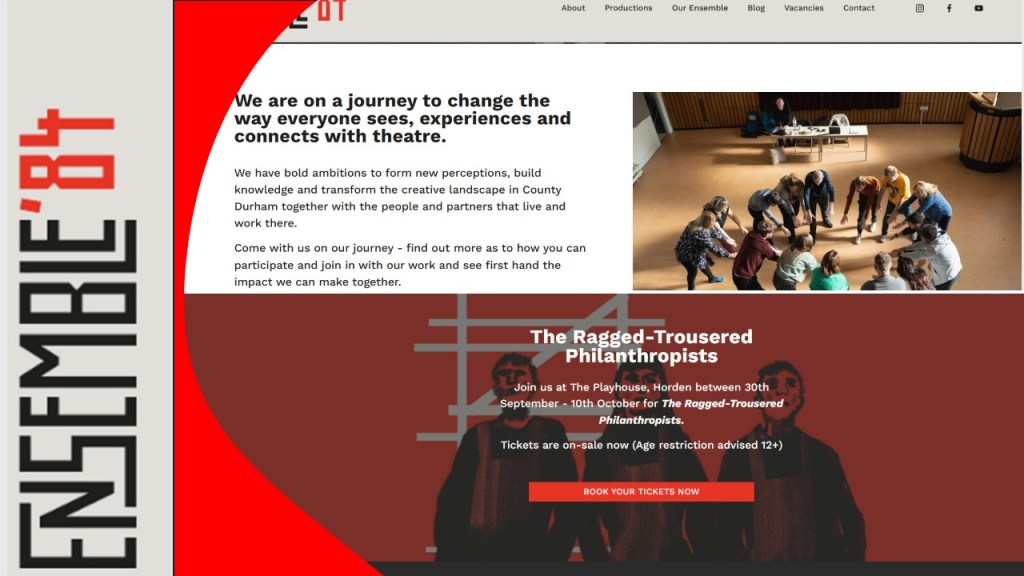
Our ‘week’ begin with uncurbed magnamininty – although actually in the tough love politics directed to an English working-calss oft found wanting in Ensemble 84’s production of The Ragged Trousered Philanthropists. I am reading the novel ans will blog in preparation.soon (yet to finish it). I am in high hope of the production from a company I know, if only since lasy year – a celebrant of working-class theatre, unafraid to plat the First Quarto of Hamlet as well as directly local-political drama – the ore truly worked, the magnaminint not of art or artists but in the hopes of justice.
I have already blogged in preparation for the McNish event (see my blog at this link).Lux Muralis are a light art company associated with larger cathedrals whom I have seen at Durham twice before. Hopefully this production, in a show based on the theme of Time (having done ‘Space‘ and ‘Storytelling‘ earlier) should blow my mind again. I am not sure here, however whether the rifts are filled by ore or whether the richness is suggested by light, filters and surfaces – though that has its own chasms in the making.

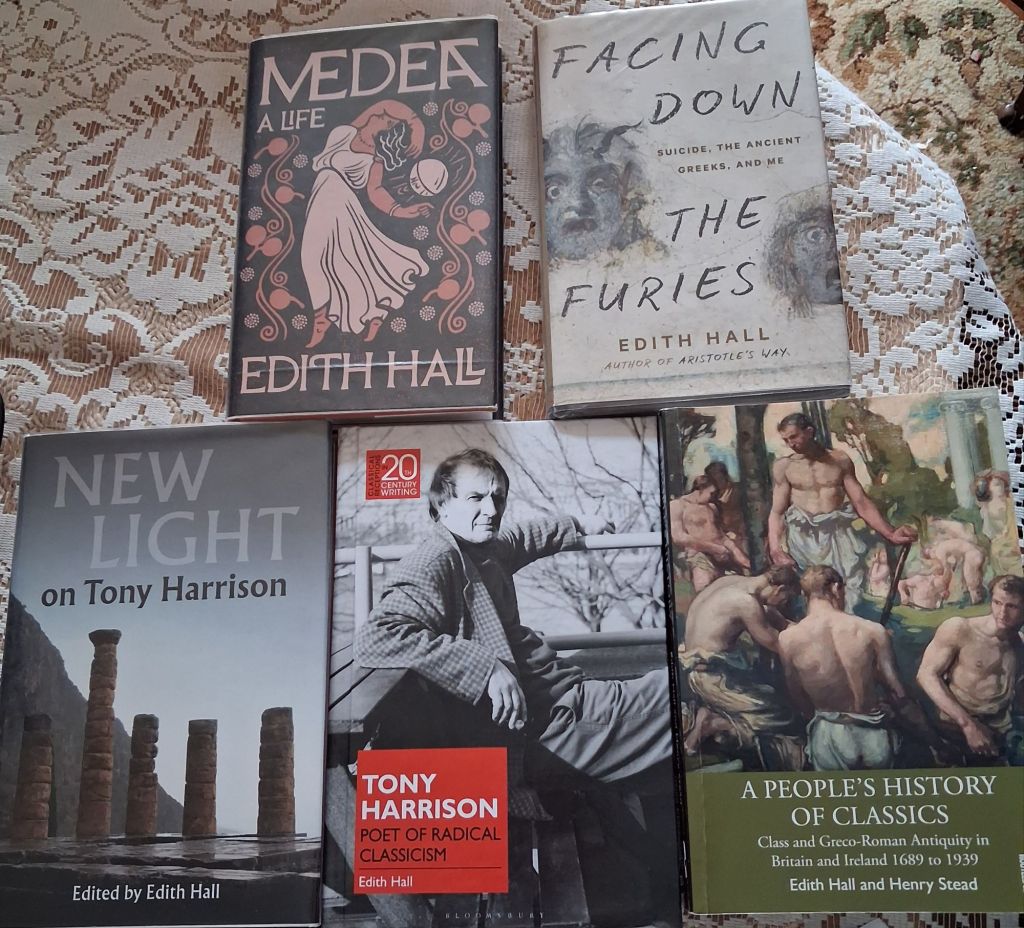
Edith Hall is a hero of long-standing though now non-resident Professor of Classics at Durham. I have a pile og her books to seek to get signed, on the classics and a common hero, Tony Harrison. I intend to blog on her new book Medea: A Life before going, as I have on many earlier ones. This takes up the strain of earlier work blending autobiography, history, the reception of Classical Greek literature and fictional biography. Below my waiting books.
The final session is a mystery although attended by Christopher Eccleston as a reader, and in honour of Tony Harrison, as loved in TheWorking Class Library podcast. I can’t prepare here but will report back:
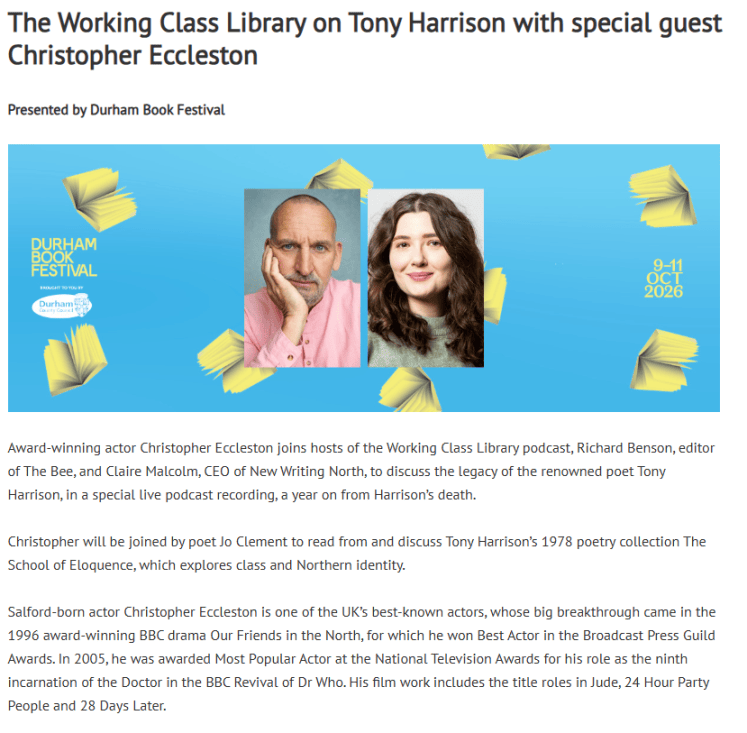
So that’s our part week. Plenty of rifts in it and of course much ore from which to discover veins of beauty and meaning.
With love
Steven xxxxxxxxxxx


One thought on “Load every rift with ore, whatever the subject!”