Do you believe in karma?
View all responses
I believe in karma, only in as much as we practice in our early life or lives what is our practise when we think ourselves grown up. Hollie McNish at the Latitude Festival said to the BBC reporter, Charlie Jones: “My poems are pretty much word for word how I’m thinking. I want people to understand them. Sometimes I wonder what I have to do just to be called a poet. I’ve been insulted at times but I don’t take it to heart anymore.” In preparation for seeing her reading from her 2025 collection Virgin and talking to Michael Pederson in Durham on Friday 9th October 2026 at 7 p.m. at the Gala Theatre, I am thinking about that question and the roots of the belief that you have to do something different than think about things in language that speak as verse, though that can involve prose poetry as well as poetry in lines, and why and how some poets are always thought to fall short of this ‘standard’.
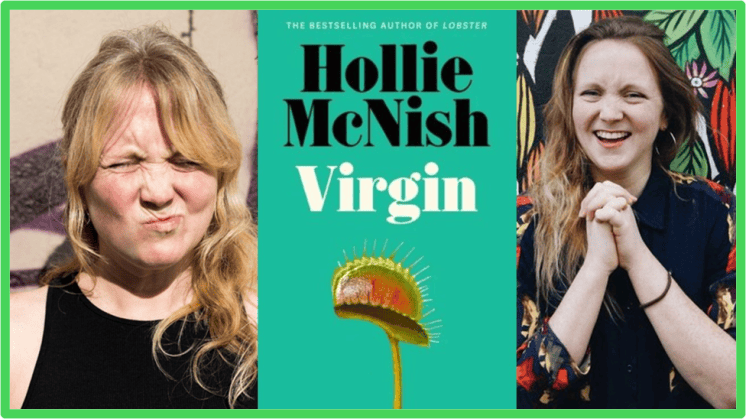
Hollie McNish at the Latitude Festival in 2026 said to the BBC reporter, Charlie Jones: “My poems are pretty much word for word how I’m thinking. I want people to understand them. Sometimes I wonder what I have to do just to be called a poet. I’ve been insulted at times but I don’t take it to heart anymore.”[1] There is a backlash currently against ideas of inclusion, which stands on the barricades that it calls ‘standards’ and will not let the excluded pass into inclusion lest that dilute ‘standards’. McNish appears to be saying that this backlash no longer works on her, and that, in order to continue as a poet, she will keep thinking and writing poetry in a way that no longer looks to the institutions of the literature and culture of the past and the status quo, with its coded words, of which ‘virgin’, in its majority social application, is one – even in the current canons of literary writing.
Hence, in preparation for seeing her read from her 2025 collection Virgin, and talking also to Michael Pederson, in Durham on Friday 9th October 2026 at 7 p.m. at the Gala Theatre, I am thinking about that question she asks. She asks, I think, why she once felt she had to try harder than others to gain recognition to be called a poet. What are the roots of the belief that you have to do something different than think about things in language that is manipulated in ways that we call verse, though that can involve prose poetry as well as poetry in lines. And why and how some poets are always thought to fall short of this ‘standard’?
There are two features of the poetry in Virgin that strike me as confronting the standards of tne past and status quo, one of which I am myself compromised in using. When I write verse, I meticulously call it verse, partly for I think it wrong to claim it to be poetry when it is not the fruit of particularly hard work. However, I would myself call McNish’s work poetry, even the proem (prose poetry) pieces. They are poetry, sometimes strong poetry, where sound and sense move beyond the function of communication alone to suggest meanings much larger than those that lie on the surface of words, sounds or articulatable thoughts, as in this from virginity: loss:
Nineteen and kissing, excitedly twitching
Toes into toes into shell-shattered sands[2]
When metaphor works it animates contexts strictly unnecessary for the surface sense of what is said – as if the passion of these nineteen-year-olds partook of the long slow but mighty forces of seas that broke down hard matter, like a shell in its wake, into granules that stand for unindividuated plenitudes of things, including the ‘sands of time’.
But there is another idea where Virgin transgresses supposed standards or could be thought so to do, that is often referred back to Keats. He is oft set aside from the worst in Wordsworth or Shelley of poetry (in fact he did that himself) that means to persuade us of an idea or doctrine not merely offer you an experience of a subject, yet unshaped by predetermined ideas – by ‘palpable designs on us’. Here’s Keats:
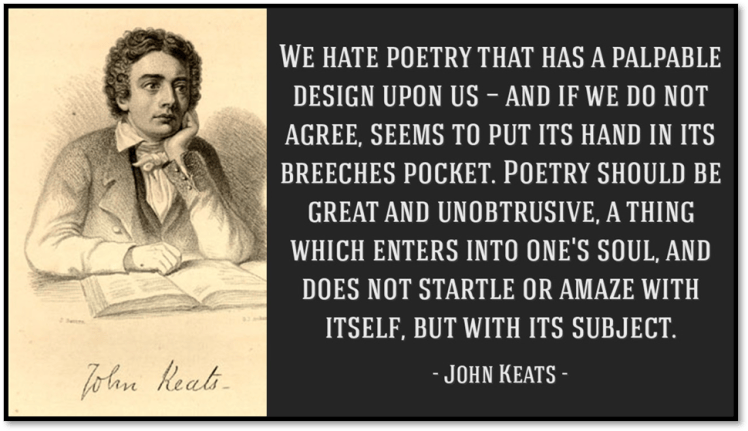
There is no doubt that McNish has an argument to put over and that an explicit value in her poetry is that she only succeeds when her ‘palpable design’ on us works and we accept her arguments about the dangers of using the word ‘virgin’ in its most usual sense – to designate someone sexually untouched (although what a ‘sexual touch’ is still left in limbo as a question). Hence her volume of poems also uses the conventions of a book. But what kind of book? It contains stories but is not offered per se as a book governed by the rules alone of storytelling. No! The book has chapters that are like the chapters of a non-fiction book with distinct ideas to convey about certain words and terms, not only ‘virgin’ but equally as important the word ‘making’ (the Makar- in English the Maker’ – being the medieval Scottish term for a poet).
Each chapter of the volume has ‘Making’ as the first word of its title, each dealing with a range of ideas that the book demands we understand them – even if only implicitly – before we try to understand that final chapter ‘Making Love’, with all its poems having that self-same title. The point seems to be to make us know that heretofore culture has been too invested in other things than ‘making’ or promoting love, or understanding that first sexual encounters are merely one of many memories that give value to lives, of different value depending upon our willing participation in them or otherwise:
1. Making Myths: From Apple Trees to Jump-Humping
2. Making Shame: Hell is Where the Hemline is
3. Making Memories: Life, Pre-loved
4. Making Laws: Wolves and Warnings
5. Making Love
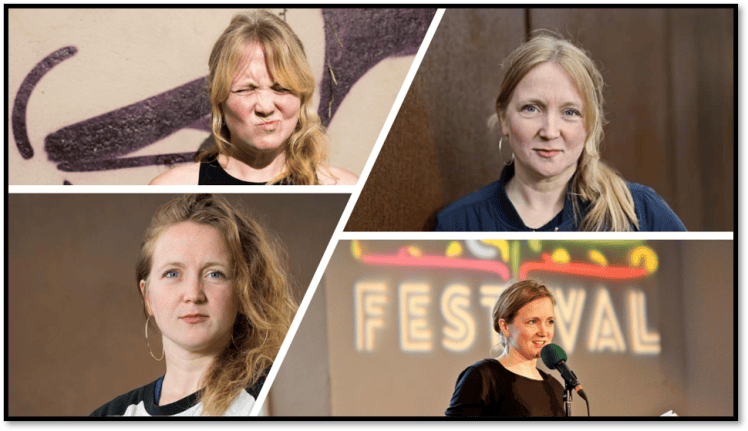
I might have preferred that chapter 3 and 4 exchanged places because the roots of sexual trauma in the current penultimate chapter might have been thereby separated a little more from the practices of making love, truly understood where intercourse is not the main determinant thereof even though it can be a part. Making love is understood better if eased into love through understanding the value of persons sharing memories mutually and freely. It is clear however that McNish will have gone through the arguments for her choice – the photographs below show a powerful cogitation on memories both cognitively and emotionally shaped.
These poems are deeply aware that the word ‘virgin’ is almost entirely used to describe a state of being that is largely applied to women not men, but that I take it is largely a reflection of the realities of the sexed-gendered distributions of power in society and between individuals. Susan Mansfield in the opening of her review of Virgin in The Scotsman (about time that title got changed!) says the following in explication of McNish’s main theme as she sees it:
The word “virgin” has too much power, and for all the wrong reasons, contends Hollie McNish in this book-length reckoning with the concept. It’s an “idea created by those in power” (not women) by which people (women) are “blamed, shamed, pressured, tortured, dehumanised”.[3]
There is a kind of feminism that is deep denial about intersectional realities in diversity – unable I think to see that ‘those in power’ includes some if far fewer women as well as men. Moreover, just as some men may be a long distance from ‘being in power’, without denying the bias of social structures to patriarchy and male entitlement to access to positions and weapons of power. And you would be misled if you thought McNish’s undoubted feminism was the same as Mansfield explicates it.
Though the concept of the ‘Virgin’ has both been used throughout history and the cycles of the same patriarchal ideologies throughout it has been used against women, as a means of inscribing the value of womanhood according to a male agenda (as in many poems in Chapter 4) especially grown man: searching for a virgin:
like browsing the library
for a book of blank pages
don’t pretend you can’t see
the appeal – only his story
to ink on their skin,
the bliss of no-one before him
potentially better, secrets
kept secret, his word
both expert and master[4]
That this is about the ownership of literature by males as an analogy of the appeal of the ‘virgin’ status of women to men, who do not wish for a woman’s educated perspective on their vulnerabilities as well as of their mastery (about which latter men have always encouraged women to opine) is clear. Later the poem shows that those in power always find ways of keeping the excluded from the ‘word’ that liberates, making it clear that those in power are those in power over ‘poor congregations / forced illiterate,…’, which must include the male excluded as well as the female for power operates too via binaries of class and status between the governed and the governor, the lawmaker and those subject to the law. That these people in power have mostly been men is not irrelevant. It is just an illustration of intersectional realities, for in fact the ruling queens in history held equal power, used quite ruthlessly, for instance, by Elizabeth I in her imposition of the Common Prayer Book against poor Anglican congregations and in restraint of female freedoms too.
One poem shows the intersections of power at work brilliantly, utilising the word ‘virgin’ to show its capacity to oppress young men too, as well as the women under them, that they oppress in order to gain supra-male status: it’s called virgins to the back. There are also poems that show that some men are the victims of men and their ideologies directly in male rape and the transformation of any hole to the glory of the phallus, as long as the person subjected to it is made to keep the secret when it doesn’t match the ideological requirement of size, strength and desirability. The key poem about the contradictions within males is the bold man-hater (although another stubble, in the world of war is equally heart-breaking). It is an anti-war poem based on the poet’s early love of Wilfred Owen’s poetry:
Most men fear for the life
Of boys they love because of men[5]
This means that these poems aren’t selling a simple ideology but the same reality where ideology and power play interesting games with each other across different domains of exclusion, though overdetermined to mould power that is for the enabled-bodied-and-minded, white, male (of course), and ruling class and not for the marginalised. There is a more potent sense of the ‘virgin’ anyway, McNish insists, one that describes ‘someone who is new to something’, but decidedly not only sex (defined in the narrowest terms as if it were synonymous with intercourse and involving necessary penetration of one body by another). She continues:
The other definition, the one which holds up first time intercourse as some pinnacle of holy judgement, I’ve had quite enough of; as a mother; as a woman, as a human.I will not be passing it on to the next generation.[6]
This is a deeply personal statement that significantly centres on the term ‘woman’, but it is an assertion that there are women who do pass on the traditional oppressive meaning of the ‘virgin’ and value it in ways they inherited it in and also transmit unrevised. It is a choice, of course, one woman,the mother of Jesus Christ, could not have made or had she done so would not be recorded but the whole point of the poem or maybe, finally, just mary? is tha it ought to be possible to glorify her even when you ‘exclude her sexual nature from her name’.[7] In that case a ‘woman’ is struggling against the oppressor in herself, an issue we could not even think about without intersectionality, wherein any position held as a human, even being a human, is also dependent on the struggle to imagine a mutuality based on shared and constantly renegotiated equality of power and how it is exercised. As a mother with her daughter, for instance. Take the beautiful poem call me, which, she apparently told Charlie Jones was written ‘after she got scared, dropping her teenage daughter at her first house party’.
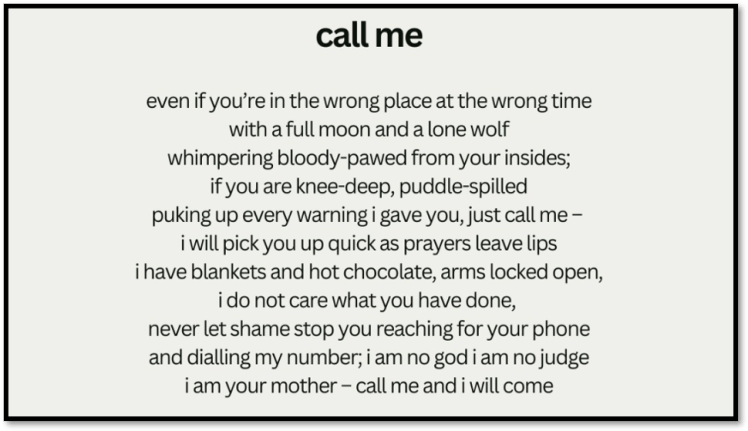
The struggle in this poem is within the voice that calls itself ‘mother’ which professes its ubiquitous availability, a rather godlike characteristic whilst denying being or even wanting to be, a ‘god’ because gods traditionally judge. Constant availability, itself an unlikely thing and certainly not proof against contingent dangers is not constant presence – it requires to be called upon, alerted in the trust of action. However impossible that promise, the real aim of the poem is to defeat that enemy called shame, which does not accept that though the enemy to her daughter may be a ‘lone wolf’ of a man or boy, that wolf that emerges in a full moon is also something that might live inside any woman even without male presence.
It is a conversation poem where a mother shapes her daughter into acceptance of realities, just like one side of the wishful hope in imaginary father-son talk, bored of my constant non-imaginary mother-daughter talks, where a father takes responsibility for the potential rapist in him and his son but asserts that Ben, the son, can ‘call me for anything at all!!’. It is a poem of satire because it is written upon a recognition of the impossibility of the situation in male refusal to know themselves, but also of hope that such a thing might be. But it is also a humorous poem about the dangers of parental control – forcing Ben to wear heaving shoes not light trainers when he goes to a house party where he might dance, so he can’t catch his prey should he become a rapist even though there is laughing agreement in the poem that this father presumes too much and is oppressive rather than helpful.
There is a love of boys in these poems too, and a sensitivity to vulnerabilities they under our present binary codes of behaviour will not own, as in the poem about the need of the penis for tender care just a penis to practise upon was all I wanted.
how to ease the foreskin back
without snapping any ligaments
there were stories of boys bleeding, screams
fists gripped so recklessly in
first fumbled wanks
the banjo snapped and never played again[8]
It is a strange little poem wherein a girl takes care of the penis as if it were her own, even though only borrowed from its kind owner but in ambiguous uncertainty of return: ‘for the afternoon or a few weeks or forever’. Again, it is a satire (for boys do not the poem presumes takes as much care of the vagina (or the supposedly receptive anus in another poem – it’s your anus, live your life) as this and force it into pain, they ought to know from their own experience of fragile links of flesh in biological parts productive of sexual pleasure or unwanted pain amongst other things.
Virgin is a volume where we learn that practice is what makes perfect but that practice needs to be about learning to respect the vulnerability of everything involved in the operation – from sexual parts to sexual persons. One of the key learning parts is practicing to hear and say ‘no’ (see practice page).[9] Hence the poems make a lot of play with masturbation robbed of shame or surveillance (imagined or otherwise) or the extension of that into mutual sexual practice which is mainly about learning how pleasure not pain is evoked and mutual consent ensured. It is written so we feel the pains, pleasure, the permission to practise and the warnings against what turns practice into abuse (of the other – especially women by men – or the self). The unequal balance in the poem skewed across the page called exchange rates with its painful ligament of a caesura: ‘clitorises and penises insecurities and shame’.[10]
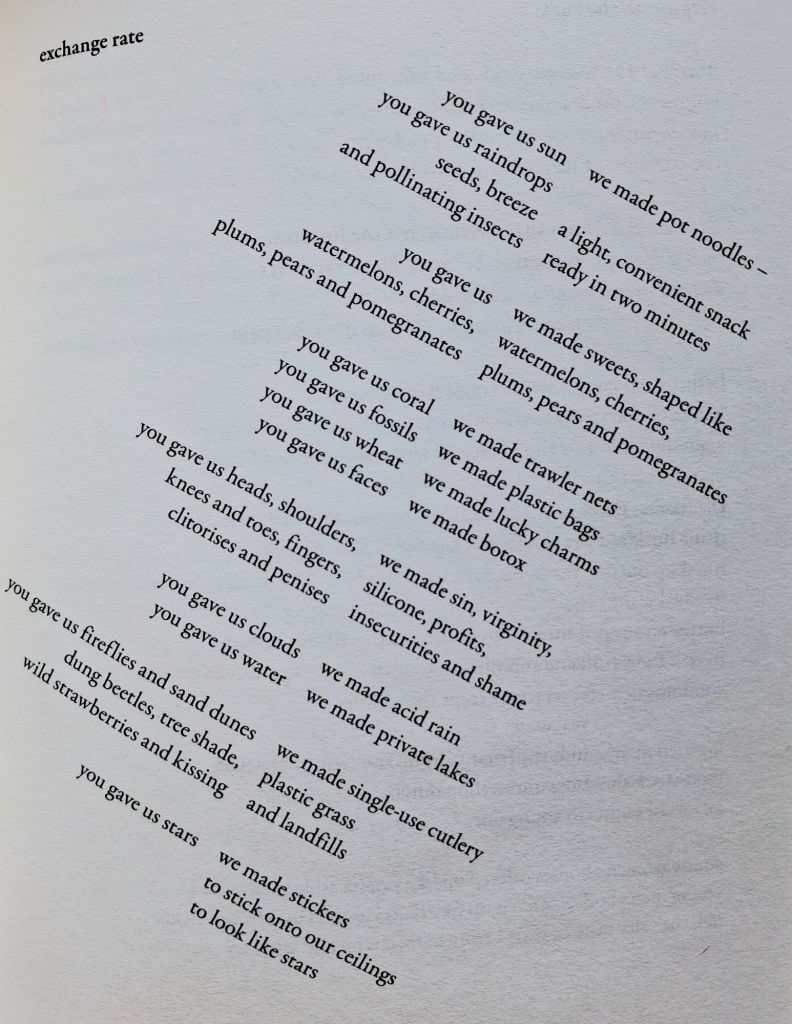
Having stood apart from Susan Mansfield’s take on the work earlier, I ought to quote a bit that gets the poems exactly right, if we forget that she does not see that they can be addressed to men as they might be as well as to the ‘insecurities and shame’ they don’t show, in a non-binary way:
She’s funny and tender about being a teenager, a first kiss “sunbrellaed by the low white blossom” of a hawthorn. After losing her own virginity, she describes hilariously coming home to eat mashed potato with her family, fraught with worry that the change is somehow obvious.
…
Beneath the marshalled arguments and conversational musings, there’s a deeper current about innocence and experience. One of the first poems is about snow, which returns us to a state of childhood exuberance. 3
Some of the poems about heterosexual sexual practice by women actually with real men (for imaginary mens are often safer in these poems, however soulfully soppy the boy seems) are beautiful as Mansfield says. And to Charlie Jones, McNish agrees with a similar proposition:
“My first attempt at intercourse was nice. It did not hurt, as rightly it should not, no matter the horrendous narrative about first time pain being some sort of marker of purity. I lost nothing except a sandal,” she says. 1
If practice is better than authority ‘from centuries-old teachers’, as she names it to Charlie Jones, then Keats’ warnings of ‘poetry that has a palpable design on us’ seems less straightforward that it is to people who make law about literary writing from it. McNish does have a ‘palpable design’ but many of the poems are about the failure of those people with a ‘palpable design’. She wants to teach, she wants to take responsibility for how girls are and behave, especially her daughter, but wants to free them to experience too, so that rather than put her ‘hands in her breeches pocket’ (when she wears these) if readers disagree, she makes them practice making love, showing it can be made as interaction where ‘sex’ as we think of it) is not there as when it is, or when it’s in a form chosen above ‘forms’ mutually, bit even in making poems of everyday thought as a kind of love:
All the touches
That turn me to art[11]
Even Keats struggled to load every rift with the ore of sensation as much as in those simple lines: ‘great and unobtrusive’: that does not ‘startle or amaze with itself, but of its subject’. Whatever Keats meant by those abstruse words, I think McNish heard him. She is a good poet not just a poet. I am looking forward to listening to her on the 9th October. Why not come and see her for yourself, for she has broken through many glass ceilings to get there in order to ‘startle and amaze’ us. That will be good karma!
With love
Steven xxxxxx
[1] Charlie Jones (2026) ‘Virgin, by Hollie McNish: Hollie McNish says she has always found the concept of virginity “weird and kind of frightening”’ BBC Online reporting from Latitude Festival (26 July 2026) available at: https://www.bbc.co.uk/news/articles/c0jl8jv22gjo
[2] Hollie McNish (2025: 27) Virgin London & Dublin, Fleet
[3] Susan Mansfield (2025) ‘Virgin, by Hollie McNish review: ‘angry, funny and explicit’’ in The Scotsman (22nd Oct 2025, 17:19 BST) available at: https://www.scotsman.com/arts-and-culture/books/virgin-by-hollie-mcnish-review-angry-funny-and-explicit-5371258
[4] Hollie McNish, op.cit: 101
[5] Ibid: 112
[6] Ibid: 36
[7] Ibid: 56
[8] Ibid: 44
[9] Ibid: 107
[10] Ibid: 333 as my photograph below it.
[11] Ibid: 139


2 thoughts on “I believe in karma, only in as much as we practice in our early life or lives what becomes our practise when we think ourselves grown up. This is really a blog in preparation for seeing Hollie McNish reading from her 2025 collection ‘Virgin’ and talking to Michael Pederson in Durham on Friday 9th October 2026 at 7 p.m. at the Gala Theatre”