What are your strategies for SEO?
View all responses
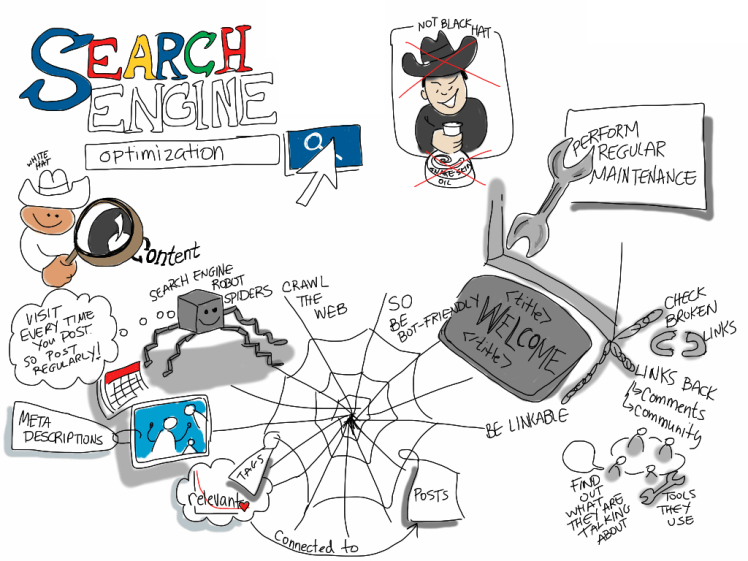
Above is an infographic by Giulia Forsythe, created for the Wikipedia page on Search Engine Optimization (the full formal name coded into the acronym SEO). It is thought by many to be thought too binary (hence the advent of grey hat strategies in the continuum between black and white hat extremes) and perhaps an outdated metaphor by others. What it certainly is, however, is a means of typifying or stereotyping’strategic’ models of ensuring that the interests of a single user of search engines created by huge capital hungry corporations, are served. Those corporations are often referred to by naive users as if they were only one (as Google in terms like Googling) but they are neither a monopoly nor cooperative between themselves as users.
The algorithms which are used to drive the engines and its varied functions are most often kept secret as commercial secrets, replicated often indeed, but not through overt sharing but rather by reinvention, backwards from its observable features to those that are kept secret, coming up with similar structures for the same function.
All small and large scale users of the web are assumed to have an interest in ensuring their visibility amongst a huge audience of people searching for data to guide their fulfilment of their needs as consumers of goods, services, including guidance in matters of truth, beauty, opinion or fashion.
The assumption however is fashioned into a model of competing self-interest wherein whatever the service (from selling to the dissemination of persuasion about an issue relating to politics, art, science or folklore- right down to the increasing retail of ‘fake news’ or claims that others retail ‘fake news’) is thought to need control over the specific algorithms that skew the visibility and accessibility favouring one or the other, either in terms of their direct competition with each other over the same goods, or as uses of scarce end-user time resources.
Bloggers with WordPress can be thought of in this economy of competitive interests, each competing with each other to harvest readership and professions of estimation (likes and recommendations) but if thought of like that, then various other issues follow in train as things necessary for a blogger to consider. Many of those considerations are in Forsythe’s infographic above. I asked Google AI the question about SEO for a blog. Here are its recommendations, not based on blogs of specific content, based on the websites it optimised for best use for attracting ‘organic traffic‘ (a term referring to users of search engines that ‘visits that come to your site via unpaid (i.e., “organic”) search results’. The aim is to make yourself immediately identifiable by the search engine:
Optimizing a blog for SEO means structuring your content and site so that search engines can easily crawl, understand, and rank your pages to attract organic traffic.
1. Keyword Research & Search Intent
• Target Long-Tail Keywords: Focus on specific 3-to-5-word phrases or questions that match what your audience is searching for rather than overly broad, high-competition terms.
• Match Search Intent: Understand why the user is searching (informational, how-to, or transactional) and answer their core question clearly and thoroughly.
• Use Research Tools: Find low-competition keywords using tools like Google Keyword Planner, SEMrush, or Ahrefs.
2. On-Page Optimization
• Title Tag: Keep your title under 60 characters and place your primary keyword near the front.
• Meta Description: Write a compelling 150-to-160-character summary that includes your target keyword and entices clicks from the search results page.
• URL Structure: Keep URLs short, lowercase, and hyphenated (e.g., ://domain.com) with a primary keyword included.
• Headings (H1, H2, H3): Use a single H1 tag for your main post title containing the primary keyword, and organize sub-sections logically using H2 and H3 tags.
• Keyword Placement: Introduce your primary keyword naturally within the first paragraph and weave related LSI (conceptually related) keywords throughout the body.
3. Content Quality & Structure
• Depth and Clarity: Write comprehensive, people-first content that completely answers the user’s query with accurate, information-dense text.
• Readability: Break up large blocks of text using short paragraphs, bullet points, numbered lists, and bold highlights.
• Visuals & Alt Text: Compress images, give them descriptive keyword-based file names, and include descriptive alt text for accessibility and image search.
4. Internal & External Linking
• Internal Links: Link readers and search engine crawlers from your new blog post to other relevant, older posts on your site to build topical authority.
• External Links: Cite reputable, authoritative external sources when referencing data, studies, or industry benchmarks.
No doubt much of this advice is industry standard and built into host sites that offer bloging sites. WordPress offers tools to every blogger to use tags, as meta-descriptive adds on to blogs. I use them because they are there, suggest themselves to me as part of the act of mounting a blog which I would have to chose to avoid. However, I don’t use them optimally by the standards set in any conscious way ot as the result of a ‘strategy’. For instance I don’t steer clear of my own eccentric neologisms, almost bound to create uncertainty about the topic covered by a blog, nor do I always use tags as direct markers of content, but sometimes as flagged ironic labels to my attitude or approach. Again this can’t be seen as optimal in the way SEO understands.
Though I use referencing it is a mix of academic, journalistic and sub-academic types, with references intermittently to the dodgiest of websites and sometimes the most subjective sources. This could not but be but seen as a rather poor approach to an assured quality of approach. Worse still, is that I so rarely think of an audience I want to attract but rather of the service to my own learning irrespective of readership. Hence I don’t check systematically that the language I use is accurate, valid, appropriate or scores high in estimations of readability and/or accessibility (sometimes glaring typos or inversions of sense get missed). Were I to get more written feedback I might try harder in that respect but perhaps I may have alienated that potential: after all, there is a kind of chicken and egg situation here.
And, as for use of other well optimized sites to increase linkages by mutual reference, that too has gone by the board, and that too may have gone by the board as this chart showing how Google ranking algorithms might assess quality by co-usage or otherwise in tje relationships between pages. Don’t rey andd understand the chart below (explained on Wikipedia). I think just by looking you get its obvious drift. Size of attraction is clearly related to the connection of others to you and sometimes mutual connectivity. The more you fit in, the more you’ll cut the mustard!
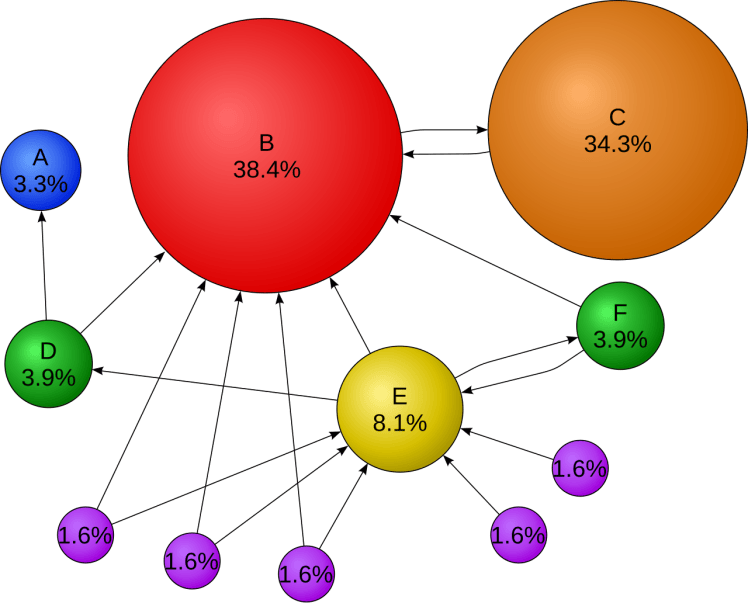
However, that isn’t the point that interests me. My point is based on a wider concern. Namely, should we want to fit in with undeclared agendas scripted into computer algorithms that are decided by others, and who who then keep these instructions, and the agenda driving their decisions about it, secret. In a world increasingly dominated by a framework of dark leadership by the moguls of self-interested social media creators, I still think in old-fashioned terms, and assert that our strategies ought to be aimed at surviving within that system (whose survival in its own terms seems certain to it) with some scrap of personal integrity.
This is not an attitude of rebellion towards a system that is hegemonic in the world of communication but a vague resistance to being moulded into the status quo of both overt agendas of the ‘Tech’ companies and their less obvious effects, often in lowering the evidence base for what we call truth or fact and for overwhelming human capacity for curation of inputs. However, to say I have no ‘strategies’ for SEO is infantile, because most of them are well built into secondary sites I use, whether search engines or retail outlets (the ever powerful Amazon), Word Press or even sites curating academic and research evidence. I will be implementing many strategic approaches to searching that I am not even aware of. The point is we need increasingly to be aware of that unfortunate truth.
Bye for now
Love Steven xxxxxxxxx

