What does it mean to be a good person?
View all responses
You know one when you see one being ‘good’! A blog on seeing, hearing and feeling together with Christopher Eccleston reading Tony Harrison. A reflection on viewing hoiw ‘The Working-Class library’ makes its podcast on Tony Harrison’s acceptance into the library for ‘The School of Eloquence‘.
The following verse refers to the detail from my photograph that follows it.
From this distance and in this light,his face
Is whited out by thick brightness. The  voice
Of class falls to the look of  some fine trace
Of our 'common' origin: there's no choice

In the fall of his creases from arse
To floor. It's primarily history:
Not some kind of secondary French farce,
But the march of unended mystery

Of the art that's in  embodied man,
Good because he says 'I am that I am'.
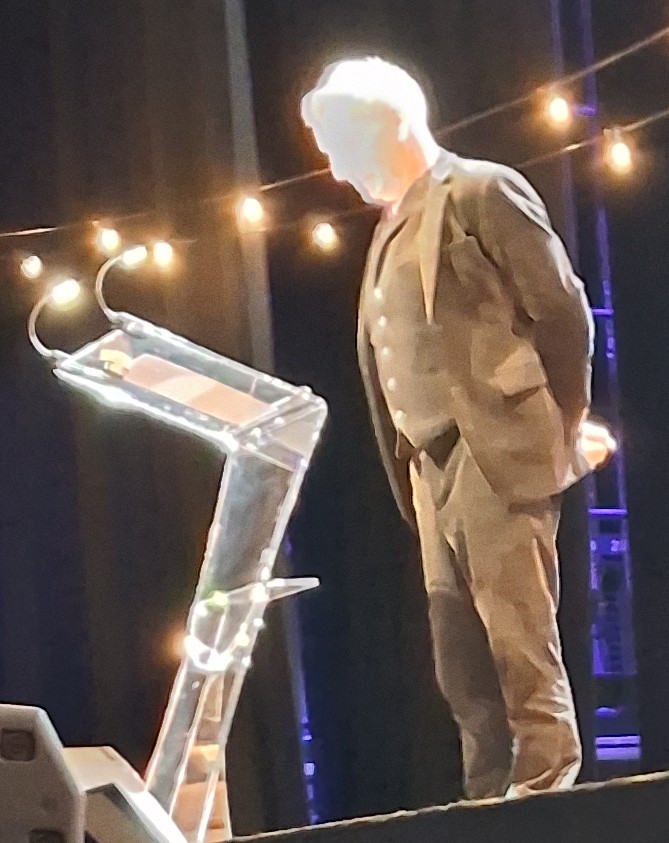
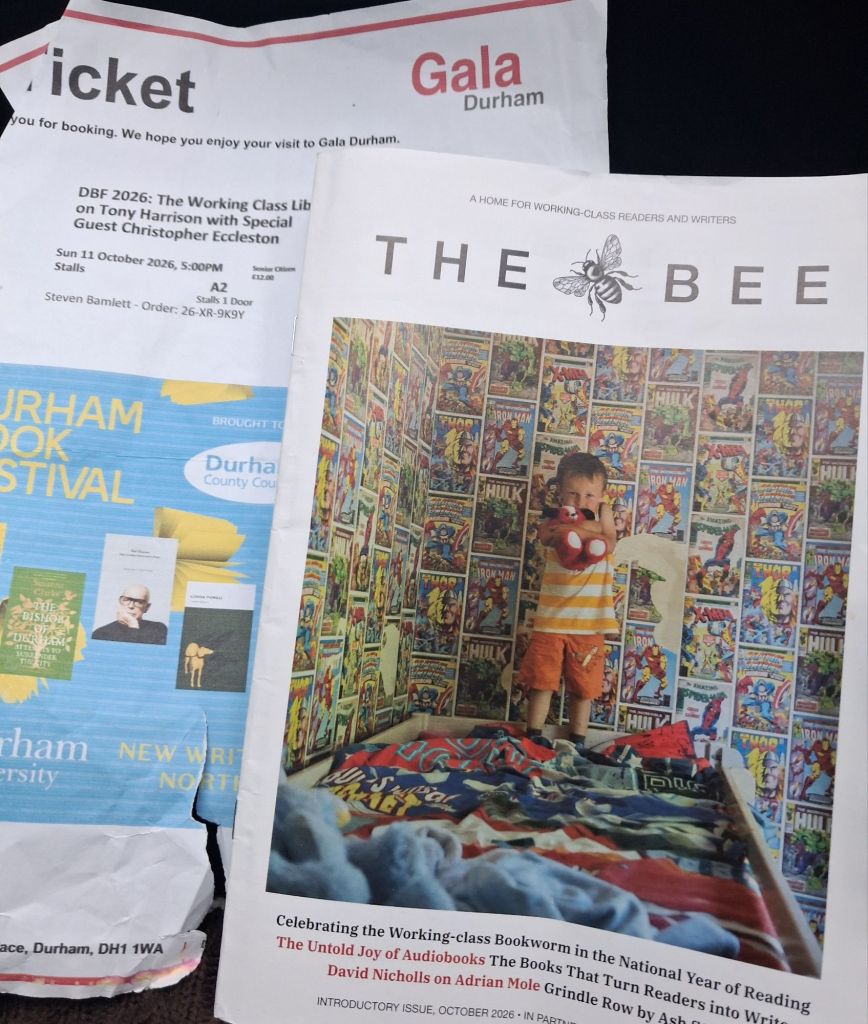
The verses are about a moment stolen impertinently by photograph (but from some inner identificatory necessity) from Christopher Eccleston‘s appearance on the stage at the Gala Theatre, where he appeared in a recording of a podcast for The Bee magazine. The podcast forms part of its project for a series of books to be tested for the Working Class Library (a kind of abstract invention in reality unlike that real one in Manchester) in podcasts with invited guests. The invited usually include the author of the book being tested for acceptance (see this webpage -at this link -for the back catalogue of those podcasts). In this case the author Tony Harrison, and the book The School of Eloquence were not able to be there.
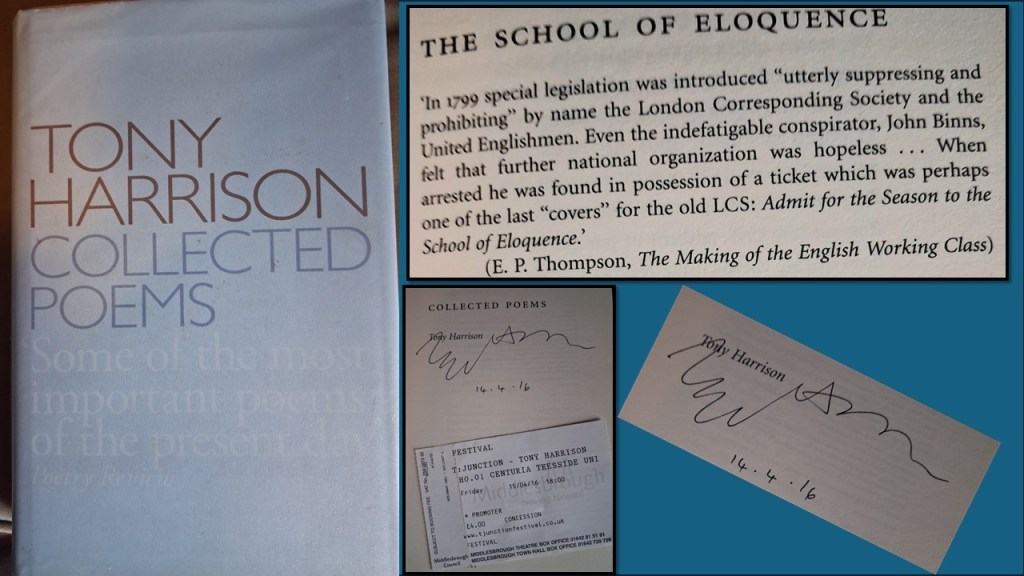
Tony died, aged 88 in September 2025. The last time I saw him alive was at an event at Teesside University where he signed some of my copies of his books including his Collected Poems, giving an incorrect date for the event as you will see in the collage below. The memory is precious to me, for he was one of tbe few hero poets and artists I follow who died, as he lived, a rebel and a socialist. As for The School of Eloquence, it isn’t really a book.

Tony Harrison
I asked Google AI if it was a book. It said:
Yes, The School of Eloquence (originally published as From ‘The School of Eloquence’ and other poems) is a collection of poetry by the English poet Tony Harrison, first published in 1978.
….
Later Editions: The sequence expanded over the years, including later collections like Ten Sonnets from the School of Eloquence (1987) and Continuous: 50 Sonnets from the School of Eloquence.
As you see, you will find no single volume book solely entitled The School of Eloquence exactly. In some way or other, all of the candidates as this book, apart from the section in The Collected Poems, are entitled as being ‘From‘ that abstract and constantly amended collection, partly because it was only ever a project in the poet’s head. Of a sense of it being complete, no-one can be certain, perhaps even the author before his death.
The idea anyway comes from a kind of code that Harrison took from another great Socialist work, E.P. Thompson’s The Making of the English Working Class, a classic in the history of definitions of the concept of class. It related to the name the radicals banned by successive reactionary government’s of the end of the eighteenth and the early nineteenth century, to whom even the most limited of moves to democracy was to be resisted, and which he quotes as epigram to the section of The Collected Poems.
That established, I wonder about the verse I wanted to write and that I display above: these words about the stolen moment of a distant photo taken from a strange angle to be invisible to others – for they come from a feeling of intense love felt for the man on stage that might still be an appropriation of something and someone not meant for me to interpret.The feeling, however, is intensely personal, like that I feel for my father and the other fathers (working-class Dads) celebrated by the speakers last night in the recording of the podcast. All this network of feeling is based on an interpretation of a man less apparently obsessively careful of his appearance tban other senior members of his profession. Eccleston, let me say first before any more of my speculations, is too young to be my father, being indeed ten-and-a-half years younger tban I. He looks here more like the idealised elder in my mind that might seem, to my imagination alone, the embodiment of a Harrison Dad, but only because of the distance, perspective and blurred focus of the detail.
Perhaps too as I took the photograph, for I had tears in my eyes that were unusual for me to have in public, his look as a fgure took on the abstraction reflected from the words of the Harrison poems he read, most notably Them & [uz], which he read twice. He only did that in beautiful, deeply valid, and authentic enactment, egged on by chair, Claire Malcolm, in order to get Tony’s words right, for the love of them and for the poet’s memory. Did he embody, for the sake of the poet and the feeling of familial and class reverence it comes from, that feeling sons in Harrison have for their fathers when they realise they might, in the past, have diminished them in memory and in their process of class alienation via the mechanism of ‘books’.
In the panel, this raised a debate about the fallacy of seeing Harrison’s working class imaginary figures, even the drunken teenagers in V, as ‘inarticulate’; a point Richard Benson, the Editor of The Bee and novelist, thought patronised the working class and misread their communication in language, so often different to middle-class articulacy but no less complex than it. This is a point made long ago by Harold Rosen, father of artist Michael Rosen, in his oft forgotten attack on Bernard Bergonzi’s theory of the ‘restricted codes’ that he used to chracterise working class children’s disadvantage in established educational models, modelled of course on middle class codes but not because they use more ‘elaborated’ coding or are more articulate per se. [1]
Eccleston became excited by that idea – firing on every actorly cylinder, his admiration for that perspective the energy that arises in the educated beyond their parents children of the working classes.
Nothing would have become the event more than if Eccleston had been encouraged to read On Not Being Milton, the most pertinent answer in literature to Thomas Gray’s Elegy Written in a Country Churchyard, as well as to the great writer in elite Latin poetry, John Milton himself. An extract from Milton’s Latine poem Ad Patrem (To MyFather) of 1637 of comes before other poems in The Clollected Poems. Though Harrison gives no translation of the Milton extract in the collection, here is David R. Slavitt’s translation of the first five lines:
My wish is that the Pierian fountain’s waters might flood
my breast and that the Castalian stream flowing down the slopes
of Parnassus might wet my lips so that my Muse could rise
from the trivial strains to which I have often turned my attention
and fly on adventurous wings to honor my reverend father.
So much did I melt that night I cannot remember if Eccleston read On Not Being Milton as a record of Harrison’s sense that the debate around the presumed inarticulacy of the working classes has always been one aimed at reproducing their marginalisation. The marginalisation is not an absense of culture (as Harrison’s hero Richard Hoggart would have brindled at) but marginalisation in and from the national mainstream ‘culture’ that alone is empowered to speaks as THE established culture, a trick of knowledge the far right has taken over from the left recently and may win elections with, speaking to the sense that that the marginalised have of the power of their patronisers in culture.
On Not Being Milton

Read and committed to the flames, I call
these sixteen lines that go back to my roots
my Cahier d'un retour au pays natal,
my growing black enough to fit my boots.

The stutter of the scold out of the branks
of condescension, class and counter-class
thickens with glottals to a lumpen mass
of Ludding morphemes closing up their ranks.
Each swung cast-iron Enoch of Leeds stress
clangs a forged music on the frames of Art,
the looms of owned language smashed apart!

Three cheers for mute ingloriousness!

Articulation is the tongue-tied's fighting.
In the silence round all poetry we quote
Tidd the Cato Street conspirator who wrote:

Sir, I Ham a very Bad Hand at Righting.
Remain ‘Red’ (the sound of ‘read’) all his life that word also is shorthand for being ‘well-read’ that his father often blames him for being, and thus becoming alienated and worse than useless sometimes in the revered father’s eyes, from the language of the Father as well as the language of oppressive high culture, so often in the period confused wuth RP or Received Pronunciation’, which caused Harrison’s most hated school teacher – the one in Them & [uz], – who who enforces the dubbing of even ‘Cockney Keats’ into RP. You are one us if you pronounce it {UZ} not {AS] as the ‘cultured do who read poetry as ‘the speech of kings’ not plebs or groundlings
 ...                                                      one of those
Shakespeare gives the comic bits to: prose!
When Tony ‘doffed my flat a’s (as in ‘flat cap’)’ it is the ultimate irony of the worher doffing his cap, itself in a style that stereotypes rather encultures differently, that ensured that Harrison would always be treated like his father in other ways (as an actor as Eccleston realises too well) not like one who has learned to ‘say [AS] not {UZ]’ to indicate doistance from that kind of patriarch.
The most moving poem read, of course, had to be Book Ends, where ‘like book ends, the pair of you‘ , as his mother would say on either side of the fire grate keeing warm in a physically cold house, Tony and his father sat. The poem is set on the day the mother ‘suddenly dropped dead’ but the distance between them not proximity to the fire is what is named here: ‘The “scholar” me, you worn out on poor pay’. The ‘economic basis of society speaks out here in protest but what pains {uz] to read it is the felt alienation of son and father, as in V too, His father is:
... not too clumsy that you can't still cut:

You're supposed to be the bright boy at description
and you can't tell them what the fuck to put!
Being cut by Dad leaves Tony wounded. Eccleston can read the verse knowing that, as it is clear too Jo Clements and Richard Benson aon the panel also felt. At one moment in solidarity of feeling the man Eccleston is his early sixties put a caring hand on Jo – a gesture by a man so cancelled out culture by the ME TOO , but what you saw was not oppressive but a challenge to oppression as the kind of distance building the bourgeoisie has always aimed to use to characterise culture, by its means (so well analysed by Foucault, of cancelling all touch.
See the podscast on the site when it is eventually dowloaded and keep your eyes dry if you can, as I could not.
This was a wonderful night – the best in showing that it is not about seeing celebrity that draws us to culture festivals but the hope of finding the authentic in those who have raised their voices through pain our divided culture. I love Christopher Eccleston. He told a story of playing Hamlet badly and seeing Tony Harrison in the bar afterwards with his head hanging downwards. Nevertheless Christopher approached him, only for Tont to say to him: @It is poetry as well you know’, meaning those glorious blank verse lines of Hamlet. It is clear the the ability to ‘cut’ goes both ways in our divided familially structured cultural discourse. But what survives is the love between those who understand the deepest dives into the realm of personal intersocial feeling.
The only thing I could add is that it is only that experience that divide that can understand why I put the potent word ‘Common’ in quotation marks in my verses – coommon as in communism, communion and in ‘he/she really is common‘.
Bye for now, with love
Steven xxxxx
________________________________
[1] Harold Rosen (1972) Language and Class: A Critical Look at the Theories of Basil Bernstein, Falling Wall Press Limited, 1972 – – 23 pages: An extended version of a paper delivered at History Workshop no.6, Ruskin College, Oxford, 5 May, 1972.

