What’s a country that’s at the top of your bucket list?
View all responses
‘We each have our space and our illusion’. So says Gharib when asked for his identification as an ‘Israeli Arab’. We expect him to claim to be a Palestinian but instead he says he is ‘Nada’, his chosen name and, as the policeman says a ‘woman’s name‘ (it is conventionally so in Arabic) to which he has no right.[1] Names have been queried before in the novel as by the third-person narrator who appears oft in The Sleep Thief: “…, what is certain and unequivocal is that ‘Gharib’, in Arabic, comes from the root ‘gh.r.b’. The following terms are derived from it: estrangement, west, to set, strange, to find strange, stranger …. And so on. There is such significance in the very name, no?”[2] Seeing the author Ibtisam Azem [trans. Sinan Antoon] (2026 {first published in Arabic 2011}) speak of The Sleep Thief [Sheffield, etc., And Other Stories] at The People’s Bookshop, Durham.

I remember the rush to get to Durham, for Geoff and I had been to the pictures that afternoon. I arrived at 6.30 to find the organisers had set in a rest time before the main event. In the end that allowed me to finish off my page-referencing notes for my intended blog on the book through the hum of the audience at the crowded into the shop, as copies of the book were sold. I availed myself of her first book published in English, but written in Arabic after The Sleep Thief, which is The Book of Disappearances and promises another blog when I get round to it, for I had been stunned by reading The Sleep Thief, and remain so after hearing Ibtisam speak of it – perhaps even more so.
My blog on the novel, and hearing the author speak about it, falls into two parts. This, the first, speals of the naming of people individually and as groups by the names of a country, a nation or abstractly in terms of a country or nation and our status within it – as native, resident, a person who belongs there or as alien, foreign, or a stranger to that place. It will spread its net wide beyond the names given to spaces on the globe in physical, demographic and political geography to the adoption of those names as self-descriptors by choice, imposition or rejected for adoption for a number. It will take on in some respects in discussing that the reduction of spaces that have names for some to something more abstract – a space whose meaning is the illusion of one or more meaning thus taking on that part of the first quotation in my title. Transitional between this and the second part will be the various ways in which sex/gender/sexuality enters into the naming of spaces from that quotation too in part, although those points may go entirely into the second part.
The second quotation is important for both parts and therefore will be starting point for both. Here it is again:
“…, what is certain and unequivocal is that ‘Gharib’, in Arabic, comes from the root ‘gh.r.b’. The following terms are derived from it: estrangement, west, to set, strange, to find strange, stranger …. And so on. There is such significance in the very name, no?”[3]
Some reviews, despite the stress on the excess of signification, or significance, of the term reduce its meaning to some reference to the strange or foreign. Even the best review I read by Britta Stromeyer in the prestigious journal Arablit. Her points, in the paragraph below, sufficiently set out the arena of operation of this first blog, but not quite the second. She says:
Gharib’s very name—meaning “strange” or “foreign”—encapsulates the novel’s central preoccupation with alienation and the longing for belonging. The narrative is deeply rooted in the Palestinian experience of displacement, generational wounds, and the ongoing struggle to assert one’s identity against the threat of erasure and occupation. Here, Ibtisam Azem reveals how the simple act of naming transforms into a powerful statement of resistance.[4]
Let’s say, first of all that naming is not all that simple an act in analysis of this novel, but otherwise Stromeyer shows the relevance of the term if we treat of its political and social geographic axis. To be fair Stromeyer does point to the fantastic as an element of the novel, although I think she uses it to characterise the style of its prose, only edging on content in the ‘exploration of the blurred boundaries between reality, imagination, memory and longing’. My own response to this is to insist that such an exploration cannot be considered as somehow different from the novel’s handling of the experience of Palestinians, whether living in Israel or not, as those in the novel do, and as Azem herself did, or outside in the lands we variously call ‘occupied’ or ‘debatable lands’. But, nevertheless I deal with them separately because it is easier. The first part though needs the second part of this blog to be fully meaningful about the wonder of this novel, because as I hope to show there is an arena of the way we name ourselves that borrows so much from the ‘uncanny’, and that term is surely as legitimate a possibility in Gharib’s name as stranger or foreigner, in fact it drives those latter terms.
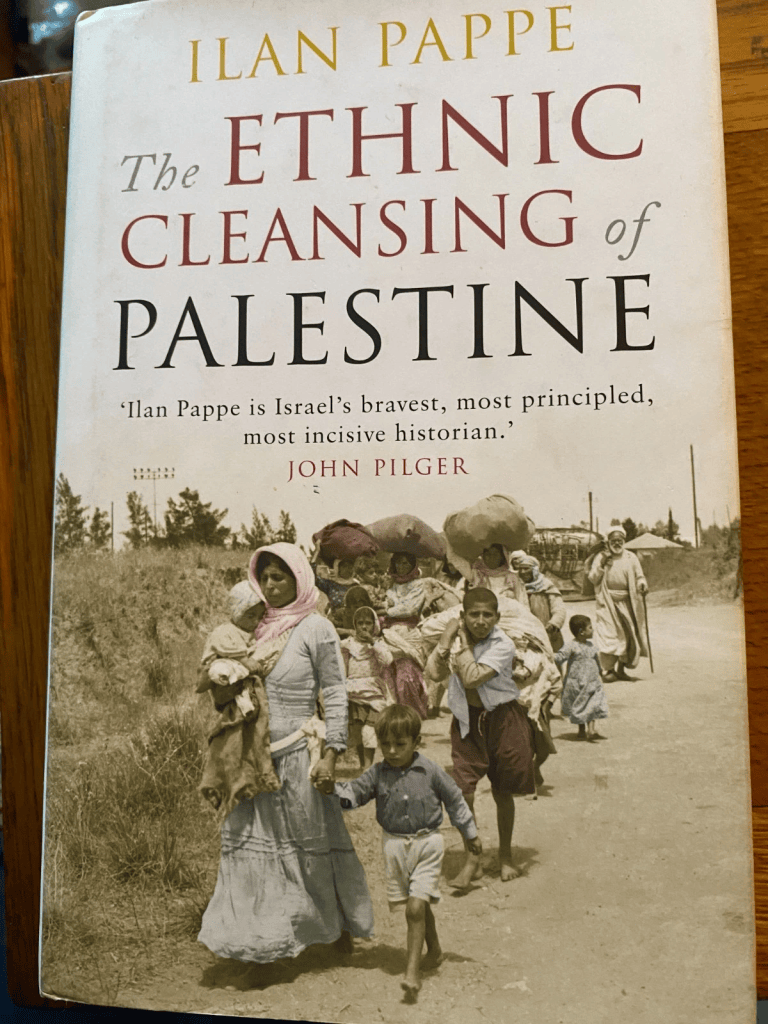
But let’s stay for now with the socio-political naming of space in the novel, for in the end this is basic to the manner in which we understand the dilemma of Palestinians believing themselves to be such, even to the fact of being able to say one lives within the physical space of Palestine, for the existence of that space is contested and its borders felt to be fuzzy, if they exist at all. But the space is liminal in other ways – its internal record in the person differing from what which that same person sees in the objective world around them, even to the naming of buildings, streets, towns, village and communities. Azem describes this in an interview in the Four Way Review. I will quote first a piece from later in the interview for it is specific about the strategies, those in the final analysis common to all settler colonials (and brilliantly described too in the recent novel The Renovation by Kenan Orhan (see my blog at this link) that estrange a ‘country’ from that you felt you knew in the past (strategies not unlike the myths analysed by Ilan Pappé). She says:
After taking control of the land through different means, the colonizer begins, and sometimes this happens simultaneously, to appropriate symbols and culture. Throughout all these attempts, there is always an effort to ‘convince’ the colonized that the colonizer has a legitimate claim to the place.[5]
Earlier she had told of how this had an affect on her own education and, in part, her shaping as person, that feeds directly into Gharib’s estranged, or should we say alienated, experience. As a person asked to be identified as an Israeli Arab living near Jerusalem, her experience of school created an uncanny world around her – one that was familiar but yet not so (and in that sense simultaneously unfamiliar) – and that duality is howe, for instance Freud defined the uncanny, because perhaps, in part, because of the differences in the names and descriptions in language, often in Hebrew which she speaks fluently, that gave additional but alien significance to the things that filled space:
…: our own history and the stories that were absent from our schoolbooks. All of this left me with a persistent feeling that the reality we lived in was itself a dream, a beautiful dream in which we could live in our own homeland, laugh, get married, love and hate, and continually try to build and rebuild our relationship with the place, as our grandparents had done; and, at the same time, an endless colonial nightmare.
There was something profoundly surreal about this reality, and that is what I tried to explore and express in the novel.[6]
Surrealism and dream experience are very much features of European twentieth century experience as is ‘estrangement’, often that rips one from one’s context, as Sartre does with Orestes in The Flies (see my blog at this link) but perhaps iconically in the novel by Albert Camus, influenced by Sartre’s work on that play, L’Étranger , which use a term almost as widely . Set in the French colonised country of Algeria during Occupation, the idea of who is the stranger and what acts of behaviour are estranged from expected norms flits through the novel around the murder of someone who is only ever identified as ‘The Arab’. It isn’t a comfortable analogy to make but a pertinent one, especially in a book that also concerns the liminal borders of the colonized setting.
Consider the question and response below, again from Four Way Review, for it contains much of what I can only elaborate in Part 1 and say more of in Part 2:
Four Way Review (FWR): In a line that captures one of the novel’s tensions–the conflict between imposed identity and lived experience–Gharib says, “I don’t like remembering street names, because each street has two: the one that is written, and the one warring with memory. Their names and ours…” What role does naming play in the novel? Were you thinking of language and names as a space where memory, power, identity, and belonging are constantly being negotiated?
Ibtisam Azem (IA): When we think about Palestine today, language becomes a trap, not because the Palestinian, as a colonized subject, has a problematic relationship with the place itself, but because there has been a sustained attempt, since the beginning of the Zionist colonial movement in Palestine, to construct a distinctly colonial narrative: to change existing names, take what is already there out of its context, and impose a new, fabricated narrative.
The colonizer initially seeks to control the land, partially or completely, but there remains a space that it has not been able to control easily, or perhaps has not yet fully controlled, despite its control over the land.
Language and narrative are part of this space that has not been completely colonized. There is a relentless desire to control the Palestinian mind, including consciousness itself, to tame and domesticate its narrative, and to make Palestinians accept the colonizer’s story about them. Naming is one of the means through which this is done. This is something that the novel attempts to grapple with in different ways, and it is also central to my writing more broadly.
In my writing, I approach language not merely as a means of literary and aesthetic expression, but as a world in its own right, one that refuses to submit and opens up a new horizon, including a space that can be carved out within.[6]
The term ‘imposed identity and lived experience’ here used by the FWR team is a good one, and I want to interrogate below its sufficiency, particularly in relation to Azem’s claim that she approaches ‘language not merely as a means of literary and aesthetic expression, but as a world in its own right, one that refuses to submit and opens up a new horizon, including a space that can be carved out within’. A lot of anyone would want to say about this would be about the notion of space that has an exterenal aspect, one generative of perspectives of a horizon and is also a ‘space ‘carved out within’, a subjective space whose excavation extends the external horizon.
For now and before we get to Part Two, let’s give one of the names of that space as Palestine, to some extent a ‘lived experience’ for the person living with the imposed identity of an ‘Israeli Arab’. Lets be clear, such a name as the latter is part of the strategies of naming which eradicate The terms ‘Palestine’ and ‘Palestinian’, not formally (except for resistance in the discourse of Palestiniand families and some resistant Jewish teachers in the apartheid Israeli teaching institutions) but it is true of other names for identity, that are best explored in the wonderful chapter called ‘The Russian Compound’.[7]
The chapter, writtenen in Gharib’s first person narration, starts with him attending a lecture that credited and weighed up against each other (as rarely done in Israeli universities but probably refering to that group of Jewish intellectuals of whom the best know is Ilan Pappé) Palestinian and Israeli narratives that leads to uproar (‘The lecture turned into one of those Knesset sessions where no one listens yo anyone. There’s just noise’.
Gharib’s eyes capture those ‘green eyes’ that ‘were so persistent in their beauty and vitality’ of a female student, whose name turns out to be Nina, a Russian Jewish recent immigrant, not yet proficient in the Hebrew Gharib is forced to learn by the state as a primary language but she wants to learn as a Israeli Jew in becoming. Nina’s understanding of the lecture about Israel’s ‘history, its myths about how the state was founded and the occupation of Palestine’ is tested unintentionally as it is clear she does not understand why Gharib’s very stomach rejects the falafael made in shops in modern West Jerusalem, not realising that his prefernce for the ‘falafel of Tel Aviv or Haifa’ had much to do with how discrimination of food quality for him is a test not only of palate but a determining ‘culture and its pleasures no less fundamental than sex or love’. It is an opening up in the senses of the body – on the cusp of internal and external worlds of a battle of cultural identities, one of which, that of Palesine is renamed as a falfel in which it is permissible to use baking powder.
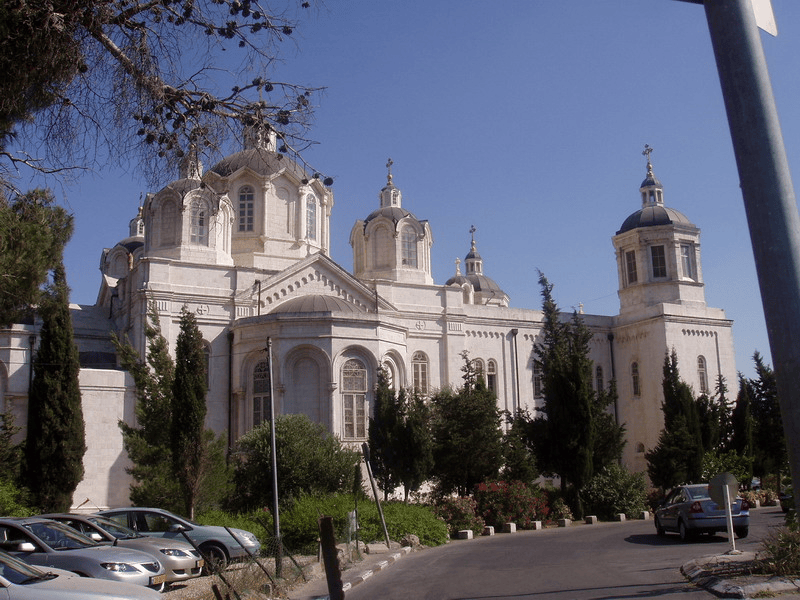
Part of the Russian Compound In Jerusalem
Their discourse as the view the space they are in, Jerusalem, is divided between knowledge of old and new city, the city each one sees in their ‘illusion’, though with no negative intention in the use of that word, as what Jerusalem actually is and means within its external appearance. The point is illustrated in the survey and conflict embedded in it of the meaning of one particularly containing space, the Russian Compound, in the sens of both a space with inner contents and a bounded area in which people are held within, a detention camp as it was in the colonial British Mandate. Nina sees it as the detention camp, it actually was during the British regime, for Jews dubbed terrorists by the British. Gharib tries to remind her that it also held Palestinians, equally judged illegals by British rulers. To Nina that becomes another instance of Arab defensiveness about primary Jewish identity and culture, against which she reacts.
The detention centre formed from a ‘compound’ betrays the very ambivalences of spaces bounds by walls of both defence and aggression, in complex nuanced relationships. The original compound was built to guard and manifest the special nature of Orthodox Russian Christianity in Palestine, create an illusion of home from strands of myth from the Christian canon, in Byzantine forms at least, especially those legends concerning the life and death of Christ in Jerusalem, but it beco.es a prison and place of torture for Jews and Palestinians under British rule, much like the first ever concentration camps built by the British for Boers in South Africa.
That space ‘carved out within’ by the projection of power, regulation and colonialism is very complex, for despite the primary purpose of the containment of presu.ed threat, inner spaces contain freedoms that cannot be controlled and regulated, the freedoms of a culture that will not and cannot be co strained, possibly because it is not even understood by those who try to ‘contain’ or repress it. Even naming it shows that its contents are in cultural excess of its containment of them for so many languages have to be evoked in order to name it – in in two paragraphs before we are told of its origin in the ‘Petersburg-based Imperial Orthodox Palestine Society’ in 1862 for Russian pilgrims , the name of the compound is instanced as variegated by evoking its unused Hebrew name, known but about which a Palestinian feels ‘uneasy’ using, and its Arabic name (‘al-Moskobiya’). The latter name is analysed as a hybrid from badly understood Russian and analysed in terms of its effects on differing users and hearers. When we then read the incongrouos name ‘Putin bar’, I, at least, met this as the name of an obstacle or barrier but read on only to discover it is a bar for social drinking with external seating. [8]
That container includes temporal-historical and physical-geographical space, contents so diverse, and possibly ignorant of each other to a greater or lesser extent and for various conscious as well as unconscious reasons (it is convenient for Hebrew to wipe out older Palestinian names else it could not be argued Palestine was an empty entity before Israel’s inception in 1947) that far exceed its contents as understood by any one person. These concerns about bounded or boundaried space – to Israel there are no Palestinian boundaries, though there are defensive walls against ‘terrorists’, because thereis NO PALESTINE – extend further. An airport, for instance can be imagined as a liminl boundary between countries, and this gives prominence to the chapter named ‘Airport’.[9] It is a chapter full of portals however – doors of entrance and exit – but in an airport it is clear why the means of transit between boundaries is important – why Gharib avois Arab and Israelin flights, prefering those of Cyprus. Going through portals varies but is longer and harder for Palestinians, even they ‘cross the border to Jordan and Egypt’. So much is this the case that the experience of being about to cross a border in a wy descriubable as ‘normal’ ‘must have been a mistake’ and he cancel;s his trip without refund. On the taxi to his student dorms in Jerusalem, he is addressed as that other crosser of real and imaginary boundaries in global literature, Do Quixote: ‘My dear Don Quixote, we’re in Jerusalem. Here you go’. [9]
This is why I suppose Gharib renounces any identity based in the paperwork of citizenship or the naming of his identity or ethnicity, other than being what he existentially is (anoth link to L’Étranger, and both Camus and Sartre:
I live here and don’t need an ID, nor do I need to prove my ethnicity. I’m simply here. I don’t want to be anything. I’m me’.
‘There is no such thing as “I dont want want to be anything”! Are you Arab?’ [10]
There are jokes for European existentialistshere that play out into the sex/gender points that follow. There is very little ‘simple’ about being here – the pspace into which with all its pre-determinants you are ‘thrown’ according to Heidegger, the daddy of the existentialists. Being anything or nothing are sometimesthe same thing. In Spanish both can be intended by the label ‘Nada’, Though in American English use it means largely and solely ‘nothing’. But languages very in invoking internal as well as external complements – the term used in the Arabic as confirmed by Azem is the Arrabic term, which to Four Square Review, she said mean ‘dew’ (the Arabic word is externally the same but internally entirely different with no link of meaning: ‘
When Gharib chooses the name of a woman for himself, Nada, meaning ‘dew’ in English, he is also, in a sense, rejecting and challenging the conventional gender divide. [5]
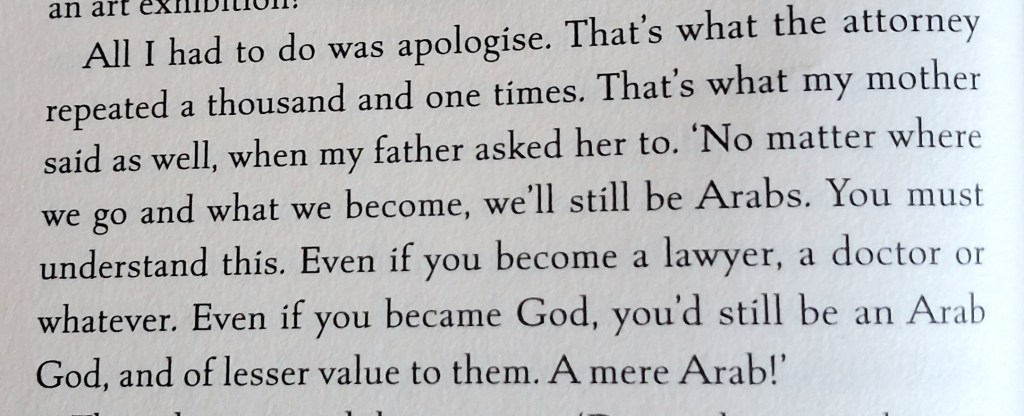
Azem stresses the way in which sex/gender becomes transferable content in the act of existential naming but she does not say here that she is invoking the word as it used in European and American literature, often across languages and with a tradition in ontological philosophy behind it, in Heidegger at least. Yet that she knows this is clear from the conversation before he claims Nada as their name, defying the binary as he doesvthe false ones like Arab / Jew and nothing / anything. I will return to the sex/gender point in Part 3 in pursuit of this novel as dream and fantasy literature, yet another reason for Don Quixote’s presence.The deeper point Gharib’s mother acknowledges earlier. Because what we are is not in the world subject position into which we are thrown of our own making we always will be what we deny we are in someone powerfully tells we are that. In an Israeli court, a teenager throwing stones but labelled a terrorist, he remembers his mother’s words, as an echo of his attorney’s advice, all advising giving in to an authority that names you other than you desire or will to be named: [11]
A lot of what I have spoken about in supposedly talking about naming is also about the functions of language, of which naming and lebeling are but one. For Azem languages are multiply full of contradiction and multipicity of ssemantic options and the differences between them are vital. In a sense they relate to space but not because they are languages whose name derives from a space necessarily, though oft spaces that call themselves nations attempt to own and prioritise one language like Hebrew in Israel as a primary language, Received Pronunciation and Syntax in England and versions of the same in French (and of course the case of ‘High German), or the eradicadition of Kurdish in Turkey. Sometimes a particular form of language is imposed such as katharevousa as a form of class institutionalised Greek in the history of post Ottoman Empire Greece. Yet Arabic is not the language of Arabia (which is not a country anyway) nor English owned by England (or the USA before it claims it) but to a changing set of groups of varied people with all their variations of kind and linguistic peculiarity. Yet it does indicate a space to be claimed inside, as Azem made clear to Four Square Review:
I speak four fluently, as fluently as anyone can claim to speak a language. Arabic, my mother tongue, Hebrew, English, and German. When it comes to creative writing, I write exclusively in Arabic. This is a choice I made for many reasons. Arabic is the language of my heart and mind, but in the Palestinian context, particularly for Palestinians inside Israel, it is also a language that Israelis have sought to distort and marginalize in different ways. For example, we see poorly written Arabic and numerous mistakes on road signs, as well as linguistic errors in school textbooks intended for Palestinian students. Speaking Arabic can even expose one to racist attacks. This happened to me personally on more than one occasion when I lived in Jerusalem. Arabic is a suppressed language within the Israeli public sphere, and when it is used, it is often used as an instrument of oppression.
For me, writing in Arabic means liberation, a linguistic uprising against this repression, which is itself part of the broader struggle for liberation from colonialism.
Beyond all of that, Arabic gives me a sense of freedom and intimacy that is difficult to describe. I don’t believe my creative writing would be the same if I wrote in any language other than Arabic. [5]
Let me, at last Word Press readers might say, apply my issue to the prompt question: ‘What’s a country that is the top of my bucket list?’ It has to be a country that is resistant to external control that would determine everything I was – my speech, writing, the intimacies that make relationships ‘personal’ and the freedom to be more than somone says I m – ‘mere Arab’ being the example for Gharib and from which strangeness and estrangement become a better option and label. At the core of all this is the relationship between Shahin, the pencil seller from Hebron and Gharib. My question at The People’s Bookshop was based on this surreal exchange about the surreal or uncanny that Gharib also signifies in Arabic, the third person narrator tells us, as already cited. Only Shahin asks, perhaps, if it is ‘strange’ that Gharib has a name that means variations on stranger, strangeness and the stranger:
… I only heard [Shahin] say my name once, when he first asked me about it.
‘Gharib. Gharib!‘
Dis he think it strange that I had such a name, or was he just repeating it to help himself remember? The first seemed normal enough; it was the second that expressed surprise. But I didn’t ask about it. Why should I? [12]
My question boiled down to asking Azem if they felt there was a reason Gharib should ask this question and what that reason might be!. It is an unanswerable question, but I shyly think it’s still pertinent, except NOT when addressed to an author, who is, after all getting her character and part-narrator to address it to us, as readers. At this point I can go no further even with the topic of ‘countries’ (including borders, portals and the means and beliefs or illusions of belonging) without invoking fantasy and belonging, and I am leaving that for Part 2.
Bye for now
With love
Steven xxxxx
[1] Ibtisam Azem [trans. Sinan Antoon] (2026: 102f. ) The Sleep Thief Sheffield, And Other Stories
[2] ibid: 9f.
[3] ibid: 9f.
[4] Britta Stromeyer (2026) ‘Stealing Sleep, Reclaiming Tomorrow: A Review of ‘The Sleep Thief’ by Ibtisam Azem’ in Arablit & Arabic Quarterly Journal (online) [August 17, 2026] available at: https://arablit.org/2026/08/17/stealing-sleep-reclaiming-tomorrow/
[5] E Ce Miller, Moby Yang (interviewers for Four Way Review – FWR), & Ibtisam Azem (2026) ‘The Resisting Power of Living–and Writing–Ordinary Lives: An Interview with Ibtisam Azem on THE SLEEP THIEF’ in Four Way Review: An Electronic Literary Journal (Sep 13, 2026) available at: https://fourwayreview.com/the-resisting-power-of-living-and-writing-ordinary-lives/
[6] Ibid.
[7] Ibtisam Azem 2026 op.cit: 93 – 98
[8] ibid: 94f.
[9] ibid: 51f.
[9] ibid: 47 – 52
[10] ibid:101f.
[11] Below this note is my photograph from ibid: 28.
[12] ibid: 39
[13]

