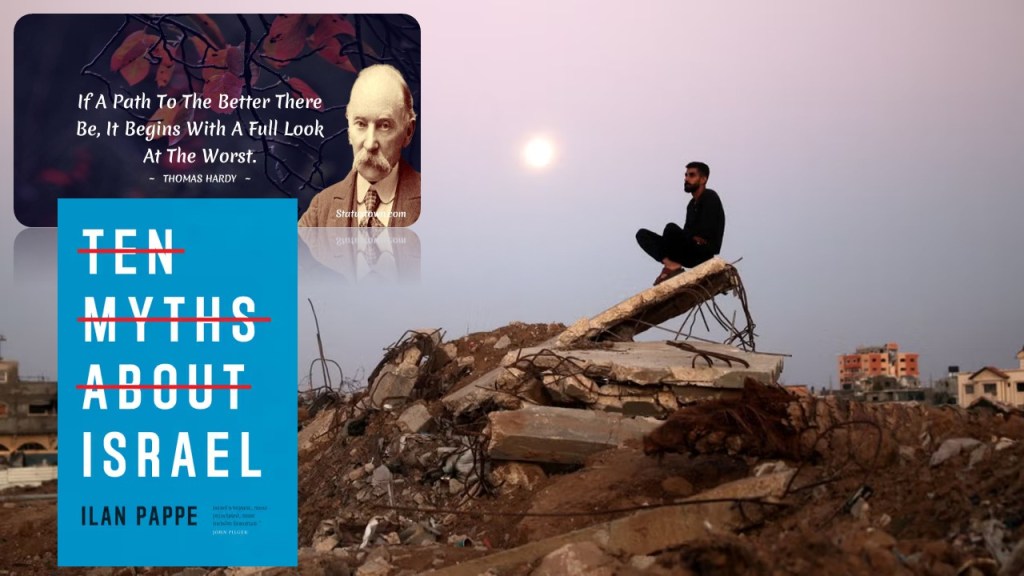
Some books just must be read and Ilan Pappé (2024 – with new preface on Gaza as well as the original of 2017 – Ten Myths About Israel, London, Verso Press is one of them. The edition of 2024 gives a necessary set of words about Gaza that now requires updating again, for as Pappé says at the end of that Preface, that though the 10 myths in his original book have ‘kept their currency’, ‘who know what might be added to them in the future’. We need to start reading now so that we can see that the deconstruction of the myths around the origins and rationale of the state of Israel in its present form are not based on ignoring atrocity wherever it may happen. The bluntness of the description of the ‘Hamas operation of Al-Aqsa Flood on October 7 2023′ has the feel of brutal truth in its words about an’military operation to breach the ghetto wall of the {Gaza] Strip’, necessary in order to state the full horror of the incident and in order to see the rationalisation in Israel of the brutality of the response which followed, which by the time the Preface is recorded as having claimed ‘35,000 lives, one third of them children’. Those numbers have more than doubled up to May 2026, and include people still being killed during a period supposedly known as a ceasefire, but not unlike the norm prior to October 2023. The latest figures in Wikipedia are below:
As of 3 May 2026, at least 75,811 people (73,770+ Palestinians[4] and 2,039+ Israelis) have been reported killed in the Gaza war according to the Gaza Health Ministry (GHM) and Israeli Ministry of Foreign Affairs, including 270 journalists and media workers, 120 academics, and over 560 humanitarian aid workers, a number that includes 391 employees of UNRWA. A study by OHCHR, which verified fatalities from three independent sources, found that 70% of the Palestinians killed in residential buildings or similar housing were women and children.
But even horrific massacres and disproportional state terror used in response need context and history, and this is the point of Pappé’s book. The Ten Myths are divided into those termed in Part I, ‘The Fallacies of the Past’ and Part II, ‘Fallacies of the Present’. In fact the Fallacies – probably a better word than myth which is used so differently in other contexts – are all interdependent on each other for they represent the interpretations of a rather different kind of history, that justify a future looking vision that is, at best, only State of Israel overlooking a dependent Banthustan (the term from privileged white South African history) that is called Palestine but without any true autonomy, at worst, in the vision of Netanyahu, a ‘greater Israel’ with expansive ambitions as the bulwark of Western advantage (over fuel supplies for instance) in the East. The final ‘fallacy’ or myth deconstructed is the one that tests my own past history on the ‘liberal’ side of this issue as it has been globally understood: ‘The Two-State Solution is the Only Way Forward’, a position held by the British Labour Party currently, together with its sequel that its achievement means making primary ‘the need of Israel to defend itself’, however that State interprets that ‘right’.The myths feed each other and circulate on that phrase, and have recently found teeth, in that contesting some of them is equated with Antisemitism, even the undeniable truth that Zionism as a historical movement of Western Europe was born out motives that were mixed in their relation to the welfare of Jews in Western homelands.
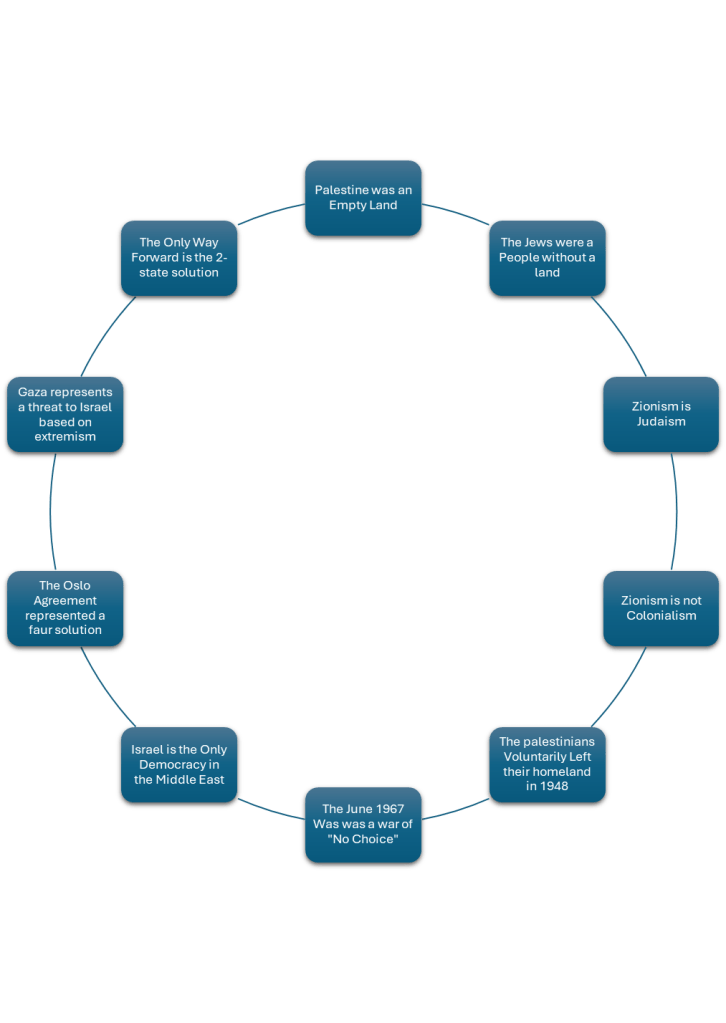
The way forward that we refused to look at is a one-state solution that is a true democracy for everyone. Perhaps the most startling facts in this book are that Israeli policy has long been led by a population calculus that expanded only by ensuring that areas annexed contained only, or a majority of, Jews, And that this explained the rationale of earlier Israeli policy allowing the annexation of what is now roughly the West bank area by Jordan, for then Israel remained a state that could be described as Jewish. As the West Bank is fragmented by Jewish only walled settlements, the land available to Palestinians decreases and the Nakba continues, often with unrecorded one-sided violence.
There is no point in rehearsing the arguments. This book says it all clearly. To read it is to begin your journey of enlightenment from the distortions and manipulations that have won favour and power recently
All the best
Love Steven xxxxxxxx


3 thoughts on “Ilan Pappé (2024) ‘Ten Myths About Israel’, London, Verso Press.”