

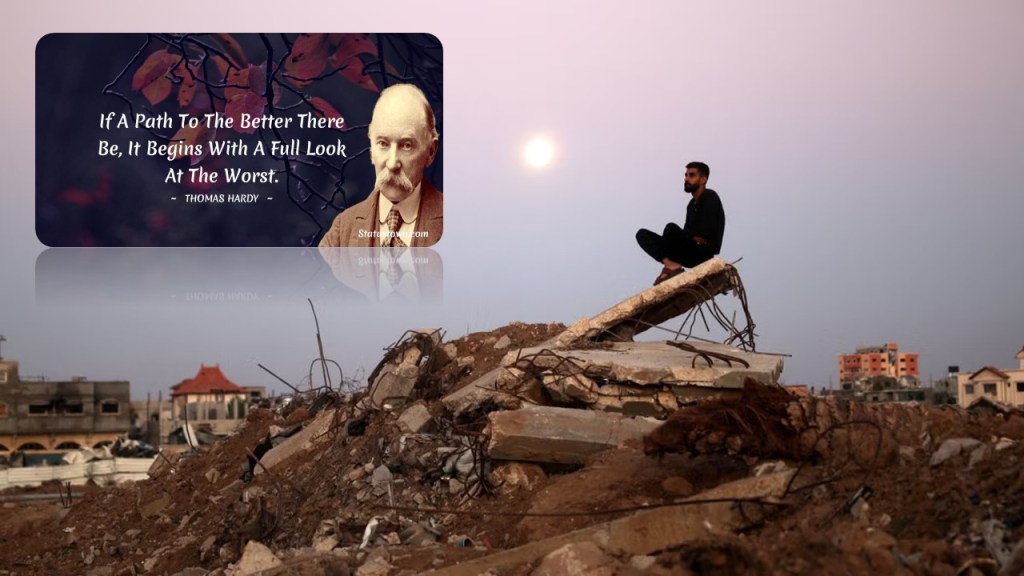
‘What’s something you’d love to see in the future, but know you probably won’t live to witness?’ This question is stuck in the mud of illusion, for as Thomas Hardy said, in a work no-one ever reads, “if a way to the Better there be, it Begins with a Full Look at the Worst’.
There is a yearning in this prompt question about the value of one’s witness and the truth value implied by one’s desire. Do we read it and understand that that which we’d love to see’ will in some distant future time occur but at such a distant time we will by then have died, and therefore are denied seeing it happen. I think the question is thus posed! We all desire things that will not happen in our lifetime, yet even if we do not witness its fruition, this very question ‘witnesses’ our desire (our ‘love to see’) based on an understanding that we are progressing towards that end unseen in its fruition by us, whenever it happens. Hence it is a question of positive witness. Whilst not in the last of those ore-apocalyptic moments before our hope comes true, we see the buds of its eventual growth, the signs of its victory. Its a kind of elegy this question, that accepts personal death at the price of a longing for that we know will be satisfied, and if not by us, satisfied in a way that gives us predictive fulfillment, the expectation without the achieved end-state of actual fulfillment.
Can it be written differently: ‘What’s something you’d hate to see in the future, but know you probably won’t live to witness?’ It changes it in ways that allow the generative meaning of the syntax to emerge – the syntax takes on the colour of the verb in in the clause which asks you to predict what you expect from the future. Hence in my rewrite, there is a relief for oneself but sadness for others in the fulfillment of one’s expectation – altogether the quotation witnesses hopelessness not hope, as in the one Word Press offers us.
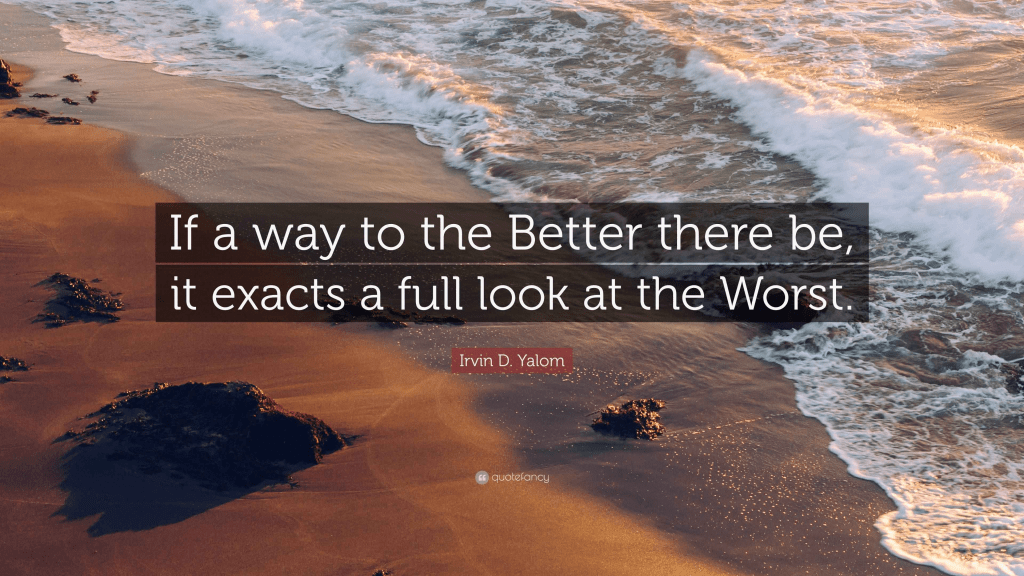
Above I chance a quotation that counters it and the witness of a present misery that is visible and the reflections in a pictured witness that are not visible, and, in truth cannot be guessed or intuited (people set too much illusory store in body language).It picture a man over-viewing from an eminence of ruin the scene of devastation in Gaza. Are his children or parents buried in the ruins? Is he contemplating the past, present or the future? Altogether it’s a scene that recalls a quotation that I much prefer to our question because it is honest. The quotation is, I believe, the vast unread verse play, ‘the longest in the English language’, by Thomas Hardy, The Dynasts. I have to say, ‘I believe’ for I have read only very brief extracts of it, though it is available fee in an e-Gutenberg text (use the link here). Quotations like this often undergo metamorphosis in transmission across time, so I will not vouch for its full authenticity, and I can’t see myself reading The Dynasts in full at any time soon. Now we see it in quotation frames on the internet, often attributed to people who merely cite it themselves like the existential psychotherapist, Irvin D. Yalom (although I think – without authority – that the verb ‘exacts’ is the one Hardy uses, not begins as as above – it is more like Hardy to stress duty not choice):
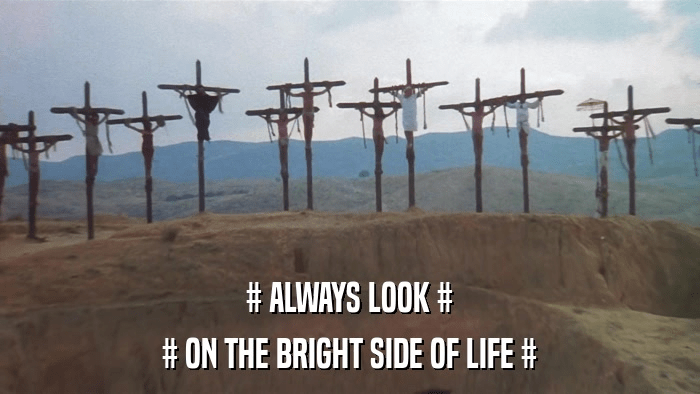
But Hardy already lived in a world where people preferred to ‘look on the bright side’, as the song from the Messianic Crucifixion pastiche by Monty Python, Life of Brian, has it). Now we call ourselves a world of ‘positive psychology’, where ‘dark sides’ are an ‘error in thinking’ replaceable by enforced mentalisation of the full picture. I wonder if the man in Gaza is, after, looking for the ‘fuller picture’ in the prospect before him, as those chorus of crucified rebels and thieves are in The Life of Brian, led by Brian himself.
There is illusion and delusion, and a very little of the actual picture, that we witness too often in positive psychology and mental re-framing in Beck’s system. These fuller pictures are often grand narratives, sometimes Messianic ones – but plentiful in Stalin’s Soviet Union too – of a future hope achieved even at great cost, of the deaths of individuals, even oneself. One’s role in these narratives is to keep ‘hope’ alive. Often the ‘hope’ belongs to very few – like the elect in some Protestant, Jewish or Muslim mythologies, who look on the ‘damned’ getting their just deserts as part of their reward of felicity in Heaven, or so St Augustine thought says William Empson in Milton’s God.
Truth-seekers do not seek illusion. They look for supposed millenial hope in the eyes of those with an interest in the ‘distortion or manipulation of history. I sought a book to try and learn more about the entrenched terror of the conflicts in the Middle East in a book by an Israeli Jew who tries to look outside of self-interest, and for as ‘true, unbiased understanding of the past’ as possible, Ilan Pappé.
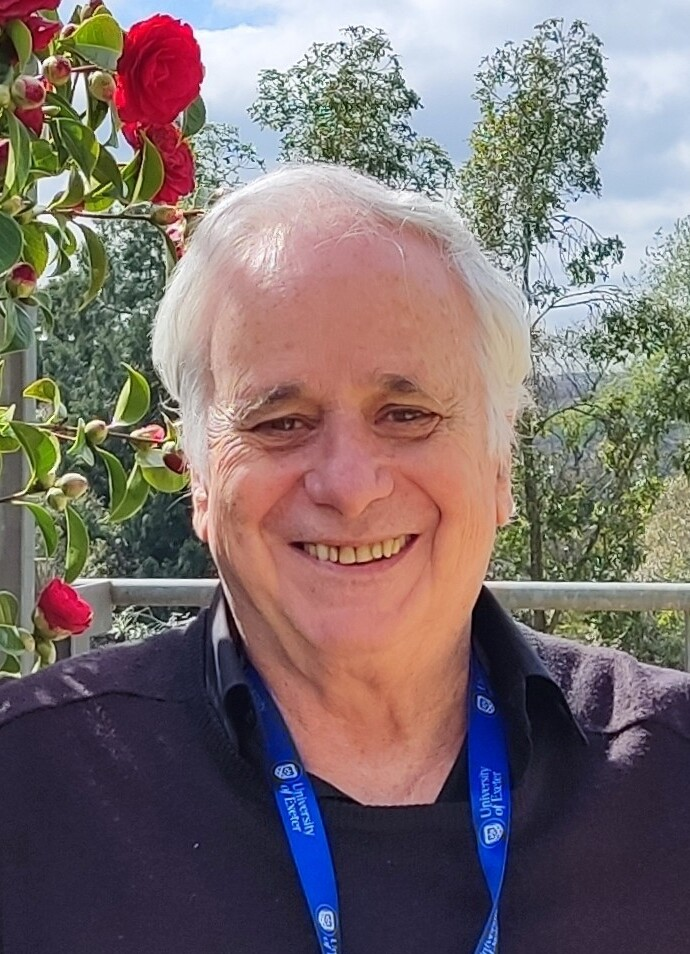
The Professor at Exeter University By Fjmustak – Own work, CC BY-SA 4.0, https://commons.wikimedia.org/w/index.php?curid=147037979
I began by reading his most famous book, republished in 2024 with an updated Preface about Gaza, but from 2017, called Ten Myths About Israel. I may blog more fully but I thought this passage worth sharing, for it is the best interpretation of the Thomas Hardy quotation, whatever it is, I have ever found. As for the Word-Press prompt, it suggests that we would need to find a way of looking at the ‘Worst’ in more focused ways in we hope for a better world, even after we are dead. I intend just to give you the passage now, from the Preface to the original (2017) edition> To me the Worst looks as if ‘distortion and manipulation’ will continue and that its practitioners turn that very accusation onto truth tellers knowingly – as in Trump’s views of ‘fake news’. Believe me, as far as the book goes, it is not one-sided but it looks to seek the sources of bias, even in its own heroes. such that it has none to speak of but historians who put themselves in peril. As I say, I will come back to the book in full.
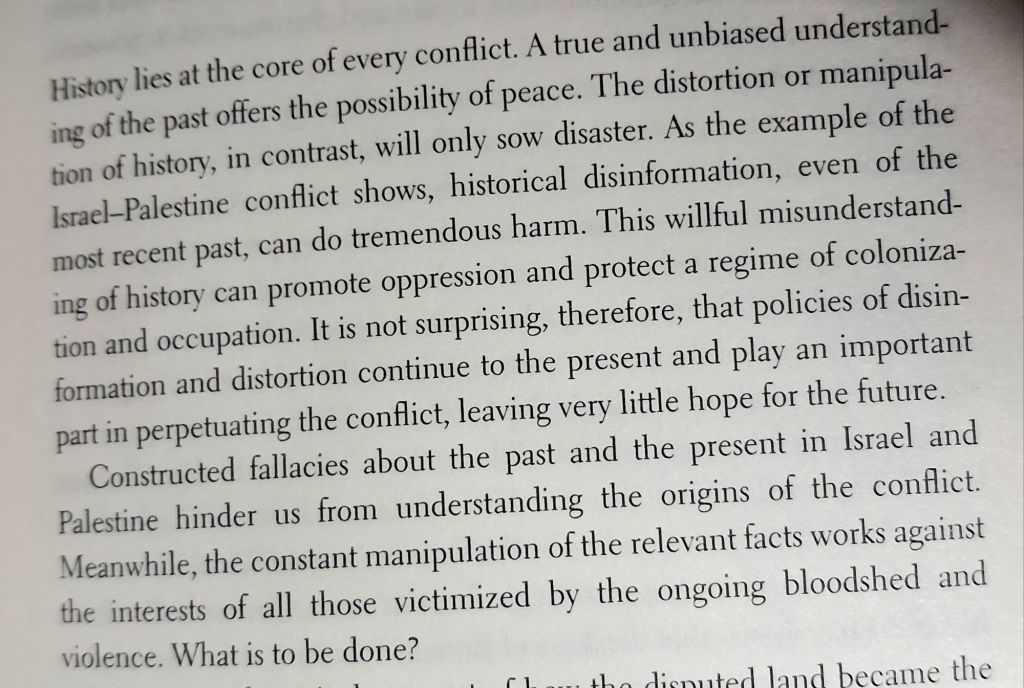
Ilan Pappé ( (2024: xv) ‘Ten Myths About Israel’, London, Verso Press.
But there is danger in cheering yourself up about a ‘better’ world ahead by merely hoping for it. Unless we witness what the world is at its very worst snd name it, we will never witness what might be for bad or good. However, we will still be responsible for the result in part. Will the world be even more full of more self-interested hate or will a ‘better way’ of knowing, feeling, acting and valuing any joy in the world be born through honest accounting for the worst that is happening now.
With love
Steven xxxxxContact

