


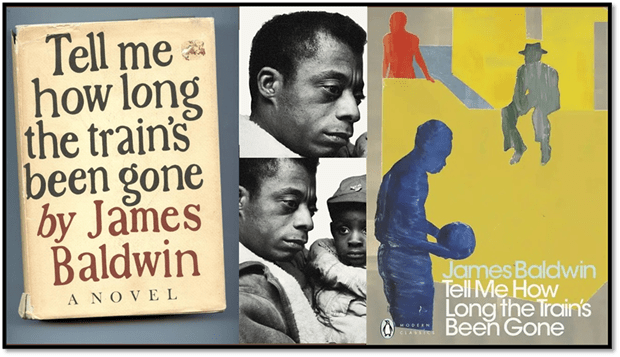
In the loosest of uses of the word ‘moment’, I want to identify a ‘moment’ as that period of time over which I realised that reality is constantly reshaped by the means of its description. It is the kind of ‘moment’ that might be used as an answer to the title of James’ Baldwin’s novel Tell Me How Long The Train’s Been Gone, wherein moments have duration and measure in so many domains including measures of time and the quality, rather than quantity, of our attention to a phenomenon: the time scales, for instance, of narrative, history and self-awareness wherein ‘reality’ is at a premium.
There is a fine note upon the definition of the term ‘moment’ in the webpage of the site, Science Insights.
A moment is one of those rare words that carries precise technical meaning in several different fields while also serving as one of the loosest terms in everyday language. In physics, it describes the rotational effect of a force. In statistics, it captures the shape of a data set. In medieval timekeeping, it was exactly 90 seconds. And in psychology, researchers have spent decades trying to pin down how long a “moment” of conscious experience actually lasts.
The page defines moment in physics, statistics, measurement of the experience of time, and finally mindfulness about time, where it ends thus:
Jon Kabat-Zinn, who developed Mindfulness-Based Stress Reduction (MBSR) at the University of Massachusetts Medical Center, defined mindfulness as “awareness that arises through paying attention, on purpose, in the present moment, and non-judgmentally.” In this context, a moment isn’t a unit of time at all. It’s a quality of attention.
The very title of Baldwin’s novel comes from Gospel singing and its offshoots where themes of loss and redemption touch on religion but are applied to to the experience of the loss of human familial and romantic love associated. I found three on the web including lyrics by Mable Hillery in 1966 and two different sets by Billy Preston (one intensely ‘gospel’ and another more secular and intense with longing for time to warp). Biographer Nicholas Boggs (read my blog partially on that biography at this link) speculates upon one or other of these versions (he doesn’t specify any of them in particular – only saying that the title is ‘a line’ in a Gospel song or that there are multiple versions of the phrases use in Gospel [and gospel styled] traditions) being sung in duet by Bertice Reading and Baldwin many times.[1]
Whichever lyrics might be that echoing behind the novel, if you read them I think you’ll find each indicates a ‘moment’ of terrible realisation that the ‘moment’ of realisation of one’s feeling – of loss, abandonment, damnation or smaller chance of hope – is both infinitely more minute and infinitely greater than one expected feeling of its duration: ‘How long? How long?’ is a yearning cry in all. In the songs there is an alienation from time measures that we usually depend upon to gauge reality that is so profound, it haunts. It is in this light that I think the novel works, in its secular achievement, to chart the moment of realisation that the ‘real’ itself is bound by its contexts of experience and articulation of that experience. What does that mean for the issues that have long been debated in that novel? Those issues seem to be:
- To question whether there is a consistent reality – something claiming absolute truth value – behind discourses of black experience in a society in which black people feel they have been left behind, as if by a train. Indeed, though a train is a metonymy of some kind, is either it or what it represents a thing that truly exists for anyone to ride on to some ideal end – even white people for whose sustained power and advantage the train service was styled towards a certain destination (progress, well-being, or whatever. When the novel first came out: it was thoroughly criticised for having put black identity politics to its forefront, at the cost of its art. However, it is difficult now to see any consistency in such a project, even if we think that is what Baldwin was doing. If he were attempting to do this he would not have used theatre as a metaphor forthe choice of life-roles in ‘reality’ at all. Hence I will develop my points below in relation to that metaphor for ‘reality’ perceived at the removed perception of it as conscious performance on a theatrical stage.
- To question whether there is, or ever could be, a discourse of queer experience, outside of the norms of descriptions of binary sex/gender which rest entirely on either or both the concentration on the label category ‘bisexuality’ and the fleshly signs of ‘biological sex’ and its mythical extensions (that valorise the penis in masculinity, for instance. Again though clearly masculinity, and black masculinity in particular, is an issue – the references to the myth of enlarged penis size in black men are legion (we get to know presumably from Leo Proudhammer’s point of view (and the surname is surely not coincidental) that when arrested he was frisked by the police, with the comment: ‘Cops love frisking black boys, they want to find out if what they’ve heard is true’. [2] Sometimes however the penis is merely a kind of disabling factor that limits the masculine character which all boys must learn to respect. In one of the strangest metaphors used as a literal means of comparing organ size in the book’s opening, the elder Leo after his heart attack, is attended by a surgeon with a big nose. That nose reminds him of a barber he knew as a boy, who had not only a big nose but huge fingers. Suddenly the prose turns on these fingers: ‘One of his fingers, or each one of them, seemed bigger to me than my penis. I was only beginning to be terrified of the imperious bit of flesh, which was only at the beginning of its career of blackmail’. [3] Those two sentences are the most telling of much prose obscurity in the novel, which suggests a depth stranger than on their surface. Freud had made something of a supposed analogy early in his career about fascination with the nose being related to the genitals and neurosis (especially relating to his work with Fliess and made it the subject of a dream analysed in The Interpretation of Dreams, but it is unlikely that Baldwin references this. what we see are shifts between categories – nose, fingers, penis that suggest but do not base themselves overtly in underlying pathology, in relation to masculine power and sexuality here, but suggest it uncertainly – it is one of the many uses of uncertainty in the novel.
Lets start however by looking at the queering of reality in the novel by the use of theatrical tropes. This is so definitiely conveyed given the consistency of the theatrical metonymy for the understanding life experience as performative, where even role models offer only a circumscribed performance, as in that moment where, on deciding that the world news would sicken an already ailing black actor resting in hospital after a severe heart attack, he finds Ray Charles on his radio: ‘And he was playing my story for me’.[4]
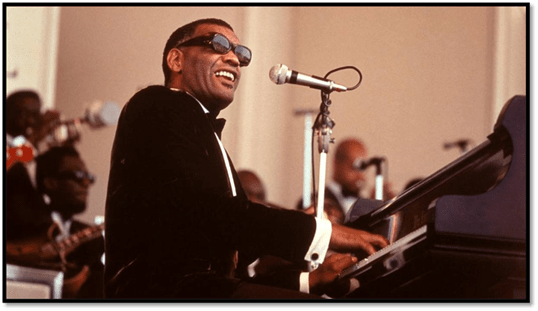
The notion of ‘playing’ moving between the child in performative practice on life, direct reference to theatre ans acting (given Leo is an actor) and the production of music on an instrument is central in this book and throughout its many shifts back and forth in time, age-related role-play and domain (such as those of psychogeography, the play between specialised space and identity, art, music, theatre, politics, work, play and sex). Let’s take a musical example in honour of Ray Charles but also because of the import to the art of the mid-twentieth century of the idea of ‘beat (think of the Beat Generation), rhythm and disruptive pattern in art.
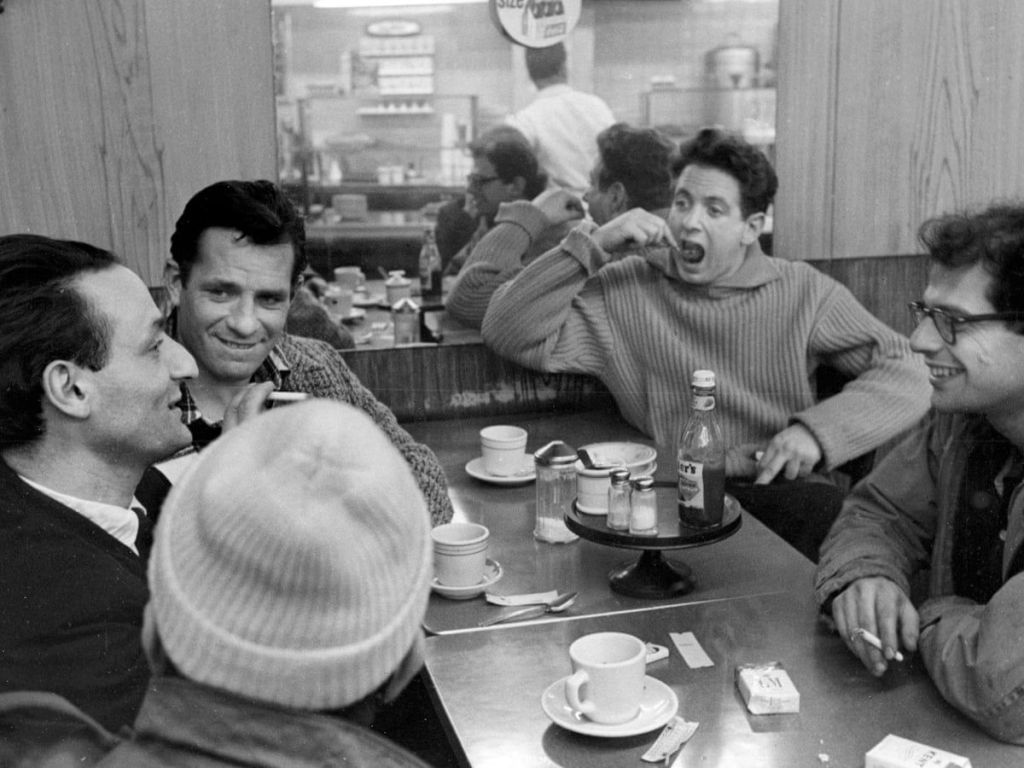
Of course ‘beat’ as Baldwin uses it is multivalent in its possible meanings and contexts. In a piece that may or may or refer to Freud’s text A Child is Being Beaten (where it is a product and remnant of polymorphous perversity – his concept – in childhood) the elder Leo has a bad dream about Caleb beating him (does that refer to that time too of mutual masturbation in which attachment to brother Caleb becomes entirely sexual-romantic). It is when he awakes he hears Ray Charles as previously cited. Charles music takes Leo back in memorial time to when his family, evicted from their first rooms, and inhabiting now ‘a defeated building on the edge of the Harlem River’. If a building can be beaten into defeat then so can Leo’s father. This thought leads Leo to show that ‘Beat’ is a word stolen by white culture (Ginsberg, Burroughs and so on) from Black experience, and robbed of some of its meanings, especially those that told of the pressing of Black experience into deprived spaces in which Black identity is further deprived of self-generated meanings: [5]
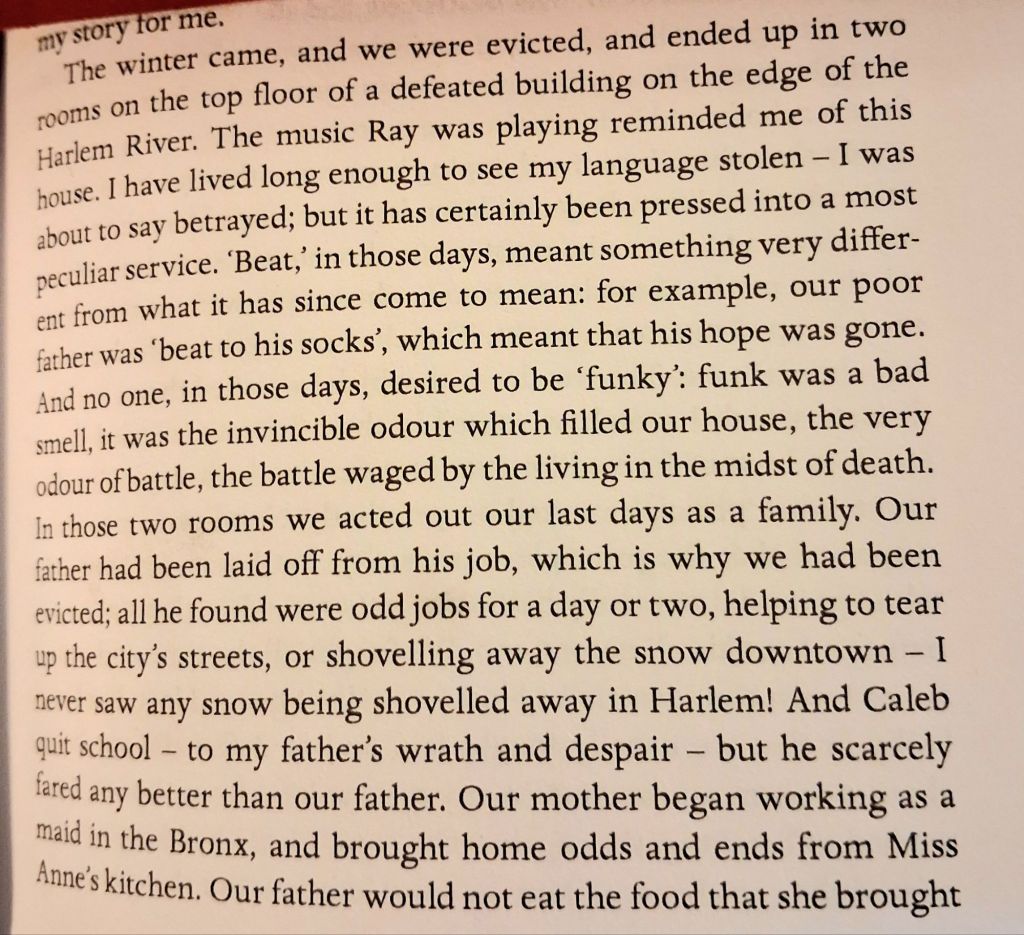
To me the key sentence in this passage is that almost toned like the Bible that reads: ‘In those two rooms we acted out our last days as a family’. Acting out is the description psychodynamic counsellors give to the way person’s perform the content of their inner neurosis in the outside world, without ever understanding the true drivers of that neurosis. It is yet another variation of the performative but here perhaps showing that the family are being forced into an apocalyptic drama of their ‘last days’ by a script written by a world that is white and holds all the power and the resources to do so in which Black people have few independent options. Later ‘Black Christopher’ will make this very point (that white people gave Black people ‘Jesus’ so that they will willingly do all the labour whilst white people ‘sat on’ their ‘ ‘big, fat, white behinds and gor rich’. to the rich Kentucky parents and brother of another character locked into the uncertainties of an over- and pre-determined white-black binary, Barbara. [7]
What is difficult to understand here, deliberately obscured I would say n the passage in the photograph above, is the attitude of the writer to their subject. Why, for instance, does Leo chose not to use confidently as his primary choice, the verb ‘betrayed’ in relation to the stolen language of past Black experience, and yet tells us that he has, and perhaps still can consider it as an appropriate usage. The fact is that like the ‘defeated building’, Black people see that white culture can rob Black language of the reason they feel they have been ‘beat’, not just by Life but by white people who rob them of fair opportunities of not being beat, and sometimes throw in a beating in a police cell to boot. Likewise with the word ‘funky, which invents the myth of the ‘naturally’ happy and rhythmic Black man to allow the Beat Generation to steal it. No easy of that applies to Ray Charles but Baldwin often though that white people often culturally appropriated great Black music and musicians for their own pleasure and cultural advantage. But think of the word ‘attitude’ I use here. It is one Leo himself uses to describe what happens to relational and individual emotion in theatrical culture, or (since it was the only one available in mainstream, the only one with power. As Leo looks at stills from a picture show he has seen, he realises that he is ‘seeing people in attitudes of danger, in attitudes of love, in attitudes of sorrow and loss’, not the realities of these things he sees in lives that no-one wishes to represent, and yet, going back to stills, Leo remembers thinking: ‘They were not like any people I had ever seen and this made them, irrevocably better’.[8]
A key moment in which the concept of beat and rhythm is explored (funky being metely mentioned) by Baldwin is in a wonderful passage in which Leo explores his own personal theory of what acting means, which is somewhat to avoid the ‘shameful tricks’ of white actors, even great ones based on ‘that contempt for the audience that is the death of art’ because it satisfies itself with not what one ‘saw – still less, God forbid, on what one felt – but on what the audience had come to see, and been trained to see’. The brilliant passage continues thus: [9]
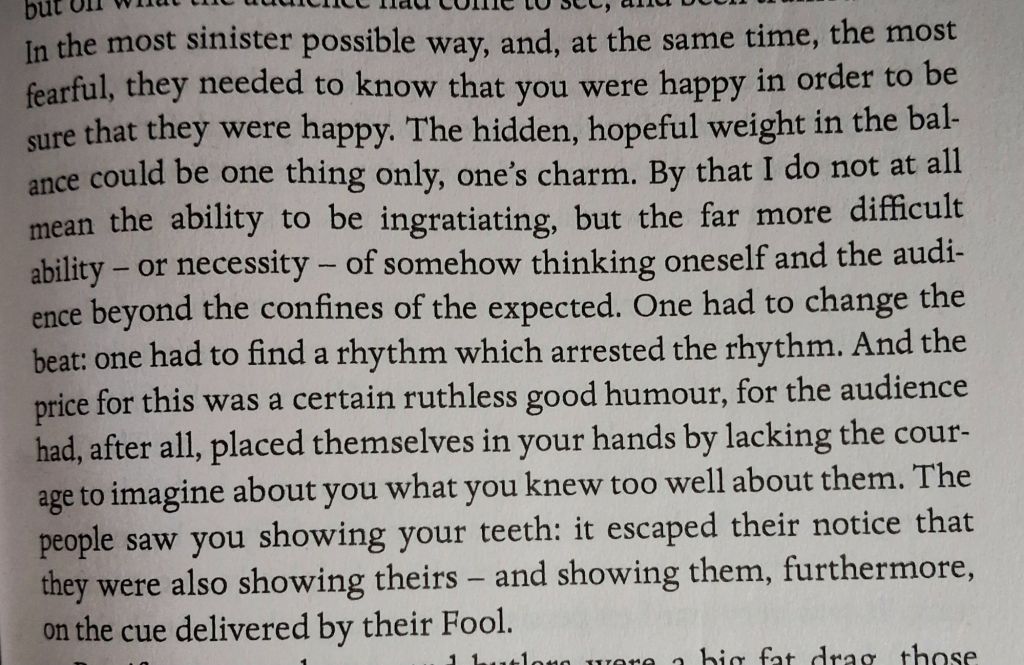
This is a difficult passage but an essential one. It takes up again the idea of ‘beat’, finding too ‘the rhythm which arrested the rhythm’, that takes things back to their beginnings by forcing audiences to see what they did not expect, or were trained, to see, but something that opens their eyes not only to the anger that might be implicit in the Black roles they have available to Black actors – of being one of many ‘waiters, butlers, porters, ‘ and so on, acting the Fool to power, and locating that anger in their own hitherto unnoticed aggression to Black people. It is again something Barbara later makes clear to her white Southern entrepreneur (in Kentucky) brother when he expresses his ‘belief’ in the opportunities available to black ‘boys’ in his employ: “That’s pure bullshit, Ken, and you know it. None of those boys who work for you are going to make their own way, you’ve seen to that – … – they can’t even join a union’. [10].
All of this seems the kind of straightforward politicised black civil rights talk, Baldwin was accused of turning his novel into sometimes, but it isn’t, for the rhythm varies so – the beat falls with different weight of nuance. Most of the black radicalism is allowed expression in the character called ‘Black Christopher’, first introduced as on his way to see the sick Leo before we see him in his prime as the radical queer Black ‘boy’ that was Baldwin’s ideal – and exemplified in many inadequate tokens of the type: the ‘boy’ usually called Arnold in the biographies, for instance. Here is the first description of Christopher, after Leo receives his telegram in bed in hospital:
Black Christopher: because he was black in so many ways – black in colour, black in pride, black in rage. No wonder I had a heart attack, I thought.[11]
The artifice and humour of these lines however, shows us that Baldwin never allows Leo, nor himself I believe, to lose himself entirely in Christopher, or in the belief that certain people expressed emotion and self in ways that were ‘black’ rather than also merely ‘human’. Within a page of this Leo is remembering his origins in his first home independent of his family: Paradise Alley, a place where it seemed there may be no barriers between white and black provided they lived outside the regulation of the system that demanded those binary divisions, living on food stolen before the conventional world was awake and by scraping a living as model for nude life-drawing in art school.
Leo finds it ‘odd’ that they loved that world in retrospect despite its rigours and their desire at the time to escape it – as Barbara as ‘the rather proud daughter of proud Kentucky landowners’ already could. And then we find in the young Leo is a means of discoursing about colour that is far from dependent on the black / white binary. It is not a ‘colour-blind’ theory – one which merely ignores structural oppression in the relationships between the hegemonic ‘race’ and others. It is based on a young artistic man’s love of creatively observing a world in which colour is anther word of multiplicity and diversity. It begins by observing ‘black’ people from Harlem out on a Saturday night for fun, and dressed to impress [12]
‘The women’s hair would …
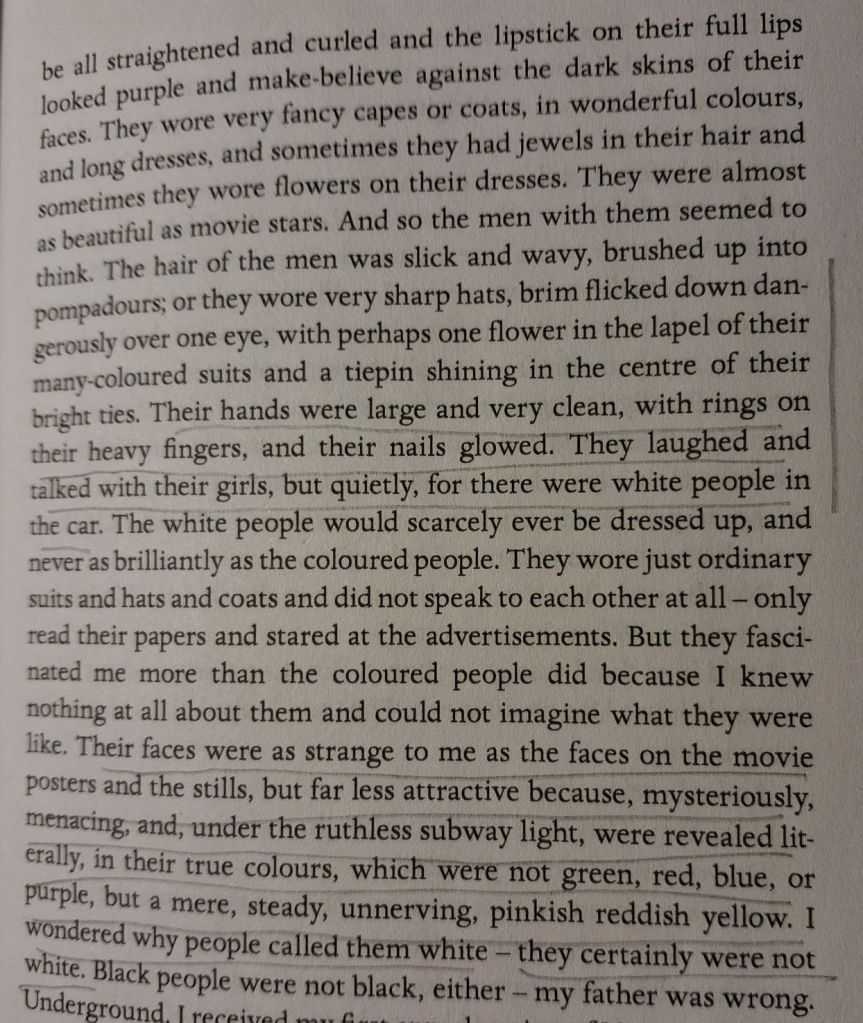
It is not just that the dress of the persons described is ‘multi-coloured’, mutiplicity in colour is its rationale, and is the reality against which binary divisions of black and white fall foul. However, the passage continues by using the term ‘coloured people’ suddenly to describe the non-white world, thus undermining exactly what we said. If ‘white’ is might and considers itself to be right to be coloured is merely to be ‘other’ than either might and right embodied but blurred. The prose does not, I am saying, support certainty of expression but only the uncertainty of attitude to what the real world is truly like. The phrase ‘they certainly were not white’ in particular is a statement of uncertainty about the meaning of diversity, questioning his Father’s authority, even on the meaning ‘black’ in the description of ‘black people’
Sometimes the way it does this is to employ the digressive prolixity of Leo Proudhammer’s own character to obfuscate the issue. At a crucial moment in his recollections of working with the Actors Means Workshop, a satirical reconstruction of the institution of Stanislavskian Method Acting in American theatre, he describes crossing the city in which they are situated, with fellow actors and two Black young men, who come from the side of the town in which most its Black inhabitants live. The idea of a frontier or border between two psychogeographic spaces in a city triggers what I have called digressive prolixity about what it means to give a space a name, that of a nation perhaps. The digression , over two tightly typed pages is described exactly as that – as a metonymy indicating movement in physical space:
…. – well, I am wandering. But I was about to say that, however dramatic the frontiers I have mentioned, the most dramatic, the most appalling, remains that invisible frontier which divides American Towns, white from black. [13]
How easily space and its mentalisation as the stuff of binary distinction become each other in these pages. Borders are merely means of holding separate distinctions that are defined by their antinomies, although there is also a sense in which the antinomies are abstracted from any reality – merely chosen for the sake of contrast, with liberal use use of the word ‘say’ to show that this may be but one example of many choosable. Otherwise supposed objective descriptions of the French and the Swiss are littered with generalised subjective judgement with lots of markers of that subjectivity – such as overstatement and admission of suppositions underlying observations, reaching hyperbole in the realms of literary fantasy, as in the description of the French frontier guard’s office, which soon segues into a fantasy reminiscent of Sartre’s play Huis Clos: ‘were it not in France, would remind one of nothing so much as a cell in purgatory; and he and his confreres seem to to feel that they are serving a sentence which they probably, after all, deserve’.This is psychogeography where any use of the word ‘certainly’ (italicised in what follows by me) means uncertainty generated by description alone and psychical trumps the physical in extremis where ‘a landscape is not a landscape at all, merely a reflection of the sensibility of the people who live in it – certainly this is what one is watching as one crosses crosses their forests and plains, vineyards and mountains, cities, tunnels, towns’. In such a world everything tells us – from the strategic use of ‘one’ to objectify downwards, tht nothing is ‘certain’ in these descriptions and contradistinctions. Yet that does not mean, truths are not told in them – that expressed by ‘Black Christopher’ for example become poignant with mass experience.’ ” I say it,” said Christopher’, explaining his case to the Kentucky parents of Barbara, ‘”because it’s true”‘. [14]
But Baldwin or Leo or both always make it clear that truths are situated psychologically and socio-historically, they are not absolutes. In fact this openness to thinking of the world as a set of shifting constructs in which certain truths are so invisible to some that they cannot be labelled truths – whether they are about the differences of black and white, or our communal humanity, tore Baldwin apart in his life. Something like this is realised by Leo when he considers that, in the process of mythologizing Black people and their history, white people mythologize themselves and their being and thus the battle, even for black people gets fought in the heads of people as well as dangerously, to the most vulnerable Black people, outside them: ‘I was discovering what some American blacks must discover that the people who destroyed my history had also destroyed their own’. [15] Leo learns this paradoxically by ascension as an actor into playing classic American white roles like Tom in The Glass Menagerie.
There is more to say, of course, about theatre in this novel – especially about why its target was Method Acting but let’s leave that, except to say that it leads to that obscenity of a Method acting teacher who tells Leo he is ‘no very striking theatrical ability’ that Paul Robeson was ‘made to play Othello’, an assumption that naturalises white stereotypes. [16] Earlier I said the novel also questions ‘whether there is, or ever could be, a discourse of queer experience, outside of the norms of descriptions of binary sex/gender’. I indicated that this question is tied in with the query of black and white experience and their differentiation, giving some examples of the penis size myth’s appearance that complicates notions of the masculine and the boundary with the feminine. In prison Caleb finds white guards obsessed with being sexually serviced by black men, though by rendering them passive to white penetration, and because it is oral sex discussed, silenced.Leo tells of how they subservience of the roles the theatre once gave him led to his silent molestation by an actor he describes as a ‘white British faggot’ until he turned the tables by exposing the ‘faggot’ to being the recipient of his sexual touching. [17] Leo learns to use myths of Black sexual potency against white me, Wrongly arrested,and viewed by white policeman as merely a ‘funky black boy, talking about a lawyer’, he says:
So fuck you, white motherfuckers. Fuck you. I stared at the detective who was asking the questions, and I charged my eyes to say, Baby, if my prick was a broomstick, I’d make sure your tonsils know that you had an ass-hole. Believe me. Oh, yes. Now, come on, you faggot, and beat my ass. [18]
Men regularly then use the ‘faggot’ myth to attempt to destroy each other. In my view this leads us to a similar conclusion about queer experience in the novel. The only person who embraces sexual commitment, without needing to embrace identity, is Black Christopher, a kind of repository of sanity, capable of missing the nuance of all kinds of politics but to the benefit of his mental health. But the Black Christopher is a fiction embraced. Indeed the only truly romantic encounter between men in this novel is that between Leo and his elder brother, Caleb, after the latter’s release from prison [19], that dissipated into Caleb’s odious retreat into conventional Christian heteronormativity. But Baldwin is to an extent before his time in realising that that sex/gender binary is an irreducible issue in all this, and one that will forever lead to the creation of other boundaries – between men in particular, whilst the valorisation of being ‘terrified of the imperious bit of flesh, which was only at the beginning of its career of blackmail‘, or some cover-up of that terror in jokey or aggressive inter-male rivalry, continues. In the end queer experience has been destroyed by people who have also destroyed heteronormative experience. The onlytime that his penis ‘blackmails’ Leo (the choice of crime name is interesting) is when his desire is given away while dancing with Barbara ‘keeping the rude witness hidden against her body’, leading to a co commitment that forgets the nuance of desire and its distance from necessary corresponding emotional bond. [20]
There is no moment where you question ‘reality’, if you expect a moment to be measurable, it is a constant interplay of time given force by the experience of motion through life. But read this novel. It is a neglected one, possibly because it is long and not as consistent as predetermined readings of it lead you to believe.
All my love
Steven xxxxxxx
[1] Nicolas Boggs (2026: 419) Baldwin: A love Story Bloomsbury Circus
[2] James Baldwin (2018 [first published 1968]: 195) Tell Me How Long The Train Hs Been Gone, Penguin Classics.
[3] ibid: 5
[4] ibid: 91
[5] my photograph from ibid: 91
[6] see ibid: 25
[7] ibid: 360 for example
[8] ibid: 91
[9] ibid: 266f. (the photograph from ibid: 267)
[10] ibid: 361
[11] ibid: 57 (see 56 – 58 for context referred to in following lines of the blog)
[12] the photograph is from ibid: 27.
[13] ibid: 144, all following extracts and quotations are from ibid 143f.
[14] ibid: 360
[15] ibid: 269
[16] See respectively ibid: 233 & 213.
[17] ibid: 266
[18] ibid: 199
[19] for that encounter see ibid: 164
[20] ibid: 150

