In an interview Ibtisam Azem says of The Sleep Thief that the novel is’fragmented and experimental, with surreal elements, references to Greek mythology, inner voices, the grotesque, and satire. Some of these elements may not sit easily with some readers, … perhaps because they do not expect to encounter them in Palestinian literature, because there are often preconceived ideas about Palestinians and their culture, held by both their enemies and their friends’ . [1] As suggested in Part One of the blog, the strange is also linked to aspects of naming, even of the novel’s protagonist, for as the third-person narrator, who appears often in The Sleep Thief says: “…, what is certain and unequivocal is that ‘Gharib’, in Arabic, comes from the root ‘gh.r.b’. The following terms are derived from it: estrangement, west, to set, strange, to find strange, stranger …. And so on. There is such significance in the very name, no?”[2] Seeing the author Ibtisam Azem [trans. Sinan Antoon] (2026 {first published in Arabic 2011}) speak of The Sleep Thief [Sheffield, etc., And Other Stories] at The People’s Bookshop, Durham: Part Two.

The following paragraph appeared in different form in Part in Part One of this blog, and is here amended to preface Part Two on fantasy aspects of this great Palestinian novel.
My blog on the novel, and hearing the author speak about it, falls into two parts. The first part (read at this link) speaks of the naming of people individually and as groups by the names of a country, a nation or abstractly in terms of a country or nation and our status within it – as native, resident, a person who belongs there or as alien, foreign, or a stranger to that place. It spread its net wide beyond the names given to spaces on the globe in physical, demographic and political geography to the adoption of those names as self-descriptors by choice, imposition or rejected for adoption for a reason by a number of people to qhom.others apply it.
Part 1 took on, in some respects, a discussion regarding the metamorphosis of spaces that have names for some physical thing like a ‘country’, that are treated normally as a reality of life, into something more abstract – a space whose meaning is the illusion of its significance for one group living in it but not another. Transitional between that and this second part was about the various ways in which sex/gender/sexuality enters into the naming of personal spaces from that quotation too in part where choosing to name oneself as female is analogous to choosing not to be an ‘Israeli Arab’. These points may be treated again in this second part.
The second quotation in title then and now is still however important for both parts and therefore will be starting point for both. It focuses on the meanings of the Arabic name ‘Gharib’, and that indicate of strangeness is explained in Part One. Here I will use the novel’s strangeness to indicate the uncanny as we confront it widely and globally in literature and myth. This I do despite the fact that some reviews, despite the stress on the excess of signification, or significance, of the term in the text reduce its meaning to some reference to merely the strange or foreign, as opposed to the ‘native’. Even the best review I read by Britta Stromeyer in the prestigious journal Arablit points to the fantastic as an element of the novel, although I think she uses it to characterise the style of the novel’s prose, only edging on content in the ‘exploration of the blurred boundaries between reality, imagination, memory and longing’. [3] As I said, my response is to insist that such an exploration cannot be considered as somehow different from the novel’s handling of the experience of Palestinians, whether living in Israel or not, as those in the novel do and as Azem herself did, or outside in the wider diaspora, and the Palestinian lands we variously call ‘occupied’ or ‘debatable lands’.
Thus, although I deal with the two themes separately in two parts of a blog, because it is easier, this second part insists that its exploration of the ‘uncanny’, in a manner not unlike that of Freud, also reflects back on the way identifications occur in the novel with named spaces such as Palestine. I insist the uncanny is legitimate reading of Gharib’s name, otherwise translated as stranger or foreigner (by Stromeyer). In fact it drives those latter terms.
Azem herself discussed this aspect of the novel in an interview for Four Square Review. I quote one paragraph in my title but here is a fuller look at what she says:
The novel is also fragmented and experimental, with surreal elements, references to Greek mythology, inner voices, the grotesque, and satire. Some of these elements may not sit easily with some readers, not because they are unfamiliar with this kind of literature, but perhaps because they do not expect to encounter them in Palestinian literature, because there are often preconceived ideas about Palestinians and their culture, held by both their enemies and their friends.
I sometimes wish readers would simply engage with the text on its own terms, with its aesthetics, its plot, and its language. Sinan Antoon’s translation has done an astonishing job of preserving many of the original text’s particularities, and I hope readers can appreciate them and approach Palestinian literature as literature, rather than as an anthropological document.[4]
That I refer to this as the literature of the ‘uncanny’ is not unknown in previous literary theory and references Freud’s treatment of the term ‘Unheimlich’. At The Sleep Thief ‘s heart is not just dream, fantasy, parapraxes, or day-dream and other indications of the Freudian Unconscious, but the myth of the double – that ‘other’ intent on replicating and taking over from the self-recognised in the normative and ‘every day’, itself a struggle in the self-stealing oppressive society of Israel. To Four Square Review, Azem expresses this idea thus:
The colonizer initially seeks to control the land, partially or completely, but there remains a space that it has not been able to control easily, or perhaps has not yet fully controlled, despite its control over the land.
Language and narrative are part of this space that has not been completely colonized. There is a relentless desire to control the Palestinian mind, including consciousness itself, to tame and domesticate its narrative, and to make Palestinians accept the colonizer’s story about them.[5]
A society that demands the ‘self’ surrender to another description – the ‘Israeli Arab’ not the ‘Palestinian’ for one thing – is a double creating society in which the self is in struggle to exist through stories that refuse colonization by the colonizer’s narratives. Gharib is constantly struggling to keep every aspect of himself together and from fragmenting so that even details of his translated language become uncanny, as after, without intending to, alienating himself from Shahin, he visits an old geography tyeacher who once help him situate himself. He fimds him stretched upon a ‘wooden bed’ , and perhaps dead. Realising he had ‘hated’ that teacher, he leaves in a hurry fearing further loss, so brilliantly and movingly conveyed in the briefest of phrases, wherein: ‘I snatched my shadow and ran the half-hour back home‘. [6] The sense that his ‘shadow’ too might be easily alinated and split off as a fragment is all too palpable. This is particularly a problem for a character called Gharib, of which name the narrator says:
“…, what is certain and unequivocal is that ‘Gharib’, in Arabic, comes from the root ‘gh.r.b’. The following terms are derived from it: estrangement, west, to set, strange, to find strange, stranger …. And so on. There is such significance in the very name, no?”[7]
This second Part of my blog ought to concentrate on the ‘strange’ , estranging, and defamiliarizing as the ‘uncanny’ or fantastic as a literary domain. Part 1 of this blog explains how and why, in rejecting imposed identity coming from the myths of the colonizer (such as Palestine never existed, and was an empty land before modern Israel, with no natural boundaries or common identity specific to it and not Arab culture and so on), Gharib feels free to shape-shift and double himself – become a woman Nada (the woman named in Arabic after the pure dew) or anything, or nothing (another unrelated meaning of the non-Arabic word Nada). This is one of the many transformations between things and persons, even between land and person. His beloved Hamsa (a name maning five in Arabic and sometimes taken to tefer to the five pillars of Islam) is even the land he occupies and occupies him. But though it ought to concentrte on this, I hve no critical insight to offer on it, other than to point out it is there.
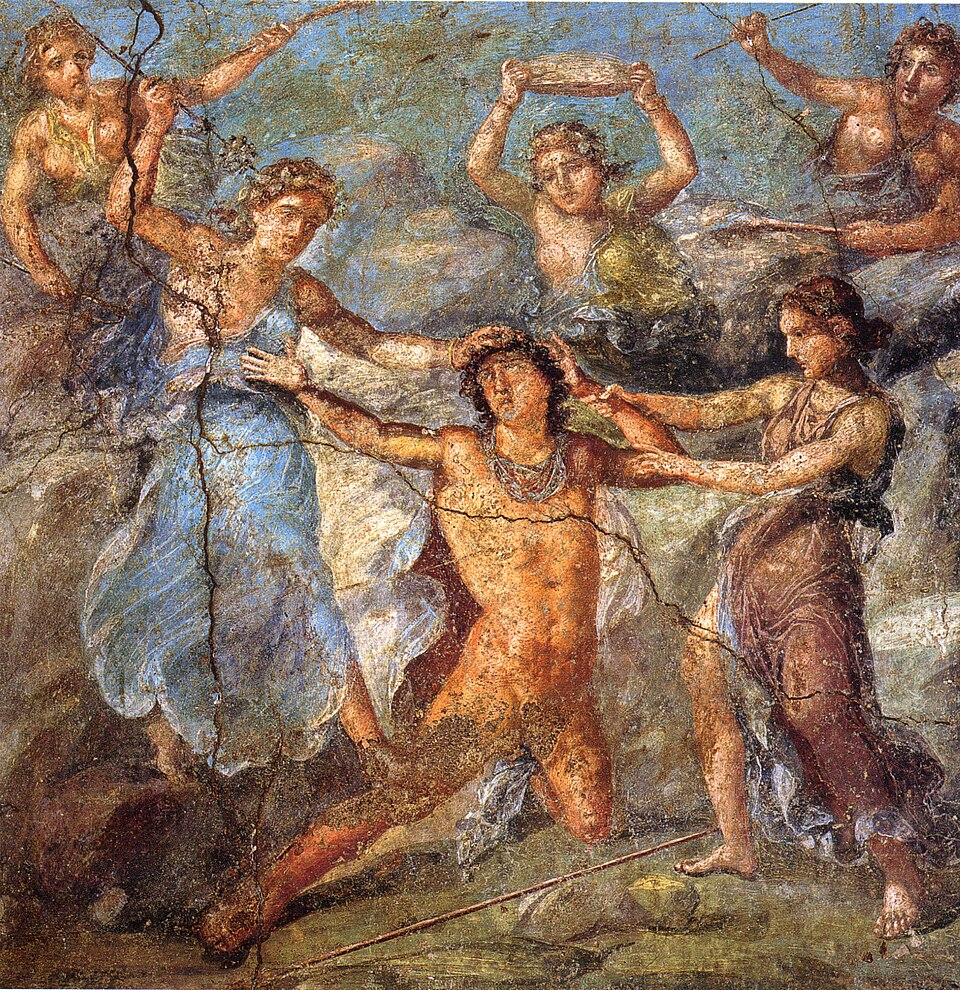
That the story is fragmented and metamorphic travelling time and space in non-linear episodes is important. That the meaning of Palestine occupies not only land but people is clear – but it shifts its occupation between the split mind and body. and often splits (I suspect the psychoanalytic idea of splitting matters here) body parts from each other, as in the metaphor of the Palestinian observed as an ‘unexploded bomb’, in part a lending from Israeli perceptions of the Palestinian as terroist. But the split body parts also recall the ancient Greek process in the Bacchic/Dionysion ritual of sparagmos, in which the body of alienated subject (pentheus and Orpheus are the best examples) are split apart and function separately – the head of Orpheus for instance still sings as it floats down the river into which it is thrown, head functions still attached but not the senses of the rest of the body but brain and mouth. When Gharib’s body is disposed of – dead, alive (the ambivalence is sustained in the chapter ‘The Winds of October’: ‘my face wallowed in sandafter they threw me out of the car onto the lips of Haifa’s shore’. The synta detaches body parts as they meet other body parts, like the ‘lips’ of the shoreline. [8]
Bodies fragment to be consumed or eaten as mouths in bodies also consume and fragment other bodies. This cannibal metaphor is not far below the surface of the book. It in some way animates the Palestinian’s sense of an embodied country being consumed by another voracious one, Israel, that when it renames cities gobbles up the old and noble to spit out its own projected modernity: [9]
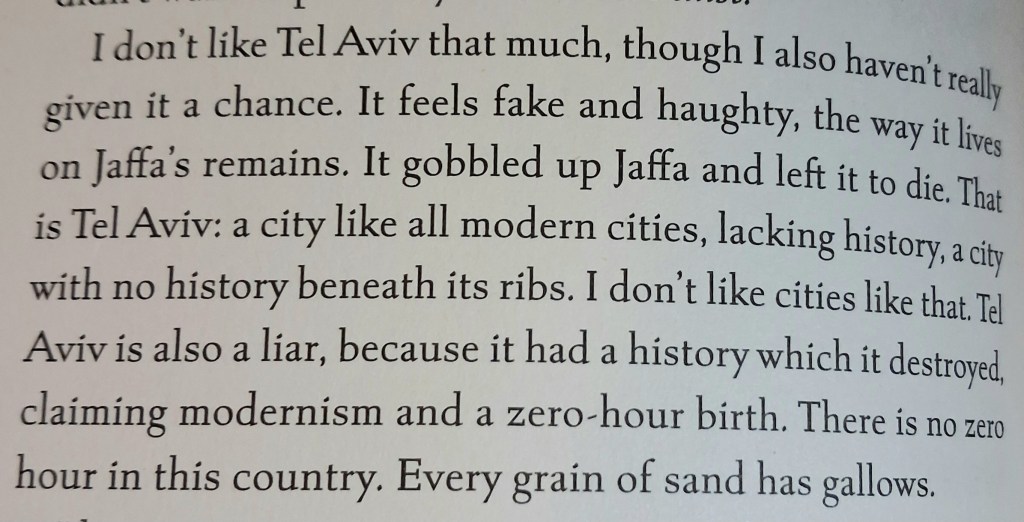
As well as the old (Jaffa for instance) being eaten by the new (Tel Aviv), modernity lives on some pretty disgusting fare – ‘remains’ in order to fake a history it has consumed. It is another instance of a double taking over an originl being but ultimately everything splits – not just into binaries but multiplicities – the number of grains of sand on a beach, each supporting the death that transformed it to this dead fragment of a whole – now lost forever. The body fragments fall out separately in Gharib all ober the novel – not just shadow from body, but body smell from its sweating origin, as in the reflection of sweat, cologne and the body pervceived or hidden. The question, ‘Do they smell their own bodies’, is about the underlying persistence of fragmentation. [10]
However, I am interested in the body part that is the mouth in particular – mouths sing in this novel, as Orpheus’ did even once his head was severed. They are the hole from which voices spring but also into which food is poured. To notice them is to notice the special literary qualities of this novelist, as long as we remember their underlying violence is directly poltical and contemporary not merely an echo of old myths and deep oral fantasies.Gharib notices mouths, even in football chants between teams opposing Maccabi games, where the Israeli fans chew gum: ”Gharib also detestested the sight of people chewing gum with their mouths open; the tongue and teeth could be seen rumbling and moving, as if in battle’. Here even the body parts within the mouth turn against each other.[11]
The lips of Haifa’s shore are mentioned soon after as before cited – another mouth body part, They are recalled in the ‘flood of spit’ cast from the body of his police interrogators as they leave. A little later we see Gharib recalling the feel of his own lips on that Haifa beach but they become the lips and mouths of his prosecutors and judges in an Israeli court where the words are split from the thing that mouths them and scattered and ‘move’ autonomously, or so the sentences convey at ‘unintelligible speed’, as if they were split frm legibility as well as bodies moving them. It’s a brilliant passage: [12]
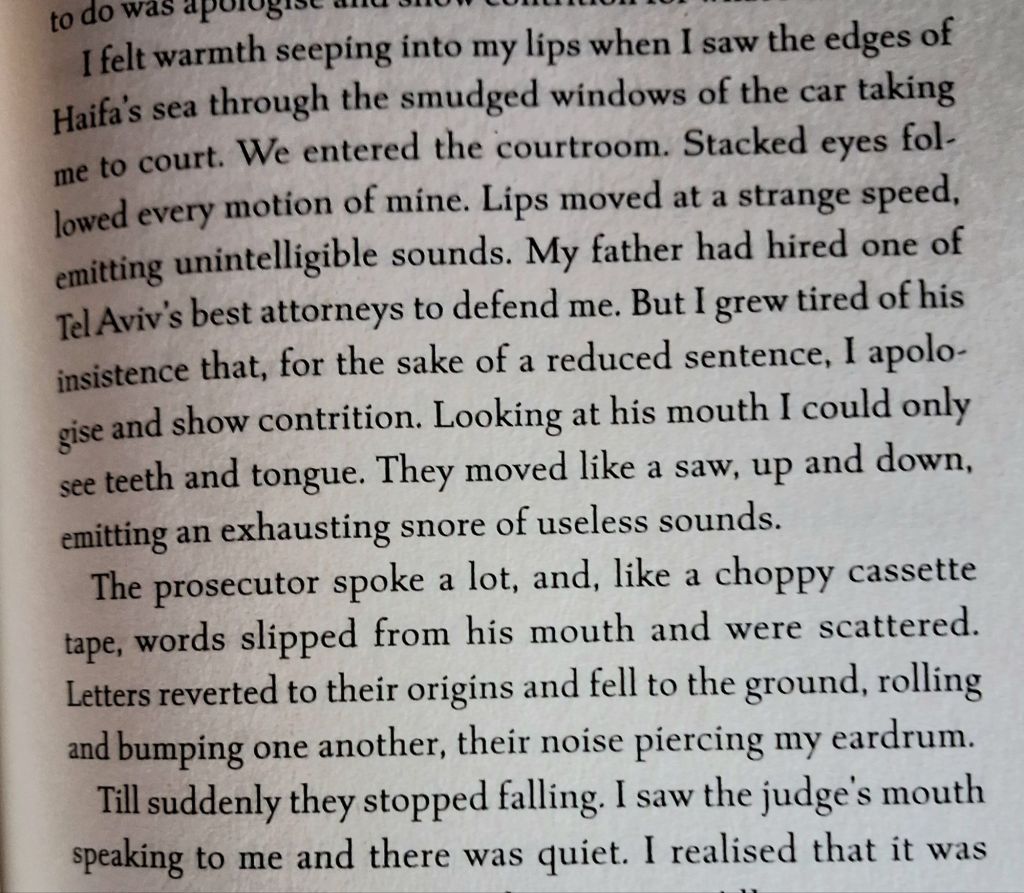
When mouths fragment from bodies, minds, senses and intelligible sense, that writing is the perceived result, where syntax helps to fragment by using body parts not persons as its ubjects and objects and oft at war, doing violence to each other, though one does not see itself as a violent actor. Indeed when Gharib decides to buy Shahin’s pencils it stems from a perception very relevant to mouths as a source of primal utterance, that pencils might help to solve if you just don’t make furniture of them (you need to read the novel to understand that);
Everything is a fight! Why does it seem to me that this country is in a constant fight? Everything around me is warring. Even calmness itself seems to befighting. looking for a place of its own, and words are like shots fired from the barrels of human mouths in battle.
I decided to buy all of Shahin’s pencils. … [13]
One could go on, and choose different body parts to discuss. The ‘thick skin’ Gharib develops would be a good one. [14] But I think the point is made. The division of the body into parts is one of many splits – the body from mind being another, or shadow too you’ll remember, but the body is vulnerable even when split from man-made dressing. Four Way Reveviw interviwers stress this in the following and Azem’s response is both interesting and inevitably, as she says, not able ‘to do justice to it and the awful vulnerability of the stripped naked:
FWR: When interrogated by the Shin Bet, Gharib narrates, “I sat naked with the black hood covering my head like an idiot. How did my naked body look as I sat on the cold chair?” Later, Gharib is in the airport traveling to Cyprus, surprised he is not questioned more or taken into a side room to be undressed, because “Being searched, humiliated and deemed suspicious had become such fundamental parts of [him]”. Yet, there is also another very different nakedness within this novel, when Gharib is with Hamsa, and we see her “undressing and touching my body as if seeding a pomegranate. Making sure to kiss and touch every single seed”. I am curious about how you balanced the vastly different kinds of nakedness, vulnerability, and intimacy Gharib experiences. Under Israeli occupation, what does the Palestinian body and autonomy look like?
IA: This is a complicated question, and my answer here will not do it justice. In the details of life under colonialism, Palestinians do not resist only through direct confrontation.
Part of resistance is joy, sex, love, marriage, divorce, hatred, and many other ordinary aspects of life in a time and place where nothing is ordinary. Continuing to live an “ordinary” life is itself a way of pushing back against the colonizer’s control over your everyday existence. When you hold on to the everyday despite the colonizer, you are saying, again and again, that they have not managed to defeat you. [15]
Well, maybe the answer does do the question justice, because the whole tenor of the book is that that when everything fragments that you claim as you – the country and ulture with which you identify, control of your own body from surveillance and violence in public, even your choice of lover (for Gharib’s father forbids him love Hamsa), the best thing you can dois try and tell stories of a life as a whole person lived whole. You may not succeeed and you will be chewed up into more fragments than you thought possible but you will have resisted the power that attempts to colonize who and what you are – the existential theme of this existentialist Arabic novel. There are still problems. Gharib even dreams of the control of mouths, especially his – experiencing not only ingestion but projecting vomit, that connect his moth in dreams to an aftertaste when awake. But taboon bread still gets baked, even if you can’tarticulate it as your culture, even when you are:
yelling from the core of my being, but I don’t know how my voice will come out when my tongue is still tied. I try to untie it but I can’t. I keep screaming and calling out wordlessly. [16]
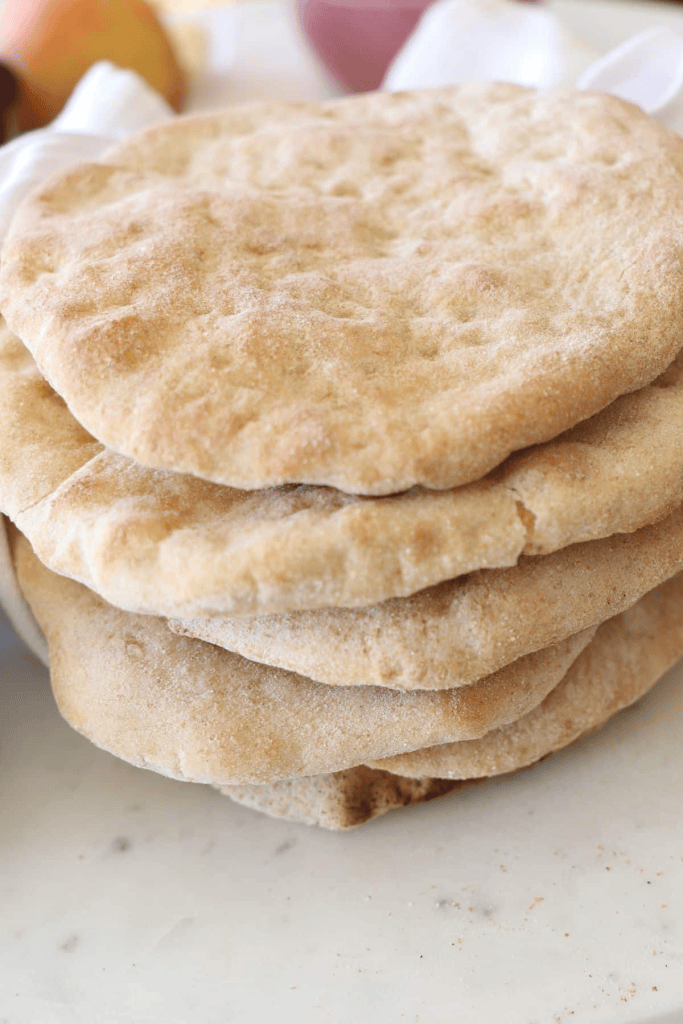
Remember as you read how long ago this book was written. When you eat taboon bread again, remember the blood spread since and resist the myth that genocide in Gaza came only out of a response to terrorism, much as we deplore that terrorist attack of 2023. It insn’t excused by history, but if you neglect history your tongue will be tied. How viscerally you feel Gharib’s tongue tied but not as much as the continuing fact of that happening on Palestinian ground now.
But remember too how Palestine is growing a literature, poetry and culture from stories that live and preserve a living Palestine, despit attempts of the IDF to kill that off too.
Much love
Steven xxxxxx
[1] Ibtisam in E Ce Miller, Moby Yang (interviewers for Four Way Review – FWR), & Ibtisam Azem (2026) ‘The Resisting Power of Living–and Writing–Ordinary Lives: An Interview with Ibtisam Azem on THE SLEEP THIEF’ in Four Way Review: An Electronic Literary Journal (Sep 13, 2026) available at: https://fourwayreview.com/the-resisting-power-of-living-and-writing-ordinary-lives/
[2] Ibtisam Azem [trans. Sinan Antoon] (2026: 9f. ) The Sleep Thief Sheffield, And Other Stories.
[3] Britta Stromeyer (2026) ‘Stealing Sleep, Reclaiming Tomorrow: A Review of ‘The Sleep Thief’ by Ibtisam Azem’ in Arablit & Arabic Quarterly Journal (online) [August 17, 2026] available at: https://arablit.org/2026/08/17/stealing-sleep-reclaiming-tomorrow/
[4] Ibtisam in E Ce Miller, et.al., op.cit.
[5] ibid
[6] Ibtisam Azem (2026), op.cit: 41.
[7] ibid: 9f.
[8] ibid: 13
[9] The photograph below from ibid: 56
[10} ibid: 31
[11] ibid 11
[12] ibid: 13- 14 for Haifa beach, recalled in passage photographed below (ibid: 27)y#
[13] ibid: 42
[14] ibid: 100
[15] E Ce Miller, et.al., op.cit.
[16] Ibtisam Azem (2026), op.cit: 82.

