What’s something you’ve done that your past self would be proud of?
View all responses
Let’s defend artistic licence over ‘history’. ‘From Villein to Villain or from Ploughman to outlaw woodsman: From Piers Ploughman to the legend of Robin Hood: The Paradox of the 1381 Peasants’ Revolt and Art. This blog is a reflection on seeing Paul Greengrass’s The Uprising in The Reel Cinema at Bishop Auckland on Tuesday 13th October 2026.
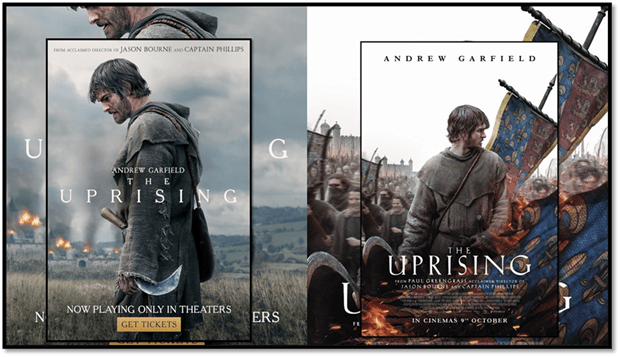
The newspaper reviews of The Uprising, Paul Greengrass’s story of the Peasant Revolt of 1831, have been either damning or sneering (especiallyy in characteristing historic poverty. That unfortunately is a true measure of the terrible state of the public culture of our time. The reviews tend to find ammunition from two dump repositories of film criticism clichés. The first is that the film is not historically valid or reliable, the second that it is stylised in ways stereotypical of Greengrass. They present the director as a faux artist in serious drama: using an inappropriate use of hand-held camera recording in the handing of narrative points of view, and an over-limted pallette at the darker and duller end of the spectrum. Neither jarred or seemed inappropriate to me.
Two reviews I read, Owen Myers in The Guardian and Michael Phillips in Variety play upon an attempt of the film distributors and publicists to increase the popularity of the historical subject matter by referring to an attempt, dropped before tbe debut of the film, to rename it. Here is Myer’s version:
A couple of weeks before release, the US distributor Focus Features briefly changed the film’s title to The Uprising: The Rise of Robin Hood, suggesting that it would show events “that helped inspire the legend of Robin Hood”, even though the Peasants’ Revolt took place nearly 200 years after the time of the folkloric outlaw and his merry men. Meanwhile, The Uprising makes no mention of Robin Hood: almost as if it was all a last-ditch attempt to drum up buzz for a movie that is about as fun as trench foot. [1]
As ‘fun as trench foot’ (based on a First World War phenonemon) is a terribly insensitive anachronism about conflict wounds and consequences but the commentary is based on sneering at another lesser anachronism that places the origins of the Robin Hood legislation 200 years after its ‘time’ and in a film where Robin Hood is not mentioned. But the point-scoring here goes too far, for the referencing of Robin Hood was apparent to me before I read this piece and not knowing about the title change discussions. Michael Philips is fairer in making the point and does seem to have watched the same film I did:
Now for the Robin Hood question. Perilously close to the release date, the Focus Features marketing team pulled a fast one, adding a subtitle to the film’s title: The Uprising: The Rise of Robin Hood. To be sure, Greengrass’ script implies as much. But the subtitle’s Hail Mary overtones hit everybody wrong, everywhere, all at once, and the movie quickly retracted it.
And now one feels sad for Robin Hood, whoever he is. He’s hardly the same character we knew a few Robin Hoods ago. He’s swung from gorgeous Technicolor exuberance (“The Adventures of Robin Hood,” 1938) to bittersweet revisionism (“Robin and Marian,” 1976) and worse (“The Death of Robin Hood,” earlier this year, with Hugh Jackman). “The Uprising” has more to offer audiences than “The Death of Robin Hood,” but it’s a well-acted blur of fits and starts — right up to an epilogue suggesting a possible franchise about an avenging-angel-farmer, blood-streaked sickle at the ready. [2]
That is mainly tongue-in-cheek and it is undeniable that, ‘to be sure, Greengrass’ script implies‘ the Robin Hood option for those rebelling against the status quo. I noticed the Robin Hood analogy as I watched the film and well before I read about the name change or saw the debate about it. However, even if the Ploughman (surely renamed now at the end as he is no longer working s such) retains his sickle, the weapons that actually lay the king’s carriage low on a trail through a forest and kill his knightly escort are the arrows of long bows, as in the Robin Hood legend, but still accurately true of the kind of weapons training open to medieval lower-class populations in England.
Of course Robin Hood is suggested here but the important idea was the a-temporal ‘origin‘ of the legend – in the experience of displaced farmers to the outlaw country of the forests there to live free of feudal overlorship from the towns and cities. As Ploughman says to King Richard II when he saves his life: ‘If you kill a King, another one will come along soon, but you can make him fear the dreams he has at night’. The film ends with the young King screaming in his dreams, that sound overlaying a vista of Windsor Castle in medieval look. For me the point couldn’t be clearer and it is about history even if in fabular form: if the rich and powerful survive only as oppressors, owning a ‘law’ speaking only to their interests, then the stuff of fantasy and dream will be the revenge of the outlaws, the making of which (Robin Hoods that is, if not the actual earlier one) their survival entails.
The burden of the film is not only the overturn of the poll tax of King Richard II’s, imposed by his Continual Council, operating between 1377 to 1380, an institution ended by the Peasant’s Revolt. Nor does it reduce the causes of Uprising to hardship and grief following the results of virulent plague years. It does posit a genuine attack on the principle of feudal serfdom, which made the poor the possession of the landowners for which their ‘tied’ or bonded peasants worked the land for the owner’s benefit. For a short time Richard abolished serfdom only treacherously to revert to the principle of it enshrined in the Domesday Book distribution of land imposed by the colonial Norman powers of William I, much as in the film. See the fourteenth century illumination below, however, also, wherein you literally see Richard turning coat and murdering the men he welcomed to his bosom as ‘their’ king, not that of the overmighty lords the Domesday Book created. Some credit Richard, though not the film, with the words, when he reversed his decision; ‘Villeins you are, and villeins you will remain’. A villein is the french derived name of the land serf.
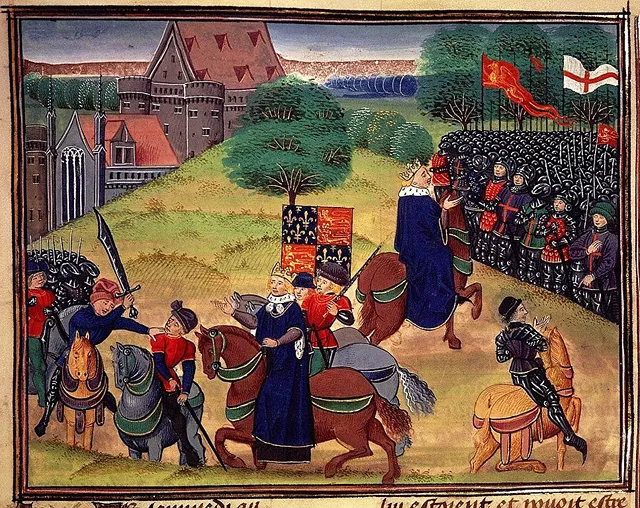
The Great Uprising of 1381 depicted in this late 14th century manuscript – British Library Royal MS 18.E.i-ii fol. 175
Critics who blame the film for a-historicity often get that history so wrong themselves. For instance, Myers compares the historic characters of Wat Tyler and the cleric John Ball, ‘ two people who actually were in the Peasants’ Revolt’, as he rightly says with Ploughman, played by Andrew Garfield, exceeding well in my view. Myers gets the point he makes entirely wrong by invoking ‘the egalitarian principles of the Domesday Book. Yet no book or state document could be less egalitarian than Domesday, even though it could be invoked by the rebels as favouring the primary right of the King over the rights of his landowning nobels and their serfs:
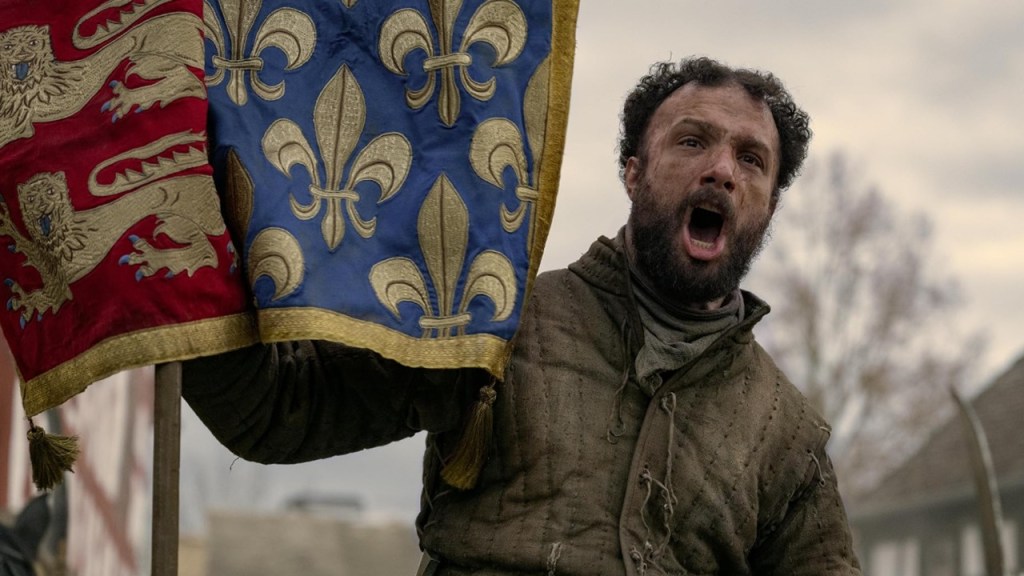
Wat Tyler ( Cosmo Jarvis) holding the Standard of the Commons of England
…, the priest John Ball and rebel leader Wat Tyler (Jamie Bell and Cosmo Jarvis, both great and, unlike Garfield, both look like they actually could be from the late middle ages). “Join us, Ploughman,” beckons Tyler, as Garfield’s character, his band of brothers and a tomboy named Alyce, Thomasin McKenzie, unite to march on London with an aim to confront the king and restore England to the egalitarian principles of the Domesday Book.
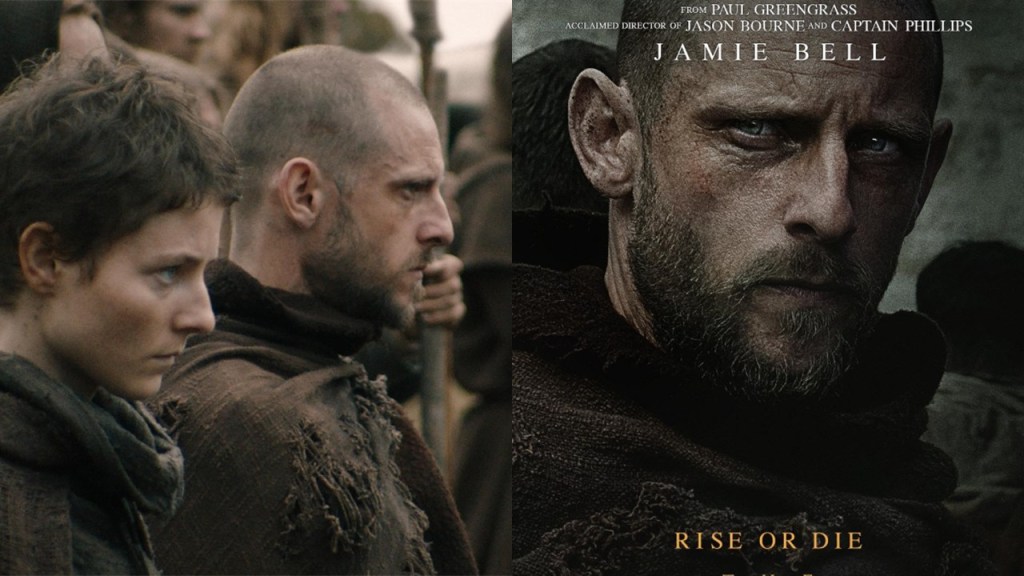
John Ball, Jamie Bell & Alyce, Thomasin McKenzie, unite to march
He is right about the quality of those actors but wrong to pit them against the Ploughman and how he is embodied, even though he is fictional entirely and idealised. Myers says:
He’s an unconvincing hero, this gruff Ploughman. The character seems to have been constructed as an everyman figure who unites the common people of England, but without any particular magnetism or spice, he often feels like he could be any man. [1]
That point about ‘any man’ is almost correct. To me it is clear that the film uses the fouteenth century literary trope of the ploughman as an everyman, standing before his God and what he believes, at first at least, as God’s representative for Him on earth, the King. Likewise Philips also gets the Ploughman wrong for the sake of a clever trope about ‘double’ effects in the film, which are far from convincing when you think more about tje detail of the film:
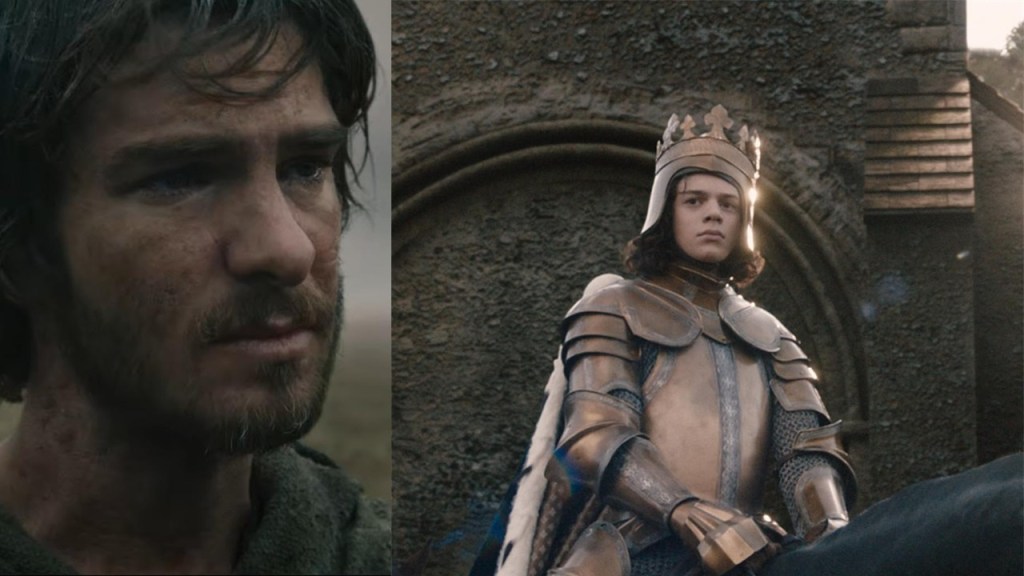
Likewise Philips gets the Ploughman wrong for the sake of a clever trope about double effects in the film, which are far from convincing: Andrew Garfield as Ploughman and, Philips thinks, the double of 14 year-old boy king, Richard 11.
For much of “The Uprising,” Garfield’s Ploughman is primarily reactive — the audience’s entry point to a time, a place and a mess of a ruling class. Slapped with a fresh round of taxes, the underclass has had enough. Around the same time the Ploughman gets off the sidelines to save a neighbor about to be killed by a short-tempered poll-tax collector, Greengrass’s screenplay positions the punk kid on the throne, 14-year-old Richard II (Woody Norman), as a contrasting study in leadership training.
The king is a distorted mirror image of the Ploughman. Garfield’s character grows into his destiny, once the ad hoc rebellion he soon joins in earnest hits London; meantime, the boy king is discreetly pushed around by the handler-oligarchs in charge. Skillfully insinuating actors on the order of Tom Hollander (Treasurer Robert Hales) and Stephen Dillane (Archbishop Sudbury) add some spice to the film’s periodic seminars in court scheming and skulking. [2]
So far so clever, but so misleading too. The Ploughman is never the leader of the Rebellion but he is used by the leaders, who carve out heroic types of the common everyman irrespective of robes and titles in reality. This is the supposed most famous teaching of the real John Ball – the Adam and Eve line below is heard as Jamie Bell preaches to a village crowd, at Canterbury, rather than Blackheath where the speech was made in full, by reputation (text from Wikipedia):
When Adam delved and Eve span, Who was then the gentleman?From the beginning all men by nature were created alike, and our bondage or servitude came in by the unjust oppression of naughty men. For if God would have had any bondmen from the beginning, He would have appointed who should be bond, and who free. And therefore I exhort you to consider that now the time is come, appointed to us by God, in which ye may (if ye will) cast off the yoke of bondage, and recover liberty.
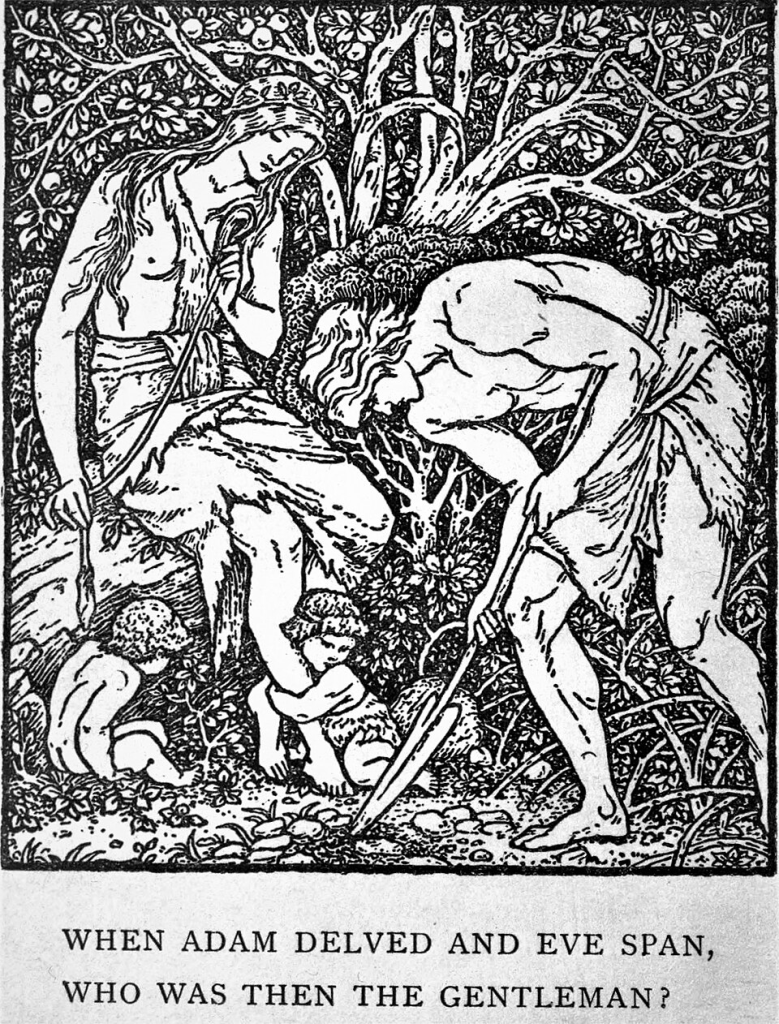
The speech is much valued by true egalitarians, as in William Morris illustration to his poem, A Dream of John Ball, above. However, its point of attack is on the feudal relationship of the bonded serf, owned by a man made to appear above him by will of God and here, holding them in a yoke; just as a ploughman’s oxen are held down, subjugated, and kept at work by a yoke. And thus both Tyler and Ball did take a ploughman into battle with them but it was the iconic legend of the contemporary poem by William Langland, loved by both of them, and invoked in their politics Piers the Plowman.
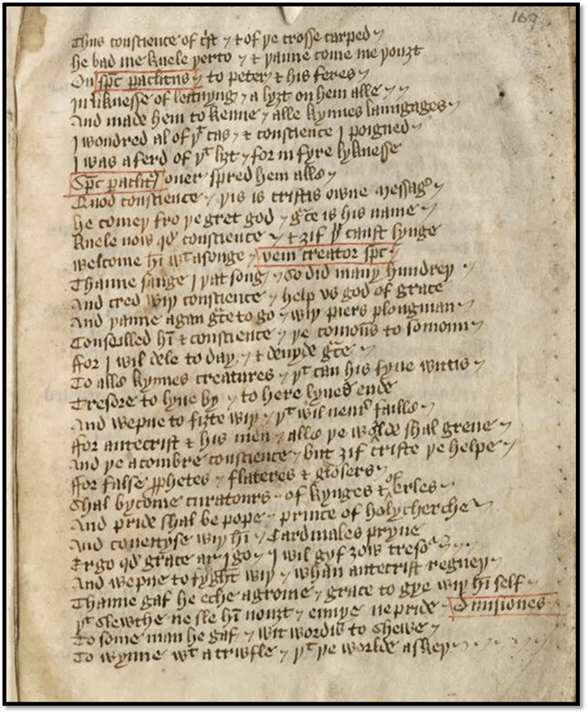
Piers Plowman from the early-15th century manuscript (a late manuscript) in the National Library of Wales
There is a great historical irony in all this historical truth, because the author of Piers Plowman, William Langland (1330/32 – 1385/6?), had entirely conservative intentions in his poem. Nevertheless, the poem contains much that is potentially legible as incendiary to the pyramidal power structures of feudalism – even in critique of those who exploit the ploughmen of this world. Let’s instance this from Langland’s ‘Prologue’, reporting a dream showing ‘The plain of all people’:
Some laboured at ploughing and sowing, with no time for pleasure, sweating to produce food for the gluttons to waste. Others spent their lives in vanity, parading themselves in a show of fine clothes. [4]
Descriptions of the suffering of the poor and his attacks on the ruling class are often thought therefore to have inspired the Peasants’ Revolt of 1381, just as Garfield’s Ploughman becomes an icon of the film version. Yet I think he is there as a living embodiment of the fictional reality from the fourteenth century, that yet bore some kind of sword.
Wat Tyler and John Ball used Piers Plowman, or at least its main character, in order to demand the absolute abolition of serfdom primarily through this figure, at least as some historians argue. Scholars tell us that the “C-text” (the final revision of the poem written after the rebellion in the 1390s), has noticeably altered and removed ambiguous passages to ensure the text could not be used to endorse radicalism, egalitarianism or anti-feudal revolt.Katherine Walton on Medievalists.net further develops the presence of the plowman as a rallying call in this paragraph from her online article:
John Ball, one of the leaders of the revolt, seems to have been particularly influenced by Piers Plowman. A letter survives written by Ball to the peasants of Essex in 1381 that calls on Piers Plowman to go to his work and chastise the corrupt officials. He tells the peasants to “stondeth togidre in Godes name, and biddeth Peres ploughman go to his werk, and chastise wel Hobbe the Robbere,” [stand together in God’s name and ask Piers the Plowman to go to his work and chastise Hobbe the Robber]. You can read the complete letter here. Hobbe the Robber has not been definitively identified but it is thought to perhaps refer to the treasurer or another unpopular church or governmental official. [3]
Although the character of Greengrass’s Ploughman is modernised in terms of his ability to learn leadership and acquire empowerment, at first in support of the principle of medieval kingship but later as an forest-dwelling outlaw, he starts as the stoic character of the poem’s reputation. Once we take on board that what the film does is take on the power of art to fuel or dampen revolution, it seems very shallow to say, with Myers, that: ‘there are far too many scenes revolving around the Ploughman ominously polishing his scythe…’ or that ‘Garfield does the best he can with the material, but by the time Ploughman has a righteous and rageful awakening, it is far too late’. [1] There is far too little evidence here yop persuade us Myers ever engaged with the film at all. Likewise Philips, in writing as he does here, seems to show the filmmaker is coding his Ploughman as an icon of the times, the ‘zeitgeist’ even (as Langland’s hero perhaps becomes in its contemporary reception if not in intenrtion),
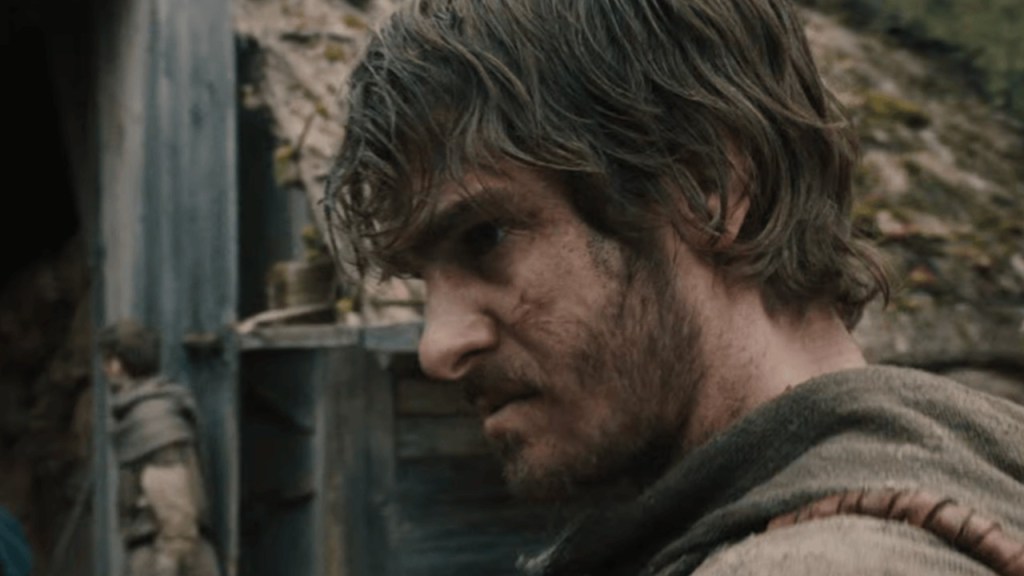
…, a stoic Andrew Garfield is first seen in a field against a smudge of gray sky, his farmland barely producing a crop. Garfield’s character is the Ploughman, no stranger to grief. His family has been wiped out in the Plague, along with half of England. Gaunt and spent, he speaks little and has less. But in the brave heart of this fictional protagonist, there lurks a righteous threshing machine, ripe for a Great Rebellion in writer-director Paul Greengrass’ latest feature. [2]
And it is not just in his actorly mastery of silence that Garfield is admitable. He dominates the mise-en-scene as an emblem of necessary revolution, as in scenes like those below, both in its communal and less pretty and violent manifestations:
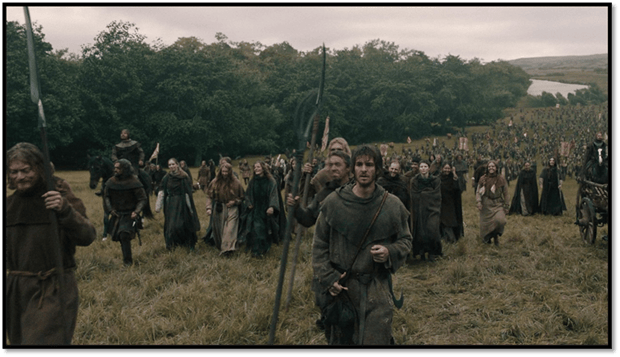
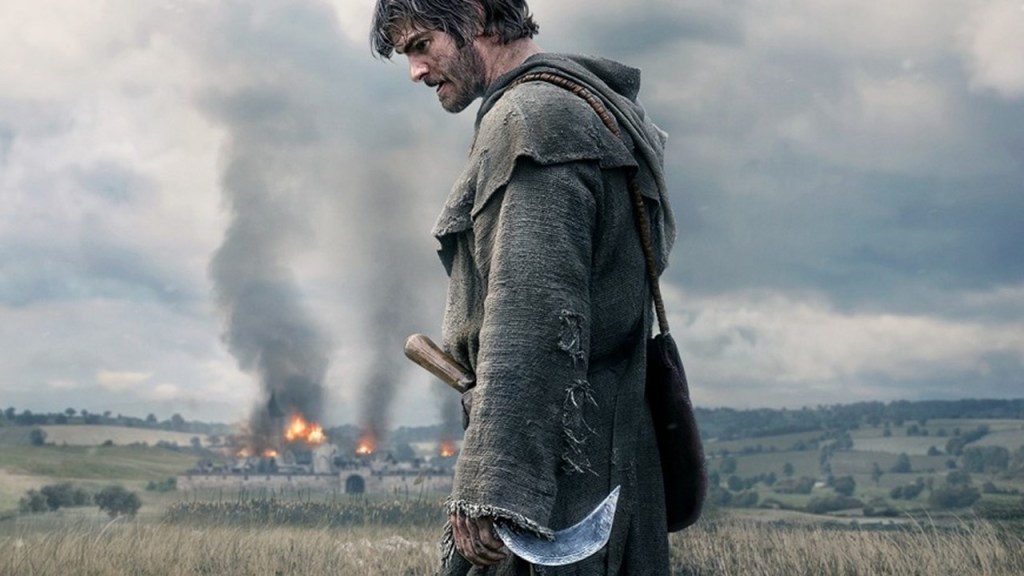
The contemporary press is absurd in its refusal to take povert (historic or otherwise) seriously. It comes as no surprise that our newspapers so fail to convey the horror of the Gaza genocide still in process whilst The Observer, who review the film as an anonymised article amongst also rans on the 11th Occtober 2026, can say this:
The farmland is blighted; the skies are sullen and greasy-looking. On the recommendation of a venal band of advisors, the 14-year-old King (Woody Norman) has raised te=xes on peasants who are down to their last turnip.
This kind of spurious facility in writing is the disease not the cure, not even a good reading of the symptoms of inequality. Of course, the history in the film is pared down. If you don’t know the history it is not clear that the king we are dealing with is Richard II and that he came to the throne at age 10 (in 1377), four years before the film starts. We get little sense of his mother as the historical Joan of Kent (except she travels in a carriage from Canterbury). She is by the way a rightly praised actor.
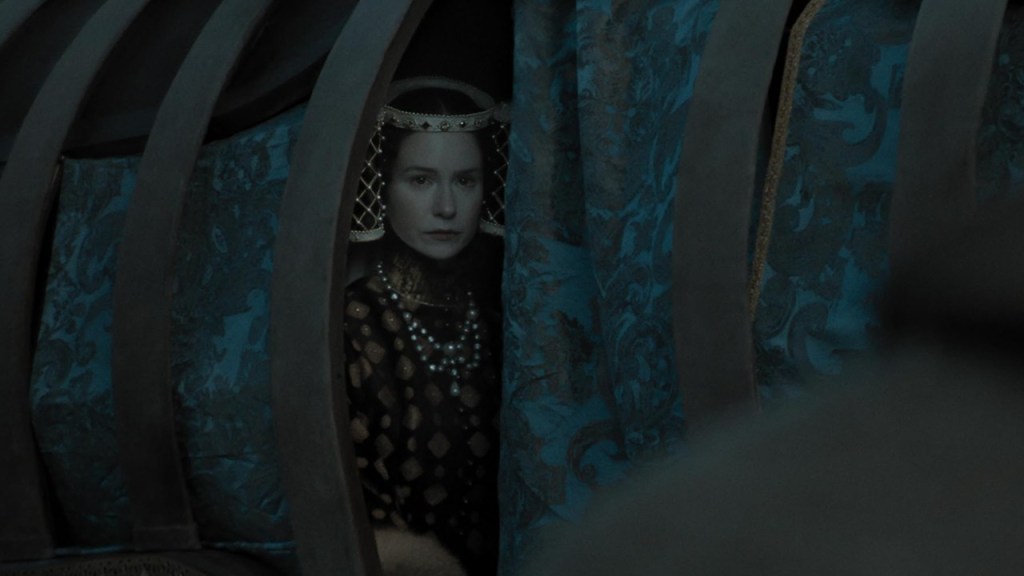
Nor do we know that she was the wife of the lost hope of masculine leadership after Edward III, Edward the Black Prince. Yet we need to know something about the nature of revolutions we do. For instances, the Continual Councils were set up to guide Richard in 1377 in order to avoid a Regency that would have have beough John of Gaunt nearer to his King-maker later role earlier. But we do see thatthe Councils resist getting money from the middle-class mercantile class in fear of raising the power of the Commons in rule, especially the new classes whose power lay in trade not land. We see thereforefore why the Mayor of London, the representative of that rich class gives the Commons standard to Wat Tyler, in order to break the hold of the church and arisyocracy on all power, and why they connive with the newly empowere KIng to get the standard back to represent their interests alone,not those of the pasant class seeking an end to serfdom. Richard is exemplary – using a supposed belief in his divine right to send off the Council, but only to restore the status quo, with the help of London mercantile interests but as absolute as ever, if not more so – at least in the interests of the king to follow him, Henry IV, the usurper.
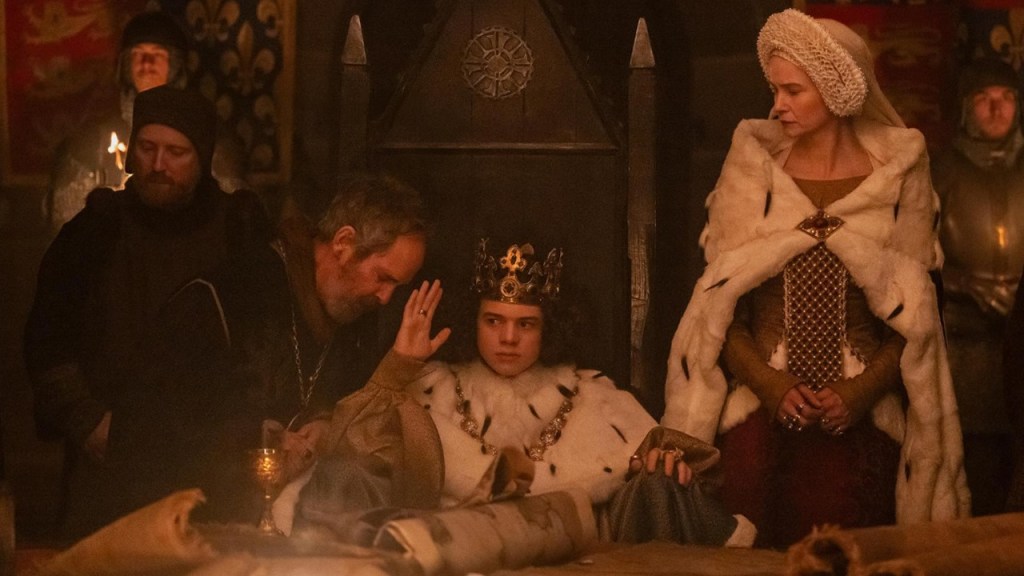
If you try to find things in this film to irritate you, you will easily find them, but trying to understand how art does something different to history and in this case by playing with transitions between literary icons. Hence my title. From a stoic ploughman who passively represents the feudal order, a ‘villein’ because that is what he was made by birt, he learns the use of arms and the vanity and folly of those liyttle people with great power and then terrorises their dreams as the legend of a free man outside the rich man’s law, the ‘villain’ (in their eyes, and in that sense, a Robin Hood of the type of Romance.
The types came from art -but who reads Langland any more – and return into it, more as the centuries pass for Robin Hood is more famous the more obscene capitalism becomes and romantic freedoms are desired (into the ninweteenth and twentieth-centuries). And if Greengraa makes a film it shows enough art to be truly interesting to me. I was engrossed in the film despite the fact that Geoff and I were its only viewers in an afternoon showing of the film at the Reel, Bishop Auckland. I’d urged you to see it.
With love
Steven xxxxxxxxx
____________________________
[1] Owen Myers (2026) ‘The Uprising review – the peasants are revolting in muddled historical epic’ in The Guardian (Wed 9 Sep 2026 14.00 BST Last modified on Wed 9 Sep 2026 14.39 BST) available at https://www.theguardian.com/film/2026/sep/09/the-uprising-movie-review
[2] Michael Phillips (2026) ‘The Uprising’ Review: Andrew Garfield and Paul Greengrass Go Medieval on the Peasants’ Revolt of 1381, With Uneven Results’ in Variety Available at: https://variety.com/2026/film/reviews/the-uprising-review-andrew-garfield-1236855448/ .
[3] Katherine Walton ‘Piers Plowman and the Great Uprising of 1381’ in Medievalists.net available at: https://www.medievalists.net/2021/05/piers-plowman-great-uprising-1381/
[4] William Lanland {Revised ed. trans into Modern English J.F. Goodridge] (1966: 25] Piers Ploughman London, Penguin
[5] on The Uprising in The Observer (11.10/26, page 25).

