What’s something you’ve done that your past self would be proud of?
View all responses
‘… happy endings are best achieved by keeping your mouth shut, and the right doors locked. … but who cares about public opinion now? The opinion of shadows, of echoes. So I’ll spin a thread of my own’. [1] Preparing to see ‘The Penelopiad’ at York Theatre Royal directed by Julie Foster.

Amelia Bullmore (as Penelope) undoing the threads in a woven rope in The Penelopiad, Photograph by Pamela Raith, as are all further photographs.
It’s the way now to look for feminist retellings of Ancient, or even not so ancient stories, as if the retelling of them healed all the sins and omissions, even those only of Patriarchal culture, that motivated their original telling. However, I tbink a ‘feminist’ retelling that focuses on the sex/gender alone of the storyteller or point of view (or worse biological sex alone) without also acknowledging other inequalities, oppressions or marginalisation of the diverse forms of the unheard, and intersections with varied empowerment is surely not enough.
When I heard Edith Hall speak of her new book Medea: a life last week (see the blog at this link if you wish), a question was asked from the floor about Hall’s response to Christopher Nolan’s blockbuster The Odyssey. Hall spoke in response of the omission of larger significance of the role given to Circe in Homer, so that the semi-goddess became a drab witch in the film (however well; enacted), but, in the end, however, said that if she had to recommend a retelling of Homer it would be Margaret Atwood’s The Penelopiad.
Professor Hall did not say why this was so and I can only hope her answer might not have been of the usual kind – that it is retelling through the eyes of Penelope. As an example of what such an answer would look like see this account from a review of The Penelopiad now running at York Theatre Royal from Sarah Freeman of The Yorkshire Post, who starts of by characterising her beliefs about Atwood’s intentions in her original novella:
His wife Penelope, characterised as the ultimate faithful wife, is barely afforded a footnote as she surrounds herself with her own hareem of faithful servants who are complicit in her skillful manipulation of an army of suitors battling for her attention.
Margaret Atwood’s novella, first published in 2005 as part of a series reimagining ancient myths, set out to right that wrong. This adaptation by York Theatre Royal puts Penelope centre stage as she reflects on her life – and her errant husband – from the depths of Hades.[2]
There is a lot not to like in Freeman’s take here. True, Penelope’s story is captured for patriarchy to use as Atwood has the dead Penelope say from Hades, this is not a story she likes, turned into an ‘edifying legend. A stick used to beat other women with’, especially women who, unlike her are reputed not to be sexually faithful to their husbands (women like Helen – ‘of Troy’, who really isn’t treated that well by Penelope either in this play once she’s dead too). [3] And Freeman isn’t thinking when she says the ‘faithful servants’ are complit in Penelope’s skilful manipulation of gullible mem. They are not so much ‘complicit’ as doing the job ordered of them by a ‘master’ of their fate, even though a woman.
The point is that Penelope allows them to take all the punishment for the behaviour of the Maids, that was entirely an authorised script from her, even when the clever ones created words for it. Her instructions gets the maids raped, and then hanged for being ‘dirty women’, in collusion with the brutish suitors for Penelope’s power in Ithaca.
After all, even assuming Freeman was speaking of the novella mentioned here only, even that is only partly only Penelope’s story; for interwoven within it are threads of other stories, of servant women in particular, whose perspective is not the same as hers and whose story is turned into the equivalent of dirt. Indeed, the Chorus of Maids makes this point just after Penelope has told the story of her childhood and the way that this childhood induced in her ‘reserve’ in storyyelling, and ‘mistrust of other people’s intentions’.
The maids say that they ‘too were vulnerable children’, but not children who chose reserve to save their lives in a crisis but had it forced upon them with lies directed to them about their unspoken origins (as slaves and so on), other than that they were not ones valued in Greek society, who even as children laboured to serve the rich. Although no tales of forced submission to women as to men are told, neither are ones of rich wives deciding to assist them forthcoming. Their life adds up to that fact that they can be told they are ‘dirty’, with a range of meanings implied: ‘Dirt was our concern, dirt was our business, dirt was our specialty, dirt was our fault. We were dirty girls‘. [4]
It is largely a reorientation of the import in the story of the role of Penelop’s maids – those brutally murdered by Odysseus, who received no effective support from Penelope, and whose orders they had followed so that Penelope’s reputation of fidelity is not challenged, although not affirmed either. Here’s a bit of sorry blank verse I made to help me see that:
I will now spin a thread, I forced my maids
To spin before; the common lies, trusting
I’ll support them, when tangled threads must be
Unspun and keep them safe from women’s lot,
Low women that is, who work for pennies
(Penelope’s wealth their pennies source).
Low women need my power, freeing them
From fear of rape, the act itself, perhaps
The twisted rope that hanging them aloft,
Shall make their feet dance, twitch in empty air.
The powerful always make their fictions
Work, and dependants on me, make fruit for
Flies of their bountiful lady’s sweet lies.
In the ‘thanks’ appended to the introduction to the play Atwood wrote using words edited and reconfigured from her novella, first played by the Royal Shakespeare Company in the UK, she ends the text with this deliberately underwritten sentence referring to her admiration of the actors who played thr Chorus of ‘Maids’: ‘For without the Maids, there would be o Penelopiad’. [5] There is something vital in that sentence.
For it at one level refers to the fact that a lifelong disgust st the fate of the maids inspired Atwood’s retelling. At another level it refers to the fact that Penelope’s story, and the plot it involves, is one upon which she is entirely dependent on the Maids – in taking the heat off the sexual desire of the suitors off the Mistress, and of weaving and unweaving the shroud for Odysseus’s father so that she has never finishes it and therefore is not available to the suitors as promised.
The text (of both novella and play) makes much of threads in the story, though the play drops the spider story about which Penelope spins a sense of the complications with which threads knit together in a web. There are the threads of the woven shroud, woven picked apart, the thread that was a metaphor of destiny in the story of the spinging Fates (or ‘Moirae or Mœræ‘ – from Ancient Greek: μοῖρα, which means “lots, destinies, apportioners”), mentioned by Odysseus to Penelope when he talks of such threads as malleable if you tell enough false stories, as he says before he is called to Troy to Penelope: ‘… he who can master the hearts of men is well on the way to mastering the Fates, and controlling the thread of his own destiny’. [6]
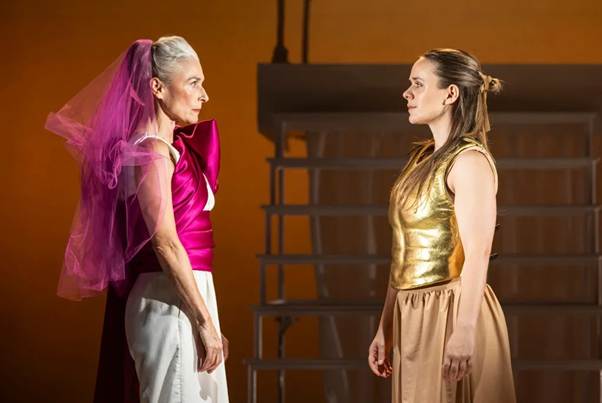
The older Penelope in memory marries the younger Odysseus, played by one of the Maids, as the other roles than Penelope always are. Amelia Bullmore (as Penelope) and Charlie Russell (as Odysseus) in The Penelopiad, © Pamela Raith.
Yet Penelope is a kind of spider. In the novella her narrative mentions the shroud thus:
The shroud itself became a story almost instantly. ‘Penelope’s web,’ it was called; people used to say that of any task that remained mysteriously unfinished. I did not appreciate the term web. If the shroud was a web, then I was the spider. But I had not been attempting to catch men like flies: on the contrary, I’d merely been trying to avoid entanglement myself. [7]
It doesn’t take much thought to see the flies she caught in her ‘web’ were the Maids. According to Angie Millard, who has connections to Northern Arts and must have checked this out, says in her review of the play in York Calling that:
Penelope becomes a narrator in this all-female production and Forster has adapted the script herself, adding to it and including wit and humorous observation’.[8]
This is all the more likely because the director Judie Forster has lengthed the play in other ways to include originally composed sound, music and elements of physical theatre. Amongst this physical theatre there appears from the official theatre photography and The Guardian’s review by Catherine Love to much use of thick red ropes, interwoven from less thick threads that appear to form the shroud and the ropes used to hang the maids. These themselves are narrative threads. Here is Love’s description:
The backdrop for this revisionist storytelling is hades. In Sara Perks’s minimal design, it’s a sterile, featureless place, deliberately drained of the passion and mess of life. Thick, blood-red ropes suggest the strands – literal and narrative – woven by Penelope and the cords used to hang the maids. These wronged figures form a chorus, acting out episodes from Penelope’s life as well as interrupting with their own bitter take on events. [9] SDB puts emphasis on that excellent critical sentence by Love
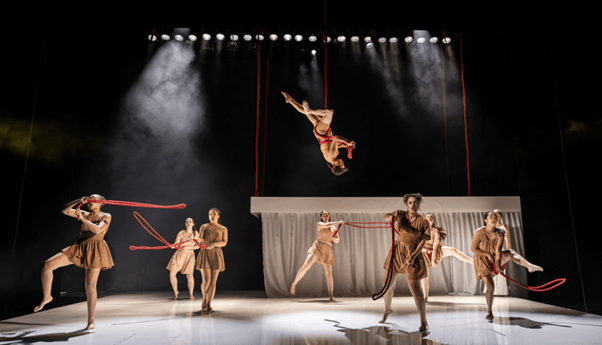
Threads and blood-red ropes as desiny, art and play in physical theatre. The tone of this scene I just can’t wait to see.
What I miss in the text, I long for in the production, which seems a return to the best kind of ensemble theatre, where the Chorus is also all the characters and are enabled to perform transformations even in their group role – becoming a crowd,perhaps of suitors, surrounding Penelope, using masks to duplicate their body, for instance.
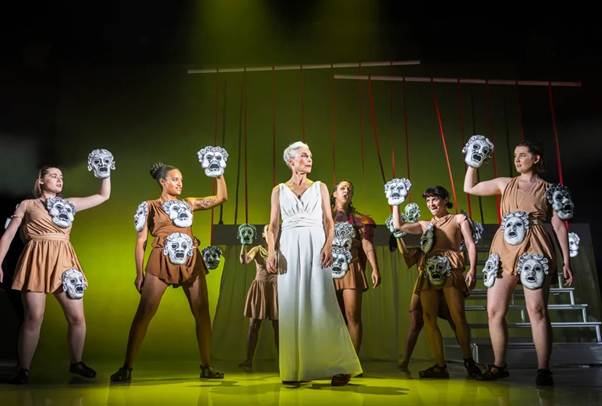
Likewise, they become a kind of Dionysiac chorus of Maenafs projecting the disorder inside the role of Helen (especially since Helen is played by one of them) that merely plays the games required of women in patriarchy, as indeed does Penelope, as she realises, except in the opposite of Helen’s man-eater, the faithful wife. In both case these aristocratic women sell out womanhood to being the collusive image of what men think women can alone be, one or the other.
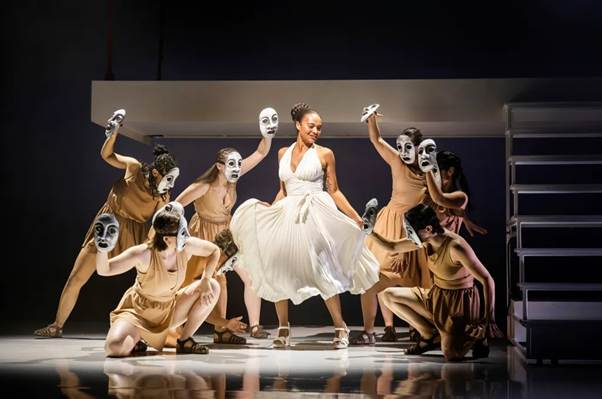
Yet what excites me as I look forward to next Wednesday’s live performance where Geoff and I will be in the audience, is the way good ensemble theatre is always physical, creating meani g by group motion counterpointing individual movement, and always use stage settings and properties to realise both communal and individual self-characterisation. Is that what Angie Millard points to in the paragraph below based on her viewing of the play as realised at York.
Sara Perks’s set and designs have a magical quality. Pure white beds are flown in and steps are moved around a white plinth, transparent curtains float by as ship sails and actors become shadow puppets in battles and scenes of slaughter. The effects of it all are used to convey a myth in which the magic of theatre is used to absolute effect. [8]
Catherine Love says something similar to earlier points raised about the primacy of the chorus, except by suggesting the relationship of the central one-role actor to the chorus ensemble is always one with restraint / reserve on one side (in the latter) and purposefully ‘over-the-top’ behaviour in the former.
The maids, on the other hand, offer a raucous contrast to Penelope’s restraint. The energetic eight-strong chorus sing, dance and skip their way through the story, pulling on different outfits like kids playing dress-up, only to puncture the silliness with reminders of their deadly fate. [9]
As with several other critics I read all of this seems indirectly a critique of Amelia Bullmore playing Penelope. At the end of the above paragraph Love says that the play could have ‘a greater punch than it ultimately delivers’, which seems to chime with an earlier statement that despite ‘Bullmore’s comic gifts as a performer, it’s surprising that much of the grim humour of Atwood’s lines feel underpowered’ and that she plays at times with ‘stiffness and lack of texture’. The Yorkshire Post‘s Sarah Freeman despite calling Bullmore’s performance ‘masterly’, says the play’s problem is that it is ‘essentially a two-hour monologue’ and that Bullmore cannot sustain ‘the intensity across it’.
Why do these critics come up with these reservations about the actor? Millard, unlike Love and Freeman, sees restraint and sel-poszession in the performance and this feels to me to align with the Penelope I see in the text. Jim Keaveney of What’s On Stage says something even more revelatory of how a great performance might be got wrong if what you look for is consistent ‘intensity’ as Freeman requests. He says almost the opposite of Freeman, whilst agreeing that putting narration at the focus of a drama, because narration is not, people often think, dramatic :
The music somewhat offsets Atwood’s tendency, in adapting her own 2005 novella, to fall into the author’s trap of retaining too much exposition. Luckily, the task of delivering this falls to the wonderful Bullmore, whose measured, and often wry, delivery matches Atwood’s text. Her Penelope is as complex as Odysseus: they are both liars. She has the youthful exuberance of a young bride and the careful countenance of a woman experienced in survival. And though Bullmore is worth the admission alone, it’s the chorus who grab you at the end with their final haunting howl of righteous feminine anger. [10]
I suspect that this is the true intention of the actor if somewhat under-expressed. The issue is, I think that Atwood puts nrration centre-stage and good actors treat story-telling as a thing to be treated with extreme care – with reserve rather than intensity, because stories and fictions can so easily be interpreted as ‘lies’. Keaveney brilliantly suggests that in order to survive Penelope must tell stories with as much of their purpose hidden as her husband knows, reputed throughout literary history, and not just in Classical Greece and Rome as an accomplished trickster. Women must act with more reserve because to be seen as a liar is even more dangerous to them than to men
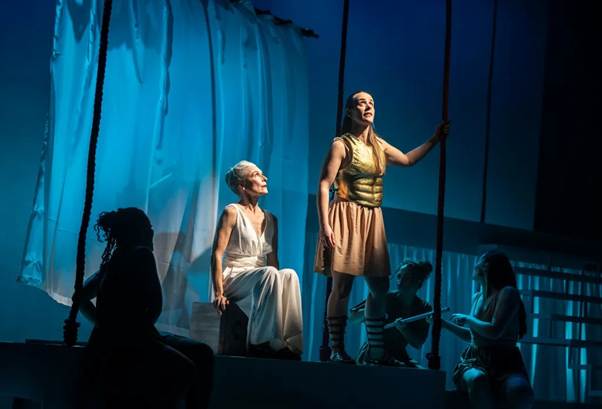
Women must act with more reserve because to be seen as a liar is even more dangerous to them than to men
The issue for Atwood I suspect in the play is how to show that though we understand why Penelope lies – in order to survive in a man’s world – she shifts all the risk of being found out from herself to the ‘girls’, the Maids, she claims to love, and indeed acts as if she loved them – as one of a community, while preserving (and reserving) the real difference between her and them (money, rank, freedom to make certain choices if not others, and self-possession). These Maids cannot possess themselves for by definition they are possessed by her, and ultimately by Odysseus. She puts them in an impossible position that they believe in because she makes them feel she can be one of them, and that they are all in it together. ‘We became like sisters’, she says, but being ‘like’ sisters is not being close, in indeed being sisters is truly a story of closeness, which it sometimes isn’t [12]:
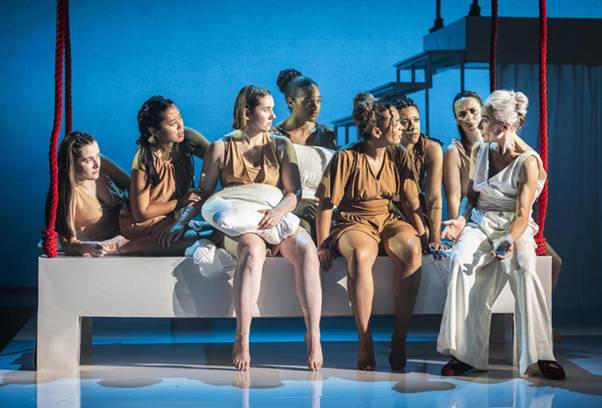
She puts them in an impossible position that they believe in because she makes them feel she can be one of them, and that they are all in it together.
To do that you have to underplay things. I haven’t see the play yet but I look forward to it immensely. Penelope tries to create a thread of authentic narrative unlike the stories told of her – though does not do the same for Helen (which some Ancient Greeks did – like Euripides in his Helen) but ends up waving webs of stories in which someone will get caught but not her. To own her own destiny from the Fates she cuts short the threads held by others and earns their eternal hate, and perhaps that of all true feminists, whilst they empathise with what brought her to this plight. In the end, aristocrats like maids can show ‘trembling and awkwardness. I wasn’t just nervous. I was terrified’, but it helps if you can use someone else to distract others from noticing your fearful playact of duplicity. [11] Penelope knows that social custom, especially in patriarchy is a set of ‘fictions’ – for instance the fiction of bride-stealing in appearance to justify the consummation of marriage as ‘sanctioned rape’. [13]
She also knows Odysseus may be lieing to her just as he does to others. She knows the origins of the formal Odyssey story may be a tissue of lies and that, for instance, the tale told about an island of Sirens may in truth be about being tempted at a brothel. The biggest lie that might be told is that Penelope merely forgot to tell Euycleia and odysseus that which would have saved the Maid’s lives. But that’s why it is a role that must be played with reserve – to reserve the truth we must seem as if we are reserved by nature and trained reserve further by life’s lessons. That’s why, I think, there are so many locked doors and shut mouths at significants points in this play, for that is reserve in action. Penelope sleeps in her room looking forward to the ‘joy’ available, ‘when at last I could tell Odysseus that my girls had been acting in his interests all along‘. [14} Instead she drinks a drink that puts her to sleep and out of the drama of the ‘Slaughter’ scenes to immediately follow.
Both the dead Maids and Penelope try to tell tales that conclude, but as Penelope says at the beginning, ‘when I try to scream, I sound like an owl’ [15]It is the same sound as the Maids who flit around ‘bat-like’ but scream like an owl;
now, we call
to you to you
too wit too woo
too wit too woo
too woo [16]
Quite honestly I can’t wait till we see this play on Wednesday evening. Oh, and what is ‘something Ive done that my past self would be proud of’? I have prepared myself to see something generously and not rely on my unthinking prejudices, as critics so often do, especially in the theatre.
With love
Steven xxxxxxx
______________
[1] Margaret Atwood (2007: 5) The Penelopiad: The Play London, Faber & Faber.
[2] Sarah Freeman (2026) Review of The Penelopiad at York Theatre Royal in The Yorhirre Post (16 Oct 2026) available at: https://www.yorkshirepost.co.uk/arts-and-culture/theatre-and-stage/review-of-the-penelopiad-at-york-theatre-royal-9293133
[3] Margaret Atwood 2007 op.cit: 4
[4] bid: 9 – 10.
[5] ibid: ix
[6] ibid: 32
[7] Margaret Atwood (2008 digital edition: 118 – original 2005) The Penelopiad Edinburgh, Canongate.
[8] Angie Millard (2026) Live Review: The Penelopiad, York Theatre Royal in York Calling (online) available at: https://yorkcalling.co.uk/2026/10/16/live-review-the-penelopiad-york-theatre-royal/
[9] Catherine Love (2026) The Penelopiad review – move over, Odysseus! Margaret Atwood lets Penelope’s maids run riot in The Guardian (Sat 17 Oct 2026 06.00 BST) Available at: https://www.theguardian.com/stage/2026/oct/17/the-penelopiad-review-margaret-atwood-feminist-york-theatre-royal
[10] Jim Keaveney (2026) ‘Margaret Atwood’s The Penelopiad at York Theatre Royal – review in What’s On Stage (15 October 2026) available at https://www.whatsonstage.com/news/margaret-atwoods-the-penelopiad-at-york-theatre-royal-review_1735043/
[11] Margaret Atwood 2007 op.cit: 21
[12] ibid: 54
[13] ibid: 22
[14] ibid; 73
[15] ibid: 4
[16] ibid: 82

