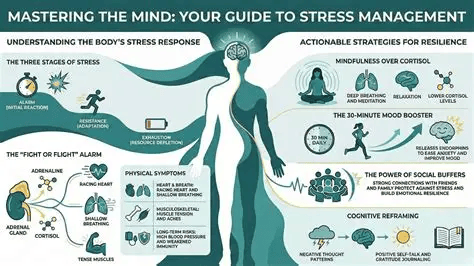
Sometimes the answers to questions are limited by the concepts they engage, which already bias the understandings of what can be said in return that will be considered relevant and appropriate. This is one such question, that can only be nswered if we all agree that the term ‘stress management’ names a domain in its own right with a predetermined of propriety in the answers given. Ask Google AI about the meaning of ‘stress management’ and it will return something like this:
Stress management is the use of techniques, strategies, and habits to control how your body and mind respond to stress, aiming to reduce its negative impact on health and well-being.
I think the question here hopes that its respondents will list or priorotise or otherwise select amongst ‘techniques, strategies and habits’ for which there is biological evidence that stress measures can be reduced, in as much as they have ‘negative impact’ on the body. That seems pretty uncontroversial – except that all the phenomena that accompany living in bodies necessarily have negative impacts and it does not follow tbat these negative i.pacts are necessarily seperable from wanted or desired impacts. Nevertheless, who would not want to reduce impact we agree as negative whilst preserving any impact we agree to be positive?
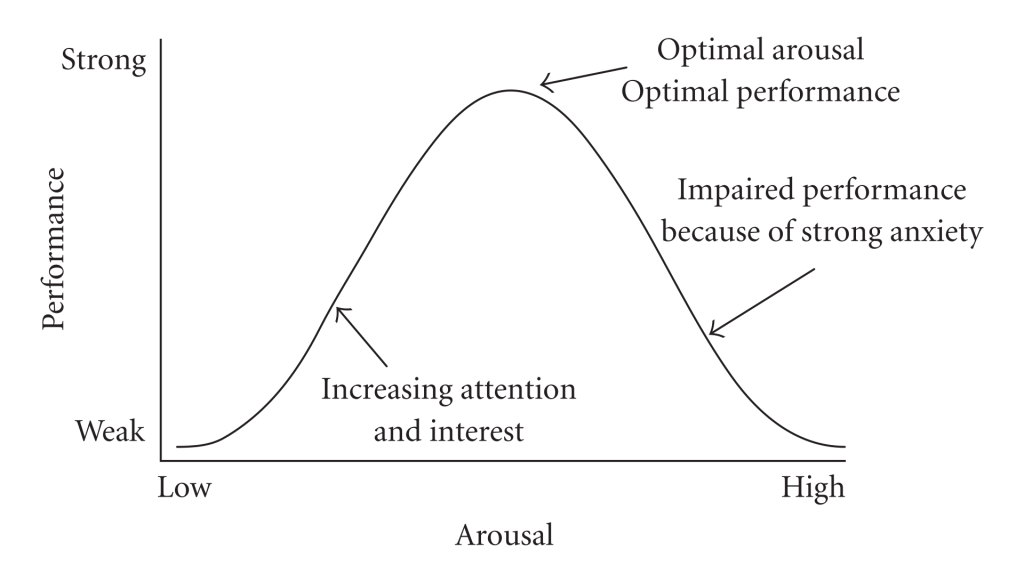
In the early days of understanding stress in biological psychology, Hans Selye started from the proposition that stress is not something in itself we would want to reduce for there are conditions when it operates as ‘good stress’, even inventing the term eustress. The term had short life because what it hid, though Selye’s hypotheses and experiments upon them – often very cruel ones with maltreated animals – did not, was that eustress was often not a different kind of stress (an irresolvable one), it was only a name for the same stress all challenges to a biological organism create when it was productive of action (work or behavioural responses more immediate that resolve the cause of stress) that were beneficial and before it reaches height over its optimal management – that is when we no longer of capable of controlling, regulating or managing stress. Later psychologists weres fond of illustrating this in an inverted ‘U’ (or bell) curve this (from Wikipedia), until that model was itself critiqued to show that the condition of challenge called eustress still contained negative impact, though in more manageable proportion (the issue was then how much negative stress supports dealing with a necessary challenge before the negative impacts dominate the organic biological systems capacity to perform and break that capacity down:
Selye first differentiated the two in an article he wrote in 1975.In this article Selye argued that persistent stress that is not resolved through coping or adaptation should be known as distress, and may lead to anxiety, withdrawal, and depressive behavior. In contrast, if stress enhances one’s functioning it may be considered eustress. Both can be equally taxing on the body, and are cumulative in nature, depending on a person’s way of adapting to the stressor that caused it.The body itself cannot physically discern between distress or eustress. Differentiation between the two is dependent on one’s perception of the stress, but it is believed that the same stressor may cause both eustress and distress. One context that this may occur in is societal trauma (e.g. the black death, World War II) which may cause great distress, but also eustress in the form of hardiness, coping, and fostering a sense of community. The Yerkes–Dodson model demonstrates the optimum balance of stress with a bell curve (shown in the image in the top right). This model is supported by research demonstrating emotional-coping and behavioral-coping strategies are related to changes in perceived stress level on the Yerkes–Dodson Curve. However, the Yerkes-Dodson Curve has become increasingly questioned. A review of the psychological literature pertaining work performance, found that less than 5% of papers supported the inverted U-shaped curve whereas nearly 50% found a “negative linear” relationship (any level of stress inhibits performance).
Before ‘psychology’ became the heartless disciplibe it became in the mid twentieth century, John Ruskin had a similar idea in Unto This Last. All work, however well managed and supported created negatives – which he called variously the ‘illth’ (accunulated bad things like illness) that accompanies wealth (or accumulated wellness in the community and individual), or the death necessitated by challenging life systems beyond resting capavity. For Ruskin it was obvious, all living creates a degree of dying to come, the point was how to justify the death we incur through hard pressure on life support through hard work or other challenge, with the utility and beauty of what we produce supporting communal life, while not being unnecessarily focused on the negatives of work. That is why he supported craft and guild socialism not managerial capitalism that reduce the ways work enhanced the life of workers.
Ruskin set his critique, following Thomas Carlyle, on a critique of a change to industrialproduction where owners, but then increasingly professional managers, distributed work in the interest of efficient production. But in distributing work, and work types, they also distributed the illth attached to work, allowing most of the illth to be experienced by those who got the least benefit from the wealth economic production brought into being from labour (they would say ‘managed labour’). The word ‘management itself takes on new association – see the Online Etymologocal Dictionary:
manage (v.) 1560s, “to handle, train, or direct” (a horse), from the now-obsolete noun manage “the handling or training of a horse; horsemanship” (for which see manege, which is a modern revival of it), from Old French manège “horsemanship,” from Italian maneggio, from maneggiare “to handle, touch,” especially “to control a horse,” which ultimately from Latin noun manus “hand” (from PIE root *man- (2) “hand”).
The extended sense of “control or direct by administrative ability” any sort of business is by 1570s; the meaning “wield (a tool or object) by hand” is from 1580s.
The meaning “effect by effort” (hence “succeed in accomplishing”) is by 1732. The intransitive sense of “get by, carry on affairs” is suggested by 1650s, in frequent use from mid-19c.
How much more beautiful is that word in its origin and how much more significant. It not only derives from the agency specific to prmate mammals, the hand, but it pits that hand, the sign of superiority a.ongst animals well before brains became that symbol, against that which human beings found difficult to control but needed to in their own interest, horses. The issue was always about human control and regulation but at least tje thing managed had acknowledgement as something requiring skill and knowledge in manual handling that at least admitted it had force and agency that needed to be respected, even though brute force is what Black Beauty received in tbe novel in their name.
Gradually, management became the role of people higher in the social hierarchy over the lower, with the added justification of that configuration of power and guidance because the high bred or trained upper classrs were thought to posses the ‘brains’ to direct the ‘hands’, as workers get called paradoxically (see Dickens’ Hard Times). That myth being continually exploded,the idea of management brains is devolved from owners of accumulated wealth to highly educated brains that they employ, who became the ‘managers’ of enterprises of production of commodities and commodified services.
James Hoopes in a September 2003 article could define that phenomenon implicitly as mangerialism, which he defined thus, as cited in Wikipedia.
“[…] the main genesis of managerialism lay in the human relations movement that took root at the Harvard Business School in the 1920s and 1930s under the guiding hand of Professor Elton Mayo. Mayo, an immigrant from Australia, saw democracy as divisive and lacking in community spirit. He looked to corporate managers to restore the social harmony that he believed the uprooting experiences of immigration and industrialization had destroyed and that democracy was incapable of repairing.
Anti-democratic at its heart in Hoope’s view, there is a similarity in this view of who the saviours of society are in the English term, meritocracy. For the merit of learning how to control and regulate, the managers that came into being in that process are perceived as naturally the best people to lead societies divided by wild differences of interests irrespective of more obje time knowledge, skills and values. This became the value base strangely of the modern Labour Party.
How does this reflect back on the ideolgies in modern psychology and counselling that prioritise ‘stress management’ as a panacea for individual and group wellbeing. I truly think it does, for the repertoire of techniques and so on come from the period where Cognitive Behavioural Tnerapies (CBT) were in ascendancy which in its focus on abstracted mental processing ignored entirely the emotions seen as secondary to cognition and behaviour interactions, which, at best, are seen as epiphenomenal.
This constructed a hierarchy in tbe understanding of persons that prioritised the educated and trained response over more mixed ones. Everything could be managed, CBT asserts, and must be managed. Failure of management was seen as either a mark of incapacity or stupidity, sen as versions of tbe same thing. Thus managerialism became an ideology of functionality in personality and every other factor of mental life sen as either or all, sad, bad or mad.
Neither physical nor mental health is advanced by this ideology. The only thing advanced is the ideology itself of top-down processing and the icon it served, the notion of function as tne equivalent of self-interest alone. There are other ways of handling stress based on commu its and cooperation, oiled by understanding of tne comes determinants of human personality. I can’t describe them here. It’s a life’s work.
All my love
Steven xxxxxxx
_____________________________
[1] “MANAGERIALISM: ITS HISTORY AND DANGERS”. Historically Speaking: The Bulletin of the Historical Society. 5 (1). The Historical Society. Archived from the original on 11 November 2012. Retrieved 5 November 2012.