What’s something you’ve done that you never thought you could?
View all responses
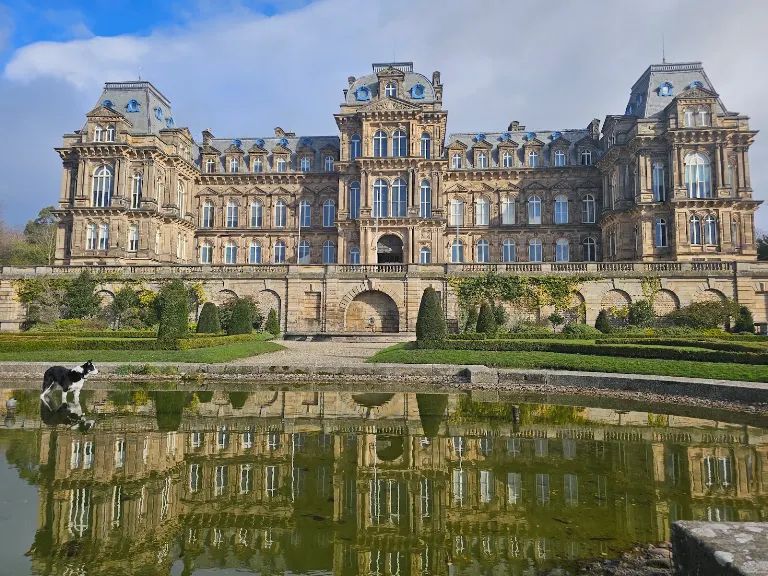
When I was young I was obsessed with words but not with pictures. I never thought I could spend time with wordless pictures, but now I do? I struggle though with the idea that I may turn them into words somwhere inside! This blog reflects on a visit to the Bowes Museum for exhibitions on Norman Cornish’s ‘Sketchbooks’ & ‘Impressions of Light: Masterpieces fromMuMA Le Havre & the Bowes Museum’.
There are some obvious ways in which looking at pictures is intensely related to their verbalisation or transformation into words that tell a story, describe a scene in narrative experience or evoke the association of the word rather than the vision. I need to see the Norman Cornish exhibition again for I barely took enough time to just look at each rich piece out of so many. Yet in many ways what these Sketchbooks do is to brilliantly capture the visual before it shifts into another form. Cornish’s son, in a film in the exhibition, argues that his father arrested motion, while suggesting it before it changed. Hence the visual capture of a short moment of time with memories of the immediate past shaping of whatever isseen and the expected immediate future alone matter and may never be available again. In the pub or on the street, his wonderful drawings – early on in charcoal and later in an ink-flow pen – worked quickly, although some of the sketches are also less shetchy than designed. The cover of the 2019 retrospective catalogue (see mt blog on that exhibition at this link) Shows perfectly our memory though of the ‘norm’ of Norman’s figures, men who lean or sit in the rare leisure from the pits or in retirement with prominent bums. In the blog I refer to I said, which refers to the picture detail on the cover of tyhe catalogue below:
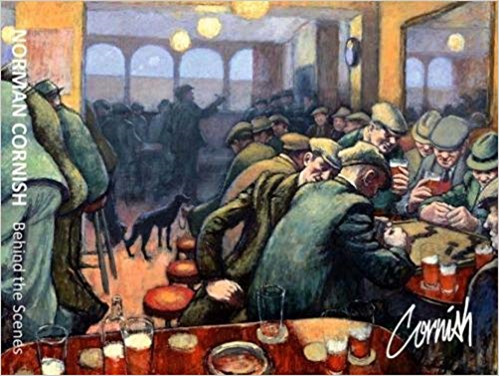
It has taken me a long time to like the images of rotund male bottoms swaying at bars. This once made me dislike what I saw (I think now totally wrongly) as a world of stereotypes that felt brazenly harmful and prejudicial; trading in fictive reductive images of working-class men as in the contemporary phenomenon, Andy Capp. Today I began to see these differently. The classic example which I once generalised as representative of his work is The Crowded Bar, here represented in fig. 1 from a detail used as a book jacket (but the wonderfully large original is in this exhibition).
Now this picture probably needs no defence but it feels still to me as externalised and objectifying as I always thought. Its achievement owes much I’m guessing to a desire to outdo Van Gogh’s images of the bars in Arles – technically if focuses on light and emotion. Cornish himself felt that the round globes in the bar, brilliantly reflected in both the window behind them and a mirror to the side were what he himself admired here. Rightly, though that is because he uses the shape of these lights to understand the overall lighting of his scenario. Only the figures and setting of the foreground mark the round light above the back of the man in a green jacket playing dominoes and reflected in that jacket. It is otherwise unseen than in reflections: on the sheen of that jacket and the polished table at the bottom edge of the window frame, for instance. This table fixes the position of the viewer looking up (as if seated) from behind that table and equated with viewer of the picture as a whole.
Thie present blog is mainly on the other exhibition currently on the Bowes but I hd to capture an a-normal’ Norman bottom – shapely and beautiful, the male figure in this sketch is one of those oft unemphasised in the rest, a young man holding a resting position:
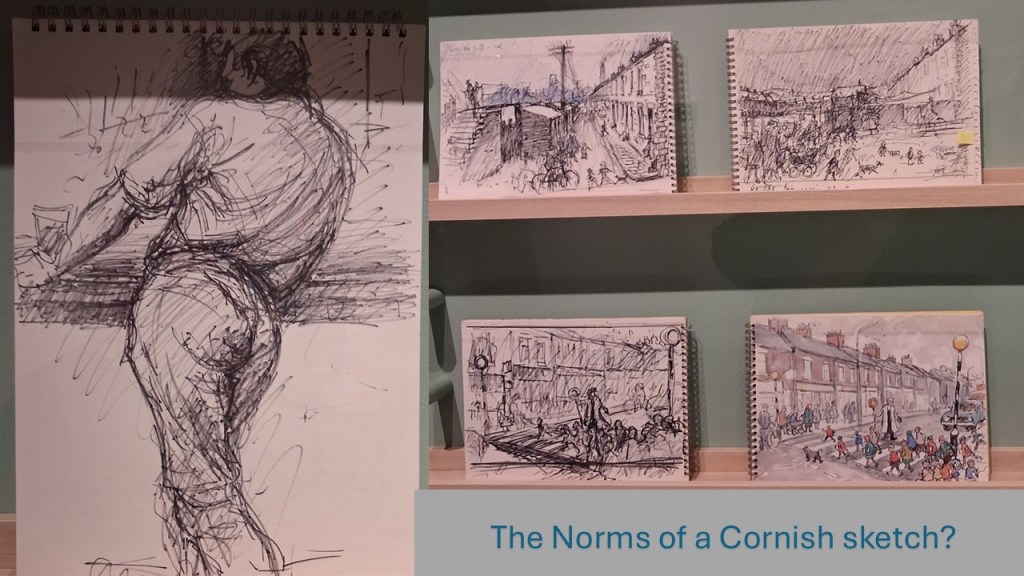
By the way photographing this picture reminded me of a beef I had woth curation at Bowes. Insistent on lighting from above, framed pictures leave a dark shadow over the top of pictures 0 truen of the other exhibition too – that entirely distort the image contained in the frame. There is a beautiful head as well as beautiful body on the man above. The curation almost beheads the man – making the most of a lovely arse of course, but losing the point of this capture of youth. You must see this exhibition – for its Spennymoor scenes – also excerpted above. So lovely.
But Geoff and I went to the Bowes to capture the exhibition based on an allince between it and the gallery at Le Havre, wherethey claim to record the taste of the bourgeois collectorsthat united the wealthy Bowes to the mechants and capitlists of Le Havre, all promoting ‘modenisms’ (so to speak) of their day. I turn off from things like this and though I’d recommend you buy the catalogue for the exhibition for its beautiful unglossed reproductions, beware of its essays fawning on the famous connoiseurs at the base of both collections. To me, like the Bowes itself, their interest stinks of the vanity of displayed wealth, to which they turn art, supposedly into aesthetics but in fact into high-end commodities. What I recommend is buy the catalogue but don’t read the dull essays.
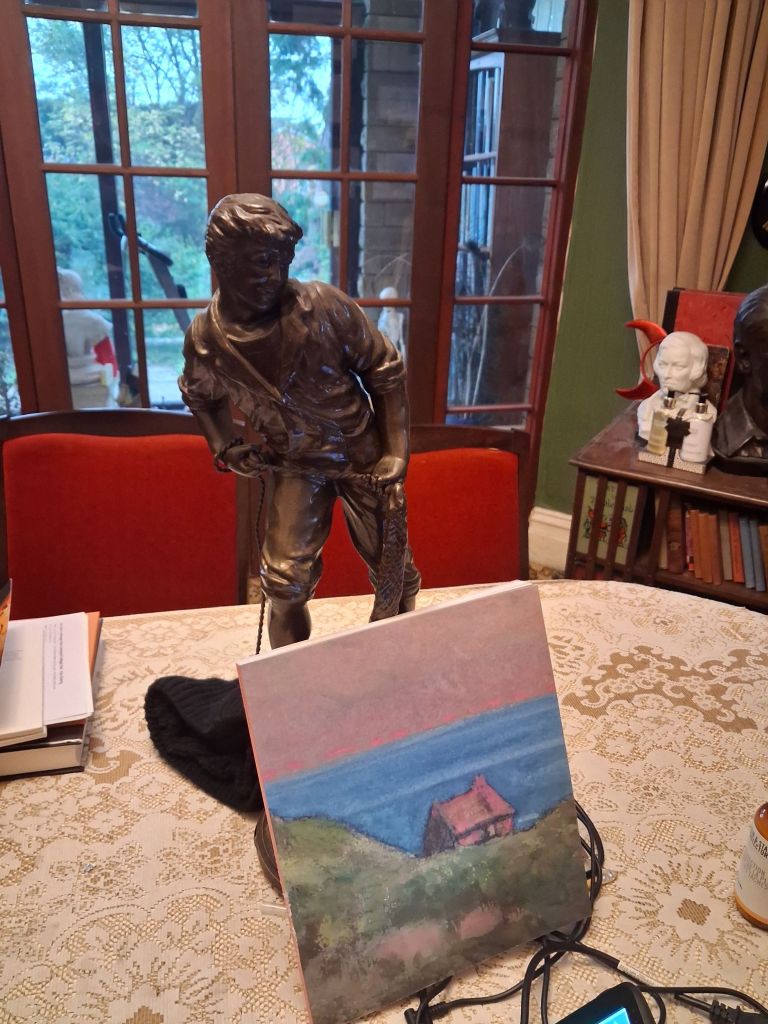
But I want here to test if, when I just looked at ‘masterpieces’ as the collection of paintings in the main exhibition I visted is communally dubbed (with a hint that they showed the penumbra of interest in light at either side of the impressionist movement), my pleasure was purely visual. Another reason I wished to go is that I have such problems with the idea of impressionism and its various justifications, but that so often rest on the capture of scenes as a product of constantly changing light that makes them as captured what they never will be again – except permanently (or so painters hope) in these pictures. The title ‘Impressions of Light’ suggests this I think.
The exhibition could be described in many ways, although the concentration on the depiction of landscape seems common – and pools riches from that genre from the Bowes and MuMA at Le Havre. The date of the pieces puts all of them with the nineteenth and early twentieth century and contains mainly French painting or French-influenced painting. I expect the painting After the Thunderstorm, 1817 , seen near the entry was meant as a starting point of that from which movements that sought to see how a landscape impressed upon one in the moment of seeing started, for though it captures a moment of land-and-sky-scape features that are in the cusp following a change: storm clouds and darkness chased away by light skies from the east, there is much in this painting that reminds one of a composed stage set in which a narrative is underway on the cusp of an ecounter. The rock in which onefigure stands even looks like a stage. The remnants of turbulence in the scene – the fast rush of the stream alongside the rock stage, seems too easily to translate into a symbol of emotional turbulence, perhaps in the process of resolution. However though light is present not only as a presence, it is meaningful only in terms of the fact that it is yet absent from parts of scene, and manifests itself mainly in its reflection from coloured objects in all their shaded tones of variegation based on the angle of the light falling upon them. Light has no substance and yet is seen only in the diversity of substances it illuminates (even the clouds of varying density and volume.that he ‘studied under Jacques-Louis David and Pierre-Henri de Valenciennes‘ suggests that his training was neoclassical – his aim to illuminate stories with design that tended to symbolism and drama. One could not be nearer to the standards of the Academy against which the refusnik Impressionists rebelled.
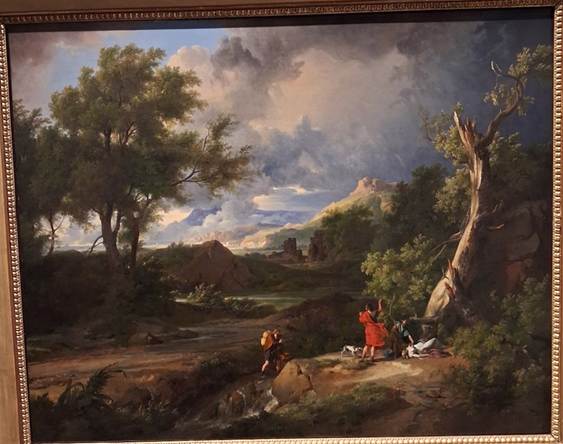
After the Thunderstorm, 1817 Achille Etna Michallon, Oil on canvas
When the narrative behind such landscapes is one derived from European Romanticism, the drama is entirely created by highly implausible ‘natural effects’ where the built lanscape and the natural landscape war to show us something of the grandeur of God or Time abstractly considered in mighty effects from the viual world seen through transparent air. Pierre Henri de Valenciennes, despite his innovations (plein air painting, the use of ‘recognisably real’ landscapes) has the same neo-classical transparency and flatter finish of the Academicians amomgst whom he counted himself. On a ruined Roman bridge he views a distant and impossible castle on a pinnacle but is the one lit into insignificance, of a noisily emotional sort like that of Byron’s Manfred, by the grandiose theatricalism of the heavens.
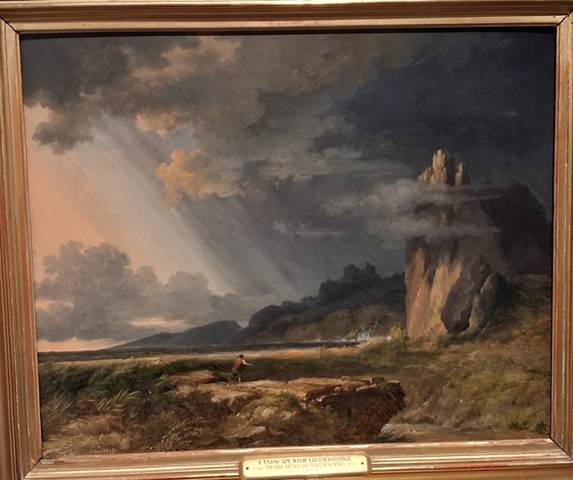
Landscape, Storm (The Ruined Bridge) 1817, Pierre Henri de Valenciennes, Oil on canvas.
As an example of one trend to look from grand drama narratives at a moment of passion where nature and the heavens might reflect inner emotion, take two examples from the exhibition by Charles-François Daubigny (considered as a Barbazon School herald of impressionism) below. It is not the case that this captures landscape as a set of figures or objects – although figures there are in the Ornamental Pond, almost whited out in the effect of the sun shining on them, as seen from this distance and perspective.Indeed though light effects objects it does not so much distinguish them but over-obfuscate with effects of depth, volume and opacity that sometimes their margins are indistinct. Sometimes a lay of light seems like a deep pool made in the surface of the ground, and promotes visual illusions of solid ities that are not there at all. Air is not a transparent medium but itself transfused with light, caturing the solids that float in air and sometimes vary its opacity in the full capture of the sin. The air is so thick, it helps obscure the figures whitened out by light. We do not look at a landscape through a clear transparent medium but the medium itself – the air is given thickness, and volume. Often what we saee is not defines shapes but defined areas of colour and its variations over distances both lateral and in the illusion of depth perspective.
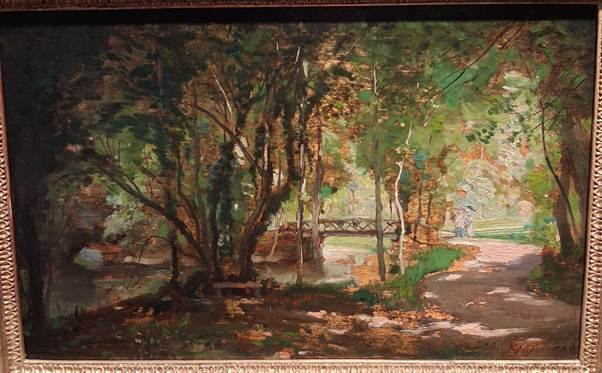
Ornamental Pond and Undergrowth, 1850, Charles-François Daubigny Oil on panel 19.5 x 32 cm
No wonder the idiom for a setting sun in French is retained in the picture below for the sense of something so dulled that it about to be put to bed sings. We see the air more than the lanscape features which we might have thought its objects. It is a wonderful painting seen in the flesh.
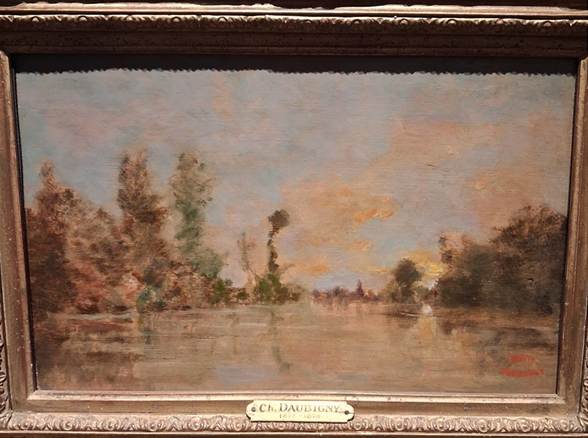
Soleil couchant, L’Île de Bezons, 1852, Charles-François Daubigny Oil on panel
In a later painter, Camille Pissaro, under-rated I think in comparison with Cézanne (who works in a definitively post-impressionist manner, who loved him and did not underrate him, the conflation of seen objects and features of landscape allowed the exploitation of painterly tricks, where in the case of oils, impasto effects that draw attention to the surface volume of the paint itself matter enormously to the illusion seen. I was fascinated by that dab of green (shown in a detail below) for instance in Apple trees and Polars at Sunset, Eragny,. Look at closely we barely see the outline of forms but sometimes illusory intensities, that seem to have their own volume, surfce sheen and density, for the representation of which the paint substitutes its own qualities.
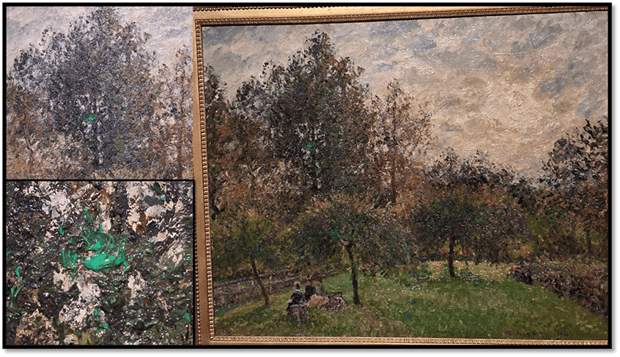
In the details below more subtle effects are achieved for the paint which captures in its impasto forms the the thickness of our apprehension of the sky is carried through into the impressionistiv view of leaves, which we see behind the medium that represents them, paint (sometimes making forms in front of them that we equate with seeing the air thickened by light falling on and through its fullness of small floating things – sometimes pollution (in urban Monet), sometimes dust and pollen.
Apple trees and Polars at Sunset, Eragny, 1901 Camille Pissaro, Oil on cnvas 65 x 81 cm.
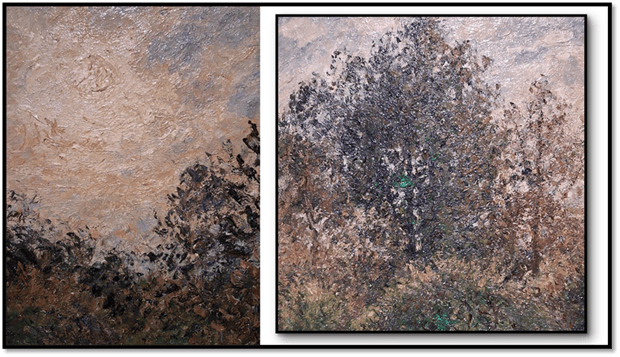
Details of above
Monet himself believed he learned to see as an ‘impressionist’ sees – in order to be labelled as such – it seems we are told in this exhibition, by Boudin, and others in his circle. And these do not use oils to achieve those effects – a naturally dense medium drying in hard relief paterns when thus llowed. The first Boudin in which I noticed this was an assuming pastel piece on paper, Coastal Scene . How without oil density is pre-impressionist light as an element of the volume of a paintins air created. It is, of course, you notice – when for instance you struggle to identify the skiff on the left of the rock on which ythe lighthousetower stands, It isn’t thst he is just defining distance from the object we see – figure, tower, distance cliff of the bay – it is the obscuring medium THROUGH WHICH we see them. I was enchanted by this scene, and I think had to find words for what I saw. For me the visual was not enough.
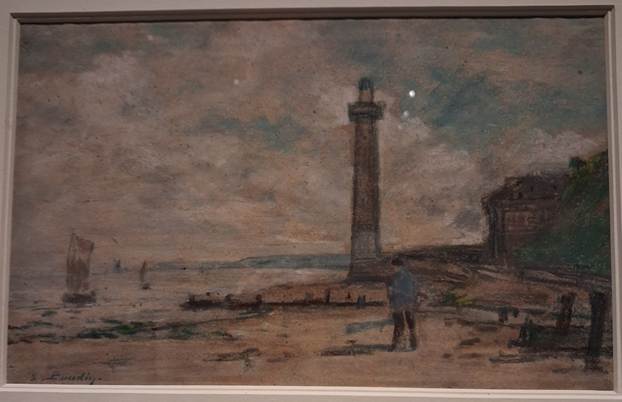
Coastal Scene Eugene Boudin (b. 1824) Pastel on paper.
This was not the only Boudin scene but as I write I am editing out many in which I need longer to think about, but couldn’t do that with the oil painting below, which prefigures so much to come. Showing only sky and an expanse of coastal plain made up of snd, grasses and hills, the boundary of a horizon is hard to find and illusions of depth keep fading into ones of surface solids of paint. So much here is about the marks applied and the marks are not a medium to see through but see with in their own surface depth. The sea cannot reflect the sky so the greens do their best to substitute as a design double. It is moving and beaitiful in the flesh.
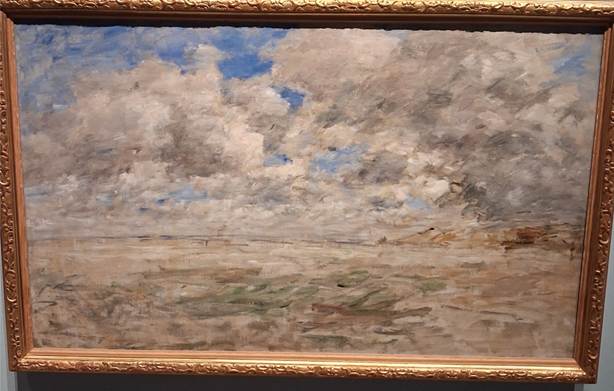
Stormy Sky over Trouville Beach, c. 1890 – 1897 Eugène Boudin Oil on canvas
Of couse, Boudin is, to some extent eclipsed by Corot in the use of light not to feine but to obscure and thicken the air in which things struggle to be defined. The castle in the Corot compared to that in the de Valencienne npainting above to show that here the common scene hides any potential grandeur of rule now ruined. The scene lives and moves because its medium does in a tension of visual struggle. Despite its fame, this scene amazes if you allow yourself to look long enough.
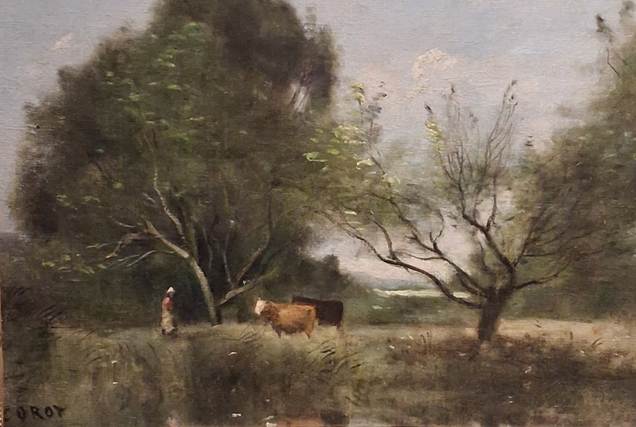
Landscape with Cattle, c. 1865, Jean-Baptiste-Camille Corot Oil on canvas.
Of course lesser know painters may predict the scene above but not without sentimentlising them, so that we think of what the painter is defining still not what we are seeing between us and the scene – a medium of plein air. That was my thought about many pictures by Auguste Paul Charles Anastasi, caugghrt somewhere between the landscape painters I start with and those pre-Impressionists following. Yet the scenes stat sentimental because there is too much definition of foreground and background, as much light is there as is necessary for the chose scenen or story of common life but too little diffusion of it such as we know we see in the world.
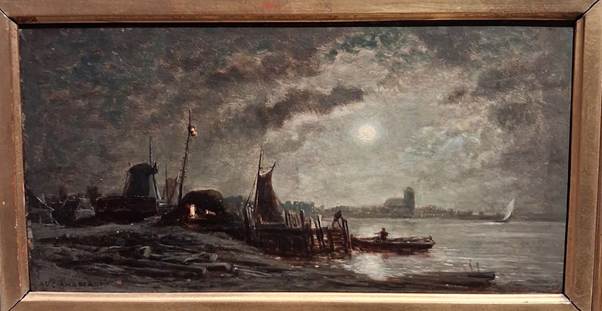
River Scene, Moonlight, 1850. Auguste Paul Charles Anastasi, Oil on Panel.
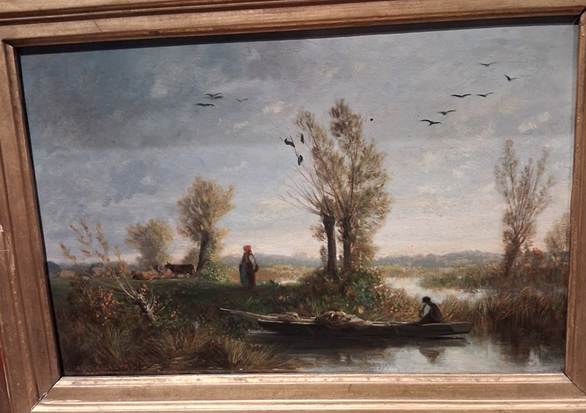
Landscape, the Bank of A Canal Auguste Paul Charles Anastasi (b. 1820) Oil on panel.
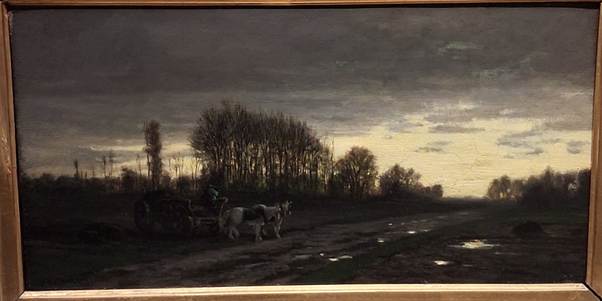
Landscape with a Farm Wagon, Sunset, 1857, Auguste Paul Charles Anastasi, Oil on canvas
None of that could have influenced Monet much to create that star of the show in one way in the exhibition as shown below:
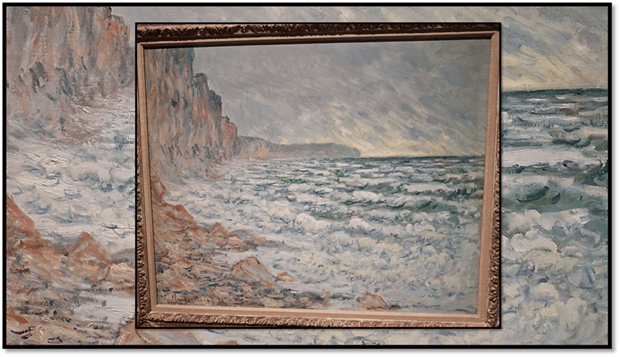
Fécamp, Seashore, 1881, Claude Monet, Oil on canvas, 65.3 x 80.5 cm
Fécamp, Seashore has moved a long way from the pre-Impressionists but not only in highlightimg immediacy of impression but in diffusing everything with the air, air full of spray from a choppy sea, as the medium of seeing. But what it also shows is that immediacy of impression removes you from expectations of natural colour, whatever deadened thing we mean by that, to the rich pallette of the oil painter, whose variations in colour are what we feel we see in nature when our sense are heightened and the conditions of the moment right but are the wherwithal materials of the fine artist. We see paint in all its possibilities.
I am not the greates fan of Monet despite denying his greatness, but pre-Impressionists also took us elswhere in rendering nature in terms that were primarily aesthetic artifice before and led to the masterly Gaigin and Cézanne, learning that natural colour, even when enriched in plein air was not the only way to described the word visually without, at the first instance anyway, invoking plein air. There was form – those cubes and geometric shapes Cézanne promoted – and there was colour in a palette range thought to be far too exotic fro true landscape. I sense this in pre-Impressionist Courbet, and it is worth seeing this exhibition to see View of Ornans, France alone.
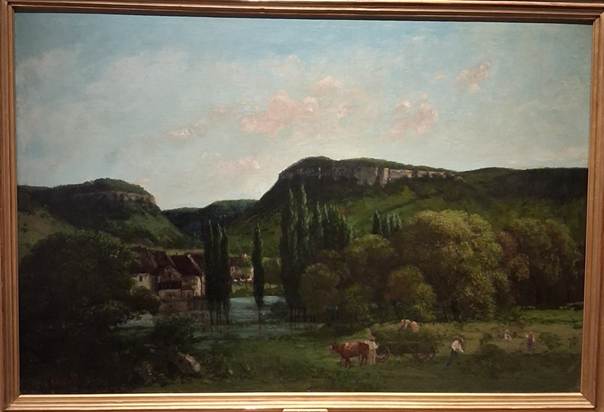
View of Ornans, France, c. 1864 Gustave Courbet, c. 1864, Oil on canvas,
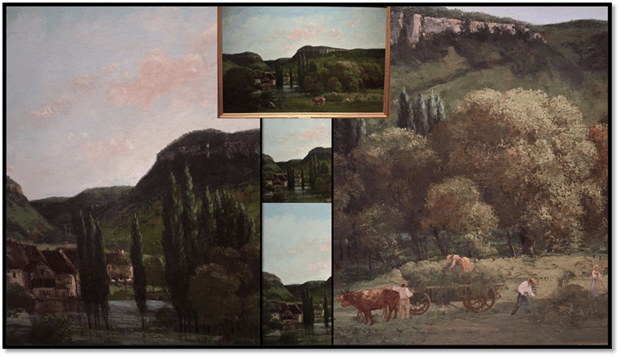
Details of above
In Courbet composition is almost theatric but the medium is thickly present to stop its romanticisation, even of the labour he sought to show ongoing in it. The diffused red in the sky seems one with the diffusion in an otherwise defined scene, as the labourers and cattle let go of labour in the evening. I haven’ttime however to say all I want about this painting. I need to see it again before the exhibition ends.
I did not know Armand Guillaumin before I saw the paintings below from this exhibition but they go as far as Gauguin and Cézanne in colourist invention and then much further, showing the painter as mark-maker in a medium (or media) not an imitator of anything much though an impression of the moment is given but in so different a way to Boudin.
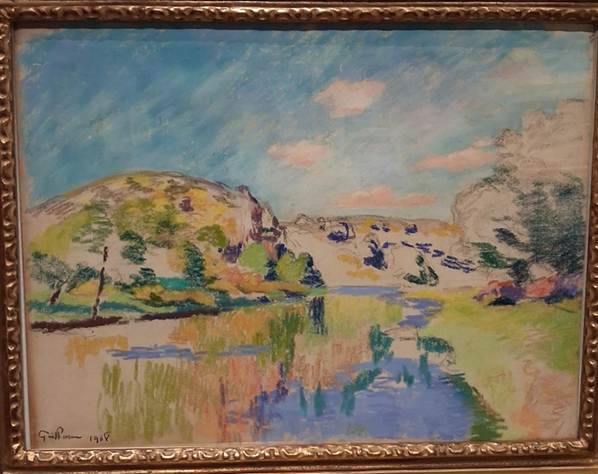
Rock of Echo, Crozant, 1912 Armand Guillamin Pastel on paper 47 x 63 cm
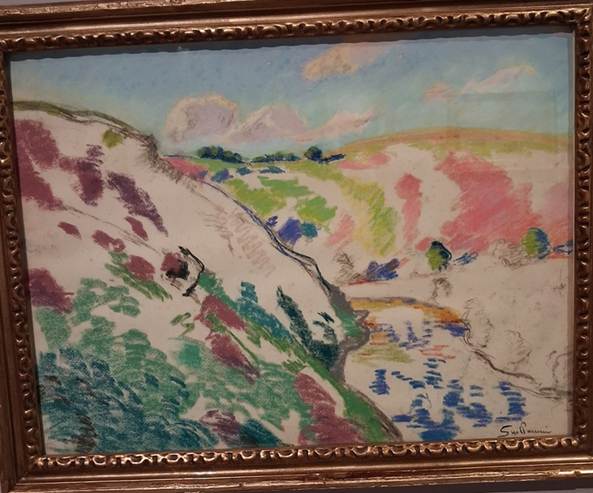
Crozant, in Spring 1912 Armand Guillamin Pastel on paper 47 x 62 cm
Those marks of pink and purple are not merely impressions of flora but of shade and composition and a surprising inbreath at the novelties seen seen herein – whether in Crozant or the flat surface space within the frame. Plain paper and thin charcoal markings seem at home. We see this even more in the Raoul Dufy work in the exhibition starting with the glorious woodland scene below and following that the industrial landscape of Le Havre at the end of day. Here claims of colour as it is seen set against conventional colouring paradigms no longer matter, for invention is the media through which we see, especially in the overlap and fusion of colour ans almost pointillist aggregation of them:
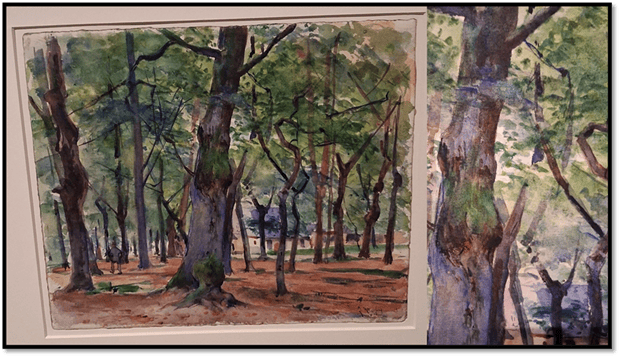
The Côte de Grace in Honfleur, c. 1895 Raoul Dufy Watercolour on paper, 25.5 x 30.8 cm
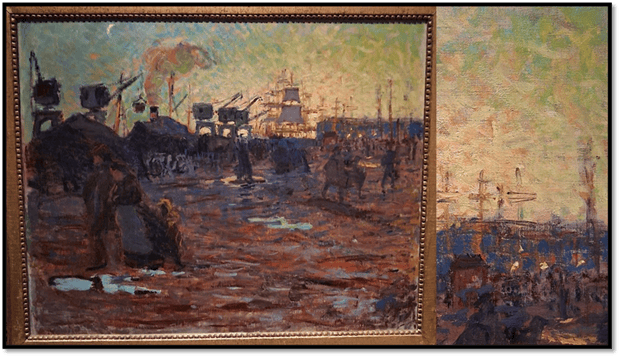
Study for End of the Day in Le Havre, c. 1901, Raoul Dufy, Oil on canvas, 65.6 x 80.4 cm
From each of these the transformation of scene to diverse marks that complement and conflict with each other variously can be seen in passage to the wonderful scene, of Le Havre we are told as well, below, where blank paper serves as much as patches, daubs and brush flights of colour or wash. EWven a rainbow is rendered in povery compared with the scope and scape of the land.
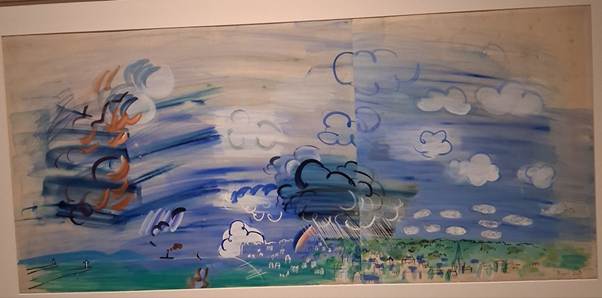
View of Le Havre with Rainbow, 1935, Raoul Dufy. Watercolour on paper, 57 x 124.3 cm
But that industrial landscape of Dufy’s is appreciated better in the light (or is it obscurity and dusk) of another painter: one agin of which I was ignorant, Gaston Prunier. I compared Dufy’s couple returning from dock labour to the factory worker below, who is seen through the dirt pushed into the atmosphere by the chimneys behind her, but still not as a victim but a hero. The red roofs of the factories seem prescient of change, boldly cutting through the media that try to hide them.
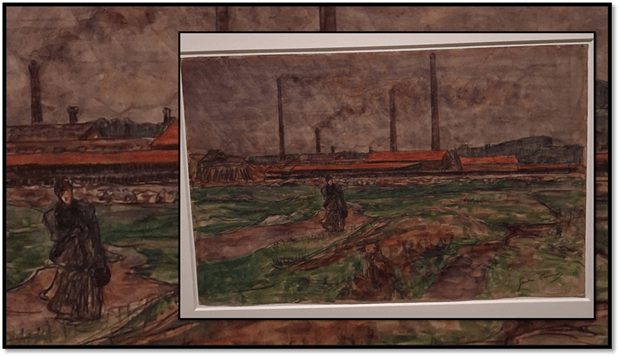
Factory near le Havre, c. 1899, Gaston Prunier: Ink, pencil & watercolour on paper 32.5 x50.5 cm
But then look at his Sorting Coal in the Sheds, 1899 which bowled me over and seems a heir not only of Impression, here insisting that the dark too is a product of judicious signs of the barriers to light. It is richer in colour than we first notice, even the obscure inner part of the coal shedon the left, wherethere are still discernible portals with figures in them. See the detail below the painting reproduction to seethis more clearly.
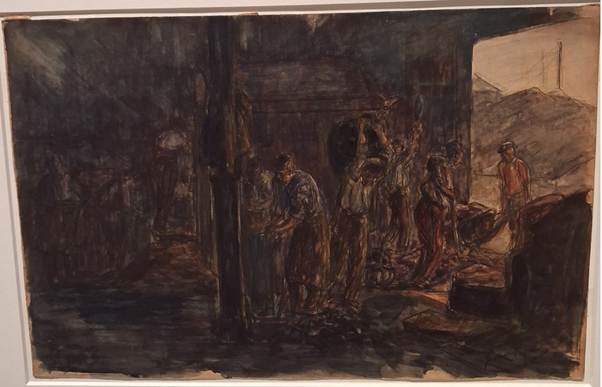
Sorting Coal in the Sheds, 1899, Gaston Prunier, Ink, pencil & watercolour on paper, 32,5 x 50 cm.
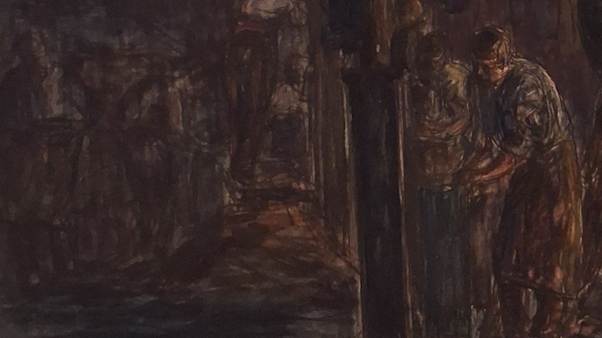
Detail of above
Labouring men are hard to see but here they are made of art cognisant that mark-making is another kind of labour, and that composition of marks adds beauty to labour as well as craft. We see more than ewe think in the dark. We see the light confined by the barriers to emergence it makes visible. Shouldn’t Prunier be spoken of with Courbet?
Do go to the Bowes. Forget the Baroque vulgar display of the externals, rooms and staircases and see the well-curated exhibitions (well except for the upper lighting that makes frames shadow the pictures they contain). I hope this blog also shows how I have battled to learn to see. And I relise that for that such labour is not the binary of articulating words, for that exercoise takes yo back into seeing again and again until you see more – even the bits of these exhibitions I don’t feel good enough to see properly yet.
Bye foe now, with love
Steven xxxxxxxxxxx

