This is a blog in preparation for an event in Edinburgh this coming Sunday as Colm Tóibín and Philippe Sands remember the Dirty Warriors that led the countries of Argentina and Chile and ‘disappeared’ their opponents. I want to know more about why all this matters so urgently again, now!
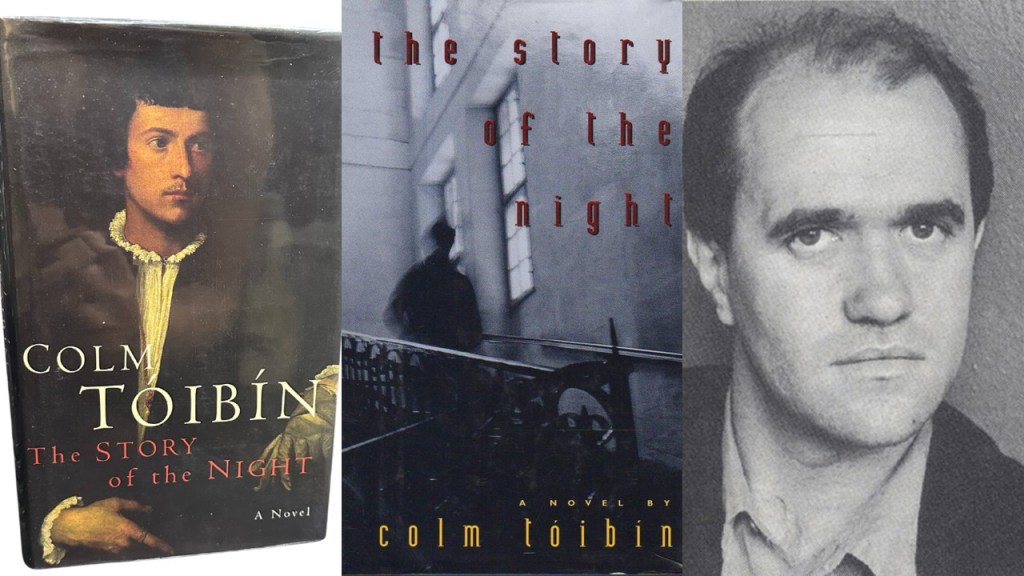
This is a blog in preparation for an event in Edinburgh this coming Sunday with Colm Tóibín and Philippe Sands. the essence of my interest lies in the following quotation. ‘The generals were in power then, and nobody stayed out late, even though the cafés and bars in the street around us remained open, eerily waiting for the lone customer, who had missed his train to finish up and go, or for time to pass, or for something to happen. But nothing happened. Or, as we later learned, a great deal happened, but I never witnessed any of it. It was as though the famous disappearances we hear so much about now took place in a ghost city, a shadowy version of our own, and in the small hours when no sounds were or traces left. I knew – or thought that I knew – no one in those years who was threatened with detention. …. And there are others who have written about this and come to the conclusion that the disappearances did not occur, or occurred on a lesser scale than we have been led to believe. But that is not my conclusion’.[1] Thus says Richard Garay, the narrator of the 1996 novel, The Story of the Night, created by Colm Tóibín, early in the telling of his life. I read this book and a piece of the author’s relevant journalism in preparation for an event in Edinburgh this coming Saturday as he and Philippe Sands remember the Dirty Warriors that led the countries of Argentina and Chileand ‘disappeared’ their opponents. I want to know more about why all this matters so urgently again, now!
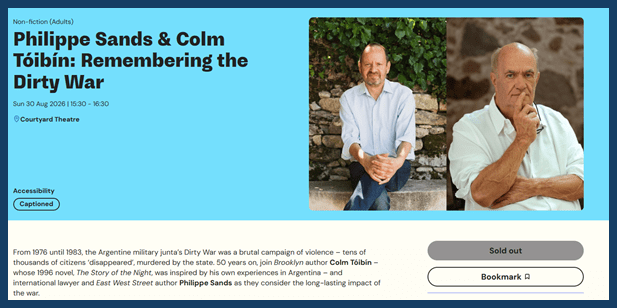
I am answering this prompt literally because I have only just begun Phillipe Sands’ 38 Londres Street, and although I will continue the smallness of the print and the tightness of the printed lines on the page of my paperback may defeat the ambition to finish it, but I will literally be thinking about if for a reason quite contingent to its content. This weekend, Cross Country trains allowing, I will be travelling to Edinburgh for the day to see, first, Douglas Stuart at the McEwan hall interviewed by Jackie Kay, and thence at 3,30 the event pictured above. The description (in that partial screenshot from the Book Festival website) confuses me because it mentions only Argentina, a country with which Tóibín is associated because of his wonderful third novel The Story of the Night about, and narrated by, an English born Argentinian, Richard Garay and a powerful piece of journalism on ‘The Trial of Generals’ published first in The New Statesman, June 1985 but in book form also by Raven Arts Press in 1990 (in The Trial of the Generals: Selected Journalism 1980 – 1990. But that book contains an account of Richard and his friend Jorge sharing a residence in Paris with a group of Chilean exiles, one of whom was tortured by the Pinochet regime. Jorge, beautiful and desired by Richard, for this is Tóibín’s debut queer novel, that broke ground in telling of gay male desire, queer venues and latterly of the AIDS pandemic at its worse.
It is a book in which themes get lost in the seams of their emergence in a very full novel, especially in its treatment of the overt theme (as I guess it) of the 3.30 session, the disappearances, of which ‘The Trial of the Generals’ is a journalistic account, containing stories by the detained and relatives of the disappeared, many of which, it is now believed, were tipped alive but drugged into the sea from military aircraft, making their disappearance irreversible. Some of the more overt means of back-grounding, that I think I will call ‘collusive ignorance’ (with a question mark over how willed the ignorance is – as in the case of the current genocide in Gaza) that theme appear in the quotation from the novel I cite in my title.
‘The generals were in power then, and nobody stayed out late, even though the cafés and bars in the street around us remained open, eerily waiting for the lone customer, who had missed his train to finish up and go, or for time to pass, or for something to happen. But nothing happened. Or, as we later learned, a great deal happened, but I never witnessed any of it. It was as though the famous disappearances we hear so much about now took place in a ghost city, a shadowy version of our own, and in the small hours when no sounds were or traces left. I knew – or thought that I knew – no one in those years who was threatened with detention. …. And there are others who have written about this and come to the conclusion that the disappearances did not occur, or occurred on a lesser scale than we have been led to believe. But that is not my conclusion’. [1]
Phillipe Sands however appears to be talking at this event about his most recent book 38 Londres Street: On Impunity, Pinochet in England and a Nazi in Patagonia, clearly mainly about Chilean disappearances, including that of the filthily guilty which Tóibín describes on its back cover as a ‘brilliant and important book’. This blog concentrates on Tóibín, for I am only two chapters into Sands book and may not, as I said in opening, finish it though I must think about it again, as I listen on Saturday, and will I think want to do so.
Hence, though I am still wondering how the correspondence between Western supported dictatorship periods in Argentina and Chile will be handled in the event, my interest remains in the mechanisms of collusive ignorance which, in their shared aspect as political commentators both writers have urgently addressed with accounts in which it is not easy to continue to profess ignorance of injustice, quite different from Richard Garay. Yet I so wanted to read The Story of the Night again too, which rocked me on its appearance and early reading, though which I seem since to have forgotten or let slip from my mind, unlike say The Heather Blazing, Tóibín’s second novel. Even now I wonder if the pertinence of its treatment of gay male sexuality but the hard-locked companionship to it, but independent in reality, of the theme of the then current AIDS pandemic amongst gay men in particular (though that in itself was a misrepresentation of the general threat of the pandemic). There is a lot in that link in that period that I wanted and needed to forget that I face now only in traumatic memory not present reality. In fact the idea of ‘collusive ignorance’ applies to the AIDS theme and its link to the mechanisms of spread of HIV, and its link to AIDS, in that novel, but not in a way I will address in this blog. I just advise reading the novel again, remembering as you do if you are a queer reader, that some of the links to AIDS are not those our retrospective awareness would foster and which, even at the time, were inevitably linked to well-founded moral panic forced onto the queer community.
This blog must be about the knowledge of disappearances – almost an oxymoron, of course, for the purpose of political disappearance, of Palestinians now, and in South America then, was the denial of knowledge of any fact that speaks up against or resists policies of oppression. It is worth remembering that those who collude in oppression, genocide and /or the removal from all domains of political opposition by violent means (and others of course) do not do so in ignorance – a fact that must and will haunt former unlamented Prime Minister, Sir Keir Starmer, as his international legacy (I say why in this blog link), as support for the murderous Pinochet and a vicious Apartheid regime in South Africa must be Margaret Thatcher’s legacy (see Peter Oborne’s book Complicit – reviewed at this link). One sign of why I think Tóibín chose to line Richard Garay’s identification with the status quo, except in small inactive moments of possible consciousness, is his interest in the strategy of ‘not knowing’ or ‘not knowing the full reality’ so often used to justify the collusion of sometimes whole populations with oppressive and murderous regimes – one that is still promoted and manipulated by the far -right from Reform Party rightwards in our own times, in ways most of us thought could never happen again. The fact is that we chose to be ignorant and choose to collude with the most atrocious reactionary politics – as a necessity of the times under threat of things labelled ‘terrorism’, regardless of whether they were so or not, it will be said (see my review of Stanley Cohen’s States of Denial at this link).
The interest of the journalist Tóibín is clear in his account of the evidence given at the Trial of the Generals (and former Presidents) in Argentina (Viola, Videla and Galtieri). In his 1985 piece he quotes the following figures for the number of disappeared (already a policy of the Peronist right), whilst saying that ‘most observers believe that the figures are conservative; some believe that they are very conservative’:
1973 – 19
1974 – 50
1975 – 350
1976 – 3,850 (this year the Generals took over from Isabel Peron)
1977 – 2845
1978 – 955
1979 – 1701 (in the following years numbers fell below 100, to 9 by 1983) [2]
Even more appalling is the witness accounts of torture, rape and mutilation and savage brutal murder inside state institutions or buildings repurposed to become so. A student witness Pablo Diaz told not only of his own torture but forced witness of the torture of others when not locked up in solitude, summing it up as “there had grown a relationship between the silenc, the solitude and the torture”. [3]
Amidst the evidence of the most vile uses of electric cattle prods to tne genitals of men and women, the standard use of theft from detainees’ homes or of their cars if detained in them. Yet it is not the theft of cars that concerns us most amid such violence except that we are told:
They needed cars for other purposes; Marta Ocampo gave evidence that she lived opposite a centre of detention where stationary empty cars accelerated all night. They were using the power to drive the prods. [4]
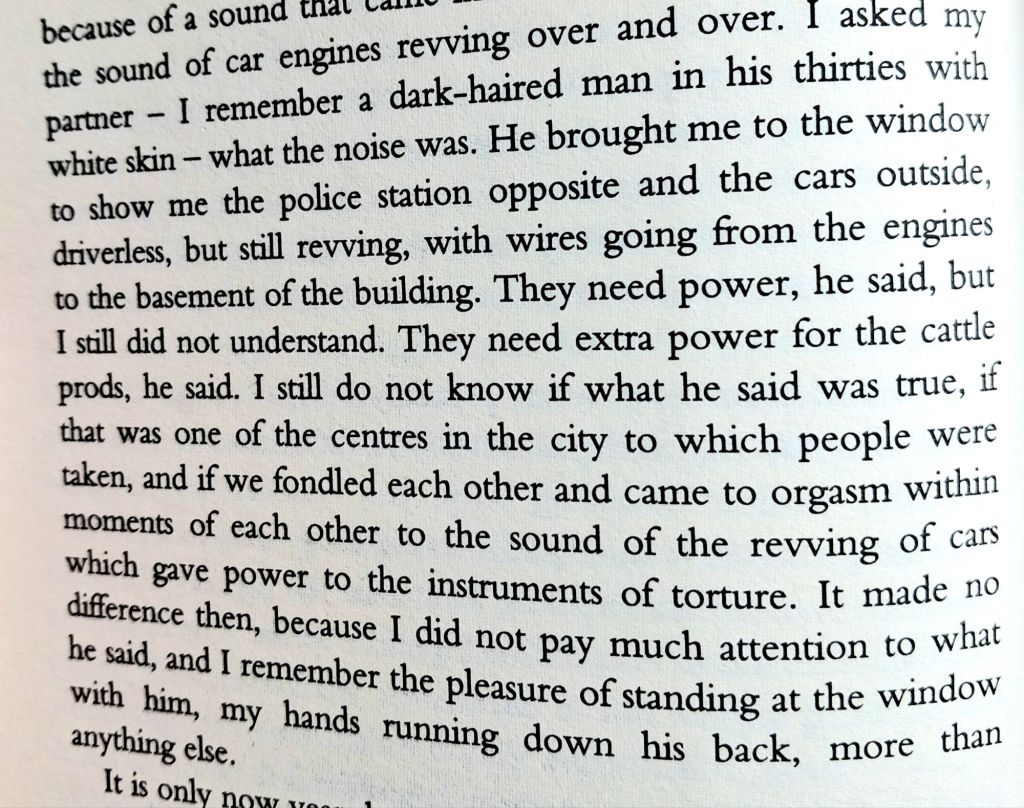
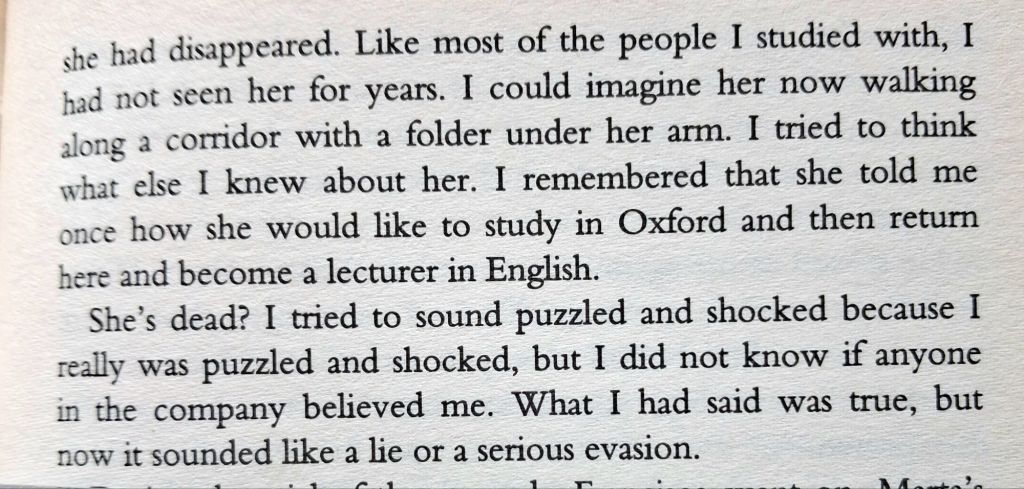
I quote this – much less vile than other evidence, at least on the surface, because Tóibín used this information very near to the passage I have already cited about Richard’s knowledge, and its extent in The Story of the Night. After locating himself at that time of his life as under the rule of the generals, his topic moves forward for at this time too he was beginning to explore queer identity though remembering one incident in the city (of Buenos Aires) ‘nor for the sex we had, but because of a sound that came into the room as we made love, the sound of car engines revving over and over’: [5]
This is finer writing that is recognised. For what it reveals is the dual consciousness of Garay spit, perhaps across the time between the event and its narration but perhaps also a split consciousness that made the even thrilling when it happened of using the stimulus of power, associated to a ruthless regime inflicting pain on its enemies (however minor), to heighten the excitement and thrill of the sex he was having – note how there the complex syntax of the sentence associating the cars accelerating while stationary and the drive to orgasm as perhaps simultaneous in the power they were given. My feeling is that Garay exemplifies perfectly collusive ignorance – the maintenance of deliberately lowered knowledge of the oppression of others to use it to fuel opportunities for pleasure for the relatively privileged. Of course gay men are disappeared too; often the ability to partake of pleasures absolutely free to the heteronormative comes at the cost of visibility, as is obvious in the story of Pablo, Jorge’s brother and with whom is the most important relationship into which Richard enters, and that another cost of invisibility is the visible effects caused by the turning of HIV infection into visible AIDS symptoms. But in the time of the generals discreet queer sex was available at the cost only of being be-suited into an homogeneous type of man who might choose which sex/gender he finds pleasure with – like the corporate oil men of the USA flexing their entitlement with Argentinian oil under an imposed International Monetary Fund (IMF) privatisation scheme – all of which Richard too finds his way into finding random sexual excitement on the way.
This is how intersections of identity work of course in politico-sociological theory, wherein a white European-or-North-American origin male has power than a marginalised South American person of whatever sex/gender, however heteronormative or otherwise. ‘The ‘Trial of the Generals’ article actually rather silently makes the same point when Tóibín shows that even a white Irishman (and Garay is half English – think of that as an intersectional benefit over Irishness when it comes to power in global prejudice) can decide being absorbed in the trial ‘get too much’ and begins to enjoy the delights of Buenos Aires’ beaches and city life (‘clean, rich, comfortable’) denied to those who lacked the social visibility that makes ‘disappearance’ more difficult for fascistic-leaning governments, even though Tóibín feels forced to think of ‘the Capuchin monk being tortured with the electric cattle prod’ and other ghastly ‘images of the day’ during the trial. [6]
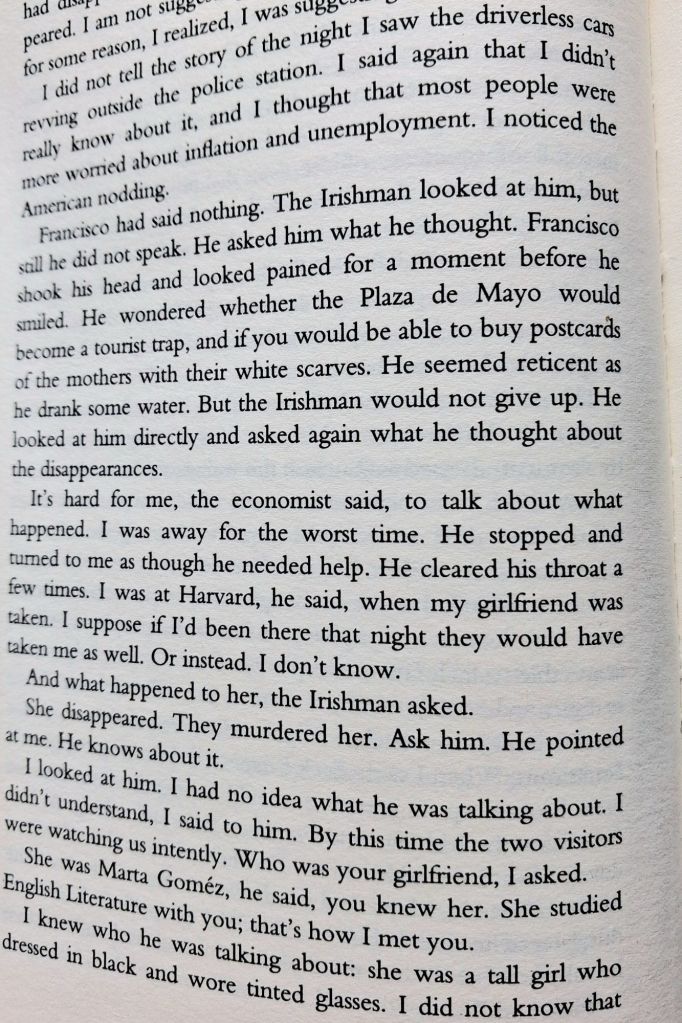
Rich Garay is more worrying – he informs the American fixers shipped in to skew the Argentine elections to American interests that very few Argentine much care about the ‘disappearances’ relative to their concerns for the economy for which privatisation is the global capitalist answer (which is not – clearly- the truth and he knows it). He fosters privatisation bidding, even corruption when it is possible ((that is, when he can get away with it) without losing the appearance of having generally liberal views that forswear radicalism (because, after all, as far as he knows the disappearances are much exaggerated despite his knowledge of the revving cars). Garay’s ignorance can be collusive, at least o the point of not justifying intervention, because, after, ‘he didn’t know then the horrors he knows now’, after the election of Carlos Menem as near puppet of American globalism), which we see planned and executed in the novel in a fiction that rings with truths. The appearance of liberalism matters to Richard. He can silently show, for instance, his superiority to Jorge’s plan in Barcelona to steer clear of visible identification with the Chilean ‘rebels’, though he randomly fucks the women amongst the Chilean group. [7] Yet in other parts he seems equally collusive with the Argentine status quo of the Generals, almost a ‘liar’ although he claims this is only an appearance that masks his genuine liberalism. I would call all this a powerful illustration of ‘collusive ignorance’: [8]
How easy it is to claim ignorance when so much evidence might also suggest you polish the truth so much it looks likea sef-serving lie that feed your own interests as a professional at best, and money-grabber at worst, and reduces your reliability as a just and good moral agent to near that of the actively complicit with Fascist oppression as it can get. I love it that it is an Irishman who so carefully questions Richard in this passage – perhaps he is Colm Tóibín?
I think now that I have for years grossly undervalued the Colm Tóibín (1996) novel. If I had to hedge my bets on why it takes the step further of showing that not all images of queer people need to be positive in order to move forward on queer equality I would instance this phrase by which Richard summarises the reduction of queer affect and the life made possible for it in an oppressive heteronormative status quo in describing the Buenos Aires’ sauna where all cats are black, and where he is about to discover that the well-endowed Pablo, brother of Jorge, is queer too: ‘I felt almost comfortable in this hidden universe of unwritten rules’. [9] No doubt sauna life was ‘comfortable’ for entitled men who could afford its opportunities, because they were hiding in plain sight in a suit the rest of the time or because they were only visibly heteronormative men when they didn’t play out at what rhey deemed ‘safe sex’, because one could not sire a child in it. I am aware that opens up the contradictions of the novel too as a queer novel but that is another issue. We need more maturity than to think if we had only positive imagery of the oppressed and marginalised as queer people are, other things being equal as they say in scientific prediction, all would be hunky dory. Try living having a conscience that you need to ct on. If Reform win the next election you might be able to try this out even before you know it – when it is not only speaking out on Palestine Action that might lead to a call before an unjust legal status quo.
Let’s leave it here. Bye for now (if I get further with Sands book) I will be back.
With love
Steven xxxxxxxxx
[1] Colm Tóibín (1996: 6) The Story of the Night London & Basingstoke, Picador.
[2] Colm Tóibín (1990: 19) ‘The Trial of Generals’ in The Trial of the Generals: Selected Journalism 1980 – 1990 Dublin, Raven Arts Press 17 – 32.
[3] ibid: 18
[4] ibid: 25
[5] Colm Tóibín (1996) op.cit: 7f. My photograph from ibid: 8
3 thoughts on “This is a blog in preparation for an event in Edinburgh this coming Sunday as Colm Tóibín and Philippe Sands remember the Dirty Warriors that led the countries of Argentina and Chile and ‘disappeared’ their opponents. I want to know more about why all this matters so urgently again, now!”




3 thoughts on “This is a blog in preparation for an event in Edinburgh this coming Sunday as Colm Tóibín and Philippe Sands remember the Dirty Warriors that led the countries of Argentina and Chile and ‘disappeared’ their opponents. I want to know more about why all this matters so urgently again, now!”