

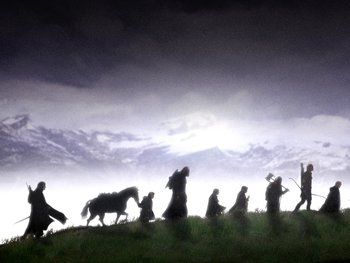
Some tropes are of such long established availability that they are, of themselves, self-mocking. The quest is one such, although I think you have to avoid slippage in calling everything a quest, like the great epics of Archaic Greece, for you cannot quest, or look for, something whose qualities are in some part already known, such as Troy and Helen are to the Greeks who seek return of the latter from the former, or ‘home’ in a nostos narrative like The Odyssey, however many diversions it contains. The quest comes into being in romance literature and it concerns an object long lost or of dubious existence: some Holy Grail or monster of lurking characteristics. Did J.R.R. Tolkien finally kill this narrative trope off by overdoing it: continually repeating, deepening and reflecting it in The Hobbit and The Lord of the Rings, where everyone is on some kind of quest, even Gollum for his ‘precious’.
The quest belongs to societies where travel always involves some kind of unknown quantity, and often intrudes into delayed nostos journeys as it does for Homer’s Odyssey for that reason. But the origin quest narrative is that of those marginal romances where reckless males look for something more than they know they can handle and which must change them. My belief is that they cannot now be bettered after Robert Browning’s Childe Roland to The Dark Tower Came, a very great poem, which makes Tennyson ending his career with those tired quests in The Idylls of the King seem like a tired examination of a trope which had lost its purpose, much as everything he cared for had for the big black dog bard himself.
But we speak of a genre already examining its own sad end here – to be revived only in the same sad form in science fiction and horror by Stephen King. In the sixteenth century even, romantic quest was already a tired trope and surely Edmund Spenser knew that in starting The Faerie Queene thus:
I
A GENTLE Knight° was pricking on the plaine,
Ycladd in mightie armes and silver shielde,
Wherein old dints of deepe wounds did remaine,
The cruel markes of many'a bloudy fielde;
Yet armes till that time did he never wield:
His angry steede did chide his foming bitt,
As much disdayning to the curbe to yield:
Full jolly knight he seemd, and faire did sitt,
As one for knightly giusts and fierce encounters fitt.

II
And on his brest a bloudie Crosse he bore,
The deare remembrance of his dying Lord,
For whose sweete sake that glorious badge he wore,
And dead as living ever him ador'd:
Upon his shield the like was also scor'd,
For soveraine hope,° which in his helpe he had:
Right faithfull true he was in deede and word,
But of his cheere did seeme too solemne sad;
Yet nothing did he dread, but ever was ydrad.

III
Upon a great adventure he was bond,
That greatest Gloriana° to him gave,
That greatest Glorious Queene of Faerie lond,
To winne him worship, and her grace to have,
Which of all earthly things he most did crave;
And ever as he rode, his hart did earne
To prove his puissance in battell brave
Upon his foe, and his new force to learne;
Upon his foe, a Dragon° horrible and stearne.
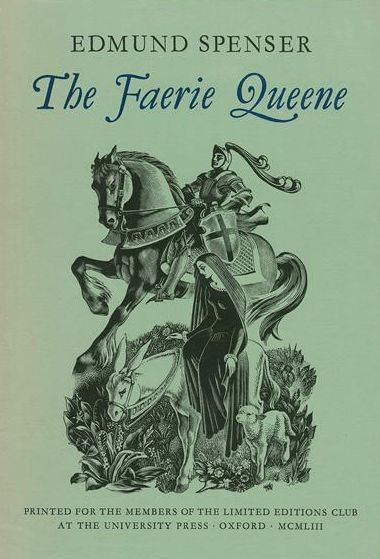
Spenser knew his trope was a trope: knights were a pleasant fantasy of courtly literature and masques and the very happenstance of the first line of this poem is a kind of joke, in which knights do what knights do – as we see him ‘pricking on the plaine’. However, readers don’t find the line problematic, as it obviously was to the illustrator above, showing the knight rearing and apparently ‘moving fast’ one possibility of meaning for ‘pricking’ – referring to, as it were, the horse pricked by the knight’s spurs, whilst his companions clearly amble and yet remain in the same space, a logical and spatial impossibility. It rhymes with the fact the knight is soon to be reminded that he carries allegorical weight. He is St. George, of course, for England but yoked to the pace of a Lamb, Christ of Course, and a Lady, her name is UNA – standing for the Oneness of the Faith established in the Church of England, its Queendom and the principle of the One and only true God. No doubt all this slows down one’s pricking!
Here is Judith H. Anderson’s take on it as sampled from the Abstract of her scholarly paper: [1]
The opening line of the first canto of The Faerie Queene, Book I—”A Gentle Knight was pricking on the plaine”—is narratively discontinuous with subsequent descriptions of Redcrosse, Una, and the Dwarf. This discontinuity, emphatically introduced by Spenser’s deployment of the word pricking, heightens our awareness of Chaucerian resonance in the line and of relations between the opening of the poem and Prince Arthur’s dream of an elf queen. Both the opening and the dream allude to Chaucer’s Tale of Sir Thopas. Like The Shepheardes Calendar, The Faerie Queene is framed by Chaucerian reminiscences: the final stanzas of the Mutability Cantos recall Spenser’s Chaucerian beginnings, even as they signal the conscious nature of his intention to end.
This says much what I was saying though Anderson resolves the problem by reference to the courtly romance tradition and its subversions in the work of Geoffrey Chaucer, itself cosmopolitan and knowing about an imported Continental tradition, and reading the discontinuation implied as a goodbye to romance tradition from Chaucer.
But we can tell from the first line itself that Spenser was implying that we have a right to be tired of the tradition of the questing Knight, and have a right to something more socially and politically relevant to his age: the project of Queen Elizabeth I’s (his Gloriana) all.out attempt for hegemony over ever aspect of Ebglish life and that of the ‘Empire’ she was keen to make a reality, against foreign Papist machinations as she and Spenser allowed themselves to see it. Both wanted to as repurpose nation and its literature for as many people as she could control as ideology.
Chaicer was no romantic quester either. He too served the court of Edward III as Spenser desired to do for Elizabeth, but with greater ferocity of purpose, played out by him in Ireland. Had he referenced the Gawain poet and poem, hi might have allowed the trope to develop in the socio-psychological depths of that poem of rebellious Northern determination. No! He went for tradition, a poet who colud be claimed to bridge the gap between himself and Virgil.
And tiredness is the quest hereafter. I think that is so in Star Wars as much as Tolkien and C.S. Lewis. There is always some religious numina in tne stories that soon boils down to right wing politics,that valorises predestined great individuals over community. Browning’s poem show that. Maybe we could do without the trope more easily than we think.
All for now
Love Steven xxxxxxx
__________________
[1] JUDITH H. ANDERSON (1985) ‘”A Gentle Knight was pricking on the plaine”: The Chaucerian Connection’ in English Literary Renaissance Vol. 15, No. 2 (SPRING 1985), , pp. 166-174 (9 pages), Published By: The University of Chicago Press, available at: https://www.jstor.org/stable/43447155

