‘The seams are pulled tight, the threads will surely begin to break. But is it, if they’re honest, not a little thrilling?’[1] The threat of something excessive that will break through the fabric covering it, scattering every thread (even of narrative) that holds it together is only one of the indicators of worlds that fall into uncontrolled tension in this novel. Anxiety, distrust and disgust are the resultant feelings of the novel – all a bit thrilling too. This is a blog on Rebecca Perry (2026) May We Feed The King London, Granta Books.
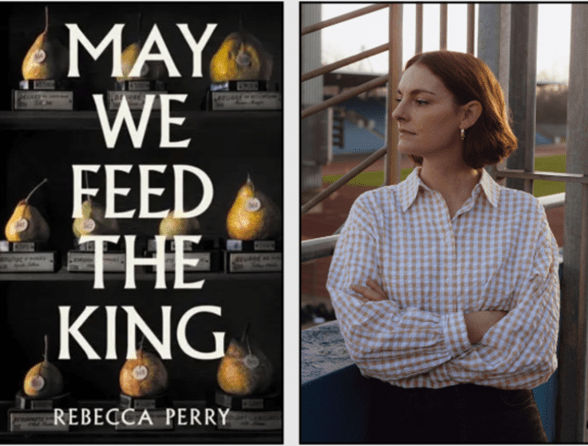
This novel falls into three parts – the first and third being narrated by a person whose story is both about their profession, which is difficult to categorise and about their personal life – a relationship in their past that has ended and one nudging into being but never getting there with an archivist, working in the narrator’s current ‘commission’, to devise scenes illustrating medieval life – its food and its people in a building described by its administrators as ‘not a palace with a history’.[2] The narrator’s sex/gender in binary male/female terms is never revealed as is not that of the Archivist (referred to throughout as ‘they’, the non-binary pronoun, to whom they find some uncharacteristic closeness during one ‘full day in the shadow of the archives, where we had sat, the archivist and I, my left biceps pressed against their right, making a double-width human’.[3]
The making of that ‘double-width’ single ‘human’ never happens except in this metaphor for their physical proximity over work, though the Archivist does visit the narrator’s bedroom to share readings of the archives they have selected for the narrator. I think the lack of distinct category for the narrator, except as narrator makes me uneasy in calling them ‘the curator’ as both reviewers for The Guardian (Melissa Harrison the novelist) and The Observer (Olivia Ovendon, Senior Literary Reviewer) respectively do. The narrator does include themselves mongst ‘other professional curators’ (though whilst mentioning other users of replica plastic food’ including drama teachers), and say that they have been ‘deciphering archives and curating semi-permanent scenes (domestic, culinary and otherwise) in medieval buildings for the past twenty-two years’.[4] However, the Archivist recognises that the narrator feels that narrator conceives their role to cover multiple functions and even perhaps other professional titles, asking them:
What parameters, if any, did I set myself? To what extent was I prone to working on feeling? Did I ever let it get the better of me? What did I see my role as being for the viewer? Where did auteur meet artist meet curator, if at all? What did I want?[5]
Multiple roles may indeed characterise the narrator but the archivist, though sure all roles are present, is less so that they these roles ‘meet’ each other, and equally unsure whether the narrator has parameters (defining characteristics of identity perhaps that presupposes boundaries and margins of a thing’s being) or whether they are not transgressed when strong motives like feelings might ‘get the better of me’? There is a clear sense that this narrator strains not to be excessive but often fails, even being excessive in certain characteristics like ‘appetite’, eating, and the desires and wishes underlying ‘magical thinking’ or even excessive in the means of negating these things, expressed in overmuch disgust and embodied rejection.
Their interest is sublimated from a rather visceral one in food and its consumption, oft revealing itself in a refusal to eat, or not to eat certain disgusting things like flesh, but to ensure everyone else is hyper-fascinated by that excess (in quantity and quality). Whilst dreaming of running a seafood restaurant, she imagines a friend cracking the ‘claw of a lobster and her face and chest’ being ‘covered in a white spray, like paint’.[6] Or like cum, one might think. Having bought a whole chicken, it makes her hand feel ‘tacky’ and ‘sticky’ and at home she can’t ‘face’ the dead animal and prepares instead pasta with a ‘colourless sauce’. Moreover in the supermarket where the chicken is bought she becomes revolted and disgusted at the sight of a baby whose pram has been filled with foodstuffs, notably ‘a vacuum-packed rack of ribs’:
The ribs’ red juices beneath the plastic formed a network of lines which overlaid the purple thread veins of the meat, pulled thin over the bone, and rested on the baby’s leg – plump and creased – as if wanting to merge with it.[7]
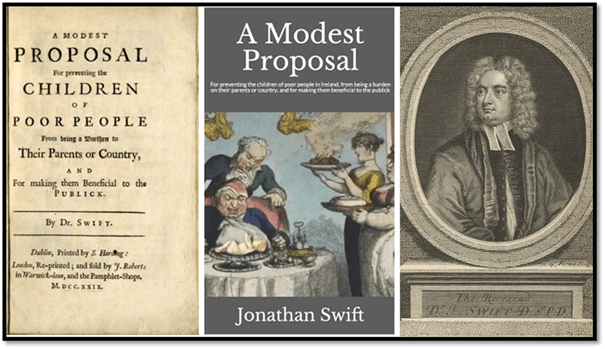
The disgust at the transformation of a baby into the appearance, perhaps even the stuff, of edible meat is part of the excess of visceral emotion, sensation and cognition here (not even presented with irony, as in Jonathan Swift’s Modest Proposal. This is especially the case in a novel where massive over-consumption of food, and wastage thereof (all in the second part of the novel) is very much to the forefront of the reader’s attention, even though the narrator of that second part is not necessarily the same as for the first and third parts, and, even if so, it is narrated in a very different manner with a shifting point of view upon events but otherwise omniscient – but reluctant nevertheless to tell all that happens or decide upon versions of events.
The manner of narration of section two wherein for some parts the hegemonic point of view of that of a court attendant, a poor man, on the old king whom no one is allowed to feed as he dies, although the attendant surreptitiously does, and again on the new king, the old one’s younger brother of three (the oldest having died before the second), who also, like the old one has a poor appetite for food, sex or power it seems at first but whom is encouraged to ‘perform an appetite’ by his wife.[8] If depression at the death of his wife and the effect of dying redoubled on that explain the old kings remarkable and excess appetitive losses as the something that might be interpretable as the excessive obverse of an appetite so gargantuan that it is its inverted double. That is certainly the fate of the king’s reputation as he begins to feel his power as King, and the narration denies his point of view, and oft takes its position as a voyeur (not always identified by which the reader could be asked to identify with) peering in through windows or cracks in doors.
That theme that positions someone as a voyeur first appears as a chapter title in Section One, though the phrase used denies satisfaction of voyeuristic impulse here: ‘PEEKING THROUGH A CRACK IN THE CURTAIN AND SEEING ANOTHER CURTAIN, a title hard to reconcile with the chapter it entitles. Later such peeks constitute potentials of where the narrative might follow: ‘Someone looking in through the window to the new King’s quarters would see …’; later the same wording specifies a specific window ‘the rectangular window on the garden side which frames a conifer’ (a phrase which allows us to see the view from both sides of that window, out into the garden as well as into the room; ‘Later that day, someone looking in through a crack in the door’, where a window gives way to a much more restricted viewpoint caused by a ‘boy who is forgetful when it comes to door shutting’; ‘ person looking in through a very small crack in the large, dark, varnished door …, reveals a possible sexual approach to the Queen by the King who had gifted here to her lover heretofore; a later instance repeats some of that wording but opens cracks in doors ‘inside the King’s own head’ too, another crack allows us visual access to the Queen’s room a page later, returning us to ‘someone looking in through’ the king’s window, in 2 pages and twelve pages later. Finally all this gazing in on private space is topped by the Head Gardener swearing ‘he saw in through a window, newly exposed after he had pruned the wisteria’, and thus not the same window as used earlier, to see revealed scenes of sexual debaucher between the Queen, the Queen’s cousin’s wife on a visit, her lover – the court physician’s assistant – and the King, now with great sexual prowess newly attributed to him, ‘draped over one another, like slugs on young plants after rain’. [9]
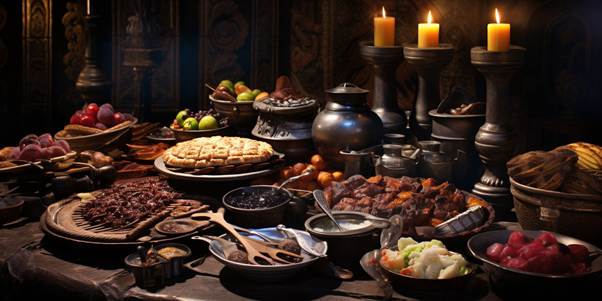
Appetite varies not only in quantity but in quality for food and sex. It is a world where Kings are told they must have the ‘stomach for bloodshed if he is to survive’, wherein violent and deadly war is equated with raw appetite. Soon after unclean men are taken to execution and get submerged in eating metaphors in a moment where a young man known to the King and like him in age and other characteristics ‘was eaten up by the mass of bodies in the crowd’ from among which someone ‘threw something – a chunk of bread? A potato?’[10] The Head Gardener in a scene cited earlier leads to the court believing that ‘the King and Queen have between them taken so many lovers, that they must now convene in the apartment gifted by the old King to his brother’s wife and her lover, the wife who is now Queen herself. We must return to these moments when the narrative itself is so overwhelmed by viewpoints on the action of the novel that things we are told as witnessed stories continually contradict each other.
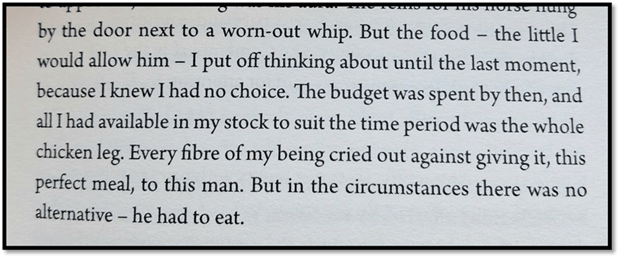
The narrator in part 1 and 3 is expert in the display of the appearances of the edible and in the social history of appetite. For them food is a necessity in the life of the imagined person from the past, but not one to be given to them lightly nor against the demands of a nature that however hungry sees excessively starving itself as part of its being too, My favourite amongst these is among the narrator’s memories of a past ‘large-scale commission’ where she created a room for a ‘witchfinder-general’ who would ‘pore over evidence in the dead of night like a wolf over a pile of bones’. What a simile is this for a man with a profession that likens him to a wolf staring at a food source long since absent leaving only the hard-to digest remnants, that a wolf might nevertheless gnaw. Everything is excessive here – the hunger and the desire not to fully satisfy it, But whose is this hunger for life, and wherein is the excess. The narrator makes it clear that her need to make him ‘live’ and hence to feed him (at least something) is balanced with the desire to keep food from him – keep him hungry:[11]
But where excess is called for – by the social, if not, in this court at least, the moral, quality of persons, it must be provided, even if only small bites are taken to test its ‘richness’ (the dual meanings of that word spread between the treatment of spiced food (spices being luxuries in the middle ages to vary and create the ‘taste’ of jaded but high-class palates) and the wealth required to afford it and the social status to validate one’s worthiness for it. The narrator fears their propensity to desire to penetrate ‘with a finger’ viscous foods. Not going thus far they stick to replica foods but not in toto. The narrator curates not only sights by artifice but smells (if not the more visceral taste of richness) by the use of ‘fresh herbs’ because ‘scent is depth, and depth is a dark pool we may dive into’, an ‘immersion’ more excessive than which cannot be imagined except by burial alive;[12]
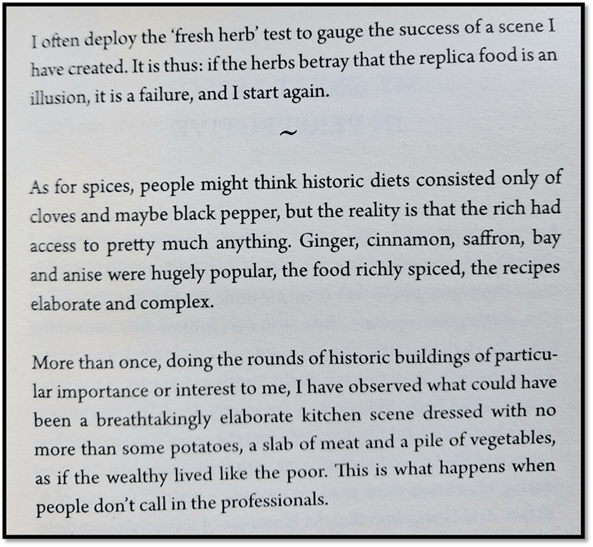
If food ‘richly spiced’ depended as in medieval times on the access of the rich in wealth to ‘pretty much anything’, then to imagine ‘poor’ eating in a rich setting is historically anachronous , and highlighted by the many scenes in the second section of the book where the poor and servant classes must learn only to eat richly when it will not be discovered, lest they themselves be eviscerated to the stomach in search of a lost ring of a powerful King that had come off in the viscera of a pig’s head or in some viscous jelly.[13] Yet the young new King who takes on that function and rules throughout Section 2 learns of the power he has as a King only when he realises that it is his right to disperse the superfluity of excess wealth owned by his courtiers to the poor, as none of his forebears have ever attempted, not, by the way, that we see him doing that in reality either, being satisfied with a lively cognition of that event based on a medieval theory of Kingship which named nations one of its King’s two bodies.[14]
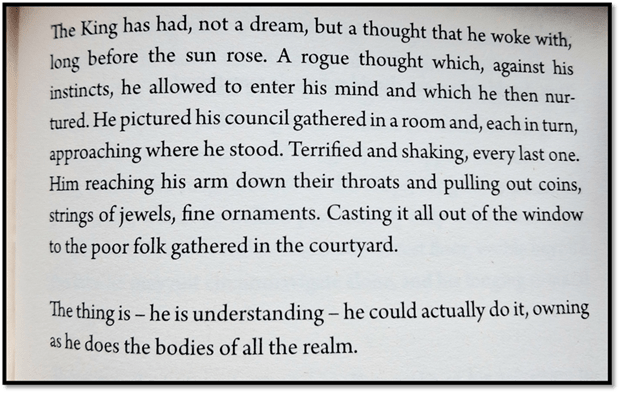
Nevertheless the poor do feast on the King’s excess – at least those in service at the place, gathering ‘to eat what is left’:
Toothmarks on toothmarks, a little saliva from one mouth into another, carried on a bit of pastry, no bother. They eat their work and they delight that they too have sampled what the King and the Queen and the harlot and the Queen’s lover have sampled. They hate them with every bite they take, that they must be grateful for their waste, but there is a thrill in it.[15]
The other excess of appetite in the medieval section 2 of the story, apart from the exercise of bloodlust in the court, civil society and overseas conflict, is that, as we have seen of the function of sexual pleasure, divorced from the link of fertility to purity so urged on the upper class, if only in appearance. Yet the appetite for sex is never simple and laced with salacious fictions cast upon it as we have also already seen; voyeurism in this novel is perhaps itself sexualised as well as offered rogue (or unreliable) points of view onto the story. We see masturbation scenes too and numerous threesomes and foursomes – including illicit lesbian sex where it appears the Queen may be hiding her cousin’s wife under her voluminous dress and enjoying her oral attention.
Likewise one rogue viewpoint is that of the Queen’s maid-of-honour who looks into a window (not previously listed) ‘shaped like an almond’ to see the King with his mouth firmly attached around the cock of the Attendant we have before seen as a primary point of view on the King’s story, although we never see his own account (perhaps because pleasure makes him shut his eyes) of being thus favoured with ‘his cock in the mouth of the King’: ‘the young Attendant had his eyes closed and his mouth open while the King was looking up at him, imploring’.[16] The lady is still ruminating the ‘story of the King on his knees, sucking on his young Attendant’s cock’ much ;later whilst serving pastries to the Queen and her lover, where she believes the queen to validate what she saw whilst ‘the rumour was at its peak’.[17]
We are not allowed to accept the validation ourselves, however. Indeed we are like the court, unable to believe where the King’s sexual interest lies, if he has any because we are told first of his asexuality, linked to his liking of his wife’s lover. Only much later told of rumours about the Attendant amid equally salacious ones that the King has taken his ‘cousin’s wife to bed’. The Attendant who stands at the door nightly does not believe it ‘unless they are fucking in the gardens’, or using ‘secret passageways’ about which he has heard though still leaving room to be in bed with the King without revealing it – which even on his deathbed to his daughter, he does not do.[18] And thus the Court’s quandary like unto that of readers:
And all the while, the council sit in their chamber – the usual circle. They must act, but they are stuck. Each man can be sure only of his version of the truth. Suspicion halts every avenue explored; each remedy is sniffed for poison. [19]
This is so much the position of the reader who even does not know they are required to act on the contradictions they see and of which they imagine the sensation of smell, taste, feeling and thought, wondering even whether to be pleasured or disgusted by what they interpret from events. The narrative overplus is even always trying to detach itself from the organ of the body that eats, sucks, kisses and, of course, speaks, as in the wondrous chapter title: ‘VOICES WITH NO MOUTHS ATTACHED’. [20] Such voices are numerous in the book. When the cousin’s wife queries the male hunger to stamp power on his own dominions her voice is heard but her body not seen, for why should a council of senior male governors look at the source of a voice when that source is a woman; instead, to them: ‘She is a bodiless voice’.[21] When these voices appear, those with no identified and embodied mouths attached, they are italicised and printed as if they constitute a new genre of political verse:
By what authority? By what authority does he believe he may refuse the throne?
What is this if not a direct challenge to the God who chose him to rule.
(By whatever divine insight, we cannot fathom but we must respect.)
God is almighty and all-knowing. Amen.
Is the King not himself blaspheming?[22]
Such disembodied discourse is the discourse of our contradictory desires and fears, about our need for governance and hatred of the same, about our insecurities and the thrill involved in the breaking of all boundaries of acceptable and predictable behaviour, which is, I think, one function of poetry on the page, no longer attached to the sloppy, drooling and wanting mouth:
A king cannot simply disappear bring the women who tend to the Queen
shut their husbands in the cellars check for missing cloaks and boats
beds cold the harlot, where is she?[23]
The trouble with such voices is not only their contradictory statements but their potential multiplicity and yet capacity to form one voice of utter confusion that fragments and disorders all, where no-one can be tested for their fitness to a prescribed role. This idea attaches to the key theme, in my view at least, of the novel – that of the need to control that which we suspect may not be controllable. That might be so of appetite – look at the two references at each end of the novel to the small medieval pie, the chewet (spelled thus in the novel) which bears sign of his fragmentation and consumption, though no mouth nor knife is visible.[24] Similarly look at that pile of peaches, the best of which is a ‘phantom peach’ already consumed known only by its absence. Against these instances are the signs of flesh that rots and the reason why we substitute it by replicas thus distorting history forever.
The narrator of Parts 1 and 3 feels life is a constant mystery people by unknown characters who question us about our right to intrude on them, of which history is only one of the discourses that talk about that. Penetrating the room and space of another unsettles everyone. They imagine entering ‘someone’s living room’, who then returns to it:
Their eyes would burn with panic, which would settle into something closer to a desperate questioning – a questioning I could not satisfy, being as I was a vision manifested in a place and time not of my control.[25]
Control is a thing narrators use, be they historians, curators, novelists, storytellers, and other people who feel they are entitled to explain human mysteries, to look good in their role – as the one in charge of what truths there are to find in their particular arena of expertise. But once voices become detached from mouths (in archival material for instance) they speak in ways that are more difficult to control, the threads of their narratives getting confused and tangled. The narrative of the two chapters before we re-meet the Attendant (pages 214 – 220) in his old age are completely disordered, each thread of story tangled with another. The disorder produced can be deep, for you will find ‘thread veins’ in the confusion of baby and rack of lamb above. The stories in the chapters referred to above end thus:
The sems are pulled tight, the threads will surely begin to beak. But is it, if they’re honest, not a little thrilling.[26]
To me this theme resolves into a recognition that the excess of signification internal and external to narrator’s, even historians, curators and artists means that threads break all the time and if they didn’t, the resultant work would not be the product concerned; art and truth. There is a thread in section 3, which is one that concerns the very conventional administrators of the museum who employ the unorthodox, in their eyes, narrator: ‘And the needle at the end of the blue thread, suspended from the table (for example) – what exactly was the point?’[27] I think this is the thread in ‘The Queen’s Parlour’ chapter described here: ‘On closer inspection, the thread is weighed down by the needle, still threaded, which hangs a few centimetres from the floor, occasionally rocked by otherwise imperceptible movements in the air’.[28] It is a thread the narrator literally picks up again: ‘The abandoned embroidery found its way onto my lap, into my hands, and I started again at the arm of the King’. This is a moment where the narrator / artist picks up the threads to refine the picture – bringing out of their creation what order they can, however temporarily before they rest and ‘felt settled’ again. [29]
Now, having noticed those links in my second reading, I did feel some empathy with Olivia Ovenden who says of the book, which she admires, and clearly noticed the links too:
When we return to the world of the curator, they are asking an audience assembled at the palace: “How do we know anything about history?” Showing the group a case displaying the king’s ledger and the record of his mysterious final day, they say: “I warn you now that there are no answers to these questions,” and that “the very lack of an ending” is the greatest gift from the king. This seems Perry’s greatest gift too: resisting neat explanations of what has unfolded; creating a story that is not set in ink and confined to the dark, but instead can be “blown free of dust, held to the light”.
Perry stages a rich feast of images and ideas. Like the curator who hopes to focus not on the “things people could easily see and understand, things people want to see”, she looks for the small detail that might pull a thread in a reader’s mind that does not stop unravelling.[30]
What Ovenden misses are the feelings this book creates in the reader of sometimes utter confusion, for it is part of its theme. Melissa Harrison expresses it better, as a novelist might:
May We Feed the King is made up of glimpses of scenes from odd angles and perspectives, with confounding reflections, shadows and movements: rooms seen through windows or from doorways, conversations half heard. It is as though we, not the long-dead courtiers, are the ghosts, as we creep around the palace peering into its rooms dressed in careful set-pieces, trying to interpret complex and momentous events from the few clues left behind.[31]
Both critics admit that there is no single truth or key to find to the puzzle of this novel. I agree but there are lots of issues about the psychosocial nature of food, the mouth and appetite that gives us a good start, or restart.
That’s all for today until the next novels from the Booker list arrive as ordered.
With love (and bon Appetit!: AGAIN for a second Booker)
Steven xxxxxxxxx
[1] Rebecca Perry (2026: 220) May We Feed The King London, Granta Books
[2] Ibid: 3
[3] Ibid: 46
[4] Ibid respectively: 7, 4.
[5] Ibid: 33
[6] Ibid: 31
[7] Ibid: 36
[8] Ibid: 107
[9] See respectively ibid: 15, 82, 89, 93, 112, 155, 156, 158, 178 & 193
[10] Ibid respectively: 91 & 95.
[11] Ibid: 9 (including my photograph from that). The reference to ’penetrate’ and the need to ‘immerse myself’ is ibid: 10 & 6 respectively.
[12] My photograph from ibid: 11
[13] See ibid: 105f.
[14] My photograph from ibid: 161
[15] Ibid: 205
[16] Ibid: 173
[17] Ibid: 203
[18] See respectively ibid: 87, 177.
[19] Ibid: 220
[20] Ibid: 153
[21] Ibid: 168
[22] Ibid: 154
[23] Ibid: 210
[24] Ibid: 10 & 245
[25] Ibid: 16
[26] Ibid: 220
[27] Ibid: 251
[28] Ibid: 242
[29] Ibid: 255
[30] Olivia Ovenden (2026) ‘Rebecca Perry’s debut novel serves a feast for an unfit king’ in The Observer (Thursday 19 February 2026) available at https://observer.co.uk/culture/books/article/a-feast-for-an-unfit-king
[31] Melissa Harrison (2026) ‘May We Feed the King by Rebecca Perry review – a dazzling puzzle-box of a debut’ in The Guardian (Fri 23 Jan 2026 07.00 GMT) available at: https://www.theguardian.com/books/2026/jan/23/may-we-feed-the-king-by-rebecca-perry-review-a-dazzling-puzzle-box-of-a-debut


5 thoughts on “‘The seams are pulled tight, the threads will surely begin to break. But is it, if they’re honest, not a little thrilling?’ This is a blog on Rebecca Perry (2026) ‘May We Feed The King’.”