


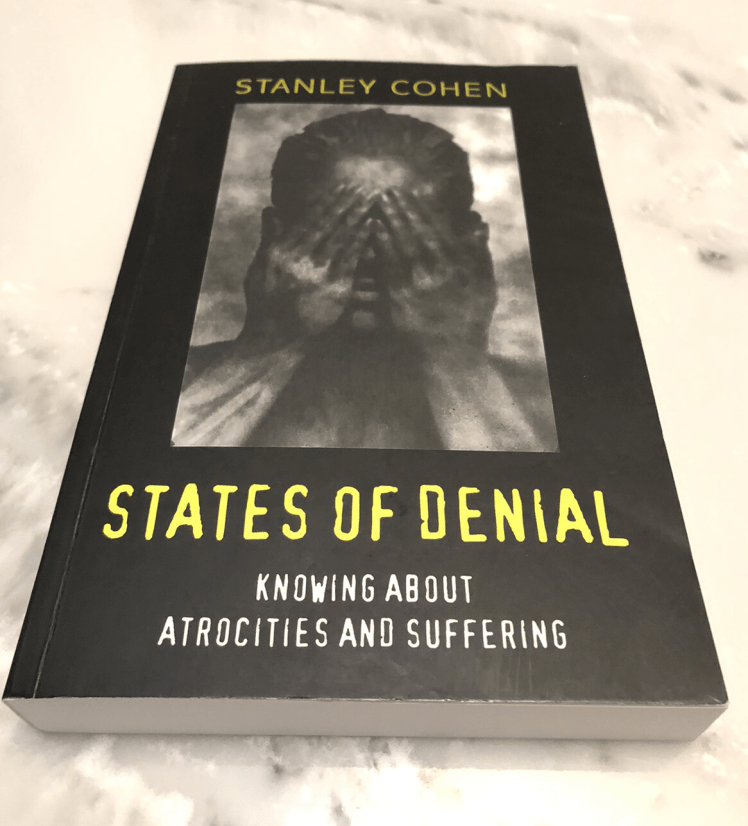
Not to take action matters if you add to the ‘moral void’ around decisions about acknowledging atrocity or suffering. ‘Looking out for one’s personal advancement’ and the persistence of ‘the moral void’: this blog aims to look beyond, with the help of Stanley Cohen’s (2001) States of Denial: Knowing About Atrocities and Suffering, the conclusions of mid-twentieth century social science including those of Stanley Milgram and the studies of ‘passive bystanders’ prompted by the brutal murder of Kitty Genovese. In the mid twentieth century it was harder for the ‘intellectual classes’ (thought to live in academia, to invoke grand narratives, like, for example, those of Marx and Freud, based on fictional moral exempla, like Oedipus or Robinson Crusoe, to examine and explain interactions in psychosocial phenomena. Yet both aimed at understanding the fundamentals of why self-interest trumped moral concern about gaps in our own moral awareness – or those of more powerful and significant others in our society? Is the denial of atrocities and mass suffering driven by the same triggers that ensure the primacy of self-focused fear, anxiety, and hope as that moral blindness? Does that mean the distance between our own behaviour in working for personal acknowledgement in the form of wealth or status and the agreed morally extreme career project of Adolf Eichmann is far shorter than we like to believe.
In the 1950-60s experimental social psychology was desperate to find a means of explaining why the Nazi regime in Germany, against whom a war had fairly recently been concluded, so successfully evaded moral norms or precepts to accept and facilitate the murder of the mentally ill and the learning disabled, at first, and then gypsies and ‘homosexuals’, followed by (though of course there was overlap) Jews, the latter in unimaginable numbers, as part of the Final Solution of the ‘Jewish problem’ (as Mein Kampf posed it) in Europe. This was, of course, an issue that concerned understanding the perpetrators of such atrocious violent genocide and mass murder, like Eichmann but also those who knew enough but yet felt that that they did not know enough, or were too powerless, to act or, in what seems likely enough to be the case for many more than sometimes posited, knew enough but accepted it as a part of the ‘status quo’ in which, in their own self-interest, dictated that they look first to ‘getting on’ and advancing in their career and accruing status and escalating income in the process. Hence the experiments of Stanley Milgram aimed at understanding how much people will become agents of a process they suspect to be ‘not right’, or to some immoral, when told to do it by someone in apparent authority (it only had to be apparent – a clinical whitecoat seemed a sufficient code of authority – for the experimental participants who were given a name inside the experiment indicating itself some authority (Teacher)).
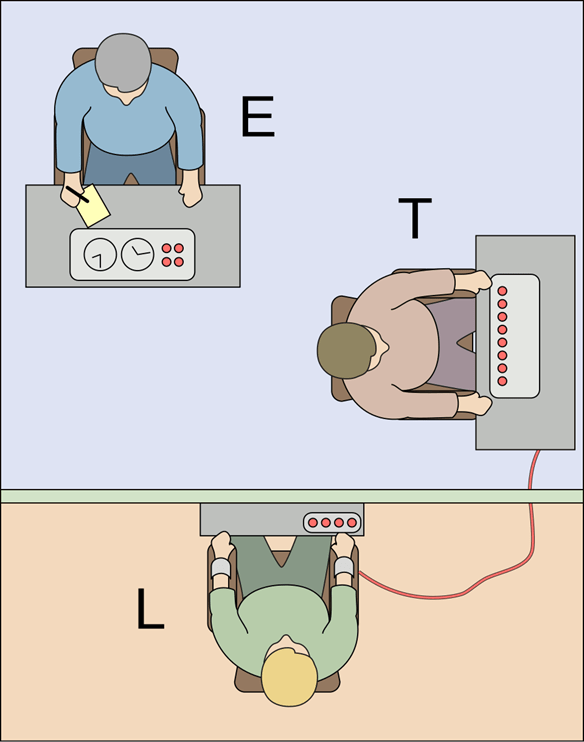
The experimenter (E) orders the teacher (T), the subject of the experiment, to give what T has been told are painful electric shocks to a learner (L), who is actually an actor and confederate. T is led to believe that (in following E’s instructions) they are administering electric shocks as punishment for imperfect performance – though in reality there were no shocks. The putative “electro-shock generator” played pre-recorded exclamations of discomfort, progressing to screams and pleas for mercy as the “shock level” increased.[1] [The illustration and text from Fred the Oyster – CC BY-SA 4.0 – 2014 – Available at: https://en.wikipedia.org/wiki/Milgram_experiment#/media/File:Milgram_experiment_v2.svg
Likewise, a real brutal and murderous attack on a woman named Kitty Genovese, overlooked by witnesses who did not intervene despite the obvious necessity thereof, stimulated studies of what was labelled ‘bystander apathy’, although that label seems too much to presume the cause to be studied, which was more about the likelihood of people taking responsibility for the fate of others that they did not know and to which they were not obviously related.
Aimed at explaining the behaviour of individuals and generalising to ‘human behaviour’ based on a sample of such individuals, in the manner of the positivist sciences, the studies posed the problem it had to solve as a debate between whether behaviour thought by the same individuals when thinking abstractly to be ‘not right’ or even immoral was determined mainly by the subjective disposition of the individual or the situation into which they were placed. Since then, two blind spots have been claimed to characterise these studies. First, they failed, as it were, to solve whether human action had agency independent of either dispositional or situational determinants, which is to see if there was space for ethical and normative analysis of human action. Second, they ignored, perhaps, the fact that human behaviour was formed by interactions between human free will, exercised individually or in the group, that can be ethically evaluated, situational and dispositional determinants, about which the individual had no control, and was thus so complex that only highly theorised narrative analysis could help us to understand it.
Both latter critiques explain why the contemporary sociologist, Stanley Cohen, is useful in re-envisaging the issue of human denial of knowledge, consciously, unconsciously, or entirely innocently, that it does not serve their self-interest nor self-esteem to have. Just as Marx was able to use Robinson Crusoe and its hero to show the interaction of ideology, and the management of knowledge in the interests of capitalist theories of production, Freud used Oedipus, as Marx did too less specifically, to show how moral ‘blindness’ (for blindness dominates the play Oedipus Tyrannus by Sophocles, in the role of endless paradox of the ‘blind seer’ Tiresias, who sees what others fail to see because he has no ‘self-interest’ in the knowledge he sees) is the desired condition of a humanity unable to cope with the anxieties involved in knowing and telling truth. That is not to say that I evoke the grand narratives of Marx and Freud as truths pre-packaged by their genius, but that I lament that period when positivism in science held sway. While scientists today are not positivists, folklore (especially in biology) has taken on its role – especially in the science of sex/gender now mediated entirely by dogmatists.
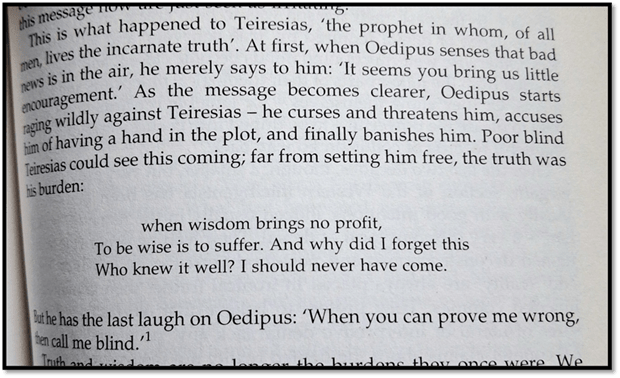
Cohen returns to that grand tradition, looking to deeply engaged artistic representations of human action to framework truths he finds in history and social science. As he moves towards a conclusion about the ‘Culture of Denial’ in contemporary societies he invokes as illustrations wisely a scenario in Oedipus Tyrannus. We live in a culture, illustrated profusely beforehand in the book, we resist, say, being told about the unnecessary death of a 12-year-old child in Angola, because we ‘always knew about the gap between knowledge and acknowledgement, the split between what you know and what you do. Those who remind us of this message are just seen as irritating.’ Many examples are in the book about how tired we feel about reminders of our inadequacy before atrocity in the wider world, or even sometimes on our own backdoor. But then to illustrate it from the case-study of the character Tiresias from Sophocles, is a move that lays flat the positivist refusal of insights that involve subjectively processed illustrative moral stories of the world’s operations. Here is Cohen on Oedipus Tyrannus, showing how and why truth-tellers are seen as an irritant and burden. True now, of those who speak of evidence of genocide in Gaza to either perpetrators or those either colluding or passively accepting its continuation, as with the current British Government.
Literature has, of course, always insisted that attention to the world through pattern-finding in one’s materials and sensitivity to the rich yield of multiple meaning in those patterns, of action, gesture, words and formal design has a relationship to truth, as much as it can be used to deny certain truths and substitute illusions. It is a relationship that integrates ethical concerns about the agency of individuals, and groups, with understandings of complex mixed determinations of action. Its means of being what is intervolved with people challenging the surface appearances of the world and/or deepening the resonance of the surface so that it echoes meaning from the depths beyond it. That is what Cohen shows in reporting a fine analysis of Arthur Miller’s The Crucible from the modern psychodynamic thinker, Christopher Bollas, wherein he develops the theory of a special kind of denial which he calls ‘violent innocence’, of which he might today find good examples in the grotesque farce of the world stage politics of Donald Trump.[1]
This of, course, reminds one that reports of the historical significance of contemporary events ensure that as well as in the case of tragic heroes like Oedipus, that there are icons of history that can tell a tale, as Marx used the farcical story of Louis Napoleon, known to him from observation as a journalist, to show how the tragic story of his forebear Napoleon Buonaparte is turned to ‘farce’ in history reduced to the demands of bourgeois goals of self-interest in The Eighteenth Brumaire. Cohen goes even more daring by looking at the twentieth-century history of ‘apartheid states known to him (having been born white in Apartheid South Africa and having lived and been a Jewish citizen of Israel, with its systematic denial of the equal humanity of Palestinians (‘exclusion from a shared moral universe’ he calls it), which he illustrates brilliantly, and with reference to his own work in Israel with the denied but frequent use of torture on Palestinian prisoners only, now, in our own sad times extended to death sentences ONLY administered on Palestinians.[2] Yet Cohen also shows, without pretending to equivalence of moral intention or effect that both Palestinian and Israeli claims to their respective tourist factfinders are born in certain kinds of denial which project crimes onto the ‘other side’ in relation to land rights struggles.
And best of all is his treatment of The Holocaust / Shoah by seeing denial existed even In Israel during the time of it occurring, with pre-Israeli Zionists in Israel often referring it as it happened as a ‘past’ feature of history, however shocking, to deflect responsibility from attention to the suffering of German Jews in the present from its own activity in establishing ‘Zion’. Yet the use of huge historical characters as exempla as perpetrators is best instanced by his use of Hannah Arendt’s readings of the career of Adolf Eichmann. I will use one pertinent to my own title where Cohen introduces the idea of ‘the moral void’ in which perpetrators of terrible actions and terrible simultaneous denial of responsibility for action are facilitated.[3]
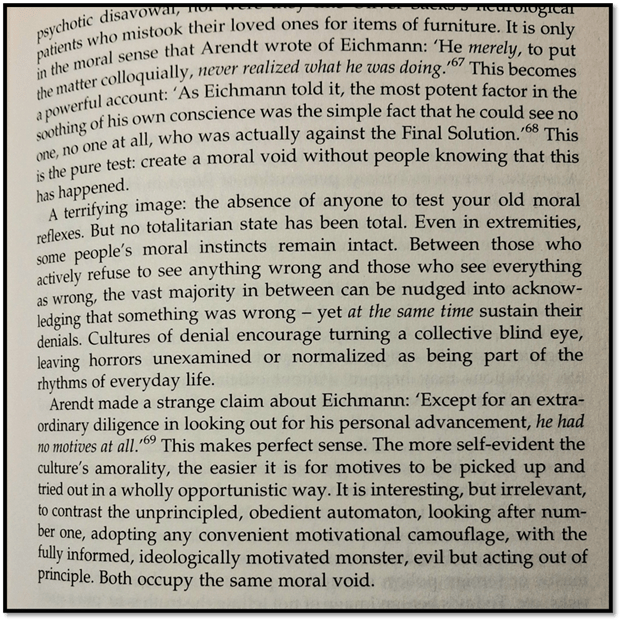
There is too much substance in this book in explanation of what the instances of ‘denial’ are or can be, and it needs reading – for it is its own lucid interpreter, but for me the key take-away for now is the concept of the ‘moral void’ which the culture of science created in mid twentieth century history, and not just in Nazi Germany. Look at the analysis her of what happens to humans when motivated only by self-interest, in the form of merely ‘doing your job’ and not rocking the boat of your financial and social stability or ‘looking out for (your) personal advancement’ in finance, status and/or power and Authority.
I will finish the part of this blog that applies to Cohen with my conclusions on what Cohen urges towards as an ethical response to denial. It is not, let me say, never to lie, never to deny what is true, for we are bound up in a world, he shows where that is impossible, and leads to real threat to the very integrity that would prompt such a response, and not only in totalitarian societies. To be ethical I pick out these factors that might be improved in our behaviour, that allow us not to be net contributors to that very real ‘moral void’ around us.:
- Be persistent in indexing examples perceived or remembered in actual experience. Document them safely, with institutional support where necessary or allies. Cohen quotes Amnesty International here, thus: ‘Amnesty once prefaced a report with these words by Arthur Miller: “Amnesty, with its stream of documented reports from all over the world, is a daily, weekly, monthly assault on denial.” [4] Note how Arthur Miller comes in here – I will end with him and my thoughts about seeing All My Sons tonight. And see my last blog on that linked here and my last blog musing on denial.
- Address the symptom that emerges when you notice that something is wrong yet somehow fail to feel curiosity about. That lack of curiosity will be a resistance to what further knowledge might spark in you of either reflection or action.
- Note down your current priorities not by looking at your conscious thoughts, which will reveal only what you think OUGHT to be your priorities, but at your actions and preoccupations. When these are prioritised by considerations of self-interest or ‘self-advancement, then review your life for, at the least, slight changes – though sometimes large ones.
- Note when you excuse yourself from action, even if only of building and reinforcing awareness with others, by saying you yourself are incapacitated from action or over-triggered by reflection. Keep safe by gaining alliances but do not retreat from your awareness. Reframe the issue with regard to issues of mental economy and active safeguarding plans to one that IS OPEN to your good enough INTERVENTION.
- Read and evaluate literature, not just ‘hard evidence’. Try Jenni Fagan’s The Panopticon first, which puts experimental positivist science in its place.
Tonight, I see All My Sons. I will report back with this in mind too.
Bye for now!
With love
Steven xxxxxxxxxxxxx
[1] Ibid: 65f.
[2] See for example ibid: 157ff.
[3] My photograph below is from ibid: 101.
[4] Ibid: 11


2 thoughts on “Not to take action matters if you add to the ‘moral void’ around decisions about acknowledging atrocity or suffering. ‘Looking out for one’s personal advancement’ and the persistence of ‘the moral void’: this blog aims to look beyond, with the help of Stanley Cohen’s (2001) ‘States of Denial: Knowing About Atrocities and Suffering’, the conclusions of mid-twentieth century social science including those of Stanley Milgram and the studies of ‘passive bystanders’ prompted by the brutal murder of Kitty Genovese.”