


I have addressed the cogent reasons for me to use social media in a blog on ‘Why I Blog!’, at this link. But following on from all that is difficult, like driving on through dark empty space and pretending that it can be named as ‘social media’ or some other name that hardly fits the thing made of networks, where control of content is dark and hidden, where it occurs at all, and which can hold voices speaking to many, or to few on to no-one at all, like that empty hall I imagined a short time ago:
As if it were a empty hall, you fill my mind
with joy, that what we see as 'empty' now
was fulsome with the blithe sweet joy of thee.
The words were genuinely as they came to my mind as requested, or an approximation to that impossible idea. But now I ask myself: is the joy here entirely narcissistic? Is it the self trying to organise itself such that it fills all available space and is enough to and for itself as a mere reflection such as Narcissus sought and drowned in, or looking for another to claim its love in the distance, or, as the modern myth goes, a virtual ‘hall’ filled with the ‘social’ joy that fulfills all appetites in a feast of celebration. As we look at the drivers of social media, it is difficult to divorce it from the pursuit of ‘likes’ and anonymous numbers in subscription, where talk, and sometimes an appearance of conversation happens, but where more often celebrants merely try out masks and costumes looking either for an answering group or to fulfill a hole that they name popularity and measured by ‘followers’. I don’t know.
Maybe all it is is a kind of play with one’s own limits of being, a search for alternative identities for overwhelming versions of the search for pleasure or mirrors of pain. I suppose for me, it fulfills that purpose in allowing me to reflect on the art that I enjoy and want to know better and feel more appropriately into its probable secret parts, looking to see if I can articulate them, regardless of their legibility or meaning to others. Regardless? I think that is the wrong word, for it is only in looking for things that aren’t what other people might be expecting you to find, driving that expectation, as they do, into a rule of appropriate knowledge, that you find thoughts and feelings that might, if there were anyone there, strike a chord of recognition, even though one would never know that were the case.
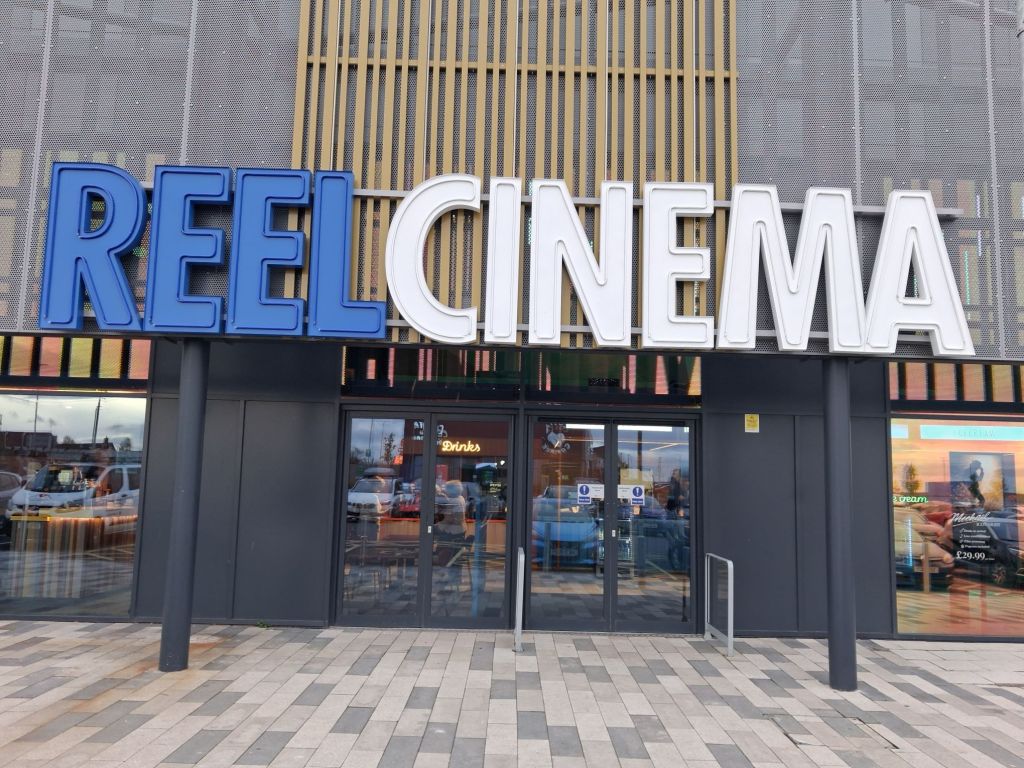
These thoughts are in my mid after seeing the live-streaming of All My Sons last night from the West End by National Theatre Live at the new Reel Cinema in BishopAuckland.
I had already read the play again (recorded in the linked blog here) and worried out the ideas that emerged from that re-reading into musing on the issue of ‘denial’ (linked here) and then on into reflections on a fine sociological study of the same by Stanley Cohen (linked here) which filled my thoughts with the nature of the ‘moral void’ (that space that sometimes ‘social media’ fills) that Hannah Arendt found to explicate, in his mind at least, the reason for Adolf Eichmann’s cruel advancements toward the perfection of means of social murder, or genocide, as a career pathway.
In this mindset, I watched that play with my husband. It tore into both of us. And it did so for me because its performed design stripped art of all aspiration to the real in order, as I thought, to cut to the chase of representing a moral void on and as the meaning of the social.space we call a stage. Christopher Bigsby has argued in the Penguin introduction to the play All My Sons that Miller prevaricated over the relation of symbols, such as a ‘moral void’ might be shown as an extreme and abstract form, and realism, by studying Ibsen’s methods in The Wild Duck. Here is what Bigsby says about the result of that for All My Sons:
Miller’s play reveals a similar commitment to realism and a similar symbol, though not with the same centrality and force as the wild duck in the earlier work. Miller also, perhaps, learned from Ibsen about lighting that would reflect a mood. In the first act the sun shines brightly, as Chris Keller and Ann plan their wedding. In the second act it is twilight, as the mood darkens. In the third, it is two o’clock in the morning, with the moon casting a “bluish light” on people whose lives have been drained, suddenly, of color and purpose alike.
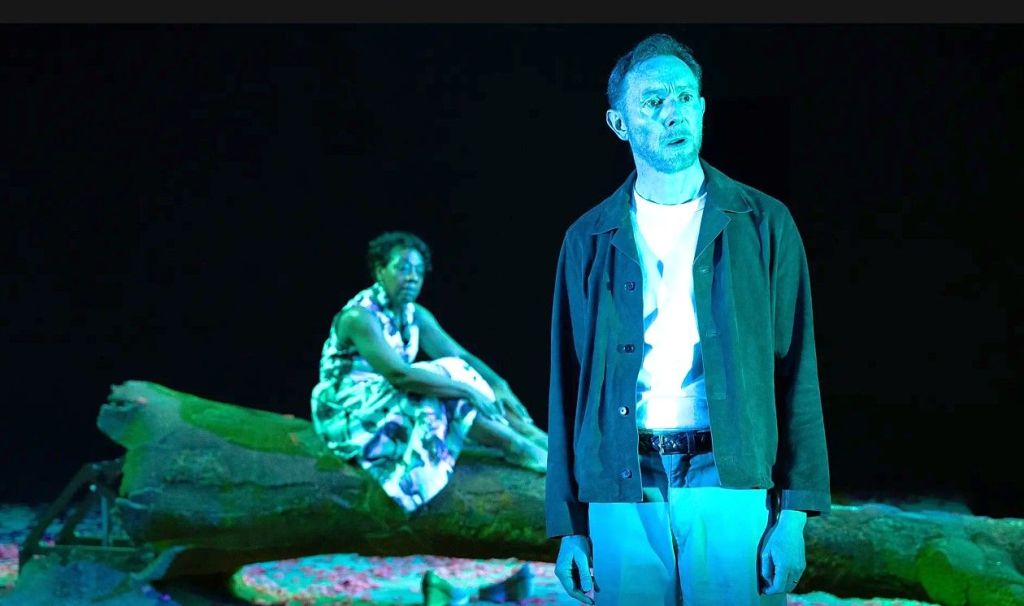
Lives in blueish light seem stripped of illusion. Here Kate and her neighbour, Dr Jim Baylis, idealist researcher into healh who has become a doctor to the imaginary illnesses of the petit bourgeoie , after he tells her that both of them are adept at lying, unlike Chris.
The dominant symbol mentioned here is the tree planted as a memorial to son Larry, missing in war for three and a half years, which falls to the ground in the night preceding the play’s opening g at dawn the day after. The night’s event is performed as a symbolic prologue to this production, without prompt to do so in the script’s stage directions. The tree moreover, variously pruned but not radically, remains the only production-long-duration stage furniture of this production. Upon its length across the empty stage, actors arrange themselves and speak the play’s words.
If any idea such as a ‘moral void’ in social interactions were intended to characterise the play, likewise their success in doing that would depend entirely on the control of the production values of this production, as any knowledge of theatre will tell us. Bigsby remarks that Miller wanted Joe Keller’s underlying value system (one the play’s whole force shows to be illusory) based on over-accumulation of assets in the name of what he calls ‘family’ and ‘home’) should be revealed in the realist staging of the Keller house (the real-estate stripped of sentiment as it were) in the background, built from the profits that came from overcharged demand in production of war machinery and now making and selling a range of household goods for the post-war American economic boom. See, for instance, how centrally Bigsby believed Miller wanted to drive the representation of the Keller house here – its’s a symbol but only because gradations of wealth and status in ‘real’ capitalist societies naturalise such symbols in everyday life:
The Keller home is hedged in by poplar trees and has a “secluded atmosphere”; this physical description develops a metaphoric force as the play unfolds and we learn of the moral isolation of this family, or at least of its patriarch. Miller pointedly tells us the financial value of the seven-room family home (fifteen thousand dollars when it was built in the 1920s), not only as a note to the director and designer but also as a clue to the actors, for whom this is to be a house in which money has been a determinant and “family” a defining term. Indeed, the word “money” recurs throughout the play, as a kind of counterpoint to the idealism generated by the war. Character after character invokes money as a reason for relinquishing ideals or hopes. A next-door neighbor, a doctor, has abandoned medical research, at his wife’s insistence, for a more lucrative general practice—“You wanted money, so I made money” (76). Another neighbor becomes financially secure because he has never served in the war. Joe Keller, whose wife also stresses money, complains that his son Chris “don’t understand money”; and Keller finally defends his own actions as no more than a reflection of a general morality: “Did they ship a gun or a truck outa Detroit before they got their price? Is that clean? It’s dollars and cents, nickels and dimes; war and peace, it’s nickels and dimes” (82).
Now it strikes me that you can feel those values in the semantic patterns of the play’s words alone without seeing the secluding poplars mentioned or the imposing seven-room house, the words being the only evidence used otherwise by Bigsby to make his point, without invoking the ‘staging’ of the ‘realistically’ reproduced garden scene – the signs of the value of the house that Bigsby thought Miller wanted to be followed by Elia Kazan and future directors. This National Theatre production did precisely the opposite of Miller’s staging advice as Bigsby sees it. It denies its audience most of the usual thrills of visual pleasure in things; things that look expensive and high status and fill the mind with consciousness of commodities used to signal wealthy luxury. It uses instead a bare stage, an ’empty space’ (the base of theatre according to Peter Brook).
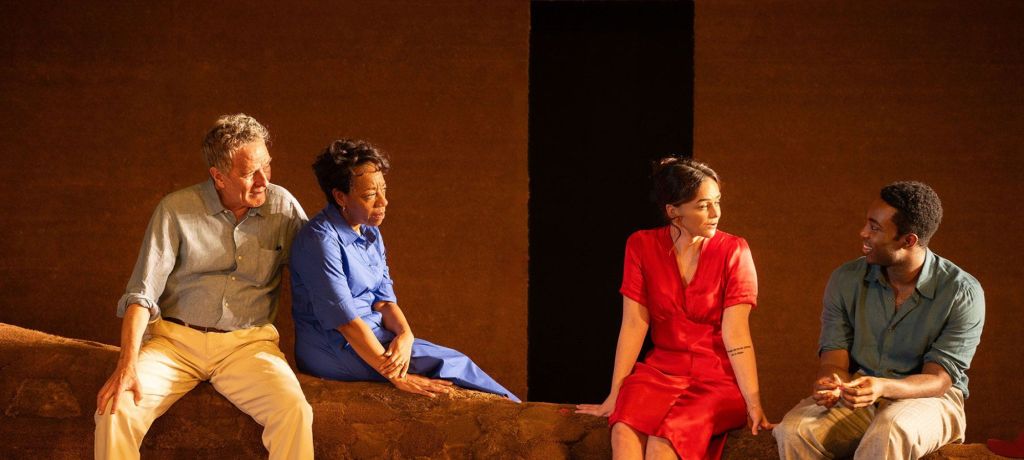
The play is staged simply on the raised platform that is the proscenium stage of this established West End Theatre, Wyndham’s on Charing Cross Road. There are no painted stage ‘flats’ or ambitious structures representing a house, only a blank wall with a dark and small open rectangular portal to the darkened space beyond the proscenium. All there is of variance is a large round disc that variously represents external light source, of course without being it for the purposes of stage lighting of the sun in Act One’s dawn scene, tbe moon in Act Two’s evening scenes and the shadowed and changing moon of the early hours of a dark clouded night in the early hours of Act Three, as represented in a blue phasing, before mentioned, of the stage lighting below of the confrontation between Joe Keller (Bryan Cranston) and his remaining son at home, Chris (Pappie Essiediu) in which all there is on stage is in close-up but still showing all there is on stage except for the fallen tree and characters interacting, usually in words.
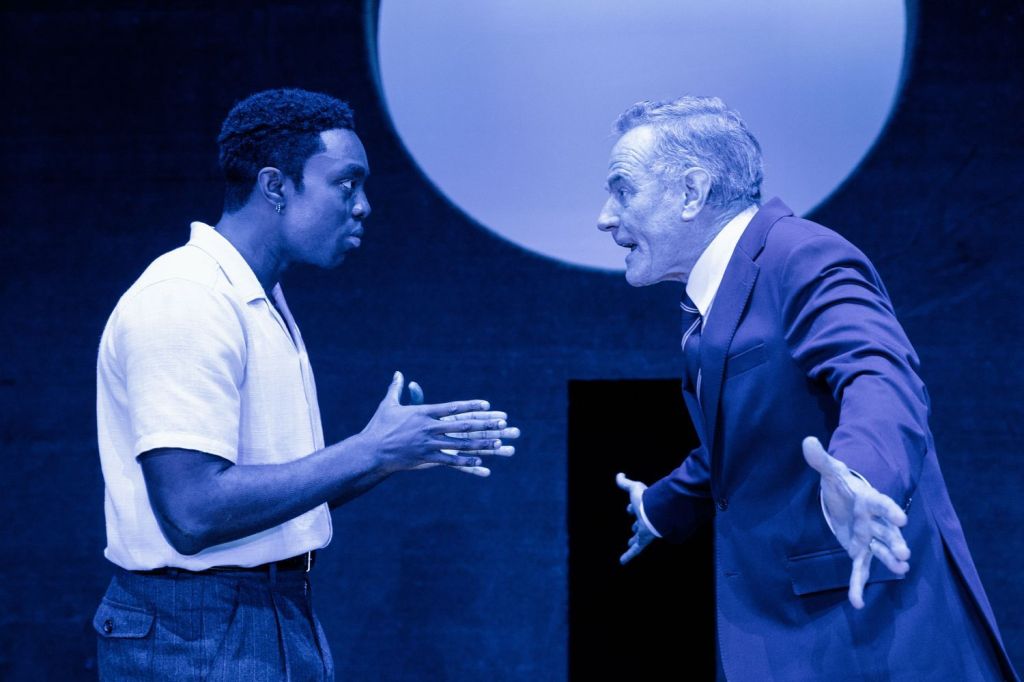
But the disc in the backdrop of the stage is also supposed to be the huge window in the wall of the Keller house at tle level of its supposed upper storey. There scenes of events interior to the houses private rooms are suggested rather than enacted on a platform presumably behind stage on which single actors appear. These actors are usually showing that they are, in role, unconscious of being seen by anyone in the garden or the audience behind the theatre’s ‘fourth wall’ (the proscenium arch). Sometimes they can use this vantage point to see other characters who are unconscious of being observed. Below Kate watches her son, Chris (Marianne Jean-Baptiste and Paapa Essiedu), pruning the fallen tree that once represented the missing Larry, her elder son.
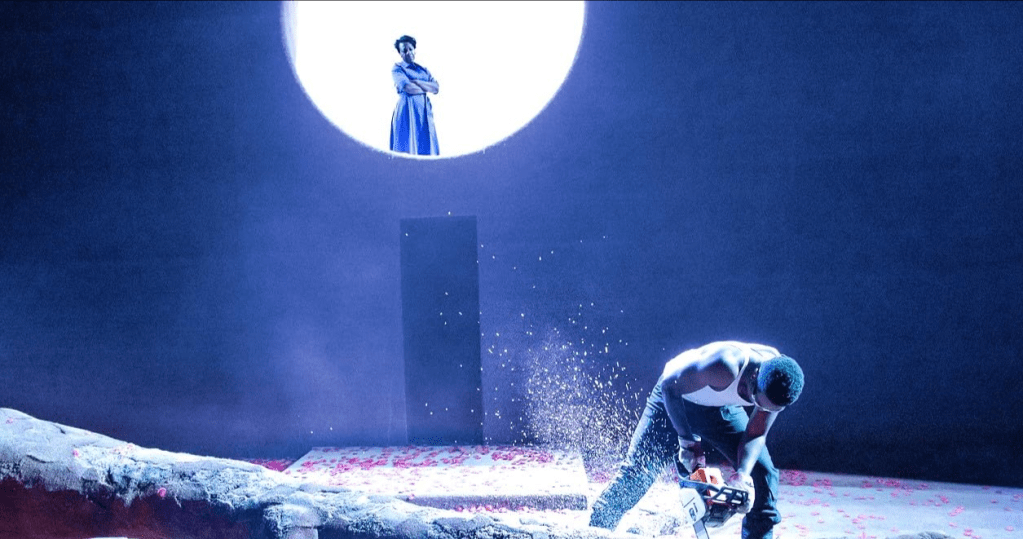
However, that space of appearance, both celestial object and a house window, can hold featured characters in the midst of some focused crisis in their inner though, suggesting that, on this stage, the interior of persons is usually well hidden, unless they are selected to appear here – as with Chris below, but also especially the spectral body of Joe Keller, after his disposed body falls from the window after his suicide. Suicide and falling are very heavily associated in the text, as an act that occurs when the surface ‘reality’ of lives is torn and what they see remaining is empty sham.

Chris is played superbly in this production, with the hint of a boy who cannot grow up and yet the only moral compass for a man like Jim Baylis, a moral realist despite himself, prepared to lie or adopt denial of moral atrocity as a way of life, as he knows Chris will be too. In this play, strangely, the characters who look to ideals of behaviour and relationship like Chris, say they have only grasped it in homosocial settings like the army, where men are bonded to each to the death. Chris tells Anne of the trrop of me he commanded but lost that they were special:
Because they weren’t just men. For instance, one time it’d been raining several days and this kid came to me, and gave me his last pair of dry socks. Put them in my pocket. That’s only a little thing … but … that’s the kind of guys I had. They didn’t die; they killed themselves for each other. I mean that exactly; a little more selfish and they’d’ve been here today. And I got an idea—watching them go down. Everything was being destroyed, see, but it seemed to me that one new thing was made. A kind of … responsibility. Man for man. You understand me?—To show that, to bring that on to the earth again like some kind of a monument and everyone would feel it standing there, behind him, and it would make a difference to him. [Pause] And then I came home and it was incredible. I … there was no meaning in it here; the whole thing to them was a kind of a—bus accident. I went to work with Dad, and that rat-race again. I felt … what you said … ashamed somehow. Because nobody was changed at all. It seemed to make suckers out of a lot of guys. I felt wrong to be alive, to open the bank-book, to drive the new car, to see the new refrigerator. I mean you can take those things out of a war, but when you drive that car you’ve got to know that it came out of the love a man can have for a man, you’ve got to be a little better because of that. Otherwise what you have is really loot, and there’s blood on it. I didn’t want to take any of it. And I guess that included you. {my emphases}
The idealism is also true of George Deever (Tom Glynn-Carney below), though it has sent him awry – going to war to fight Fascism with other men but coming back broken and divorced from meaning, and facing Joe Keller, who had seen his father go to prison as a scapegoat for himself, and had adopted the Keller’s as his own family whilst in denial of their complicity in his own family’s downfall. In this production he enters the stage through the auditorium, shattering the stage illusion, followed by a red spotlight that stains his neck and eyes red. This illustrates symbolically Jim Baylis’ warning to Kate Keller:
JIM: You know why he’s here, don’t try to kid it away. There’s blood in his eye; drive him somewhere and talk to him alone.
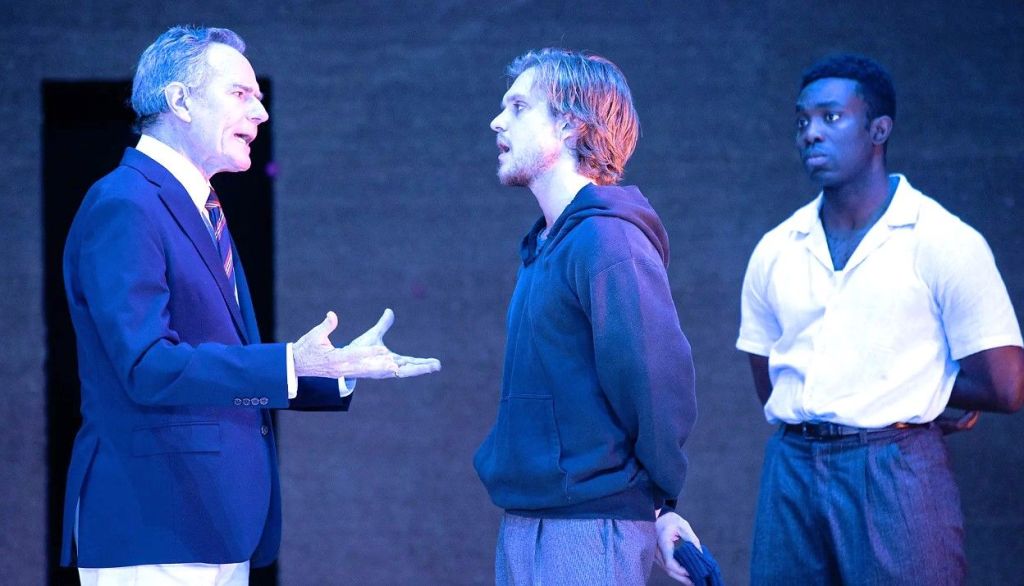
The still above does not quit capture the tinge of red cat ion the combatants.
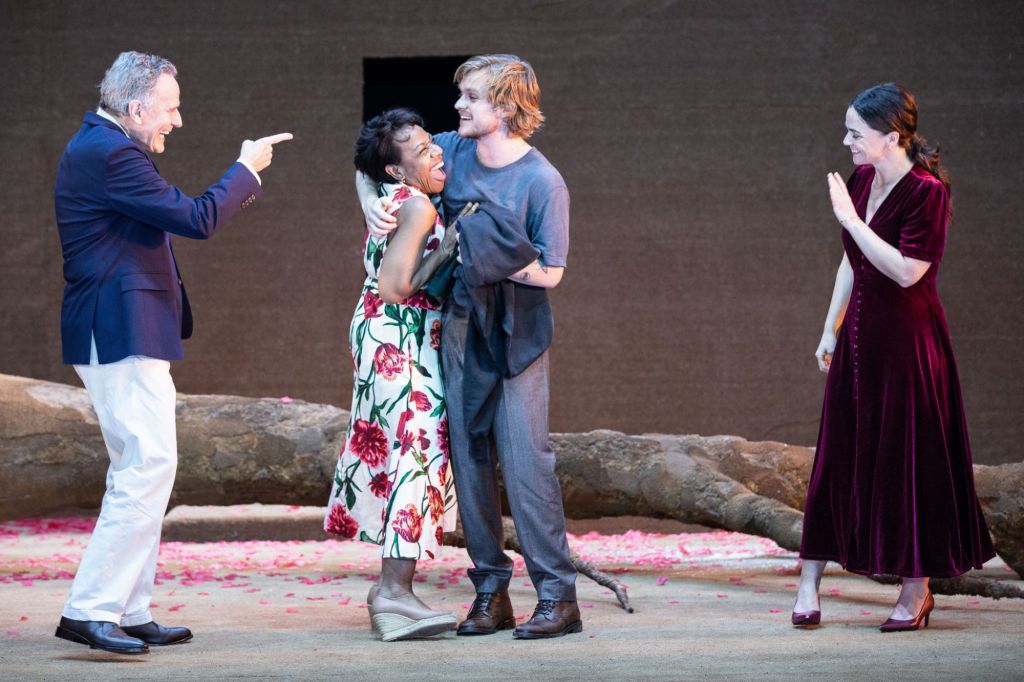
Throughout the scene, George has the anger of Orestes avenging his father and the red light bathes him, as it does Ann when his mood catches her. Until that is the sub-scenes below where lighting changes – the stage is stilled to affect the change – to white as George is talked round to allowing Kate to mother him again, whilst his sister Ann – once betrothed to Larry – (Hayley Squires) is on the cusp of entering the family again through Chris. Red roses on Kate’s dress are mirrored in the fallen blossom on the stage. It is not only ‘theayrical, it is a lie, or fiction, that will be shattered when the Keller’s are caught out in another long-livedlie about Joes health status now, and when he used it as an excuse to scapegoat Steve, George’s father. Then all goes red again.
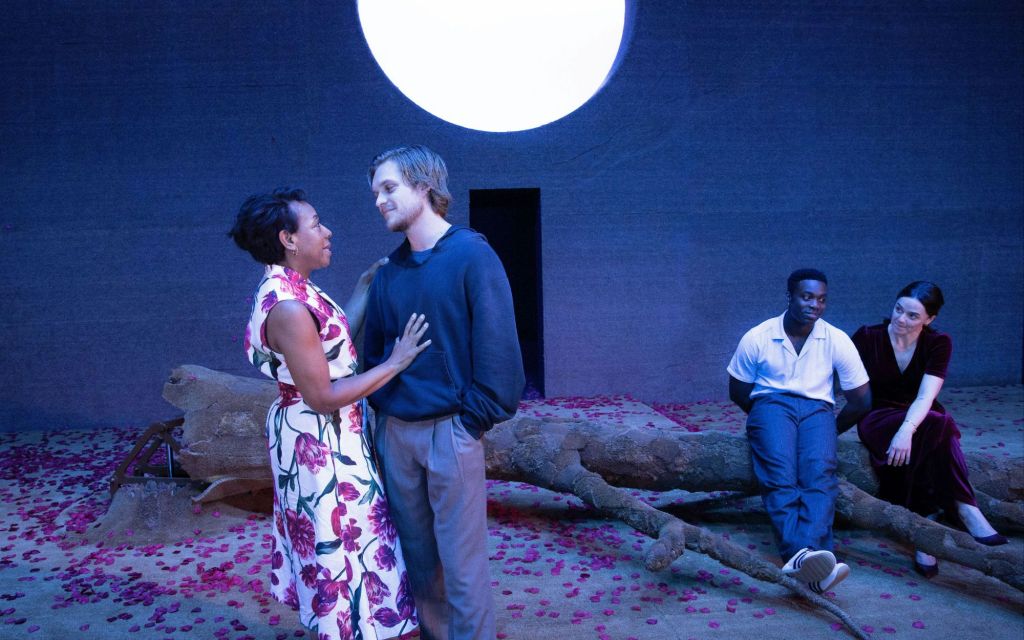
The levels of denial in the play are staged through layered proximity between groups of characters. Above Kate and Frank Lubey, who married George’s ‘girl’, talk through a horoscope of missing Larry proving he can’t be dead, whilst the doubters but not naysayers Chris and Joe behind them stand in visible discomfort staring helplessly at their backs. Behind them Ann has turned away to the dark portal / entry to the interior, for she knows Larry is dead and that he committed suicide to escape the shock of his father’s complicity in the deaths of servicemen that to Larry, Chris and George created a family community – men that Joe ought to have recognised as ‘all my sons’.
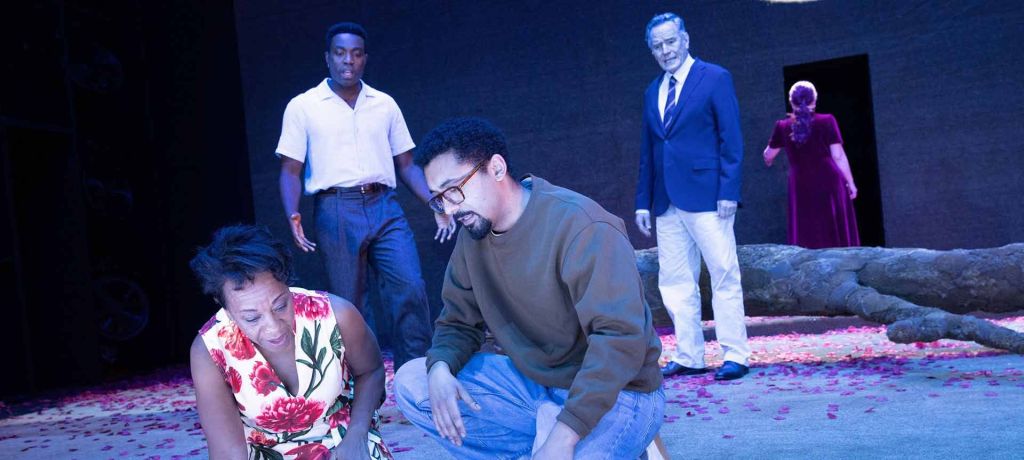
That dark portal Ann stares into. It is the darkest interior of the ‘moral void’ in the play – the truths that no-one acknowledges about those who not only collude, but profit from the deaths of lost men. Always men, in this play, though Ann’s isolation too marks her a victim. It is a dark play and Joe’s death marks this play as being as great a tragedy as those of Sophocles, Shakespeare, and Ibsen. … The thing is not to become vicious as Kate, the strangest character in this play does, threatening everyone who challenges her chance of maintaining denial of her selfish dreams of her son being alive and dependent on her quite brutally, thinking little really of the sons or daughters of others.
I use social media to acknowledge that moral void fearful that social media is itself such a void, where loudest voices and power and might trump evidence. I wonder! I keep on talking to myself in a mirror or some other behind it. It keeps hope alive, and who knows …..
With great love
Steven xxxxxxxxxxxxxx

