‘Man measured his words like food and decided what was worth opening his mouth for’.[1] No-one measures his words like Derek Owusu, and no writer has pursued the link between food and the ‘matter’ that is, as in Hamlet (Act 2, Scene 2, 204ff.), ‘Words, words, words’, (whether spoken or written) like him since Shakespeare. He is heading towards being our greatest contemporary writer. [I tend to write using spoilers so don’t read if you don’t want to confront one].
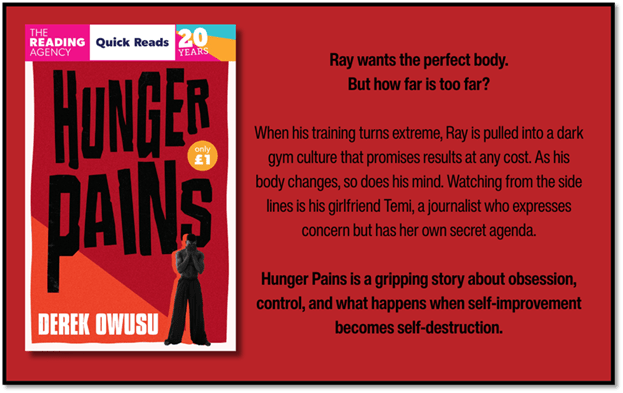
It is a near miracle that a writer will allow their books to sell for £1 a copy, but any use of the word ‘cheap’ has to stop at the consideration of the sale price alone, for this book is a stunning achievement. It is so not only in the further illustration of the emptiness of diagnostic categories – here under scrutiny are the behaviours that psychiatrists label (and so does the character Temi, Ray the narrator’s ‘girlfriend’) as an eating disorder. Temi in the last chapter calls Ray’s experience that of ‘anorexia nervosa’, although that experience could equally be categorised by an eagle eye on DSM-V as bulimia. But there is perhaps a spoiler involved in taking this idea further. I tend to write using spoilers so don’t read if you don’t want to confront one. Although, it may be too late for any such readers if there any readers at all, for the quotation in my title already presupposes the most subtle of linkages of themes in this novel – between ‘words’ (spoken and/or written) and food, a very sold ‘matter’. But Owusu is cautious of speaking his talent up. Speaking to Ella Creamer about his reasons for contributing to the Quick Reads project and his cooperation with the man who initiated the idea, fellow artist Stormzy in initiating #Merky Books and its involvement in the project, he says:
Having never read a book until the age of 24, I wish I had come across Quick Reads sooner. They’re accessible, affordable and gentle in their approach, allowing new or lapsed readers to find their way into the pleasure and fulfilment of reading fiction and nonfiction. … I’m excited to be part of their legacy and to add my voice to something that helps people feel confident enough to pick up a book and look forward to spending time with it.[2]
Owusu is a man of many proud faces as a writer; I am beginning to believe him to be as vibrant as Dickens if with more warmth and more ‘gentle in his approach’, at least this time, as a creator of characters driven by their differences from others, driven though and however gently to ‘extinction’ except as a written record of life. That is because I think, like Dickens, he is fascinated by his characters’ relationships to their own process of becoming such (as in say David Copperfield and Great Expectations) in writing or conversation, hence the quotation cited in my blog title, spoken about Ray’s friend, Kofi: “Man measured his words like food and decided what was worth opening his mouth for”

How do we reconcile that late starter and gentle encourager of others in reading in Owusu’s picture of himself recorded by Ella Creamer and the kind of writer who knew that ‘words’ should be ‘measured’ for them to hold value and hence ‘matter’ for others, a highly developed literary master. Words, after all, are used all the time and do not claim always to hold much ‘matter’, as the play on the word ‘matter’ here from Shakespeare’s Hamlet (Act 2, Scene 2, 204ff.):
POLONIUS: (aside)… I’ll speak to him again. — What do you read, my
lord?
HAMLET: Words, words, words.
POLONIUS: What is the matter, my lord?
HAMLET: Between who?
POLONIUS: I mean the matter that you read, my lord.
Owusu in this novel has elected to use a character who thinks words are analogous to a very material kind of thing that uses the mouths of speakers and readers to manifest its function, though with apparently very different function: food. This book talks food and turns food into talk and writing, including the writing of life stories that focus on the peculiarities of diet and the values (including quantitative values like calories) that make food a matter of conversation as well as intake and, once processed, fully or otherwise, output. Just a word though about how mouths mediate words and food. Whilst talking about food is an output (of words) from mouths, food is usually though of as an input to mouths on the way to digestion.
However, the novel equally sometimes sees food not only as input but output, sometimes at toilets but more from the mouth as vomit or ‘sick’, such as that which fascinates Ray when he cleans out hotel bedrooms where the guests had either ‘threw up in the morning and thought fuck it’, or ‘did it earlier and just chilled in the room with the smell of stomach acid and food stinking up the room’. We even see the regurgitated food ‘in the centre of the room or in the middle of the bed, pieces of undercooked hotel chicken goujons or microwaved pizza bits’.[3] And partial chewing of ingested and spat out food form the relationship of mouth to food, when he would ‘quickly put it in my mouth, chew it and then spit it out like I’d done before. But even the juice of whatever it was made me want to be sick’.[4]⁷
Food and diet and their use to regulate both absolute weight and the configurations of relative values of fat and muscle under the skin become the means by which Ray plans his self-appearance as both the body that is it’s subject and the text itself. Part Two of the story is in chapters each marking a significant drop in body weight as its title: 140 lbs., 130 lbs., 125 lbs., 115 lbs., 105 lbs., 95 lbs., 90lbs., 90 lbs., (these last two chapters cover the discharge – and its justification from hospital), 85 lbs., 80 lbs..On the whole the chapters get thinner and the energy of their told story reduces as Ray’s body wastes and his organs fail. In Chapter 12 he tells us that ‘is about everything’ as if there were no more to say, although he still obsesses about the fat on him that he knows in fact is not there and of the muscle he will later put on to replace that ‘is gonna look crazy’. [5] The nest chapter is not by him but by Temi who tells of ray having ‘passed away from complications of anorexia nervosa’, but then tells us something else. She tells us that the book is in fact co-authored and edited by her. Whilst telling us that she ‘tried to remain true to Ray’s original voice and structure’, that very wording admits that neither voice nor the structure (of the book – or Ray’s body?) can be trusted to be purely that of Ray. Her description of the editing process is itself interesting in that she (the following account being hers with some omissions I have made to emphasise what I saw as crucial to what she is doing and saying here):
used some of my own notes of the time to help flesh out a few of the missed details, the feelings I know Ray felt but was unable to articulate. … I know Ray wouldn’t have wanted me to publish this, but I felt and still feel that his experiences can help others struggling the way he did. And I hope that adding my voice to his means that something new has been created. … Ray chose to omit me from the last part of his struggles. I’m not sure why and it does me no good to speculate, but I was there. Supportive and hopeful. ….
The eeriest moment of this passage is that wherein we see Temi using her ‘notes’ (Ray often records her making them with no clear notion of why she does so) to ‘flesh out’ a narrative that was, in some original form we will never see, too ‘thin’ presumably to convey Ray’s self-conception to a reader as Temi imagined it (or co-produced it). How does she add ‘flesh’ and of what kind – ‘muscle’ or ‘fat’? That would matter to Ray. And that ‘fleshed-out self is also added words to an account that was becoming even more inarticulate – for Temi is convinced that Ray has authorised her to speak words (‘add flesh’ – fill out his body substance or ‘matter’ as food does when serving its human function). I find the whole passage from which these extracts are taken of some concern to us – for they have not only cast doubt on the authenticity of the words we have read through the book from its beginning, but raise issues about where ‘hope’ or other emotions fit into such an account, or the degree to which the story is a valid account of ‘real’ experience, even given that we know the characters to be fictional. What kind of account, after all, is it? In this very chapter Temi describes it as Ray’s ‘short memoir, a slice of life from a difficult time’. [6] Whatever, we should note how foods and words here are serving the same function for radically different modes of understanding that of which a ‘life’ (and death) is made up from – whether life embodied in a Ray reluctant to have the body he has or a ‘life’ as a written text, an autobiography or biography of kinds, depending on whom really articulated it as either muscle or words. It is an idea mooted in different places, when Ray’s words sometimes seem to disinvest himself of life, as when Kofi disappears from his life, and his function of measuring Ray’s body fat index, having ‘basically ghosted me’. { Likewise at a dinner party when Temi tries to feed Ray manually a piece of lamb topped with caviar (I gag at the thought) on a fork he poses as being sick, is directed to a toilet and looks back to see Temi ‘still sitting there with the fork in her hand. She looked like she was trying to feed a ghost’.[7]
It strikes me that Temi is to this novel, what other editors are to Gothic novels in which doubles proliferate, taking over the life of the person whose life they enter. Unlike Ray, she has a huge appetite, which he notes often, especially on their first meeting, which when listed (‘fried chicken wings, some curry goat, mac and cheese, ribs, spicy beef chunks on those kebab sticks’) makes him wonder not only why she eats so much protein but why also so ‘late in the day: ‘still in that moment I just wanted to see what her mouth tasted like with that mix up in there, even if that meant she had to taste the blood from mine’. [8]
The blood in his mouth by the way comes from an injury to his tongue caused by chewing too fast earlier, which he had resisted washing out because the mouthwash, not being his, was likely to contain ‘food and shit from the same day or day before’ that had dropped back into the bottle.[9] , but the passage is nevertheless comic-Gothic, for at that moment as their mouths commingle, together with the food (and, of course words) they have been stuffed with, he offers her his blood to taste, as one might a vampire. The mix of almost comic realism – such as the issue with the mouthwash) and the truth that we do taste each other’s meals when ‘lipsing’ (Multicultural London English (MLE) – more on this later) or kissing – with Gothic suggestion is classic Owusu. The reason for the Gothic suggestion is precisely because Temi might be said, like a double, vampire of ghostmaker, seek to possess Ray’s body and self – to ingest him while draining him as a succubus would do.
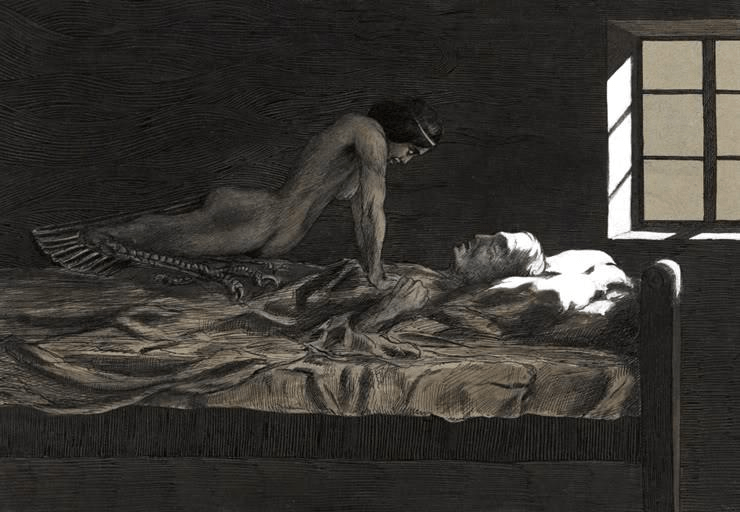
Depiction of a Succubus-like vision from My Dream, My Bad Dream. 1915 by Fritz Schwimbeck (1889–1972) Available at: https://commons.wikimedia.org/wiki/File:Fritz_Schwimbeck_-_My_Dream,_My_Bad_Dream._1915.jpg
A ferocious meat-eater Temi, she says she ‘eats what she likes’, and though she, at the same time feels the need to tell Ray that, if he is not eating she feels uncomfortable that he is ‘watching the food going into my mouth’. Only when she learns that Ray knew and remembers the actual food she had on her plate does she often, presumably because he needed to know is ate the ‘same food’. [10] Eventually Temi monitors Ray’s food, taking over as advisor from Ross, whom she freezes out of Ray’s life, including the book Ross keeps insisting Ray should read. With regard to this book, Owusu can make another analogy between food and ‘writing’ (‘writing’ that is ‘read’) that ties Temi’s huge appetites in foods to those she has for books (‘Ray, I talk about what I’m reading and writing all the time and you don’t say anything’). It ties Ray’s food abstinence too to his fear of reading, which he pretends to be a fear of ‘reading’ or ‘eating’ in public and being observed doing those things. Temi says, as she disparage’s Ross’ book on diet and exercise:
…. and since when do you read, anyway?’
‘I always read.’
‘When?’
‘When I’m on my ones. Sometimes before I go bed. Here at work. I don’t like reading in public. It’s like eating in public, makes me uncomfortable.’
‘Makes you uncomfortable, why? Reading in secret.’
‘It’s not a secret. I just don’t like chatting about it….. [11]
Secret eating, and vomiting, reading and writing – all things done too thinly by Ray it seems – Temi can do in public and make art out of other people’s ‘deaths’ (and sometimes their lives. She is introduced to us, and Ray, as an ‘a journalist but mostly write obituaries’. In fact her obituaries are also things that slip the boundaries of its genre – to become eulogies. She explains that whilst obituaries are ‘mostly factual stuff’ about ‘the life of the person’, a ‘eulogy can be full of emotions’, though she found she got away with one being seen as either, whilst being neither strictly. It’s is all practice for her to ‘channel all; these feelings into a book one day. A novel’. [12] I can only wonder if the novel she first comes up with – in which the characteristics of the obituary, the eulogy, the memoir, and the novel all appear – a book called Hunger Pains, perhaps, in which the entirety of Ray is possessed, or co-possessed by Temi, having sucked and drained the life from Ray into herself as Ray and she combined (‘adding my voice to his means that something new has been created’ as quoted above).Temi even plays the idea of this novel with Ray saying only that ‘she was interested in the lives of Black men’, as its subject-matter. [13] Asked though what role he wanted in the world just after this by Temi, Ray lamely says: ‘Nutritionist’. It couldn’t be more funny and more self-aware in this novel. By the end, we wonder (at least on re-readingit ) whether Ray should not have realised that he was in the end just a ‘matter’ of words in a novel (someone else’s), as in this fabulous passage:
So yeah, the next thing I remember I’m walking up the high road now and feeling like I was on something. By these times I was semi-used to the tiredness so I couldn’t figure out why I was feeling so mashed. I couldn’t even see lights properly; cars were coming like they were just a blur on some painted canvas. That’s how the world was looking to me: like something created and not real, like someone tried to recreate what I was seeing but couldn’t get the realism right. My belly started rumbling, chatting shit to me, and that’s when I finally realised: I forgot to have breakfast.
This is perfect writing. In one way high comedy. Ray’s world is turned queer by the sense of a force controlling him that he cannot understand, until we discover in the last chapter that he is a character in a co-authored novel and only suspects that has taken away his agency and ‘mashed’ him. He thinks he is a figure in a painting but the only artist he knows is a growing novelist, who still years to make things that are ‘created and not real’. He attracted Temi too him after all because she is intrigued by him who creates himself he thinks out of self-consciousness, unaware she is prompting even that, He is the ‘Descartes off gym”, who ‘knows who Descartes is but’ doesn’t ‘know what a novel is?’ [14] Ideal fodder for a budding novelist.
But I love the novel perhaps for another reason that the wonderful co-creating monster that is Temi. But Before passing onto that, I want to admit that I am still unsure of my reading here, and think another issue might arise from thinking of Temi’s full name. The following is only guesswork however. It is usual for Owusu in his writing to use names without some contextual resonance to the West African diaspora in London. Temi Olurounbi is a name in which both first name and family are from the language of Yorùbá, a language differentiated widely geographically and nationally although both West African from the Twi (Nigeria and Ghana specifically) that Ray tells us he still speaks. I have added the meanings I found in AI search below in a footnote but can’t, of course, be sure they are used thus specifically. [15] Nevertheless the African context is clearly not that of the same language or of the same word values. I cannot however judge whether this adds to my thoughts about the relation of words to the authenticity of the selves and lives they co-create. There is more to say on language and words and I want later to look at Owusu’s use of what is sometimes named Multicultural London English (MLE), of which the words in this book can be thought to originate when they are not African, and include London-mediated Jamaican influences, as well as some from Irish (‘chatting shit’ for instance – where fully digested food is emitted from the mouth as words) that enter the merge of that growing multiethnolect.
I noted the words from MLE that occur frequently: ‘bare’, ‘wagwan’, ‘man’s’ as a pronoun, ‘calm’, ‘hot sec’ or ‘hot second’, ‘skanky’, ‘lipsing’, ‘beat’, ‘shook’ . ‘mandem’, gyaldom’ and so on. Syntactic forms in MLE are used too. This is a language one grows to know but I still looked some up, though often feeling that Owusu uses them ore widely and in different syntactic places than the definition suggests. These words create a world for me as they probably don’t for younger Londoners, especially from mixed diaspora communities. And I inhabit it. And in doing so, they raise the issue of a novel that I find queered in many ways. Of course, I don’t attribute the queering that relates to sexuality to Owusu. as I have said before, he is too playful with sex/gender and sexuality terminology, and in breakdown of the false binaries of western and northern global convention. But I think one function of Temi is to ensure that Ray is spit away from his male friends – the mandem of the novel. Partly that is undermined by Ray’s suspicion of himself. At one point, he refutes the world traditions that equate women with male suffering, from Eve onwards. Look at how Ray kicks back against what might be Kofi’s misogyny:
But Kofi was telling me how everyone suffers and how it’s just part of being human. But how women suffer in different ways because they’re built different. But even still, women can cause the suffering of man just because it’s their nature.
Before this I’d never really listened to this kinda chat. Not about suffering, but about gyaldem hurting man and all that kinda stuff. But by this time, Temi hadn’t spoken to me for around five weeks. Even though I’d be staying at her house sometimes, she’d just give me one-word answers like some child.
‘Because they are basically children,’ Kofi said.
‘Yeah, I hear you,’ I said.
‘Don’t get it twisted, I love women. I’m not gay or anything, but I know what they’re like.’
‘Yeah, I hear you.’ [16]
The denial: ‘I’m not gay’ feels uneasy, not that it need be doubted but the binary assumption of gay/straight perhaps ought to be. The ‘mandem’ from the start mock Ray’s riole as a ‘gyalist’ whilst he says, ‘it’s never been like that for me’. His language always makes room for attraction, or a overwrought disgust reaction to ‘mandem’: ‘Anyway, there were loads of tings at Jeremy’s. And everyone looked good. Even the mandem looked decent’.[17] Ray reacts strangely to male touch – to Ross in the first instance:
I don’t want to blame Ross because obviously I was the one lifting the weight. But he didn’t understand, like, he didn’t get that when I can sense hands under my elbows, it puts me off. It makes my body relax a little bit because it thinks it’s safe. So this is what I was feeling when I was trying to get the weight up. I told him to move but he said, ‘Don’t worry, I gotcha.’ Idiot. I didn’t say nothing again because even speaking draws energy out of you. I kept pushing, gritting my teeth, my arms wobbling a little, becoming embarrassed. Then I actually felt his hands and that was it, I dropped the weights. ‘Ray, mate, you could have got that one,’ he complained. ‘Nah, man, I told you don’t do that. It puts me off,’ I said. ‘I only touched you when I saw you needed help.’ ‘Yeah, but that’s what I’m saying. You always … you know what, forget it, man, it doesn’t matter. I wasn’t getting it up, anyway. Safe for that.’ [18]
‘Safe’ is an important word for Owusu, from his volume of essays by Black Men onwards, but being ‘safe’ with Ross is resisted – as his touch, whatever its supposed meaning Later their competition to win the most girls for sex or to ‘beat’, seems self-enclosed in bromance, or at least I read it so, somewhere below the men’s own consciousness of that.
That’s how I moved. Ross was different. He had all these tactics he’d practise to try and get girls, like that Neuro-Linguistic Programming shit he used to try and tell me about, and I know he probably tried to use it on me as well. I don’t even know why he needed all that shit because he wasn’t ugly, like, he was genuinely handsome and probably had the biggest chest and arms in the gym. … Anyway, Ross was still training for hypertrophy, muscle growth, so after my set, he wrapped his weight belt around him with a 25kg plate and went for twelve. Do you think I even touched him? I encouraged him but didn’t touch nothing, and he got out that last rep with so much satisfaction that he threw off the belt afterward and stepped to me like he wanted to throw hands.[19].
Ross comes into tension with Temi and is cast off, almost without Ray knowing why. And soo, after Kofi too starts shedding suspicion on Temi, he goes too -Ray is ‘ghosted. [20] We move into that part where Ray seems to see Temi’s behaviour with respect to him as ‘controlling’, until it threatens his ‘self-control’. [21]
And the relationship with Temi is a strange kind of identification that crosses sex/gender boundaries. Starting with an goal of achieving a form he thinks of as Brad Pitt’ss as his ‘aesthetic’ , this passage seems to suggest that his aesthetic ideal – of ‘being’ not ‘admiring’, as he pursues a form robbed of fat but purely muscle, that is Temi’s:
When she sat down to do her set, I watched her back. I didn’t feel nothing sexual or anything, but more like this aesthetic pleasure. See, women who go gym, their backs usually look better to me than men’s. Obviously men’s backs can hold more muscles, but at a certain point it just looks too much, like just bare meat packed into one space. But with women, you can see the muscle, and it looks like there could be more but it’s not necessary. Holding back. This is what I’m saying – restraint looks and feels good. [22]
Owusu’s writing is great and it is nuanced. If it has secrets, they are the ones of observed masculinity – open to anyone to see if they refuse denial of anything outside convention. This ought not to be his best novel, but my, to me now, it feels as it might be, until I read again his new offering in September. For other Owusu blogs by me see: on Safe, on That Reminds Me (both thin blogs unfortunately), on Losing the Plot, on Kweku, On Borderline Fiction, On the draft of The Recovery House.
That’s enough for now. This is a great book. Please read it. Even my love for it is an understatement.
With love
Steven xxxxxxxxxxxx
[1] Derek Owusu (2026: 81) Hunger Pains London, #Merky Books for The Reading Agency Quick Reads, Penguin Random House.
[2] Cited in Ella Creamer (2026) ‘Stormzy calls reading a ‘superpower’ as he backs accessible books campaign’ in The Guardian (Tue 3 Feb 2026 00.01 GMT) available at: https://www.theguardian.com/books/2026/feb/03/stormzy-calls-reading-a-superpower-as-he-backs-accessible-books-campaign
[3] Derek Owusu (2026: 35) Hunger Pains London, #Merky Books for The Reading Agency Quick Reads, Penguin Random House.
[4] Ibid: 104
[5] ibid: 109
[6] ibid: 110f.
[7] ibid: 92
[8] ibid: 8
[9] ibid: 3
[10] ibid: 48 – 50
[11] ibid: 78f.
[12] ibid: 26 – 28
[13] ibid: 55
[14]: ibid: 52f.
[15] (a) Temi is glossed thus at Ancestry website: ‘The name Temi has its origins in Africa, specifically in the Yoruba culture. Derived from the Yoruba language, Temi is a meaningful name which translates to Mine. Within the Yoruba culture, names often hold deep symbolic significance, representing a quality or attribute that the parents wish for their child to possess. In the case of Temi, the name reflects a sense of ownership and endearment, as if to say, My precious one or My treasure’. (b) Olorounbi is glossed thus by Co-Pilot when I asked it: ‘Olurounbi is a Yoruba surname. It is famously associated with a Yorùbá traditional folktale/song about a woman who makes a promise to a tree spirit (Iroko) to have a child’.
[16]: Owusu, op.cit: 95 – 97
[17] ibid 4f.
[18] ibid: 16f.
[19] ibid: 42f
[20] ibid: 80 & 96 for examples of the tension with Temi respectively
[21] See respectively ibid 100 & 107.
[22] ibid: 46f.


2 thoughts on “‘Man measured his words like food and decided what was worth opening his mouth for’. Words and food in Derek Owusu (2026) ‘Hunger Pains’ for The Reading Agency Quick Reads.”