Which outdated technology do you miss the most, and why?
Some reaons for missing a technology that still required a person to drive and regulate its process: the case of the hand loom and cottage industry in literature. A blog on extracts from George Eliot’s ‘Silas Marner’ and Douglas Stuart’s ‘John of John’.
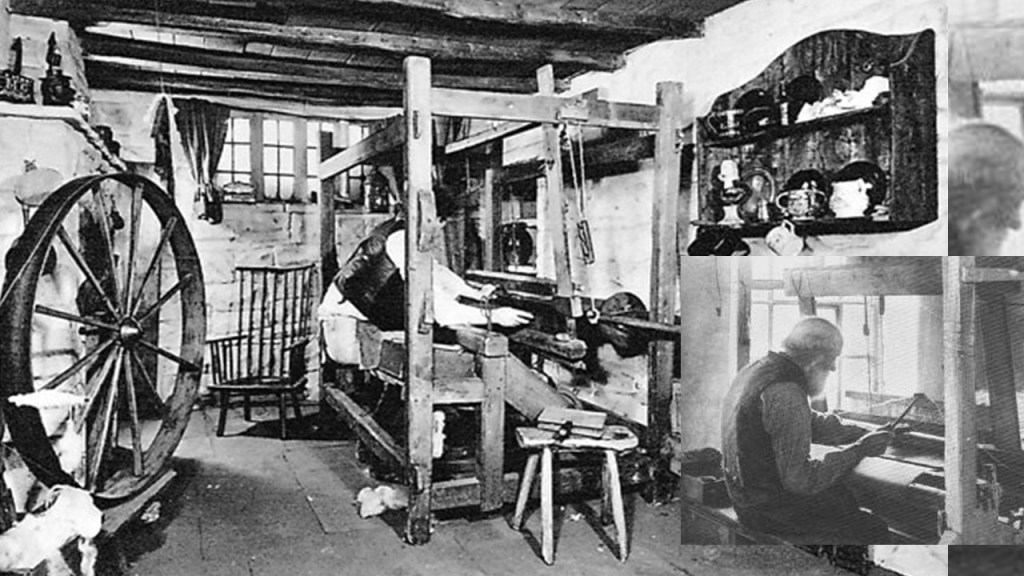
My collage of hand loom weaving in weaver’s cottages in West Yorkshire. Sourced from Bancrofts from Yorkshire: Hand Loom Weaving in Yorkshirehttps://bancroftsfromyorkshire.blogspot.com/2011/11/hand-loom-weaving-in-yorkshire.html
In an earlier blog (linked here) I have already had a say about the issue of technology and time, a relationship between things that is merely assumed in the phrase ‘outdated technology’, and thinking out that relationship further will always lead to the idea that a technology is not ‘outdated’ by progress but the persistence of a demand for it’s particular products, at least if we assume that the stage of process of development of the technology used in any specific process has its own peculiarities that aren’t necessarily passed on to its developed technological forms. Whether I miss such technologies is a question I won’t get into, although I could – textiles and weaving in its factory production stage being in my family history: my mother and my father’s mother both being involved in industrial spinning and weaving processes in the West Riding of Yorkshire. I have sat in a weaving shed and a spinning shed with my mother when that was required – it was a small family business and legislation about children in factories easy to ignore and my memory is of tedium and unending noise from the mechanical artifacts of the process, staffed then by women because largely considered low grade work badly paid (this must have been the 1960s). So I cannot say I miss it, though my memories have that nuance.
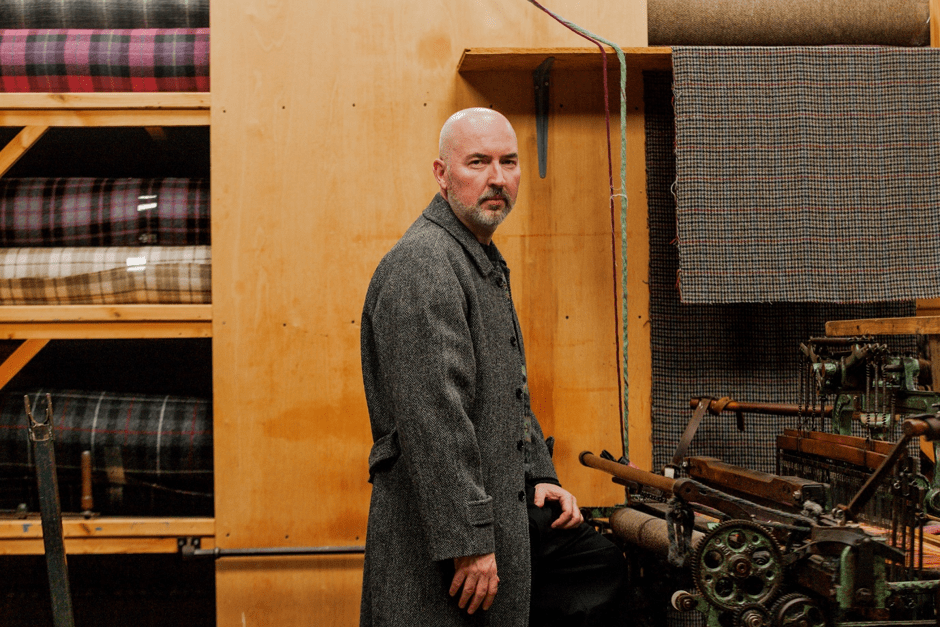
Douglas Stuart with a handloom: Robert Ormerod [Photograph] (2026) in ‘‘I felt like I owed Scotland’: author Douglas Stuart on championing Hebridean weavers’ in The Observer [online] (Wednesday 1 July 2026) available at: https://observer.co.uk/style/features/article/i-felt-like-i-owed-scotland-author-douglas-stuart-on-championing-hebridean-weavers
Douglas Stuart was brought up in modern industrial communities in Glasgow (although now gone in that form they had before the Blatcherite Revolution (which did for the Yorkshire wool textile industry too). Yet there was obviously enough awareness of the tradition of industrial weaving, mainly focused on the Scottish Borders towns now, for his school teachers to recommend a bright and creative boy who never had time to excel at school, having a mother lost eventually entirely to alcohol, and who became the model for that wonderful mother portrayal in Shuggie Bain, to go into a textile design career. In an interview with Craig McLean of The Observer relate to his novel John of John (I have already tweeted on this novel at this link), that story is told with some warmth felt Stuart for those teachers, although they were clearly wrong about ‘always’ getting a job in Scottish textiles, unless in fashion design as Stuart was employed – at a high and lucrative level, which was also creative.
Stuart’s teachers, aware of these struggles, and that he was unlikely to pass his exams, nudged him towards textiles “as a creative outlet, because I could express myself. But also: if you couldn’t make it creatively, you could always get a job making cloth in Scotland.” People suggested he move to Innerleithen, the mill town, or get a job at Pringle. “It was a very practical thing my teachers did for me,” he says. “They pointed me that way.” [1]
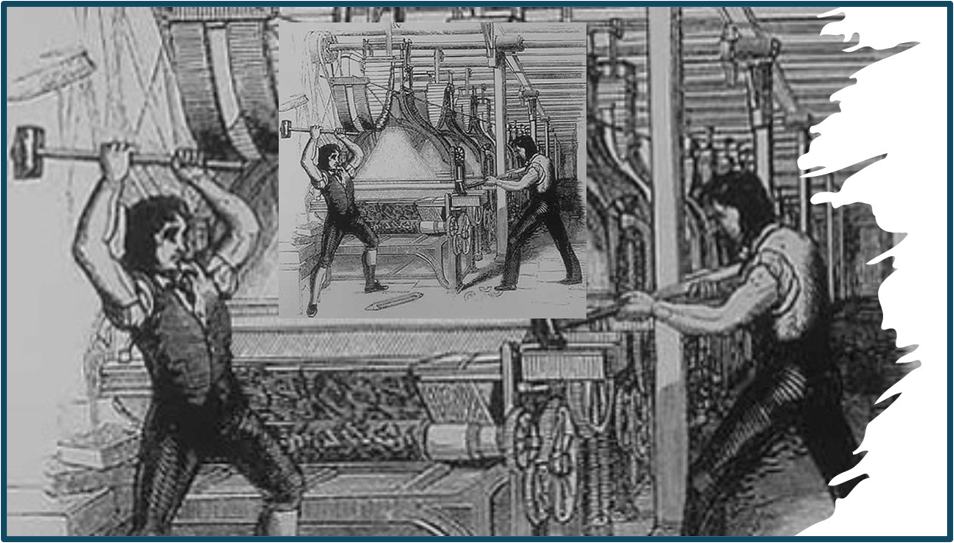
Yet what attracted him to a story in which the hand loom holds a special part, as it does in John of John as the staple part of the income of John MacLeod, the father of the junior John (John-Calum “Cal” MacLeod, known as Cal to avoid family confusion) , is its relation to time and notions of the ‘outdated’ I have something to say of that but not before pointing out that he is not a first writer, though possibly the first to have a hand at practical cloth weaving, to use the hand loom as a ‘thing’ that stood at the drift of time, as its golden boy for a period, only for it to become the symbol of the ‘outdated. The earlier case is George Eliot who knew both the cottage and industrial technology from the English Midlands town of Nuneaton, where she was born, which dealt mainly with silk ribbon weaving and which in the early nineteenth century was a focus of Luddite action against machine looms that were outdating and impoverishing hand loom weavers and decreasing the need for unskilled labour.
Yet George Eliot did think of herself as a weaver and it is at the heart of her interest too, as with Louise Bourgeois in another age, of her interest in the contest between Ariadne and Arachne as competitive weavers and in the spider as a weaver of webs and nets, which Arachne became in metamorphosis – think of Velasquez’s stately version of the project but not as informative as the print below from the Harvard archives.
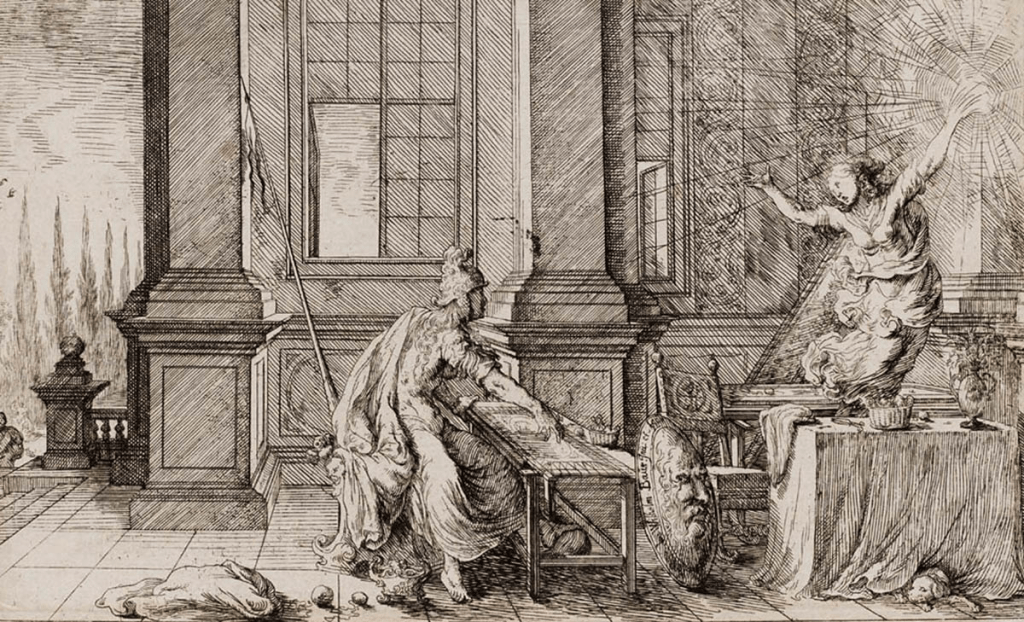
Arachne Is Transformed into a Spider, by Johann Wilhelm Baur, from a German edition of Ovid’s Metamorphoses, 1639, via the Harvard Art Museums
For Eliot, any storyteller, but particularly a’ ‘realist’ novelist dealing with the web of relationships between classes, groups and individuals in historically determined circumstances. A novelist must ‘weave’ and intersect threads of narrative that emerge as a pattern, where the intersections can often come loose and must be repaired. The idea runs through the mature work in different ways in Middlemarch and Daniel Deronda, in the latter the seams often showing. The idea was fully employed in Silas Marner, whose subtitle is The Weaver of Raveloe. On this novel, in this piece, I confine my remarks to Chapter 1 of the novel, because I could copy that as an Appendix at the end of this blog.I should say that I will also only deal with one 3 – 4 page section of John of John but that there may be spoilers, so I would advise anyone against this blog if they hate spoilers, unless they have read these books, or don’t intend to do so unless persuaded, as I would, if I knew you, persuade you.
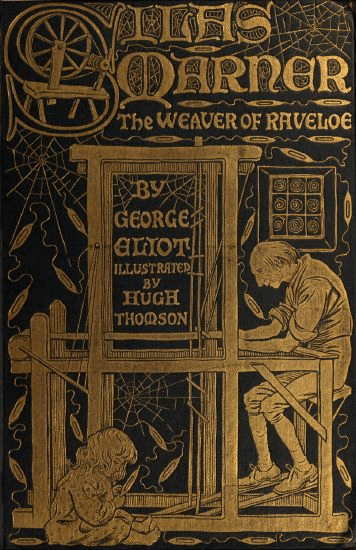
The novel is full of anomalies that are always the feel of the process of time, in which what was outdated depended on the function of the thing considered or its other circumstances, such as remoteness from those centres in which change and technological advance happened. Raveloe, ‘a village where many of the old echoes lingered, undrowned by new voices’, is not even on any major thoroughfare, Eliot tells us: ‘nestled in a snug well-wooded hollow, quite an hour’s journey on horseback from any turnpike, where it was never reached by the vibrations of the coach-horn, or of public opinion’.How lovely that the waves of passing time can be described as ‘the vibrations of the coach-horn’: it speaks of a metaphor of an outdated technology in transport that is used to describe the unsettling effect of the noise of modernity. That is, part, the effect on the boys of Raveloe, out adventuring in the margins of the village where Silas lived as Eliot tells us in a picture in which technology is again evaluated by hearing its regulated sounds – much more insistent in the inventions of machinery before the application of non-human power to work their heavier processes:
In the early years of this century, such a linen-weaver, named Silas Marner, worked at his vocation in a stone cottage that stood among the nutty hedgerows near the village of Raveloe, and not far from the edge of a deserted stone-pit. The questionable sound of Silas’s loom, so unlike the natural cheerful trotting of the winnowing-machine, or the simpler rhythm of the flail, had a half-fearful fascination for the Raveloe boys, who would often leave off their nutting or birds’-nesting to peep in at the window of the stone cottage, counterbalancing a certain awe at the mysterious action of the loom, by a pleasant sense of scornful superiority, drawn from the mockery of its alternating noises, along with the bent, tread-mill attitude of the weaver.
Eliot sets the historical period precisely as one before, at least, she was born, but in a place where outdated venues at which labour once occurred have have disappeared, such as the old quarry or ‘stone pit’, which will again come into use in the novel to obscure events in time for a space. A loom is more up-to-date here than hand-worked agricultural ‘machinery’ and hence even its sound speaks of an unreasonably modern past pace of production, as well as the beginnings of the worker’s alienation from their weaving craft, about which even village boys can feel superior since they involve the absorption of its worker into the loom in a ‘bent, tread-mill attitude’. Marner is at a strange point in history, for he reverses the trend that will soon make internal migration of workers from country to town. Marner has fled a large city back to the slow country in which he is strange, even though they had a weaver there before who has died. In Raveloe even the idea of technology as ‘craft’ is a suspicious manipulation of time, that seems less modern than the age-old work of the Devil. This is how Eliot so beautifully puts it:
To the peasants of old times, the world outside their own direct experience was a region of vagueness and mystery: to their untravelled thought a state of wandering was a conception as dim as the winter life of the swallows that came back with the spring; and even a settler, if he came from distant parts, hardly ever ceased to be viewed with a remnant of distrust, which would have prevented any surprise if a long course of inoffensive conduct on his part had ended in the commission of a crime; especially if he had any reputation for knowledge, or showed any skill in handicraft. All cleverness, whether in the rapid use of that difficult instrument the tongue, or in some other art unfamiliar to villagers, was in itself suspicious: honest folk, born and bred in a visible manner, were mostly not overwise or clever—at least, not beyond such a matter as knowing the signs of the weather; and the process by which rapidity and dexterity of any kind were acquired was so wholly hidden, that they partook of the nature of conjuring.
In truth, this is a picture of ignorance in action and as ‘outdated’ a view of the country community as is revealed by the word ‘peasant’ (soon to become a word that brands those called it slow of mind). To Eliot it was a word used in the nascent social science of Auguste Comte, who was a major influence on her thinking, though she rejected much of its ‘positivism’. Nevertheless the ‘peasant’ was a sign of the culture of the past, that, in her novels would signify something of both dark ignorance and necessary stability in society. To the peasant what moderns meant by technology, Eliot thought, was like showing ‘any skill in handicraft. All cleverness, whether in the rapid use of (…some…) art unfamiliar to villagers, was in itself suspicious’. Eliot overdoes omniscience in narration by sociological generalisation in continuing, in a tone of irony: ‘honest folk, born and bred in a visible manner, were mostly not overwise or clever—…; and the process by which rapidity and dexterity of any kind were acquired was so wholly hidden, that they partook of the nature of conjuring’. If craft done at speed is witchcraft, at least thought so in the least rational part of one’s mind, then that suggests all technology is in part evil (a symptom of the Fall of Man).
Silas is woven himself into a pattern of mythical icons. Amongst them is the antisemitic trope of the Wandering Jew (which she resolved in favour of Zionism in Daniel Deronda): a man who ‘looked like the remnants of a disinherited race’, although the name Silas was also a potential for the ultra-Protestant group to which he belonged in Lantern Yard. But he is also amongst the ‘pale men’ thought of as necromancers, who held communion with the dead – indeed his health condition of narcolepsy is read by the Raveloe populace They see him that is, as the icon of how the excess knowledge that fuelled technology was seen in the ‘outdated’ past, as magic. ‘Raveloe lasses’ say ‘they would never marry a dead man come to life again’, based on gossip from Jem Rodney, the mole-catcher, who:
averred that one evening as he was returning homeward he saw Silas Marner leaning against a stile with a heavy bag on his back, instead of resting the bag on the stile as a man in his senses would have done; and that, on coming up to him, he saw that Marner’s eyes were set like a dead man’s, and he spoke to him, and shook him, and his limbs were stiff, and his hands clutched the bag as if they’d been made of iron; but just as he had made up his mind that the weaver was dead, he came all right again, like, as you might say, in the winking of an eye, and said “Good night,” and walked off.
And, I think, more than that is the icon of the queer male, a bachelor who invited no-one to his home and who allowed no-one to know him, had education and imagination enough to hold desire and empathy, that leads to the miraculous ‘birth’ of his ‘found’ and adopted daughter, Eppie, but no-one to share it with. It would take a longer piece dealing with the whole novel to argue this queer case, but it echoes in the analysis of the persecution of the unknown and marginalised in Raveloe, that points out how, amongst other things, normativities – and I include heteronormativities – kill the possible of ‘appetite’ that considered unnatural might be some life-saving, and indeed to be amongst those wherein ‘their imagination is almost barren of the images that feed desire and hope’ is a sad fate, even if those such fated can bear no witness to their deficiency.
Such strange lingering echoes of the old demon-worship might perhaps even now be caught by the diligent listener among the grey-haired peasantry; for the rude mind with difficulty associates the ideas of power and benignity. A shadowy conception of power that by much persuasion can be induced to refrain from inflicting harm, is the shape most easily taken by the sense of the Invisible in the minds of men who have always been pressed close by primitive wants, and to whom a life of hard toil has never been illuminated by any enthusiastic religious faith. To them pain and mishap present a far wider range of possibilities than gladness and enjoyment: their imagination is almost barren of the images that feed desire and hope, but is all overgrown by recollections that are a perpetual pasture to fear. “Is there anything you can fancy that you would like to eat?” I once said to an old labouring man, who was in his last illness, and who had refused all the food his wife had offered him. “No,” he answered, “I’ve never been used to nothing but common victual, and I can’t eat that.” Experience had bred no fancies in him that could raise the phantasm of appetite.
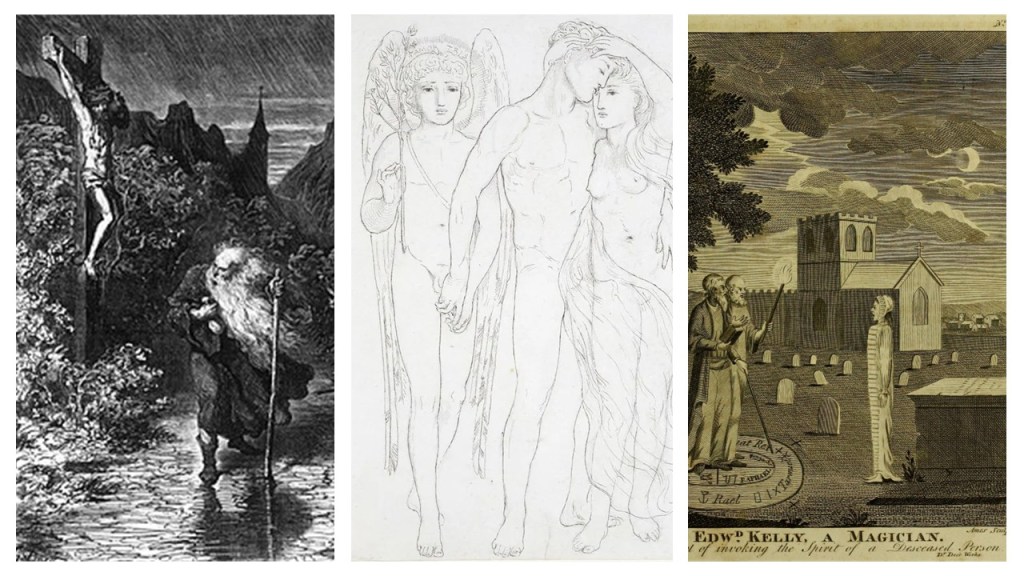
My collage containing R to L: The Wandering Jew by Gustave Doré; Samuel Solmon’s 1865 drawing The Bride, The Bridegroom and Sad Love – held in a private collection – is more explicit than other works intended for public display (Credit: Tate); and, Engraving of occultists John Dee and Edward Kelley “in the act of invoking the spirit of a deceased person”; from Astrology (1806) by Ebenezer Sibly.
That communal wonder at the weaver is not the case in John of John, for at the time of its setting, though hand loom weaving was a technology displaced-by-time in the mainstream of industry, this was not so for specialist weaving of Harris tweed, Harris being the place where the novel is set. Far from being seen as an outsider in his community, John the elder is the protector of a narrow sexual and social Protestant culture, where divorce is sinful – though John has secured himself now from the stain – he is, in Wikipedia’s words ‘deacon in the local Presbyterian church, a strict Calvinist congregation that still disciplines its members in public shaming sessions and forbids activities such as swinging on the Sabbath’. We know of the latter, because the almost pagan Cal has to wear the chains about his person on his way, like Jacob Marley, when he steps in to do fulfill his father’s job of tying up the communal swings in the port’s recreation ground. The descriptions of weaving are wonderful in the novel – particularly of the tedium and hard work involved. Stuart researched rather than knew the islands of Harris and Lewis, as Craig McLean [Words] & Robert Ormerod [Photographs] (2026) show us, even though they call the novel ‘a kind of homecoming’ as it is certainly an Odyssean nostos for Cal.
He spent 16 weeks researching John of John on the islands, the first eight in 2019, when he was still an unknown, unpublished author. He got to know the geography and geology, flora and fauna, religious traditions and weaving lore, crofters and churchmen and key figures in the communities. He even got to know some Gaelic. He knows a thing or two about fashion, too. Before becoming a novelist, Stuart – having relocated to New York from the UK in 2000 – designed clothes for Calvin Klein, Banana Republic and The Gap. [1]
But homecoming as it might ostensibly be, for Stuart it was also, as with George Eliot (though I haven’t heard him apply the analogy) about the craft – even witchcraft – of the novel, for he had to weave together stories about different times – Call’s historical, if half-hearted, ‘coming out’ as queer at textile college, the past history of the islands and their present economic and social dilemmas, and the hidden repressed story of the romance of his father and lover Innes, about whom noone knows, as well as other threads like the story of Doll, the one that made me most moved. For Stuart, tweed weaving had another link to the craft of the novel: the use of colour to talk about unspeakable emotion. McLean calls him:
the author, who once told me that “coming from a visual background, there’s a language I can bring to writing that a lot of other writers can’t”. John of John is rich with the kaleidoscopic colours of the islands, and the chromatic specifics contained in the finally calibrated warp and weft of Cal’s weaving – and that of Calum Iain Macleod, the man who wove for Oprah.
“Colour is a language in the novel,” Stuart tells me as we finish our tattie scones. “The men can’t talk about the truth of their feelings, or about what’s really going on. But they have such specificity around colour, and that’s the one place they can meet.”
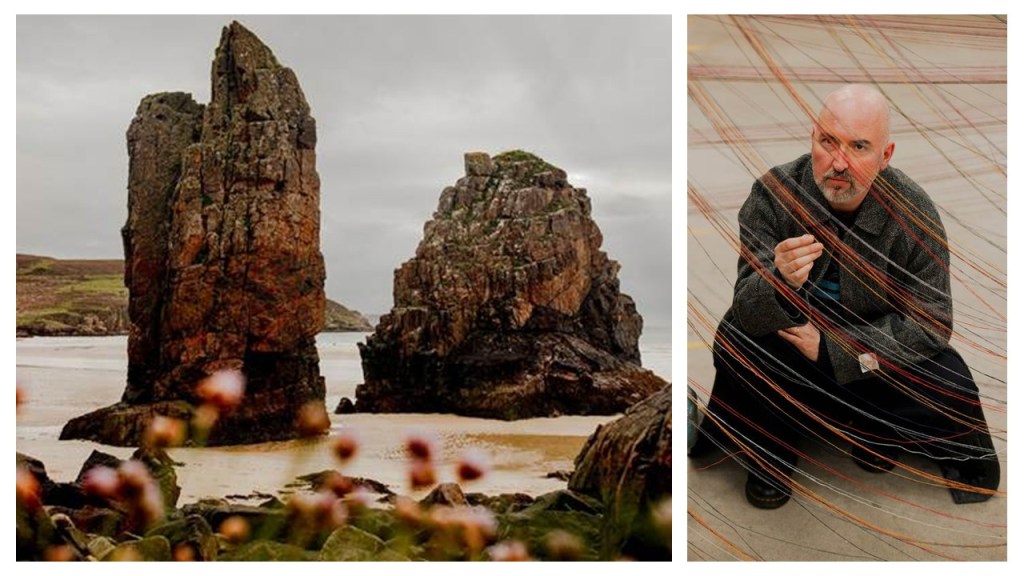
“Before I came to the islands, I thought, ‘Oh, the green in that tartan – maybe it’s just some green from the world.’” But, of course, it’s a historical thing. The colours they use come from the land beneath their feet. If they choose a green, it’s the green of the lichen, or the yellow of the moss on stones, or the pink of the helleborine.” The weavers of Lewis and Harris, of John of John, are “working with their own colours,” Stuart says. “And they belong only, specifically, here.”
If you want to judge the truth or otherwise of the last statements consult the photographs from Ormerod, from which inadequate copies are collaged below because they are essential to the argument above. Stuart is looking at the threads. Only you can decide if these are the colours of the island, short of travelling there which I have never done:
Personally, I think Stuart’s craft with narrative thread awes me more that his colour usage, but that is a deficiency in me since, as we shall see the colour themes mesh into the other themes of the multiple threads. However, it matters more, does narrative thread, in discussion of time and currency in time in this novel, in which what is past, present and to come is too intensely interwoven with themes of queerness and their transparency. And that goes too in considering what is outdated, in attitude or mode of thinking and making livable stories for ourselves. The knot in the threads comes for me when Cal imagines a future, of unknown duration, with a man he does not know to be his father’s lover, and with the knotty interventions into their possible future when it is resolved they may leave the Scottish islands.
This wouldn’t be so brilliantly realised by Stuart if it did not, like George Eliot, evoke the history of objects like looms and practices like weaving, themselves woven into more multi-coloured threads in the work, like tbe practice of religion and ethics. fishing, farming and hobbies like that of tbe ‘radio ham’ (another outdating technology) and the messy busy of intersecting issues of economics for individuals, working more than one social economic domain, localities, nations and hypernations. Tweed manufacture as a cottage industry run fron a factory hub such as we see in the novel, and crofting, are both outdated in their means and viability, but perhaps less so than had Stuart set the novel later.
MacLean shows us that Harris tweed is kept alive by tne taste of economic Queens of taste like Oprah Winfrey. The most embarrassing aspect of the article is the extremes Stuart goes to win Winfrey’s support, commissioning a cloth type special to her alone. It is fairly clear though that though that makes a windfall for a crofter-mussell-fisher- weaver also called MacLeod to whom the mill farms out tbis work, it doesn’t amount to a living in the long term, for historical reasons. MacLean says:
Even if Stuart hadn’t written John of John, tweed would be having a fashion moment. But that wasn’t the case when he graduated with a BA Honours in textiles in 1998. Stuart was educated at the Scottish College of Textiles in Galashiels, now part of Heriot-Watt University, in the Borders. “By the time I came out, the textile industry had gone the same way as everything else,” he says. He is referring to the post-Thatcher decline in Scottish manufacturing. “It had been happening for years,” he says, “and the industry was all centred down in the Borders. So even as students we were involved in the news about mass unemployment and the layoffs and the mills closing and production going to Asia. All these businesses,” he says, “just gone.”
Margaret Ann Macleod, too, remembers life being tricky on the islands. “It was a difficult time,” she tells Stuart and me at Shawbost. “The industry, the whole world, was going through a transition. We moved away from traditional textiles to modern fleeces, modern textiles. So when Douglas writes about the hardship of people on the islands” – John of John is set in the mid-1990s, when all this change was at its most pronounced – “that was true. He’s managed to capture the challenge of crofting and weaving, of life then in the rural communities around our island.”
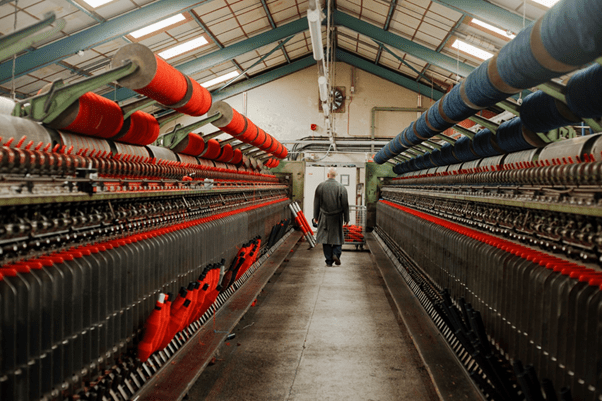
To see Ormerod’s photograph of Stuart at Shawbost walking away with his back to Shawbost like the match of capitalist history itself is to see even the eventual demise of fuel powered machine working which had previously squashed out of history the hand of the loom worker, except in that work the mill farms out still whilst thete are cultural Queens like Oprah to demand things for them be hand woven whatever the cost.
I thought it best to look at a brief section of the novel which centres on hand loom weaving from Chapter 5/ a còig: pages 71 to the end of the chapter, page 75. I chose tbis section because it is only when I reread it that I saw that its use of the theme of precision in the colour of threads matches somewhat some colour themes in Silas Marner.
Marner’s life is one in which life has been drained by poverty of thought, feeling and community which has led to him becoming a miser, hoarding his gold, although it is tje colour gold as a living thing tbat redeems – the curls on Eppie’s head as he sees them in his purblindness. Before that he is ‘one of these alien-looking’ who are ‘dark against the early winter sunset; one of; ‘these pale men’ that ‘rarely stirred abroad without that mysterious burden’, a burden but only of flax or linen.
Now there is an analogue in the life of MacLeod croft: all live a simple life where needs have to tailored to scant resources and hence when our section begins pallor is present, although a family intent in which Cal’s maternal grandmother, Ella, is intent on colouring in up-to-now drab black-and-white pictures in a child’s book made for that purpose: [2]
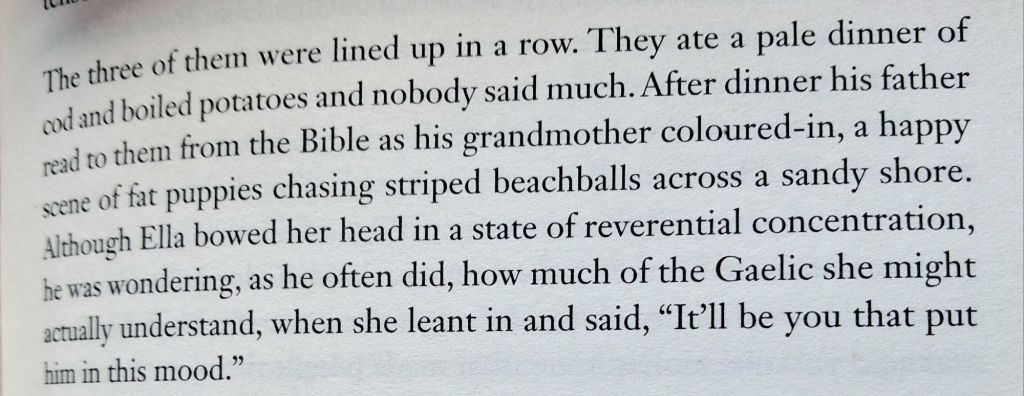
Of course, I may be stretching the point, for we all know a meal of cod and boiled potatoes would look ‘pale’, but given that why would the novelist choose to say it just before entering onto themes of colour that run through lives in more living forms than colouring in as we shall see. The pallor of these religious lives are yoked down by Bible Christianity, not unlike that of Marner’s stern religion (also Calvinist), that makes him one of the ‘pallid’. But it also follows a discussion about the possible use of hair dye by Cal in which father John quotes Deuteronomy to say that a ‘shall a man put on a woman’s clothing’, that it ‘abomination unto the Lord they God’. [3]
Strangely enough colourlessness of a kind also characterised Stuart’s clothes designs, whilst his student colleges interpret ‘fashion design’ as working in ‘the usual “riot of colours – so over-the-top, a little preposterous,he through having ‘won a travel bursary, in a competition run by the Guardian, to research the history of the Shakers in New England’ had done just that. Hence his final examination collection revelled (if that’s the word) in Protestant simplicity whilst not holding anymore those views as his religion. He said of the research into the Shakers that:
Part of that religion is design, “Hands to work, hearts to God” is what they call it. It’s about how the best way to serve God is to be useful. As a Glaswegian socialist, I was into that!” (Stuart got so into it that at one point a tutor in London remarked that he “might be under the influence of a cult”.) Ultimately, the trip influenced his graduate collection. [1]
Hence, his ‘collection was ‘“all black and grey. Just these long columns. Really monastic”‘. [1] Of course, when fashion houses like Gucci and Prada came by, they employed the student colleagues not Stuart, who despaired, until he was discovered by employers of a more creative ilk. However there may be something a little tongue-in-cheek in these answers for the section I am looking at now goes on to show how an apparently neglected boy in a religion that appears to sacrifice him to its grim ideal of work and pallor : after ‘evening worship, Cal tied his hair back and let himself be led like a docile heifer’, like, that is, a sacrificial animal. Yet there is more interest to the work-shed than that; its wall, though decorated only with ‘maintenance parts’ for the loom are ‘like primitive idols’ in appearance. The Hattersley loom itself is introduced as ‘the iron pulpit’.
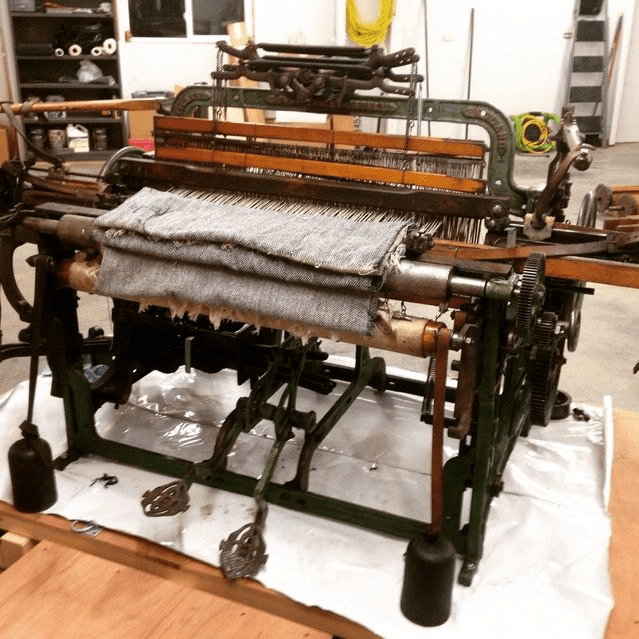
The Hattersley loom
The religious metaphors continue as the loom is described – ironically like a ‘papist’s organ’, anathema to John MacLeod. Once the work is started on this outdated apparatus, giving the ‘feeling of a Victorian workhouse’, John shows cal the ‘new colours’, just in. There follows a passage that is itself a riot of colour and joy, which starts off as a list of ‘all the romantic colours of Scotland’, hence rather sentimentally, to launch itself into queered modernity: ‘punkish hot pinks and acid yellows, violent tones that made people recoiled until they saw the finished cloth’. If this isn’t giving the feel of the novel’s interweave of narrative threads nothing would – where we will read of parties fuelled by mainland drugs as well a homosexuality as deeply entrenched as in the mainland in the flirtations of both Innes and the elder John, flirtations neither tells the other anything about. It is clear that half of this description is about the ‘new colours’, the other half about Cal’s memories of the love of his father in the teaching him these colours, whilst controlling disruption from him: sending him out to find exact matches for the colour of the threads in the natural world, samples of which he brought back. It is a beautiful passage (see below) as full of love like that Marner learns when he inherits the illegitimate child, Eppie.
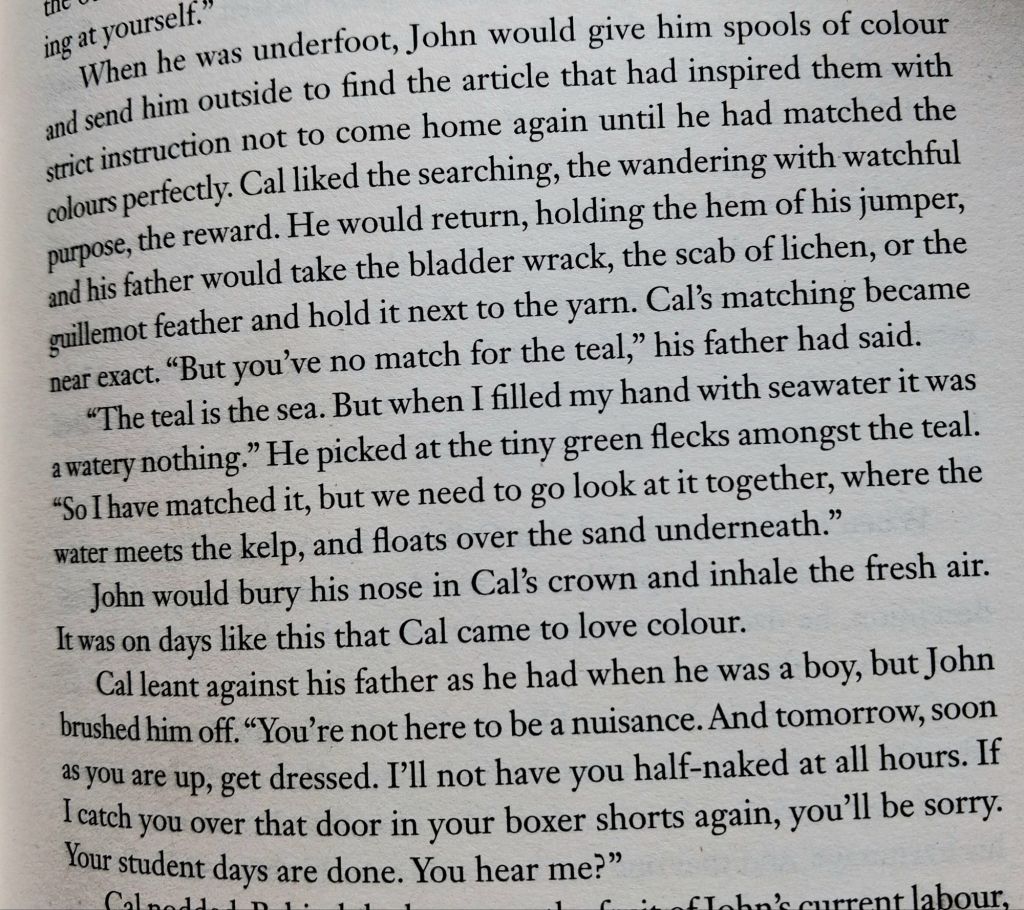
John burying his nose in his boy-child’s hair is so fine, although the painfulness of John’s adult rejection of his adult male son’s proximity tells us so by being doubly painful. It is also about how isolation sours single things, just as: ‘Alone, the colours were too dull or too sharp. Together they had made a kind of harmonious magic’. [5] However, this scene also uses colour to weave other threads, including the role of deceit and ambiguity in the kind of need father has for son now – as merely an appendage and survivor with the same name to sugar thoughts of upcoming death. As John repairs breaks in threads from the warp. Faults in cloth are like ethical ones – they can have colour too – like the colour of grandmother Ella’s feet, that are used to entice Cal back home as the sign of near death – a reason partly deceitful in Cal, but more so in Ella, whom, we shall discover at the end, coloured her feet with dye to achieve the double deception for her own purposes.
All of these plots and plans are not unlike spinning narrative threads. But these people call the effect of them ‘God’s plan’ or perhaps, whether they know that or not, really their own plan. All the time we relearn that single colours never look as they did alone when associated and overlapped with other coloured threads. Here the loom teaches the novelist’s lesson:
John turned back to the loom. He showed Cal how the overcheck sat upon the undercheck. “You see how the colour lies?”
In literature, stories are fictions because they are not lies but everyone understands lies and fiction are somewhat related as is fiction to truth – the textile terms ‘overcheck / undercheck’ provide a beautiful ambiguity. the passage goes on to show how the two men working on one cloth breaks the rules for Harris tweed but that two versions of woven threads, including a father and son’s stories, may lie together, even in the sense of parallel sexual lives, that for some time both will ‘get away with their deception’. [6] The chapter ends even more beautifully ambiguously about the creation of woven patters on looms or in writing, but I hope you want to read that for yourself.
I have written myself up to a position where I need to stop. I have never exactly ‘missed’ the technology of hand loom weaving in cottage industries, but I have written mysel into as well a feeling that I ought to miss it because such favoured novelists miss it and write their nostalgic longing in a way that tends both of them into ways of creating new kinds of novel. That will do for me.
All the best for now. With Love.
Steven xxxxxxxxxxxx
____________________
[1] Craig McLean [Words] & Robert Ormerod [Photographs] (2026) ‘‘I felt like I owed Scotland’: author Douglas Stuart on championing Hebridean weavers’ in The Observer [online] (Wednesday 1 July 2026) available at: https://observer.co.uk/style/features/article/i-felt-like-i-owed-scotland-author-douglas-stuart-on-championing-hebridean-weavers
[2] My photograph of detail from Douglas Stuart (2026: 71) John of John, London, Picador.
[3] Douglas Stuart (2026: 71) John of John, London, Picador.
[4] My photograph of detail from ibid: 73
[5] ibid: 73
[6] ibid: 74
APPENDIX:
Chapter 1 SILAS MARNER
In the days when the spinning-wheels hummed busily in the farm-houses—and even great ladies, clothed in silk and thread-lace, had their toy spinning-wheels of polished oak—there might be seen in districts far away among the lanes, or deep in the bosom of the hills, certain pallid undersized men, who, by the side of the brawny country-folk, looked like the remnants of a disinherited race. The shepherd’s dog barked fiercely when one of these alien-looking men appeared on the upland, dark against the early winter sunset; for what dog likes a figure bent under a heavy bag?—and these pale men rarely stirred abroad without that mysterious burden. The shepherd himself, though he had good reason to believe that the bag held nothing but flaxen thread, or else the long rolls of strong linen spun from that thread, was not quite sure that this trade of weaving, indispensable though it was, could be carried on entirely without the help of the Evil One. In that far-off time superstition clung easily round every person or thing that was at all unwonted, or even intermittent and occasional merely, like the visits of the pedlar or the knife-grinder. No one knew where wandering men had their homes or their origin; and how was a man to be explained unless you at least knew somebody who knew his father and mother? To the peasants of old times, the world outside their own direct experience was a region of vagueness and mystery: to their untravelled thought a state of wandering was a conception as dim as the winter life of the swallows that came back with the spring; and even a settler, if he came from distant parts, hardly ever ceased to be viewed with a remnant of distrust, which would have prevented any surprise if a long course of inoffensive conduct on his part had ended in the commission of a crime; especially if he had any reputation for knowledge, or showed any skill in handicraft. All cleverness, whether in the rapid use of that difficult instrument the tongue, or in some other art unfamiliar to villagers, was in itself suspicious: honest folk, born and bred in a visible manner, were mostly not overwise or clever—at least, not beyond such a matter as knowing the signs of the weather; and the process by which rapidity and dexterity of any kind were acquired was so wholly hidden, that they partook of the nature of conjuring. In this way it came to pass that those scattered linen-weavers—emigrants from the town into the country—were to the last regarded as aliens by their rustic neighbours, and usually contracted the eccentric habits which belong to a state of loneliness.
In the early years of this century, such a linen-weaver, named Silas Marner, worked at his vocation in a stone cottage that stood among the nutty hedgerows near the village of Raveloe, and not far from the edge of a deserted stone-pit. The questionable sound of Silas’s loom, so unlike the natural cheerful trotting of the winnowing-machine, or the simpler rhythm of the flail, had a half-fearful fascination for the Raveloe boys, who would often leave off their nutting or birds’-nesting to peep in at the window of the stone cottage, counterbalancing a certain awe at the mysterious action of the loom, by a pleasant sense of scornful superiority, drawn from the mockery of its alternating noises, along with the bent, tread-mill attitude of the weaver. But sometimes it happened that Marner, pausing to adjust an irregularity in his thread, became aware of the small scoundrels, and, though chary of his time, he liked their intrusion so ill that he would descend from his loom, and, opening the door, would fix on them a gaze that was always enough to make them take to their legs in terror. For how was it possible to believe that those large brown protuberant eyes in Silas Marner’s pale face really saw nothing very distinctly that was not close to them, and not rather that their dreadful stare could dart cramp, or rickets,1 or a wry mouth at any boy who happened to be in the rear? They had, perhaps, heard their fathers and mothers hint that Silas Marner could cure folk’s rheumatism if he had a mind, and add, still more darkly, that if you could only speak the devil fair enough, he might save you the cost of the doctor. Such strange lingering echoes of the old demon-worship might perhaps even now be caught by the diligent listener among the grey-haired peasantry; for the rude mind with difficulty associates the ideas of power and benignity. A shadowy conception of power that by much persuasion can be induced to refrain from inflicting harm, is the shape most easily taken by the sense of the Invisible in the minds of men who have always been pressed close by primitive wants, and to whom a life of hard toil has never been illuminated by any enthusiastic religious faith. To them pain and mishap present a far wider range of possibilities than gladness and enjoyment: their imagination is almost barren of the images that feed desire and hope, but is all overgrown by recollections that are a perpetual pasture to fear. “Is there anything you can fancy that you would like to eat?” I once said to an old labouring man, who was in his last illness, and who had refused all the food his wife had offered him. “No,” he answered, “I’ve never been used to nothing but common victual, and I can’t eat that.” Experience had bred no fancies in him that could raise the phantasm of appetite.
And Raveloe was a village where many of the old echoes lingered, undrowned by new voices. Not that it was one of those barren parishes lying on the outskirts of civilisation—inhabited by meagre sheep and thinly-scattered shepherds: on the contrary, it lay in the rich central plain of what we are pleased to call Merry England, and held farms which, speaking from a spiritual point of view, paid highly-desirable tithes. But it was nestled in a snug well-wooded hollow, quite an hour’s journey on horseback from any turnpike,2 where it was never reached by the vibrations of the coach-horn, or of public opinion. It was an important-looking village, with a fine old church and large churchyard in the heart of it, and two or three large brick-and-stone homesteads, with well-walled orchards and ornamental weathercocks, standing close upon the road, and lifting more imposing fronts than the rectory, which peeped from among the trees on the other side of the churchyard:—a village which showed at once the summits of its social life, and told the practised eye that there was no great park and manor-house in the vicinity, but that there were several chiefs in Raveloe who could farm badly quite at their ease, drawing enough money from their bad farming, in those war times,3 to live in a rollicking fashion, and keep a jolly Christmas, Whitsun, and Easter tide.
It was fifteen years since Silas Marner had first come to Raveloe; he was then simply a pallid young man, with prominent short-sighted brown eyes, whose appearance would have had noth- ing strange for people of average culture and experience, but for the villagers near whom he had come to settle it had mysterious peculiarities which corresponded with the exceptional nature of his occupation, and his advent from an unknown region called “North’ard.” So had his way of life:—he invited no comer to step across his door-sill, and he never strolled into the village to drink a pint at the Rainbow, or to gossip at the wheelwright’s: he sought no man or woman, save for the purposes of his calling, or in order to supply himself with necessaries; and it was soon clear to the Rave- loe lasses that he would never urge one of them to accept him against her will—quite as if he had heard them declare that they would never marry a dead man come to life again. This view of Marner’s personality was not without another ground than his pale face and unexampled eyes; for Jem Rodney, the mole-catcher, averred that one evening as he was returning homeward he saw Silas Marner leaning against a stile with a heavy bag on his back, instead of resting the bag on the stile as a man in his senses would have done; and that, on coming up to him, he saw that Marner’s eyes were set like a dead man’s, and he spoke to him, and shook him, and his limbs were stiff, and his hands clutched the bag as if they’d been made of iron; but just as he had made up his mind that the weaver was dead, he came all right again, like, as you might say, in the winking of an eye, and said “Good night,” and walked off. All this Jem swore he had seen, more by token that it was the very day he had been mole-catching on Squire Cass’s land, down by the old saw-pit. Some said Marner must have been in a “fit,” a word which seemed to explain things otherwise incredible; but the argumentative Mr. Macey, clerk of the parish, shook his head, and asked if anybody was ever known to go off in a fit and not fall down. A fit was a stroke, wasn’t it? and it was in the nature of a stroke to partly take away the use of a man’s limbs and throw him on the parish, if he’d got no children to look to. No, no; it was no stroke that would let a man stand on his legs, like a horse between the shafts, and then walk off as soon as you can say “Gee!” But there might be such a thing as a man’s soul being loose from his body, and going out and in, like a bird out of its nest and back; and that was how folks got over-wise, for they went to school in this shell-less4 state to those who could teach them more than their neighbours could learn with their five senses and the parson. And where did Master Marner get his knowledge of herbs from—and charms too, if he liked to give them away? Jem Rodney’s story was no more than what might have been expected by anybody who had seen how Marner had cured Sally Oates, and made her sleep like a baby, when her heart had been beating enough to burst her body, for two months and more, while she had been under the doctor’s care. He might cure more folks if he would; but he was worth speaking fair, if it was only to keep him from doing you a mischief.
It was partly to this vague fear that Marner was indebted for protecting him from the persecution that his singularities might have drawn upon him, but still more to the fact that, the old linen-weaver in the neighbouring parish of Tarley being dead, his handi- craft made him a highly welcome settler to the richer housewives of the district, and even to the more provident cottagers, who had their little stock of yarn at the year’s end. Their sense of his usefulness would have counteracted any repugnance or suspicion which was not confirmed by a deficiency in the quality or the tale of the cloth he wove for them. And the years had rolled on without producing any change in the impressions of the neighbours concerning Marner, except the change from novelty to habit. At the end of fifteen years the Raveloe men said just the same things about Silas Marner as at the beginning: they did not say them quite so often, but they believed them much more strongly when they did say them. There was only one important addition which the years had brought: it was, that Master Marner had laid by a fine sight of money somewhere, and that he could buy up “bigger men” than himself.
But while opinion concerning him had remained nearly stationary, and his daily habits had presented scarcely any visible change, Marner’s inward life had been a history and a metamorphosis, as that of every fervid nature must be when it has fled, or been condemned to solitude. His life, before he came to Raveloe, had been filled with the movement, the mental activity, and the close fellowship, which, in that day as in this, marked the life of an artisan early incorporated in a narrow religious sect, where the poorest layman has the chance of distinguishing himself by gifts of speech, and has, at the very least, the weight of a silent voter in the government of his community. Marner was highly thought of in that little hidden world, known to itself as the church assembling in Lantern Yard; he was believed to be a young man of exemplary life and ardent faith; and a peculiar interest had been centred in him ever since he had fallen, at a prayer-meeting, into a mysterious rigidity and suspension of consciousness, which, lasting for an hour or more, had been mistaken for death. To have sought a medical explanation for this phenomenon would have been held by Silas himself, as well as by his minister and fellow-members, a wilful self-exclusion from the spiritual significance that might lie therein. Silas was evidently a brother selected for a peculiar discipline;5 and though the effort to interpret this discipline was discouraged by the absence, on his part, of any spiritual vision during his outward trance, yet it was believed by himself and others that its effect was seen in an accession of light and fervour. A less truthful man than he might have been tempted into the subsequent creation of a vision in the form of resurgent memory; a less sane man might have believed in such a creation; but Silas was both sane and honest, though, as with many honest and fervent men, culture had not defined any channels for his sense of mystery, and so it spread itself over the proper pathway of inquiry and knowledge. He had in- herited from his mother some acquaintance with medicinal herbs and their preparation—a little store of wisdom which she had imparted to him as a solemn bequest—but of late years he had had doubts about the lawfulness of applying this knowledge, believing that herbs could have no efficacy without prayer, and that prayer might suffice without herbs; so that his inherited delight to wander through the fields in search of foxglove and dandelion and coltsfoot, began to wear to him the character of a temptation.


2 thoughts on “Some reaons for missing a technology that still required a person to drive and regulate its process: the case of the hand loom and cottage industry in literature. A blog on extracts from George Eliot’s ‘Silas Marner’ and Douglas Stuart’s ‘John of John’.”