


Changing the ending? The issue is not with ‘books’, so to speak, but with stories, where changed endings are only one form of a work, which must exist through history as ‘translations, versions, or adaptations of works’ that involve ‘a conversation with an earlier writer’. Let’s choose, then, as so many have already done, a story where conversations with the original are ‘an encounter … across the span of two-and-a-half millennia’.[1] Part Three of an examination of three versions of The Oresteia before Simon Stone’s brilliant version: the ‘Girl Who Closed Her Case’ in The Oresteia of Zinnie Harris, This Restless House.

This Restless House is a fine trilogy of plays and genuine theatre, a good place then to end this preparation on versions of The Oresteia, which often seems the model of trilogy writing and fine theatre. It also has a complete rewriting of the final play, the ending of the story as it were, in which a new set of characters, who work and / or live in a twentieth century psychiatric hospital, force the comparison with the ‘case’ of Electra, one of the residents at that hospital by setting up a ‘trial’, like that of Orestes in The Eumenides (The Kindly Ones), of Electra (who is the murderer, not Orestes, of Clytemnestra, their mother, in this play) which opens up the ambiguous use of the word ‘case’ in this play – being at once a ‘case’ tried in ‘law’ and a ‘case’ in the workload of a medical psychiatrist.
The word flits between those meanings. Clytemnestra demands that the Chorus of residents – the same Chorus who sits throughout the play representing the most marginal (and considered abject by most) of the world they act in for the moment – vote in the trial of Electra as the chorus of Athenian citizens vote on the case of Orestes in The Kindly Ones. Their vote is split but there is no goddess to cast a deciding vote – as does Athena in Eumenides – on the case. Electra appeals to the Doctor, once herself a patient, Audrey, to vote, but she has ‘gone’, the Chorus say, ‘she isn’t part of this story’ (that which involves a case at law). With no Gods or other authority to which to appeal, the abject Chorus fall into free verse despair – as in earlier plays they do at the oppression used against them – contempt and / or manipulative usage – by those with power in their status quo.
She’s gone,
we can’t finish then?
no moral
no conclusion
bloody hell
we’ve failed
this restless house will stay stirring and vengeful
there must be someone else who can vote?
no-one, who else could there be?
tell the audience, we have come to the end but there is no conclusion
...[2]
Having no apparent power yet made to feel responsible is much like the position of the audience who continually watch those dramas into which they feel they cannot intervene, in life as well as in the theatre – for audiences could ‘vote’ (couldn’t they?) to stop the madness of only punishing those who stand up against oppression like that of Agamemnon, Clytemnestra and Aegisthus. They could but they don’t – preferring their abject positions at the margin, watching those who dare to have power work entirely in their own interests. No wonder every ‘restless house’ (the ‘house’ is the name of theatre in process as well as a family, or its setting or parliaments (literal talk-shops in etymology) of all kinds) stays what is ‘stirring and vengeful’ but never decisive.
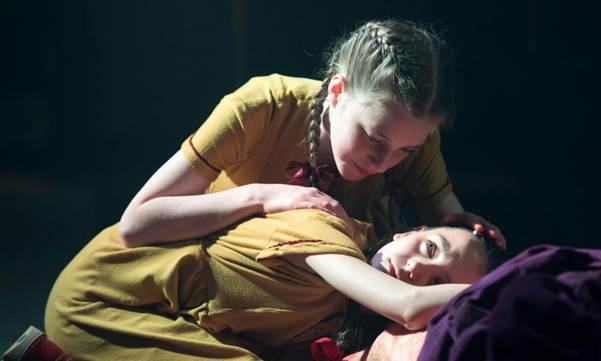
In the end a girl-child with whom no-one plays in the way children love to play at life, Iphigenia (the daughter of Agamenon brutally sacrificed – officially murdered – by her own father to secure his international interests) who closes ‘her case’, with her psychiatric doctor:
MICHAEL:
It’s nearly the end of the clinic I think we’ve got somewhere
Are you happy to close your case, little girl?
She nods.
Then I’ll see you next time.[3]
In the theatre, this must have been excruciatingly painful (it is to my regret I never managed to get tickets for this play and I have never been in its audience, passive or otherwise). For the little girl, her ‘case’ is a little suitcase she carries in which she keeps symbolic gifts (does she see them as symbolic) for those who ought to have played with her but abused her instead, as both Electra and Audrey were abused in their own specific ways) Iphigenia is the last to vote and her ‘vote is for an end’
it’s to stop
I was just a little girl
everything else was you [4]
Having condemned what we call ‘adult’ life, and its lies about protective families, Iphigenia still has to confront the psychiatric system, with its eternal play with words. Her psychiatrist (also the doctor who transformed the woman, once abused girl, Audrey into a shadow of himself, a junior psychiatrist soon to become fully fledged and to whom Electa was assigned as patient) Michael, asks Audrey what’s in ‘her case’. She immediately, as who would not, tells him what is in her childish suitcase carried everywhere, but not before it is clear that, for Michael, what girls contain in closed cases is the symptoms of the psychiatric ‘case’ she is to him:
Michael comes on, as if in a clinic
MICHAEL
what is in your case, little girl?
IPHIGENIA
you know my story?
MICHAEL
yes, I have your notes
IPHIGENIA
in my case
nothing really
a little poultice that my mummy made me, that helps me sleep
and a little picture of my dad
and my sister is just a baby but she is here too
and my brother
…
IPHIGENIA
I have a toothbrush and a hairband [4]
Just as psychiatric cases are internally made up of case notes, a little girl’s toy case is made up of very little at all, except those partial truths (sometimes wholly lies) passed to her by parents who, in reality, ‘fucked her up’, to use the terms made famous by Philip Larkin.[5]
They fuck you up, your mum and dad.
    They may not mean to, but they do.
They fill you with the faults they had
    And add some extra, just for you.
Read the rest of This Be The Verse (use the link on the title): it’s salutary, for the self-centredness of parenthood (which may not of course be without nuance- or even contradiction – as with the rest that follows), together with its necessary pretence of self-sacrifice, is literally legendary. This the Greeks knew when they wrote over and over again of restless houses: not just that of Atreus but the more infamous Labdacid House (whose central son was Oedipus). But Iphigenia had it worse, though young enough to know there was an alternative to the abuse that adult self-interest fosters and not yet learned to be vengeful or self-interested herself (I am not sure that that is a schedule of childhood development with which I entirely concur).
Somebody has to rewrite the end of The Oresteia as This Restless House! Zinnie Harris makes Iphigenia her on-stage representative (strangely enough of the two Iphigenia plays that survive from Attic Greece, both by Euripides, in one Iphigenia in Aulis, the child is sacrificed, in the other, Iphigenia in Tauris, she lives on to become high priestess to Artemis in Taurus, forced to make human sacrifices, even of her brother Orestes who visits the island. He escapes with her help. Harris’ Iphigenia is actually the one who links the last play of This Restless House, entitled Electra and Her Shadow, to The Kindly Ones, transforming the perception of the avenging Furies (‘the creatures out there’ ) into kindly ones as childlike perception can rightly do, institution a peaceful communalist revolution:
IPHIGENIA
I’ll invite them in, give them tea. There is plenty for us all.
ELECTRA
no wait a minute
IPHIGENIA
they are only scary if you run from them. If you ask them in  they sit down like friends. There is nothing to fear.[6]
This play is about woman and girls who rebel against the sins of the Fathers (and the patriarchal Mother) but it is also about communities – especially those who ‘watch’, as do audiences, considerably enlarging the role of the ‘Watchman’ from Aeschylus’s Agamemnon in Harris’s Agamemnon’s Return, mainly as a working-class male using his not-to- auspicious role in the Royal House to lord it over the Chorus. When employed to lay down the red carpet for Agamemnon’s royal entry to the Palace, the Watchman laughs at them, thinking Clytemnestra ‘mad’ to employ such unkempt lumpen wasters:
what did  you do, smooth your hair?
clean some vomit off your shirt?
I wouldn’t call it transformational [7]
I think the Chorus in the play owes so much to the representation of the People of Argos, in fact, in Sartre’s The Flies, that I may have mixed them up in that respect in Part Two of this blog on that version. They are the people no-one deigns to acknowledge or value in any respect, and they know it from the start. Their first lines in Act 1, Scene 1 of the first play is:
go on then avert your gaze
look away
don’t stare at us for too long
…
you walk past us on the street after all
you close your curtains
shut your door
…
don’t get too near though you might catch something
…
Nevertheless they feel that their main worry is the ‘audience’ the theatre ‘house’ as it were, who, bourgeois probably as those who turn away from, do not realise that there are more terrible things than poverty in the drama to come. They cajole the audience’s willingness to stay through ‘our pain’.
oh, no one’s leaving
there’s the door
let me tell you this tale is not for everyone
and it’s not going to be funny either
comedy this is not
if you want to laugh try elsewhere we suggest[8]
This is then a play about power and its absence in some as much as Sartre’s is. Harris also takes some aspects of Sartre to characterise her Furies. They are flies often when they are external, but not of the Beelzebub character in Sartre, but certainly taking from The Flies, their attraction to the rotting flesh that Clytemnestra believes she is ‘ there are things crawling across my skin, eating the rot –‘.[9] But more often they are irritants, making us conscious of the air around bodies as a space full of threat and disgust.
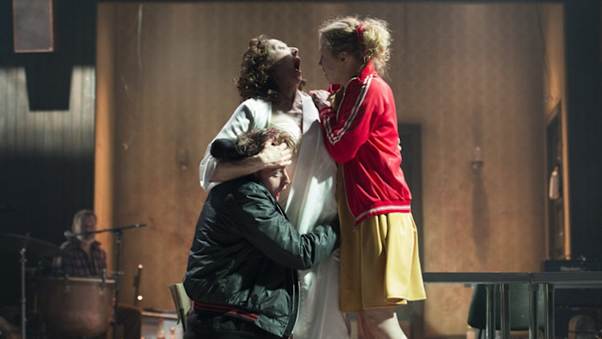
They match up with the internalised Furies that are itches on or under the skin: they remind me of the commonly reported feel in excess barbiturate users that something crawls beneath their skin – like imaginary scabies: ‘you’ve no idea how much it itches’, says Orestes. He says that in a scene, which like others and despite the Chorus who also created laughter at their human ill-condition , is played for laughs: ‘maybe you need some cream –‘, says Electra in complete bathos. [10]
We first hear of flies from Clytemnestra, where no-one else much notices them. It isn’t that they are imaginary – but that people of class put up with being surrounded with tiny insignificant things that disgust them, because it makes it easier to claim life itself is rotten to pacify those who might one day turn against you because of the conditions your pollution creates around them. Asked to take care of her daughter when she is physically sick, she first fears that her daughter smells her own disgusting rot and decay, then (Electra having thrown up in a bucket) says ‘there are flies in the vomit’. She eventually sees, as no-one else does on the scene, her ‘heaving up insects / they are coming out of her mouth’. This is an excellent way to renounce the duty of care for a daughter, allowing her to run off stage whilst Electra feebly calls, ‘Mum?’, in a question that cannot be answered. [11] In the same way, Aegisthus, who mainly thinks Clytemnestra imagines things, is really pushing his need for her away (this Aegisthus is poor at everything, especially governance when Clytemnestra falls into a coma.
you aren’t rotting. that’s the point
you know I wish you would say what is actually going on here
you don’t want to spend time with me
…[12]
Clytemnestra hates contacting that which disgusts her, even herself. In the trial she protests that the Chorus will her the case between herself and Electra because they are ‘the ill-fitting, the insane’. When they protest that that makes them good ‘watchers’ because they are ‘the left behind / the unseen’, she then calls them deceitful for being significant to her in a way she had rather not acknowledge.[13]
Like the Orestes in the first half of The Flies, who starts off as a girlish-boy only to be metamorphosed by existential commitment and good faith, Harris’s Orestes knows about nothing but running away from fear, which itches like the Furies, and can only be himself by passing his active self onto Electra though their transitional likeness (‘it’s like a mirror’ says Electra), not that he wishes this transition on her, just as he dreads his transition into his beloved father which explains the itches in his skin. At the end of the scene where all this happens, Electra picks up a real mirror, begins to itch inside as she transitions into family type. When left with the mirror: ‘She looks again at her reflection’, but then seeing in herself Father, Mother, Brother and itching ‘alive’: ‘She smashes the mirror’.[14]
This play needs to be seen and I haven’t seen it, but it is the least programmatic of the three plays I have examined. It completes the journey started by Mourning Becomes Electra, by eradicating the masculine, other than as the irritant that ensures the persistence of the itch to power and command, the same thing which ties Michael in the final play to his profession. As in the O’Neill play women are stronger than men. Apart from Christine, who follows her seaman into death as Electra will follow Orestes using the same method – a rope to hang themselves, it is the men who kill themselves violently as first recourse, and the only non-fictional suicide attempter – but a clearer model of how talented women are made vulnerable in a male world – is the one who survives to give us hope:
I’ll always have to live with that
but I can live
I can live with it
and look the window is open
She looks out
She leans right out[15]
It gives us hope for Clytemnestra has kept every window in the palace shut and Electra inherits the behaviour, ostensibly because of the flies, though they itch just the same. This dramatic symbol is hopeful but not trite. It remains just opening a window for the first time and leaning out, as if after freedom from some phobia, but you feel its virtue as a gesture and that is what good theatre writing does.
Having said that the play has dubious hope to give to women who, trying to negotiate hatred of their oppressive husbands and burdened with the loss of a first child because of him, turn to welcoming their absences and party through it as Clytemnestra does. Cassandra points out that everyone is talking about her:
They say she has drunk herself into a stupor and neglects her living children
They say she has filled her house with vagrants.
For these sins of the Mother there is still no forgiveness, and Clytemnestra is harsh against other women too, who give in, as she does and does a living hell thar ‘never ends, unlike the play. She says that to Electra and Audrey, who think they (as one) have just jumped to enact the strangulation rope supplies. Clytemnestra is nothing but truthful, which is why it is good that the hanging of Audrey failed if not that, finally, of her Electra complex, personified in Electra herself.
hell, Electra, is without end, that is the purpose
You don’t get to jump free[16]
That is not much like The Flies, but is very Sartrean.
So that’s the last of three Oresteia versions. I await now to see if Simon Stone publishes in Methuen Drama’s playlist his new play as he did his versions of Lorca’s Yerma and Ibsen’s The Lady From The Sea, both highly praised London productions like The Oresteia. If he does I will be back on this subject sometime, should I survive!.
All my love
Steven xxxxxxx
[1] These quotations have not been referenced in Part 1 & 2. They are from Charlotte Higgins’ ‘Introduction’ to This Restless House. Charlotte Higgins (2017: 14) ‘Introduction’ in Zinnie Harris This Restless House London, Faber and Faber, 11 – 14.
[2] Zinnie Harris (2017: 307f.) This Restless House London, Faber and Faber.
[3] Ibid: 317
[4] Ibid: 313
[6] Ibid: 317
[7] Ibid: 96
[8] Extracts from ibid 19f.
[9] Ibid: 184
[10] Ibid: 196
[11] Ibid: 204-6.
[12] Ibid: 178
[13] Ibid: 302 – 3
[14] Ibid: 194 – 200.
[15] Ibid: 319
[16] Ibid: 299


3 thoughts on “Changing the ending? The issue is not with ‘books’, so to speak, but with stories, where changed endings are only one form of a work, which must exist through history as ‘translations, versions, or adaptations of works’ that involve ‘a conversation with an earlier writer’. Let’s choose, then, as so many have already done, a story where conversations with the original are ‘an encounter … across the span of two-and-a-half millennia’. Part Three of an examination of three versions of ‘The Oresteia’ before Simon Stone’s brilliant version: the ‘Girl Who Closed Her Case’ in ‘The Oresteia’ of Zinnie Harris, ‘This Restless House’.”