


Changing the ending? The issue is not with ‘books’, so to speak, but with stories, where changed endings are only one form of a work, which must exist through history as ‘translations, versions, or adaptations of works’ that involve ‘a conversation with an earlier writer’. Let’s choose, then, as so many have already done, a story where conversations with the original are ‘an encounter … across the span of two-and-a-half millennia’. Part Two of an examination of three versions of ‘The Oresteia’ before Simon Stone’s brilliant version: the Family Romancing of White Power in The Oresteia of Eugene O’Neill, Mourning Becomes Electra.
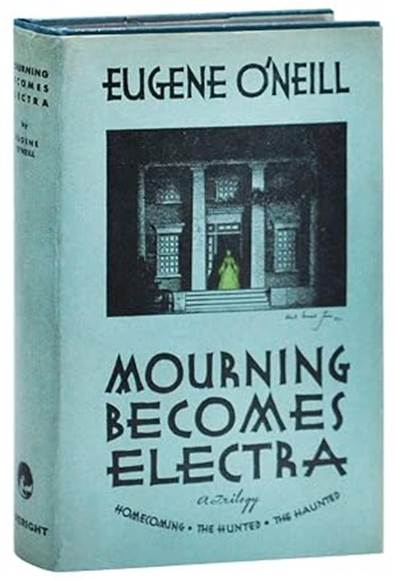
Eugene O’Neill is much less secure member of the literary pantheon than he used to be. In the shadow of Tennessee Williams in his lifetime, he is difficult to feel securely positive about as a dramatist, even becoming suspect as a writer of poetic prose, though I like it well enough because it diagnoses its own peculiarity as dramatic writing. The Agamemnon of this Oresteia-styled trilogy, Ezra Mannion, returns home a victorious General from the American Civil War on the side of the Union just as Agamemnon comes home from Troy. Ezra has seen no more death than Agamemnon did, no doubt, but unlike Agamemnon, those deaths have made his own life seem insignificant. What he sees as significant, is not the loss of his own life, whatever that might mean, but the loss of a man who was the yet unfulfilled husband of his wife Christine, a man who could not satisfy his wife.
He describes that loss, difficult as it is to fix in clear words, as ‘queer and wrong – like something dying that had never lived’.[1] It is clear that not only will O’Neill change the ending of his Oresteia, ensuring that his Orestes, Orin Mannon dies at his own hand with a faint gunshot off-stage, but that the focus of the play is, as its ending on his Electra, Lavinia or Vinnie Mannon, who will stay where she is haunted by the dead of her family – those dead before the play starts and during it, from which nevertheless she describes as hounding her, like a type of pursuing chorus of Furies after all but where everything is without motion, shut quiet behind the nailed-up windows of a ‘tomb’ of a Boston house, brutish and nasty in style made by and for the nouveau riche shipbuilding and trading Mannon family. However, we never see that style, for it is fronted – the word used consistently in the play and its stage directions is ‘masked’ – with a Greek classical façade.
O’Neill truly felt masks important in his production – so much so that he must be referring to the use of masks by Greek actors in the great original tragedies. But he uses them differently, as a metonymy for both similarities of appearance and the meanings that represents, disguise and that kind of inflexible facial style that does not easily show variation, if at all, that might exist underneath it or hides it. But like a tragedy where there is at its centre ‘something dying hat had never lived’, it is near to impossible to imagine how to instruct a stage director, set designer or actors to convey the ubiquity of the mask in the whole play. To make the point, I’ll tabulate some of the occurrences I noticed, so that you are encouraged to look at them not as vague poeticisms of a vaguely poetic writer but problems set for directors, set designers and actors.
| Reference | Where it occurs |
| The house … is a large building of the Greek temple style that was in vogue in the first half of the nineteenth century. | General Scene of the Trilogy, p. 9 |
| After a long description of lighting effects created ‘shortly before sunset’ with luminous mists and ‘the whiteness of the columns’ intensified, we get: The white columns cast black bars of shadow on the grey wall behind them. The windows of the lower storey reflect the sun’s rays in a resentful glare. The temple portico is like an incongruous white mask fixed on the house to hide its sombre grey ugliness. | Homecoming, Act One. ‘Scene’, p.15 |
| I’ve been to the greenhouse to pick these. I felt our tomb needed a little brightening. (She nods scornfully towards the house) Each time I come back after being away, it appears like a sepulchre! The “whited” one of the Bible – pagan temple front stuck like a mask on Puritan grey ugliness! | Homecoming, Act One. Christine Mannon speaking (with stage directions), p.34 |
| Above the fireplace, in a plain frame, is a large portrait of Ezra Mannon himself, painted ten years previously. … His face is handsome in a stern, aloof fashion. It is cold and emotionless and has the same strange semblance of life-like mask that we have already seen in the faces of his wife and daughter and Brant. | Homecoming, Act Two. ‘Scene’, p.51 |
| Vinnie is furious with her mother because she knows that Christine is using her as a front, pretending Captain Adam Brant, skipper of the ‘Flying Trades’, comes to the house to see Vinnie, whilst he is in fact having a sexual affair with Christine. Things may be complicated by what Vinnie may in fact want from Adam for herself. Threatening to write to her Father, she says she will expose Christine. Then follows a long stage direction, describing Vinnies exit by the side door, which we hear closing, and Christine enacts this: Then she turns and stands in tense calculating thoughts. Her face has become like a sinister evil mask. Finally …. | Homecoming, Act Two. The stage action that follows Vinnie’s exit prior to Brant’s entry, p.62 – 63 |
| They went to a white meeting-house on Sabbaths and meditated on death. Life was a dying. Being born was starting to die. Death was being born, (Shaking his head with a dogged bewilderment) How in hell people ever got such notions! That white meeting-house. It stuck in my mind – clean-scrubbed and whitewashed – a temple of death!. | Homecoming, Act Three. Ezra has returned and is now talking with his wife about the origins of the ‘Mannons’ way of thinking’, p.92 |
| A choric group of townspeople have talked about the death of Ezra. They leave and immediately afterwards Christine comes out of the house and after standing a while ‘descends to the drive’. She is obviously in a terrible state of strained nerves. Beneath the mask-like veneer of her face there are deep lines about her mouth, and her eyes burn with a feverish light. Feeling herself free from observation for a moment she lets go, her mouth twitches, her eyes look desperately on all sides, as if she longed to fly from something. [Hazel is described as entering]. Christine at once senses her presence behind her and regains her sense of control over herself. | The Hunted, Act One. p.119 – 120 |
Perhaps, all we can do with these references is acknowledge that they are almost impossible to realise in the staging of the play, or at least realise such that they understood in their visual realisation as being what is demanded of them in their different functions in mis-en-scène, or embodied but silent characteristics of the personae on stage, even in casting decisions which are made, since so many of those that distinguish character are about likeness between characters’ appearance, or appearance in the bearing of certain features which are seen as masks because worn by different people to stress their often family similarity of Ezra Mannon, the Mannon portraits, the illegitimate son of Ezra, Captain Adam Grant, Christine, and Vinnie. The portrait of Ezra has a facial appearance that is ‘cold and emotionless and has the same strange semblance of life-like mask that we have already seen in the faces of his wife and daughter and Brant’. These aren’t always but are sometimes masks intended to show genetic likeness in features – but more often in the external handling of the appearance of emotion that sometimes hides an emotion under the look of another state of emotional or its control.
They aren’t static masks either – why, I think, they are called life masks rather than the well-known death mask casts taken of renowned persons after death. Yet truly speaking a life mask is as stilled and static a representation as a death mask, the difference between whether the mask is moulded from a living or dead original. The masks on the dramatis personae are meant to register change of action mood or thought such as when the actor playing Christine is asked to perform in a manner that her ‘face has become like a sinister evil mask’. The stillness of the mask defies the fact that is the product of change related to something changing in the inside of body, mind and action. Clearly O’Neill is not making the same point made by Justin Cash in a page I link to from ‘The Drama Teacher website’ here. That page is an excellent resource for drama teachers precisely because it investigates how masks relate to both the stereotyping and metamorphosis of both emotional states and markers of character, status or identity in Greek dramas. Cash says, under the heading ‘Dramatic and Symbolic Functions’ pertaining to masks in Greek tragedy:
When a character’s fortune dramatically reverses—a common occurrence in Greek tragedy—the unchanging mask creates a powerful contradiction between stable appearance and altered circumstances, highlighting the theme of human vulnerability to external forces.[2]
It is clear that O’Neill is not here talking about the same thing – that life masks are something flexible enough to change, which the term does not convey when used in speaking of the use of ‘life’ moulds. He wants the actor to create dram out of the very appearance of tensions between different states of stillness and change in their living face, as well as resemblance to the same happening in other faces on stage or in portraits, or in stage setting or properties, such as portraits. This is not only an impossible demand to make of even the Stanislavskian method actor but of the play’s general management.
It is like the impossible expansive landscapes demanded on stage by O’Neill but less in resources and technique (which can be got in days when cash for the arts is plentiful) but in hardened types of the imaginary which is what ‘realistic’ theatre is. I think this is why television felt it had the edge on theatre for O’Neill, as in the famous TV series of the whole play (5 episodes of I hour) in which the realism (such as it was understood at the time) was employed to vary mis-en-scène in ways it was easier to do in that medium, and to costume and set it in realistic reproduction of the time of the play. Of course, the more appropriate term may be naturalistic rather than realistic, that term used of Zola to accommodate the place in such stories of the appearance of underlying ‘natural’ emotions that can only be expressed by natural symbols braking through human manipulations of the world – like the underworld does in Germinal. Indeed, The Radio Times referring to this production called Mourning Becomes Electra a ‘glowering great cliff of a play, something thrown up in a stone by some old, convulsive, primitive upheaval of nature’.[3]
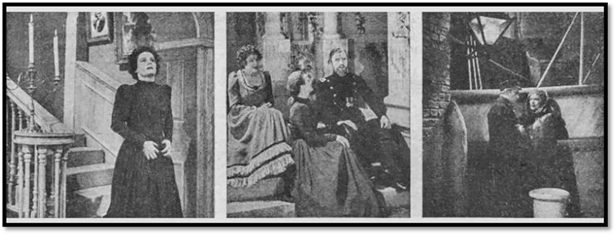
Originally broadcast on BBC Television on Sunday 30 March 1947 (with part 2 on Thursday 10 April), it was the first substantial success of post-war television drama. Being broadcast live, with no telerecording made, the play was remounted again in 1948 and in 1952. …. (https://televisionheaven.co.uk/reviews/mourning-becomes-electra)
On the modern stage, productions will sometimes tend to the heavily expressionist and symbolic handling of these problems, using lighting to recreate underlying natural emotion – there is an awful lot of intense sexual jealousy in this play, as here:
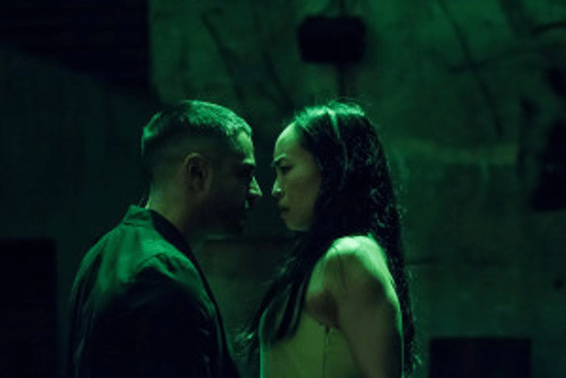
Eunice Wong as Lavinia (Vinnie) with unidentified male actor (is it Peter or Orin?) in the production by Target Margin Theatre, from Jessica Foley (2017) ‘[NYC] MOURNING BECOMES ELECTRA (Target Margin Theater): Getting closer to O’Neill’ in phindie – independent coverage of Philadelphia theater and arts (online) [ May 10, 2017] available https://phindie.com/15170-15170-nyc-mourning-becomes-electra-target-margin-theater/
The expressionist trend is in the Target Margin production above even more emphasised, as in this still of the mis en-scene in which interior and exterior of the Mannon house appear simultaneously, but not realistically as O’Neill directions try to attain, in which physical likeness is abandoned for the aura shed by multiple portraits that lower over the space. The scene is presumably that following the death of Ezra, murdered by Christine Mannon or Orin, pushed to suicide by Vinnie.
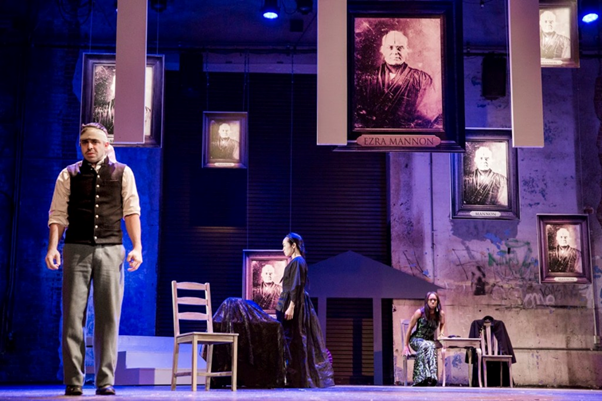
The mask characterises the Mannon house which is already a rather different thing is in the still above, appearing as dirty white fascia covered in graffiti, modelled down stage as a small tomb and its columns lifted tup but hanging over the upstage acting space. The house as a mask is also the house as a sacred public space, a temple or tomb, but also, if only by unspoken analogy, a Protestant whitewashed meeting house which succoured the religion of the Mannons.
Yet, being a mask that sacred (and mostly patriarchal) symbol (temple, tomb) is also a cover – supposed beauty, by classical standards covering grey ugliness. But how, we have to ask O’Neill, is the house meant to show, reliably, the emotions it needs to communicate about itself to the audience: those that type the family, in the stage directions: ‘The windows of the lower storey reflect the sun’s rays in a resentful glare’. Not only that, but a ‘resentful glare’ that is covered over by American Puritan tradition civility, as is the behaviour of the Mannons when it is not frankly dour.
One other interpretive use of the mask concept by modern dramatists can be considered by citing Edith Hall’s essay in the Simon Stone Oresteia theatre programme. Hall is discussing what different societies consider acceptable and unacceptable to represent in the theatre spaces each society favoured, showing that ancient societies, just like ours, could ban plays that were ‘exciting extreme responses or pushing discussion of painful topics or current affairs too close to the edge’. She continues to say that:
… tragedy that explores mythical or fictional conflicts can allow us to peer much deeper into the darkness of our psyches and society. The great poet and dramatist Tony Harrison, whose own version of the Oresteia made theatre history at the National Theatre in 1981, said that the form and frame of Greek tragedy functioned like a mask through which we could look directly at suffering so acute that it would be intolerable to contemplate in reality.
In the end, this may be unhelpful too. One thing is sure that most of these mask references already cited and discussed exist in the stage directions and are difficult to interpret on the whole, but seem to relate to the need to appear to be in control. Of course that relates to the need to not look the prey of natural emotion or to become so when these emotions are extreme responses to harm and hurt inflicted on us or likely to be so, that, for one reason or other, we want to look as if though we can handle. However, it can also be a means of deceiving by appearing not to feel, think or do what others think we should not feel, think or do. The fact that this is related to ‘whiteness’ throughout the play interest me, especially given that black or brown people as such do not appear in the play and when they do, are discussed offensively, as by Seth Beckwith, the Mannon’s Gardener, and leader of the ‘chorus’ (O’Neill’s word always invoking the theatrical convention of Ancient Greek Drama, though ranging between class types as it often did in Euripides’ tragedies and Arisdtophanes’ comedies) of the lower class types (‘poor whites’) in ‘Homecoming’, who says early in the play and repeats later:
SETH: That durned nigger cook is allus askin’ me to fetch wood for her! You think I was her slave! That’s what we get fur freein’ ‘em!
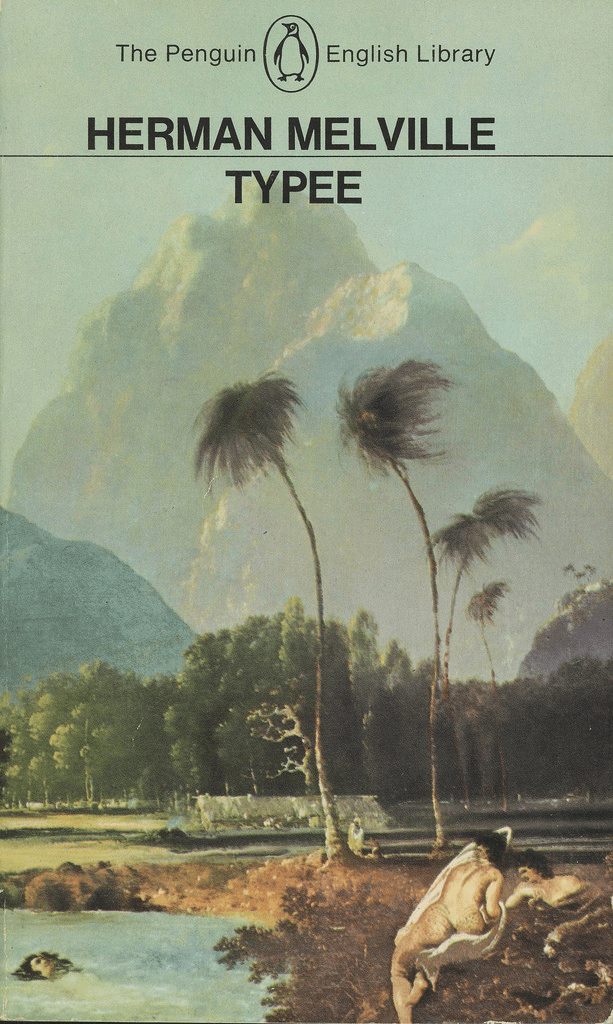
As a statement made in a play set at the end of the Civil War in which slavery was the supposed trigger is telling and the only other way in which races of colour is represented is as a model of bodily, sexual and ‘natural’ freedoms that characterise the unseen but often referenced Blessed Isles – which seems to reference some of the islands of the Caribbean but mainly those of Polynesia, even if only encountered in Herman Melville’s Typee.
The Wikipedia entry on Typee quotes, from Chapter 4, an essential insight (or bias if you are so inclined to call it) from it. The qualities of sexual (‘voluptuous’) freedom seems to be what attracts Orin Mannon, in a kind of non-binary fantasy manner and the hyper-masculine Captain Adam Brant (the handsome skipper of the Mannon built and owned The Flying Trades and illegitimate nephew to the Mannons we see – we do not see his father David) to these islands –the latter less innocently and ideally than Orin . Where Vinnie stands on the idea of the ‘voluptuous’ South Sea “Indian”’ will be another matter in the play, when she reveals finally she lusted after and obtained a naked man to have sex with on these islands near the play’s end. Melville says, as cited (I have not reread the book):
[The] voluptuous Indian, with every desire supplied, whom Providence has bountifully provided with all the sources of pure and natural enjoyment, and from whom are removed so many of the ills and pains of life—what has he to desire at the hands of Civilization? Will he be the happier? Let the once smiling and populous Hawaiian islands, with their now diseased, starving, and dying natives, answer the question. The missionaries may seek to disguise the matter as they will, but the facts are incontrovertible.
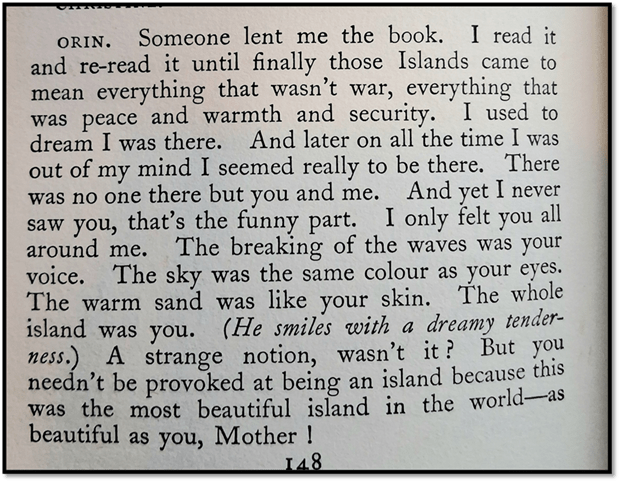
It is Orin who dreams of the Polynesian islands solely because he has read Melville, and he dreams about them not as containing the figure of his mother, but of her as so identified with everything in those islands that she is them (still then a containing mothering receptacle). Though that might be an importation of the Oedipus complex as often suggested is likely, but that is less important than the fact that any sexual reference is metamorphosed into safer meanings in which the maternal body represents ‘peace and warmth and security’. Nevertheless no-one has written of being so encompassed by a mother, and the chances that this is a Jungian image of primal attachment to the mother is also possible (for the sea is the containing symbol of amniotic liquid in the womb), indeed likely, for when Orin does visit the South Sea Islands with his sister, Vinnie, he is horrified even by the thought that she chose a naked voluptuous man from its inhabitants and had sex with him outside in Polynesian nature (which she confesses that she did without shame):[4]
In non-white races, as represented in the play, ‘freedom’ seems to be desired to exist so long as it doesn’t disturb the status quo of white entitlement and superiority nearer to home. The constant rendering of masks as facias and masks (‘clean-scrubbed, whitewashing’ like in the Methodist Chapel set up by the shipbuilding and trading Mannon entrepreneurs) hides a refusal to realise black or brown, or even other migrant race in the USA than the white ones, experience, even that of the mother of Captain Adam Brant, actually the mistress of Ezra Mannon and the reason for their likeness except in age, which draws Christine from the elder to the younger (and secretly still a family member with like mask)versions of Mannon white masculinity (though clearly Brant’s lineage from Ezra’s brother David, after his affair with the disgraced Marie Brantôme, may add French colonial, and therefore potentially mixed-race, spice).In fact the clue to the both the racially exclusive feel of the play and the Mannon’s is Christine’s characterisation of the house she lives in and its ‘mask’ as a ‘tomb’: “it appears like a sepulchre! The “whited” one of the Bible – pagan temple front stuck like a mask on Puritan grey ugliness!”. The reference is to Matthew 23:27f. which I quote here from the King James Version:
27 Woe unto you, scribes and Pharisees, hypocrites! for ye are like unto whited sepulchres, which indeed appear beautiful outward, but are within full of dead men’s bones, and of all uncleanness. 28 Even so ye also outwardly appear righteous unto men, but within ye are full of hypocrisy and iniquity.
A tomb officiated by Judaic religious officials is easily transferable to the idea of Bible Protestantism of the New England tradition, in which no-one is inside what they appear outside and thus must show emotion whilst still wearing a mask unless ‘(f)eeling herself free from observation for a moment she lets go, her mouth twitches, her eyes look desperately on all sides, as if she longed to fly from something’. This is as strong as it is unactable, as it tries to take the flight motif from The Oresteia, that mainly of Orestes from the Furies there, to a space inside a female character, forced by internal pressure, and supposed lack of an audience, outside. This is particularly the issue in the treatment of white female sexuality in the play, where every look has to be gazed to the gaze of others. This makes for a strong for the comparison of Christine, the hidden scarlet woman, to her daughter, the ‘Puritan maiden’, a maiden being a virgin: (although that look is not true of her either as his suppressed desire for the same man as her mother – her secret cousin – shows. As in Homecoming Act Two, Vinnie tries to absorb the fact of the family relation of Adam, told to her by Seth, by staring at the ‘moon’ like a woman after her demon-lover. Christine emerges behind her and O’Neill stresses another unactable moment:
The moonlight, falling full on them, accentuates strangely the resemblance betweentheir faces and at tne same time the hostile dissimilarity in body and dress. [5]
Those feelings translate into the hostile prose that maintains an elegance almost civil in tone of Cristine’s opening statement as she let’s Vinnie know she is being observed.
CHRISTINE: What are you moon-gazing at? Puritan maidens shouldn’t peer too inquisitively into spring! Isn’t beauty an abomination and love a vile thing. [5]
Two women are ostensibly in love with the same male, one latter associated with chantymen and as like with ‘something romantic’ in his look and being; the chantyman we see described as having ‘a queer troubadour-of-the-sea quality about him’. [6] They have enough similarity to be soubkes almost and both look like their husband and father respectively, whilst the romantic secret cousin says Vinnie has the same look as his own disgraced .other, thought of as wanton by Mannon Puritanism. The issue hete is that Puritanism and sexual romance, fully embodied in its nature, playback each other for the interior of the persons who ate doubles.
I have said this is unactable but lighting, especially of the intimate and expressionist kind used in black and white TV can do its best as in tje still below, from Ezra’s death at the hands of his wife to whom he points. The tesemblance at least works for morher and daughter, as does the suggestion of a fixed white mask. These women appear like bloodless vampiric pale ladies.
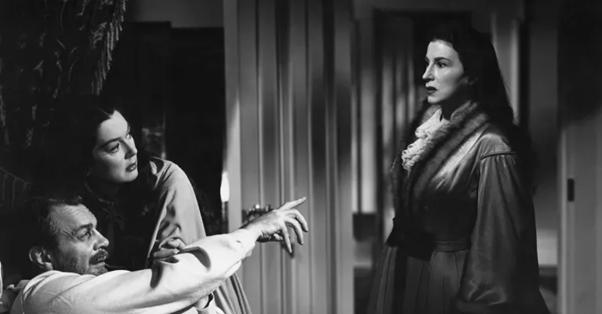
Still from Dudley Nichols’ Homecoming Act 4. Mannon gasps to his daughter Lavinia as he dies, pointing to wife Christine: ‘She’s guilty – not medicine’ Adaptation of’ Mourning Becomes Electra (1947)
The pale lady or femme fatale is very much associated with the wasted pallor of white femininity, as Mario Praz showed long ago, especially that associated with the relatively upper class ‘lady’ as the haute bourgeois Mannons are by the standards of the Civil War North. Captain Adam Brant is of mixed parentage if not ‘race’ in nineteenth-century terms, and is reputation is of a sailor who finds easy sex amongst South Sea Islanders (Vinnie refers to his ‘admiration for the naked women’, a reputation that even excites Christine Mannon). [7] Yet his feminine ideal is that of pure white lady ridden by bold men, the ‘white’ trading clippers of the Mannons. As he plays at flirtation with Vinnie, to .ask his actual sexual liaisons in distant hotels with Christine, he wonders if his talk of ‘pale ladies’ that are his absorbing passion has bored Lavinia. In response she mimics his romantic talk:
LAVINIA; (dryly). “Tall white clippers, ” you called them. You said that they were like beautiful pale women to you. You said you loved then more than you’d ever love a woman. Is that true, Captain? [7]
This is just one of the fanciful,strange or queer things that happen in a word where the word ‘queer’ is a regular occurrence. [8] Masks are associated with tombs and other instances of the ‘uncanny’. including ghosts, or the appearance, doppelgängers or doubles (in persons, scenes of familial romance situations) , situations where life-in-death and death-in-life supplant the usual binary of being alive or dead (as indeed often in The Oresteia original), fascination with decaying flesh and non-conventional sexual liasions between classes, incest in families – or its suggestion – and complex configurations of sexuality and family, as well as the fantasy-island sexuality of the South Seas in nineteenth-century South Seas mythologies owing much to Herman Melville. And with that comes suicide of course and murder, so often occurring in bedrooms. Sex/gender is often implicated in Orin whose war trauma involves confusions of killing Southern soldier rebel (or Reb as he calls them) as if they were one and the same man constantly returning, that man being himself: ‘Their faces kept coming back in dreams – and they change to Father’s face – or to mine” [9]. He returns to see the house as ‘ghostly and dead’, an effect of the ‘moonlight’ according to colleague Peter,(yearning to be affianced to Vinnie), and not just because to Orin his father has just died in it, apparently of heart failure. [10] Orin, like Orestes, renounces the day ‘in which normal people live’, for perpetual ‘night – darkness of death in life’, the ‘fitting habitat for guilt’. His suicide returns him to the arms of his mother, where he is bound up with Adam Brant whom he also killed. [11]
What I hope this suggests is how difficult this play is to direct, set, act in or even see. When incompetently done O’Neill is excruciating as I found in an Elysium Theatre Company production at the Gala Theatre Durham of A Long Day’s Journey into Night (at this link I blogged on the play in preparation) . I think this would be all the more so with this marathon and it explains the lengths Target Margin Theatre in 2017 went to to reset its spacing and style, as described by Jessica Foley. The play is reinvented in order to queer its feel directly. Foley says mentioning the director’s notes:
In the program, Herskovits notes: “Mourning Becomes Electra is a haunted play. It is haunted by the Mannons, the story of the United States at the end of the Civil War, and it is the story of the theater. Eugene O’Neill weaves together the influence of Greek tragedy, writing his own adaptation of Oresteia, but he also digests the American melodrama he grew up in (and his father James O’Neill performed in.) To open all these different textures of the writing, our process for this production has been unusual. Early on we carefully walked through the play and asked Where is the furniture ? When do people sit or walk or turn? Yes, O’Neill writes all of these things into the play. So we did it all. But you won’t see that play. All the language from Mourning appears sequential as written, but the primary version hovers over the actors like the ghost of a story we all shared years ago.” [12]
The queerness, as with A Long Day’s Journey Into Night, has much to do with the absorption of O’Neill’s family memories – of a damaged (and therefore difficult and demanding) mother constantly undermined by a patriarchal husband and father, who all get into the dynamics of Mourning Becomes Electra too. The Oresteia is rewritten – especially the end to which it drives, which ends with a woman being nailed up in a house that will act as coffin and tomb for her, her sexual life and the kind of WASP (White Anglo-Saxon Protestant) family that the Mannons were, and his Irish Catholic family were not quite. That is a family as Ezra describes in this piece already quoted above:
They went to a white meeting-house on Sabbaths and meditated on death. Life was a dying. Being born was starting to die. Death was being born, (Shaking his head with a dogged bewilderment) How in hell people ever got such notions! That white meeting-house. It stuck in my mind – clean-scrubbed and whitewashed – a temple of death!.
And what the play tries to show is the similarity of that to the inside space deep in the recesses of characters’ minds, and somewhat expressionistically recreated on stage in a queer over-the-top mass of impossibilities. And the ending of the knotted set of incestuous and other family romances is a space inside a house with no windows to see through from outside or inside. There is no political resolution, or psychopoliical one as in The Flies.
We are left with the remnants of uncompleted incestuous relationships ‘dead before they ever lived’. A good way of measuring this version of The Oresteia with that of The Flies, is that Sartre too created an incestuous relationship between brother and sister in his play, but it was not hidden into the darkness but offered as an option, that (had Electra accepted it) would have beef easily aligned with the values of existentialist choice. However, one reason this play is more like Zinnie Harris’s This Restless House (to come next) is that whatever remains of respect for the pain of the matricide is only feasible in an increasingly subjective terrain for flight, and aligned to delayed suicide (not quite as long as Vinnie’s living death inside her house and inside her head).
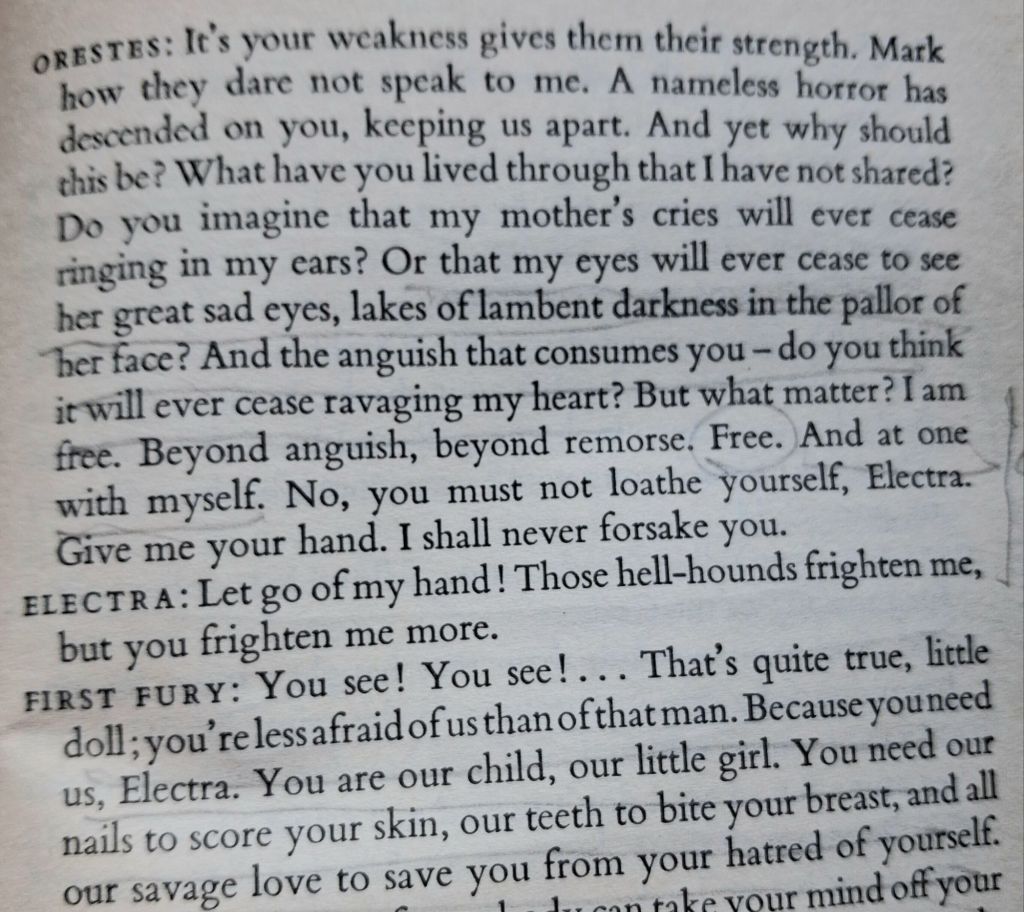
This shift comes as the psychopolitics of the family displaces the wider psychopolitics of the original play and Sartre. I will wonder about this in the next blog. [13] In Sartre, Orestes can ot convince Electra that her fear of free choice – to live with Orestes and face the music of social despisal – is created by the internal fear that gets externalised as pursuing Furies and their violence, the violence too against her own body (self-harm) that comes from self-hatred, and which the Furies relish. She is more in fear of freedom than bondage to feelings of self-directed sin and guilt.
The next Part of this trilogy of blogs preparatory to one on Simon Stone’s text when it appears, if ever, is on an Oresteia based on Personal is Political Feminism: This Restless House. See you then hopefully.
With love
Steven xxxxxxxxxxxxxxx
[1] Eugene O’Neill (1932: 93) Homecoming, Act 3 in Mourning Becomes Electra: A Trilogy London, Jonathan Cape.
[2] Justin Cash (2025 ‘The Role of Masks in Greek Theatre: 10 Critical Facts’ in The Drama Teacher (website)
(May 12, 2025) available at: https://thedramateacher.com/the-role-of-masks-in-greek-theatre/
[3] https://televisionheaven.co.uk/reviews/mourning-becomes-electra
[4] My photograph from The Hunted, Act 2, ibid: 148.
[5] Ibid: 78
[6] ibid:169
[7] ibid: 43 – 44
[8] For instances, see iobid: 21, 24, 42, 81, 92, 116, 143, 157, 169 & 220.
[9] ibid: 156
[10] ibid: 124
[11] ibid: 244 & 270 respectively
[12] Jessica Foley (2017) ‘[NYC] MOURNING BECOMES ELECTRA (Target Margin Theater): Getting closer to O’Neill’ in phindie – independent coverage of Philadelphia theater and arts (online) [ May 10, 2017] available https://phindie.com/15170-15170-nyc-mourning-becomes-electra-target-margin-theater/
[13 My photograph of Jean Paul Sartre Trans. Unnamed Hamish Hamilton Translator (1960:303) Altona and Other Plays, London, Penguin Books.


One thought on “Changing the ending? The issue is not with ‘books’, so to speak, but with stories, where changed endings are only one form of a work, which must exist through history as ‘translations, versions, or adaptations of works’ that involve ‘a conversation with an earlier writer’. Let’s choose, then, as so many have already done, a story where conversations with the original are ‘an encounter … across the span of two-and-a-half millennia’. Part Two of an examination of three versions of ‘The Oresteia’ before Simon Stone’s brilliant version: the Family Romancing of White Power in ‘The Oresteia’ of Eugene O’Neill, ‘Mourning Becomes Electra’.”