In Simon Stone’s The Oresteia, the character Alice says to her brother, Augie, of their family tragedy: ‘it has to stop’.[1] Does it stop? Does it even have to? This is a blog on reading, long after seeing Simon Stone after Aeschylus and Others (2026) The Oresteia London, Methuen Drama.
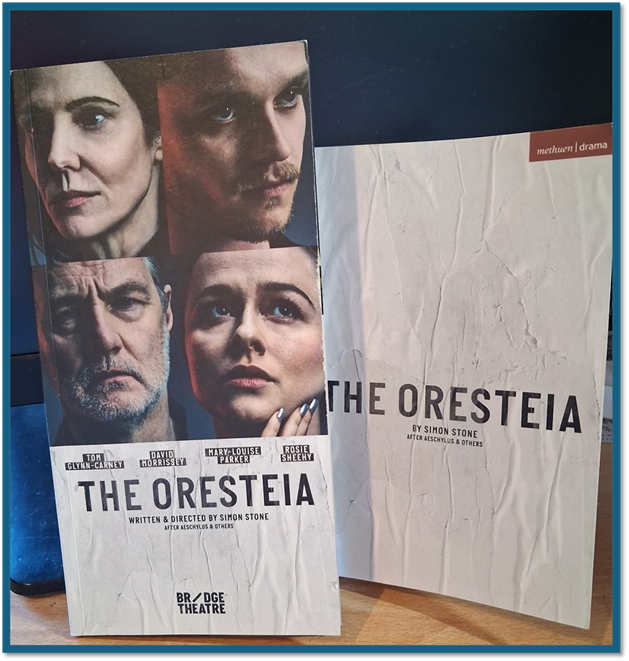
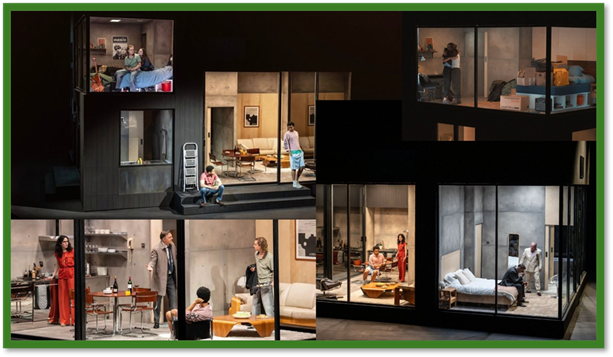
I saw Simon Stone’s The Oresteia at the Bridge theatre in London on the 8th July 2026 but had been waiting for it much longer. Admittedly I had been disappointed when the Bridge’s new adventure was not the version Stone was preparing of Chekhov’s Ivanov, as a vehicle in part for Chris Pine. The latter play was due (up to this week) to play next year instead but has already hit the rails again, I believe over a dispute with set-builders. In truth that is understandable given the ambition of the sets Stone commissions, not least in The Oresteia, where the stage holds a full-size modern new-built house which revolves to show scenes occurring in different rooms of the house as well as on the patio and drive (see the collage below and actually see the house revolve in the trailer at this link) and perhaps liminal places half obscured.
From the outset, as usual I tried to prepare myself for this experience of a trilogy of plays that fascinates me but that is difficult with a new Simon Stone adaptation for he holds back publication of any script until well into the run of the play – in part because rehearsal is, in his work, a kind of collaborative revision of the text, but also, since he admits it was in largely written before rehearsal, because he does not believe in audiences knowing his version before they see it performed theatrically. I did what I could in preparation (see the link to that blog here). I saw the play in on one of the hottest nights of our near tropical summer, and though I loved it, my blog will bear signs of the contingent weariness of those over-heated days (see it at this link).
Hungry to read the script, I knew, a long wait was ahead of me. One project I took on to try and keep the mind and heart alive was to overview other dramatic versions of The Oresteia, which brought the play into either contemporary themes qua Sartre and Zinnie Harris or settings as in Eugene O’Neills update to the nineteenth-century in the USA. Of course, I chose Jean-Paul Sartre’s political-philosophical revisioning in his play The Flies (see the blog at this link) to start, which like Aeschylus focuses on Orestes. But, after that, it seemed important to look at Eugene O’Neill’s Mourning Becomes Electra (in the blog at this link) which focuses on an Electra figure, before looking at Zinnie Harris’ ambitious This Restless House (the blog is at this link)
Then suddenly I find the play described as closing in London, and find the script already available. It took a while to come when ordered but by then I was engaged with the Booker prize. Yesterday I sat down finally to read Simon Stone, and cannot regret it – reading it has made the play live in resurrected version in my mind and body, perhaps in a far less sluggish mind than I took to that hot theatre in July and hence with all the play’s dynamic rhythm rising to a crescendo in the third part of the trilogy, rather poorly entitled ‘A Kentish Madness’, but the structure of the play, which allows feels like one play not three is more important than its titles and is difficult to describe – hence the musical term above. I will give it a go by using inappropriate markers from conventional theatre (Act and Scene divisions – for the play has none of those words to show its divides where they exist. It does use dates but I was as puzzled as I was seeing it, for in both experiences the Epilogue is set in 2015, though the events in it follow those from the opening of the play dubbed (even projected onto the set in the theatre) 2016. Was this some comment on the plasticity of events in time, for some brief episodes are said in stage directions to be played in ‘liminal space’,[2] or an error that avoided proof check. No doubt I could have missed a vital point, but reading the script of the play has not solved my confusion and I would prefer that the label time of the epilogue was changed, for in that Epilogue Isobel runs to her death before we see the reason she was sacrificed to the ‘terror of the father’ as was Iphigenia to Agamemnon outside the action of Aeschylus’s tragedy. Yet that poorly re-membered configuration of the play may relate to the theme of re-membering the dismembered, that I will deal with later.
Uncertain of how, or indeed whether, that fact matters, we need to remind ourselves that in Stone’s adaptation none of the characters is a direct translation from those in Aeschylus, and their storylines and representations differ greatly, especially Alice (twin-sister of Isobel) and perhaps who is as near as we get to Electra. Christopher Middleton is no Agamemnon, but rather a munitions company executive, whose power becomes in the play entirely a front for others, notably his brother Melville. Agamemnon’s long absence in foreign wars is displaced into the lack of control of his own time, as he sees it, because of his ‘responsibility’ of the firm (known as Middletech) to fuel foreign wars (in Syria and Afghanistan in particular given the play’s timeline and dictators like Putin (mentioned) and Hassad (not mentioned) with arms but according to his brother that authority has long been merely a matter of fronting decisions made by more significant players and agents who are unseen but answer first to Melville rather than Christopher. Once Christopher overtly falls from grace, his seat in the company is taken by another tokenistic male, Jerome.
Even as a father and husband, his authority is constantly questioned by his own obsessive behaviours as a gambler, drinker, and man of explanations economic with the actualité and characterised by blustering panic as a decision-maker. No one thinks twice either that as husband, ‘father’ of sorts and company director he is displaced by the hapless, if sexually rampant, Jerome whom is also chosen by his wife, thus gaining the family home and symbolic patriarchal role, perhaps the nearest to the character Aegisthus in Aeschylus, though Jerome matters most because he has a ‘cool’ son, Lorenzo – the issue of an earlier affair of Jerome’s in Italy – who becomes the rather ambivalent love interest of Augustus (‘Augie’), a facet of fate not dreamed of by Aeschylus. As in Aeschylus, neither Christopher nor Jerome measure up to the power imagined and delivered in the obsessive matriarchal neurosis in the sexually-driven Clytemnestra of the piece, Montie. It is his wife, Montgomery or Montie who points out that fathers rarely are as good as the hype of patriarchy and that the ‘;terror of the father’ is little more than an ideology but one that still drives family dynamics.
She accuses Chandra, the girlfriend who has mentored him out of suicidal intention after his sacking and split with Montie, of taking Christopher as a partner because he resembled Chandra’s father, the murderer of Chandra’s brother, but whom she forgives: ‘there’s a theme here, isn’t there, fathers and daughters, a love so big it kills you’. Whilst Montie claims she married Christopher as the opposite of her father, a ‘soft man’, she finds parallels in Chandra’s choice, despite Chandra’s denial, with choosing ‘the terror of the father: the attraction despite the horror’.[3] Yet that is surely mainly an attack on the thinking of Chandra, for later, we see her turn on Christopher for his failure to be the patriarch she wanted him to be, for fathers ‘create safety, they create certainty and stability’ which he never did for Isobel and which he cannot do now when he has lost everything but looks to be held up in the arms of a woman rather take responsibility: ‘fucking weeping and confessing and fucking healing and redeeming it’s ll a fucking performance to get someone anyone to hold you again’.[4]
If Chris is a bad father, Jerome is no better, either to his own son, Lorenzo, nor the children he takes on from Christopher with Montie. There is no ‘terror’ exuded here, in this man who plans the murder of Christopher for Montie by illegal medication and stumbles into murdering a marginalised housekeeper he hires, Jenny, too. That is, of course, the gist of Clytemnestra’s hatred of Agamemnon, that he put other priorities above protecting his family (or so she says) whilst choosing Aegisthus who is far from the model of a protector too. But at least Agamemnon’s reputation as a warrior is not tarnished.
But we will come back to some of this later. At the moment, I want to take on the way that Stone’s The Oresteia deals with fate and time. To start this I wanted in my reading to recapture the feel of how time passed in the theatre – to see how the pace and sequence of events in the stories in the play related to its themes, for there is a massive change in these features in the third part of the play. It falls into Parts in the script rather than conventional Acts, but each of Part 1 (‘Inauspicious Beginnings’) and 2 (‘The Reckoning’) have a relatively uncomplicated structure in time, with one scene following another though there is a change in time setting, forwards in Part 1, backwards in Part 2 (though all of Part 2 uses episodes from ates within the timeline of Part 1, thus:
| Part No. (with Scene Nos. within each Part). | Date set | Page number in text – to estimate durations) |
| Part 1 (Scene 1) | 2016 | 5 |
| Part 1 (Scene 1) | 2026 | 53 – 62 |
| INTERVAL | ||
| Part 1 (Scene 1) | 2023 | 63 |
| Part 1 (Scene 1) | 2019 | 74 – 110 |
| INTERVAL | ||
There is much missed explanation of events that occur in the interim between 2016 (the date of the twin girls (Alice and Isobel) 21st birthday ) and the present, 2026 (on the day a detective, Lester, supposedly arrives to interview Augie on his and Alice’s invitation, although the truth of that visit as an event happening in the objective world is later questioned)). Part 2 will fill in some of this starting the time after Montie’s remarriage (to Jerome) and just after the night of the murder of Jerome by Augie, with hers perhaps to follow in 2023, then returning to 2019, the day Christopher and new intended Chandra visit Montie and Jerome for dinner, and perhaps reconciliation.
Part 3 is much more difficult to chart. It is not even clear the Part falls into scenes, but in analysis I will call them that, marked only by a date – a date that would feature on the set at each transition. The pace makes the backwards and forwards movement in time, sometimes perhaps claiming less to be a historical record that the enactment of a character’s narrative, such as when Augie tells his version of the death of his father, Christopher, or a memory held by one person. For many, but Augie in his ‘madness’ in particular, memory has little reliability as a record. Scenes involving Lester and Augie are brief and the characters: ‘Lester and Augie are in a liminal space for these commentaries may move through the memories or observe from the periphery’.[5] Here is my attempt to dismember Part 3’s events by the dates indicated. Those liminal ‘scenes’ are in bolded italics:
| Part 3 (with Scene Nos. within each Part). | Date set | Page number in text – to estimate durations) |
| Scene 1 | 2026 | 111 |
| Scene 2 | 2019 | 111 |
| Scene 3 | 2026 | 114 |
| Scene 4 | 2021 | 114 |
| Scene 5 | 2026 | 119 |
| Scene 6 | 2021 (cont.) | 120 |
| Scene 7 | 2026 | 120 |
| Scene 8 | 2021 | 121 |
| Scene 9 | 2026 | 124 |
| Scene 10 | 2023 | 125 |
| Scene 11 | July 2023 | 141 |
| Scene 12 | Aug 2023 | 153 |
| Scene 13 | 2019 | 155 |
| Scene 14 | 2019 Later that night (Christopher murder) | 155 |
| Scene 15 | 2026 | 159 |
| Scene 16 | 2023 | 162 |
| Scene 17 | 2026 | 163 |
| Epilogue | 2015 | 171 – 175 |
The time changes are dizzying and may well be unreliable as noted but the pace is incredible, making the fragmented feel of time part of the confused hurtle across the spaces in time and between interior and exterior worlds, held together only by the House that forms the scenes, although some scenes in its rooms are in Part 3 allowed to become other spaces, such as the cell or room in the mental hospital in which Augie is incarcerated and visited by not only Lorenzo but ghosts, perhaps of those he killed and/or hurt. The uncertainties take another liberty with the representation in Aeschylus’ Eumenides with Orestes flight from the Furies out to avenge Clytemnestra’s death – for Augie’s furies are internal where they are not those of external wars that bring both him and his father down in Stone’s version. That ‘the time is out of joint’ is certain in Part 3, and hence my puzzle mentioned earlier about the dating of the Epilogue.
We need to turn to how Augie himself prefaces Part 3 that will in large be his story, with the man of myth who might be Lester, the detective Augie injured in his ‘fury’, DS cartwright, now running a community centre in Cornwall, who first met him but who retired before he could be in all the liminal spaces hallucinating Augie puts him in Part 3, as Lorenzo reminds him: ‘you’re not at home, Augie’.[6] The preface I talk about is at the end of Part 1, the scene in which Augie and Alice, if she is really there, are visited by ‘Lester’ (whatever he is). Augie promises to tell Lester ‘this story, Lester, what should we call it? The Fall of the House of Middleton?’, most of which is not unfolded till Part 3. Here is how he meta-describes the story – as a story about how stories are perceived, understood or otherwise, and recalled, asking Lester: ‘ what’s the antonym for dismember’, for so many bodies are in some way disassembled in this story or in the history around it especially in Syria and Afghanistan (‘the hacking and sawing and snipping and tugging and flaying’). Lester is out of his comfort zone with antonyms:[7]
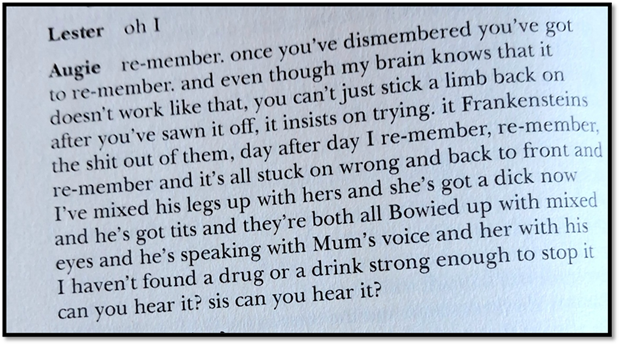
Putting back together severed parts of the killed is enough to Frankenstein anyone, by which the ‘remembered’ thing becomes a metaphor for the fear held in traumatic memory, which fear dismembers the memory again. And thus Part 3 is prepared for, where voices and perceptions, and sex/gender get mixed up, as if the family itself could be a monster, especially one supported by the collusion with war, as, after all Middletech truly is, if no more than was the great king Agamemnon, for whom Troy represented booty and trade opportunities for Mycenae as well as honour, just as Middle tech does for not only Christopher but Montie, married twice into an arms company supplying repression of its own population in Syria and Western colonialism more openly in Afghanistan.
I would say that the war theme supplants the Furies in Aeschylus trilogy in Stone’s play, though issues of war are real enough in the latter already. Isobel dies because of a war as does Aescylus’ idea of Iphigenia whom Isobel nearly represents. Her dispute with her father opens with her ‘tweeting about fucking Syria’, about of course the links of Middletech with supplying the arms Putin used to attack Syrian resistance to its own fascist government. Christopher thinks he has chosen the side of the angels when he sells his shares in Middletech but, as Jerome shows, that also meant he avoided the effect of the company’s collapse when Putin’s war cause arms sales to him to be sanctioned. Chandra, whom Montie sarcastically calls ‘the professional peacekeeper in our midst’ allows herself to believe in Christopher’s road to Damascus conversion thinking him touched by her case against arm sales relating to ‘children orphaned in the Syrian war’.[8]
Augie, of course, has been brought up in a culture of patriarchal war-mongering, the role I suppose of the Medieval knight in his final scene in his asylum cell who says ‘war is the only god of this nation’; a more significant ghost to stand in for the deficiencies of real Dad Christopher who sits on fences getting drunk on first-rate champagne (‘Dom’ not ‘Bolly’) unless his self-interest is threatened. Montie identifies that tradition much earlier as responsible for Augie going to fight in Afghanistan, though he was as much escaping her sexual empire building, for glorying in war (as ‘Just Wars’ engaged in by the ‘Mighty Moral West’ but also being silent about the evils of Hiroshima, Dresden, not so just, not so righteous’.[9] These wars Isobel speaks so eloquently about in The Epilogue to her father before he shuts her up: ‘you can call it realpolitik all you like but I call it rampant capitalism, unconscionable money-grubbing fucking’.[10]
That vengeful wars conducted by the richest of the world in their own interest are ‘Furies’ enough for any grand epic set of plays, does not mean that other people take on their mantle, even in protest against war, such as the Peace Alliance, who revenge themselves on capital by blocking the roads it uses, so important to Isobel, whom Christopher at his very worst, truly condemning his own daughter in the process, calls ‘a bunch of fucking. Shoreditch dwelling, wannabe Gandhis’. [11] However, their vengeance is not, however represented a means of fighting on but asking with regard to exchanges of violence for a full stop.
And this theme is played on in the substance of the murders in Stone’s play, the model of his adaptation demanded – murders within a family already locked into the governance of killing abroad. The only ‘fury’ as such (they are Clytemnestra’ ministers in Aeschylus) is Montgomery, notably in this dialogue with Jerome, as they take a progress check on their murder plan – Montie wanting to extend it to Chandra as Clytemnestra did to Cassandra in Agamemnon. Montie even takes on the character of Regan in King Lear being avenged on Gloucester, as well as Aescylus’s winged Furies.
MONTIE I want to be a bad person
JEROME no you don’t
MONTIE I do. The avenging angel of vengeance doesn’t give a fuck about good, all she wants is disembowel fucking decapitate
JEROME you are not the
MONTIE yes I am, look at me. I have wings, wings of rage. And look at these claws motherfucker I’ll pluck out his eyes
This I think gets us near to the heart of this adaptation which is about the nature of the ‘closure’ that human beings claim to want and sometimes pursue – for Montie it is almost impossible to stop the process of vengeance – which moves from Christopher alone to he and Chandra (though Jerome gets her spared for she witnesses nothing) and to Jenny the housekeeper, who sees far too much. And this capacity of being unable to stop is the force that drives war and munitions building, as well as some forms of the ‘terror of the father’ who must keep spreading himself abroad. It is this characteristic Augie inherits, more from mother than father, such that when the sister he loves insists that: ‘it has to stop’, nothing stops not even the headlong hurtle of the play into total destruction, starting with Augie stabbing Alice with the same Stanley knife that killed his father, even though when this happens it is Augie asking for time to wait and to stop:
AUGIE GET OUT OF MY
ALICE it has to fucking stop
…
Alice has grabbed him and the knife has ended up in her gut.
Oh shit
AUGIE no wait
ALICE oh shit I think that’s deep
AUGIE no wait no wait no wait no wait NO STOP STOP. [12]
And then Augie does wait and stop, the result being that very act leads to more ongoing destruction as Lorenzo later explains: ‘twenty-three minutes it took for her heart to stop’, as he reminds Augie he merely covered up her dying body and lied about where she was to Lester. Yet at the very moment Lorenzo is stuck in what cannot be stopped: ‘I’ve got to stop coming here’.[13]
Stopping isn’t closure, so what is. What Lorenzo tries after he stops stopping is to ‘forgive’ Augie, for forgiveness is a kind of closure too, but it horrifies Augie, since one-sided forgiveness cannot bring closure to his need for Alice and his need for Lorenzo for the three of them are in a tight romantic threesome of a kind. Lorenzo from the beginning, though he toys with Alice and despairs by choosing the horrible Letitia to attempt to marry, has from the get-go been interested in Augustus really. Pointedly telling him that he imagines ‘people naked’, to which Augie asks the unanswered question: ‘you weren’t imagining me naked though?’[14], asking Montie a little later ‘you think he’s into girls?’, with whatever expectation, though Montie fortunately misunderstands the question.[15] At other times he insists that Augie ‘looks good’ and ‘look rugged it suits you’, and invites him to a ‘restaurant dinner’ where he pays.[16] The key scene is that in which they sit in the bath in which his father is also murdered at another time and kiss, only to be discovered by Letitia, a kiss that gets retailed in story to Alice, and of which Augie reminds Lorenzo of a time ‘when we first kissed’, which may precede that last kiss being dated by Augie as 2015.[17] That Augie was also jealous of Lorenzo and Alice is also suggested (‘the two of you all conspiratorial looks and knowing fucking’).[18]
How do you stop cycles of behaviour and response like that one and the things it might mount to – murder in the final analysis. The theme of the nature of forgiveness (of the other and the self) is taken up in another aspect of the play and it is the one that justifies the role of Chandra. Invested heavily in humiliating Christopher and showing him his own responsibility – for death in the Middle East wars and in a related way for Isobel, she asks him to look into a moral ‘mirror’, which brings in Chandra into the discussion of what Christopher thinks is his process of self-forgiveness:
CHANDRA it’s a process obviously, and you can’t rush
MONTIE what? Recovery healing? Redemption? Forgiveness? Closure that’s a good one
CHANDRA I think closure is a myth
MONTIE I disagree I see closure within reach
…
CHANDRA I’ve been a part of a couple of Truth and Reconciliation commissions and my experience
MONTIE god I mean it’s like he found his own personal sin-eater[19]
Even the sarcastically inserted myth of the sin-eater plays on the closure theme, and its relation to mythologies of interpersonal and social processes related to war, conflict. And personal or collusive guilt, that touch on Christian models as well as folklore ones. Montie is intent on uncovering that her ‘closure’ will come only with revenge, but (as we have seen): and perhaps not even then. Hence she must tear up the myths that Chandra really believes in in which she includes human models of redemption which are only ways, she insists, of finding a way to tell the mawkish story of your life to make yourself look good, or at least better than you are in your own estimation alone. In her view women forgive men for their direct or indirect violence because it keeps the world unchanged that way, and justifies the deaths for which they were forgiven. She will not accept that kind of closure – strangely she speaks as if it is not manly enough for her, as her first exclamation to Chandra suggests:
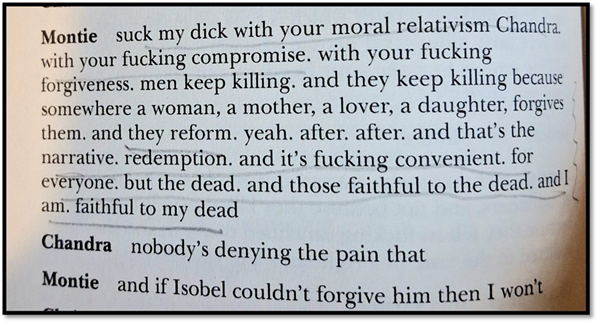
The endings imagined that are posed as means of ending a problem are suicide or murder (finding closure Montie thinks would be her murder of Christopher but she is wrong). These are versions of solutions that depend on where you see the problem residing most. Montie chides Christopher for not having the foresight to commit suicide.[20] When she kills him she asserts to Chris when he calls for support: ‘no, Chris, this is the end’.[21] Given that Montie stages her part for Christopher to collect evidence that he died by his own hand, the idea of whether it was a suicide or murder inevitably gets raised by the survivors.[22] That debate shifts when Montie herself becomes the problem to be solved. But though recovery, redemption and forgiveness are mooted as means of closure, none of them are really applied without much irony. The only one that works – is that which propels the audience from its seats very soon; the Knight’s view that, if ‘the earth here can’t sleep, it’s screaming with the voices of the slaughtered’, then all anyone can do is ‘get out while you still can’.[23]
I will end here because I must. You may not be able to see The Oresteia now, but you can read it. One great feature of the writing as theatre is how continuous interruption in dialogue are used. It is an art I quite like to read the products thereof and the stuff of truly modern theatre.
Bye for now
With love
Steven xxxxxxxxxxxxx
[1] Simon Stone after Aeschylus and Others (2026: 163) The Oresteia London, Methuen Drama.
[2] Ibid: 111
[3] Ibid: 96
[4] Ibid: 157f.
[5] Ibid: 111
[6] Ibid: 161
[7] Ibid: 60 & 59 respectively. Followed by my photograph from detail on ibid: 60.
[8] Ibid: 20,86, 84 & 92f. respectively
[9] Ibid: 104
[10] Ibid: 173
[11] Ibid: 26
[12] ibid: 163
[13] Ibid: 166
[14] Ibid: 23f.
[15] Ibid: 31
[16] Ibid: 131 & 137 respectively.
[17] Ibid: 148f., 150 & 164 respectively
[18] Ibid: 162
[19] Ibid: 88
[20] My photograph is a detail of ibid: 106. Her chiding on ibid: 107.
[21] Ibid: 157
[22] Ibid: 114, 119f., 123,
[23] Ibid: 168

