


This blog contains all I have to say of the experience of David Hare’s ‘Grace Pervades’ playing at the Haymarket Theatre (seen by me on 9th July at 14.30) and all I have to say about the experience of Simon Stone’s ‘The Oresteia’ playing at the Bridge Theatre (seen by me on 8th July at 19.00) at the moment at least with regard to the last named: for about the latter there will be more. The excuse it addresses is this one: “that since theatre is the basis of theatrical art, no drama in it could ever be anything more nor less than ‘theatrical'”.

I don’t think that anyone in actual fact has ever said in these very words the ‘excuse’ I address in today’s blog; namely, “that since theatre is the basis of theatrical art, no drama in it could ever be anything more nor less than ‘theatrical'”. But it has a feel to it of the often said and even more often unsaid be cause thought to be obvious and entirely logical, with a presumption being that the trait of theatricality is merely a neutral description of things as they are done in theatres.
However, theatre history would not allow you to see what has passed as a theatre, and how things are done in that passing thing as representing the same ‘thing’ at all times. This was the presupposirion of Peter Brooke (mentioned in Grace Pervades in recognition of the very true interest of that great director in Edward Gordon Craig, the son of Ellen Terry’s first marriage and one of the foci of David Hare’s play. But Peter Brooke is also an avowed influence of Simon Stone, the author-director of the modernised version of The Oresteia, dealt with here.
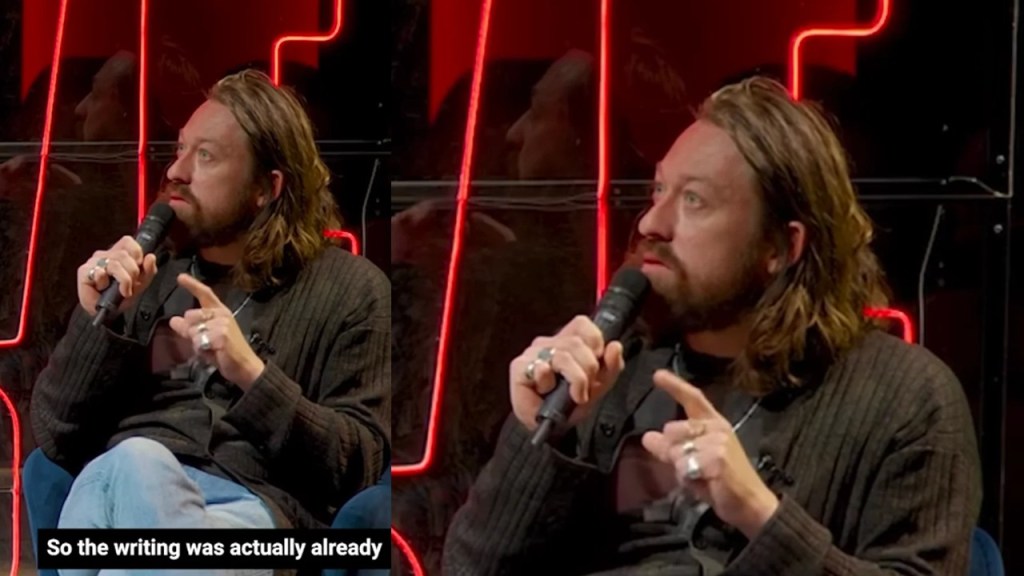
Simon Stone, here being interviewed about the making of the playscript of The Oresteia
Brooke’s thesis is contained, or so Stone says in a Ted Talk of his referenced in my preparatory blog on visiting the play (see it this link) is contained in the first sentences of his book, The Empty Space. [1] I will quote the whole paragraph again here with the sentences that Stone uses bolded again:
I CAN take any empty space and call it a bare stage. A man walks across this empty space whilst someone else is watching him, and this is all that is needed for an act of theatre to be engaged. Yet when we talk about theatre this is not quite what we mean. Red curtains, spotlights, blank verse, laughter, darkness, these are all confusedly superimposed in a messy image covered by one all-purpose word. We talk of the cinema killing the theatre, and in that phrase we refer to the theatre as it was when the cinema was born, a theatre of box office, foyer, tip-up seats, footlights, scene changes, intervals, music, as though the theatre was by very definition these and little more.
You might not have felt that paragraph active in a positive way at the Haymarket watching Grace Pervades. The Haymarket is par excellence, and more the thing described by Brooke when he describes the misconception of what theatre was in his own day. And Grace Pervades is a play about the formation of such theatres in Henry Irving’s projection into theatrical history of his actor-managed company at The Lyceum in London. Hare’s play breathes and lives the world of theatre and attempts to change its meaning – in Craig’s confused work on Hamlet with Stanislavski, his sets for which are somewhat satirically reproduced in tthe second Act of the play by Hare. Edith Craig in the play is also forging a kind of socially conscious theatre replete with socialist and feminist content.
However, the bulk of the plot breathes grand architecture and properties of ‘theatre’ not empty spaces at all. One scene reproduces an Irving curtain call in which the back wall of the set stage is the auditorium of the completed Shakespeare performance by Irving and company, such that we see that convention from the point of view of the actors whilst on stage receptive to the call and immediately afterwards when the curtain falls. It is therefore, in this scene and others, as if the Edwardian theatre were a character in its own right., enacting itself, sometimes almost parodying itself.
This is a bold move for an actor at the top of his profession and professional advancement as Ralph Fiennes very definitely is. Sitting in what is made to be his dressing-cum-sitting room, the actor plays the spent actor aged by the hard work involved in forever being ‘theatrical’ for a living.
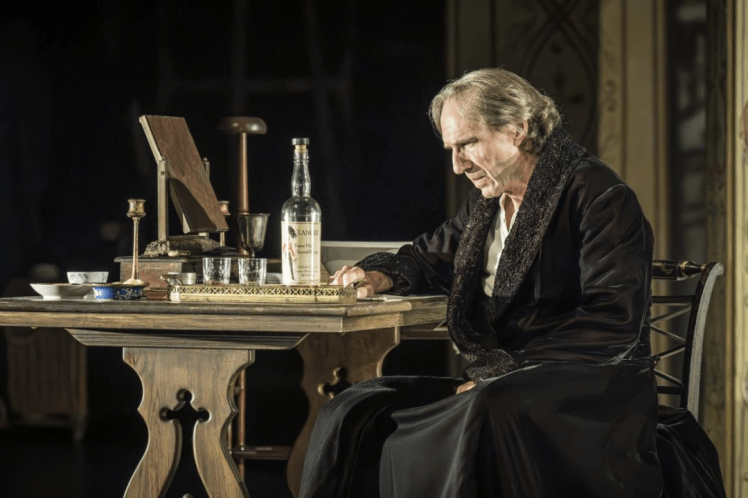
Even the ‘excuse’ I pretend to be writing about in this blog, becomes part of the script and its meanings wete performed in the Haymarket in more than one way. One quoted in my preparatory blog on the play, based in reading the published playscript (at this link). In it, Irving worries about his manner on stage is interpreted by Terry, whom he thinks of as ‘natural’ actor, forever delivering her lines with a difference at each performance. Irving, in contrast, was associate with the pre-Stanislavskian grand manner. That is why he starts off his conversation with her with this cautious approach:
Irving You may think me overly theatrical –
Ellen Not at all –
Irving I’ve been accused of it –
Ellen Not in the slightest. And by the way I’ve never understood why ‘theatrical’ should be a term of abuse –
Irving Nor me –
Ellen Nobody says of music that it’s too musical, why then do they say of theatre that it’s too theatrical?
Irving I really don’t know. Though you yourself have a naturalness I envy – [2]
The two actors are, of course, being faux naive in a way that the originals would have been unlikely to be at the time, since both ‘theatrical and ‘musical’ had become code words for queer males even by their time, with the example of Oscar Wilde as a dramatist, and Charles Ricketts as a scene and costume designer, leading the way in developing camp sensibility:
However, what struck me hearing those lines on stage is how very little different the experience was of reading them as a reader accustomed to reading plays and accustomed to seeing them realised in theatres. Though some of those lines are written in a manner that could have indicated interruption of the other speaker’s flow of speech, ending as they do in a dash, on each occasion the actors interpreted the dash as a pause or hesitancy,or even a prompt for the other person in the dialogue to resolves one’s hesitancy as one tries to say the right thing, and not offend tbe other.
The conventions of polite discourse are perhaps those of the stage. The perhaps we’re so when Harold Pinter so thoroughly embedded the pause into theatrical dialogue, tbough clearly learning from Samuel Beckett. But, it took longer for theatre and actors, and perhaps audiences who oft tend to judge a piece by its capacity to match a convention or even a prescribed rule, as the supposed ‘classical unities’ were in seventeenth century theatre; that, at least serving high culture, such as court theatre in France, to accept tbe end ofother conventions,such as that dialogue on stage should not involve more than one speaker at a time, except in crowd hubbub.
Yet, this is how speech can be detected as ‘theatrical’ (by one standard, at least) for real people in ordinary (non-theatrical, even if no less performative) times and spaces oft talk over each other and not just to silence and subordinate the speech of another, as all men are claimed to do with all women, and especially as conventions of the practice of social politeness or the non-statutory rules of etiquette in conversation are lost. And it is precisely the breaking of those rules of over-talking other actors (sometimes by more-than-one actor with more-than-one other actors). This created moments of incomprehension even greater than those possibly intended in the script in the preview week performance I saw, for – in acting the piece often within enclosed space – allo the actors had to wear head microphones that lead to some interference between the microphones projection in some (if few) scenes where what was articulated even by one actor came with an echo of itself – possibly through an adjacent microphone. After all, when I saw the performance that effect, given the stress on the queering of experience in this play (even in its original Greek story-line)but more so in this production), it could have been intentional, to show how people get estranged from what they say. However, I mentioned that to one of the front-of-house staff, who had heard it too, and, apparently, it was not intended: no doubt technicians will have by now eradicated it.
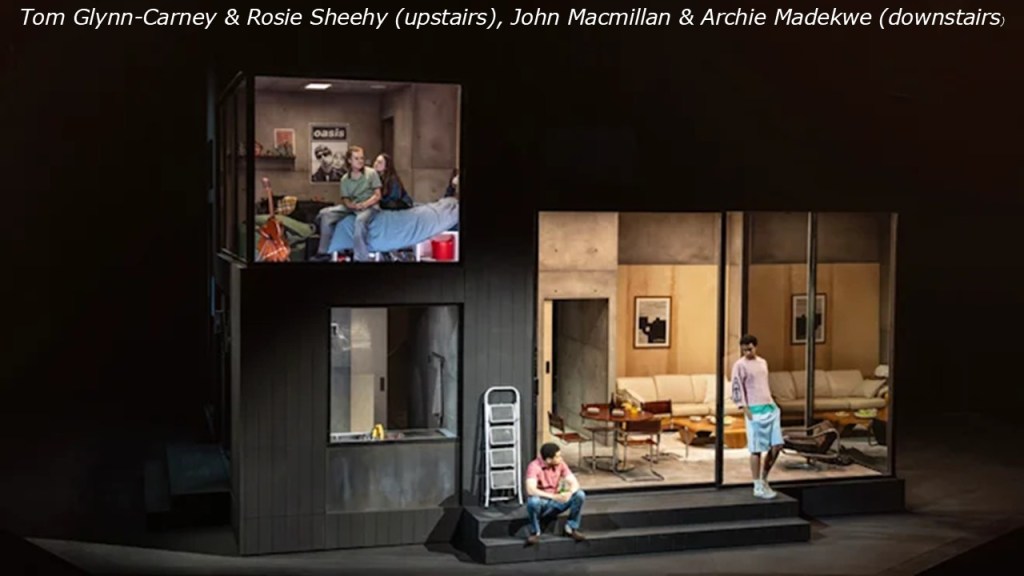
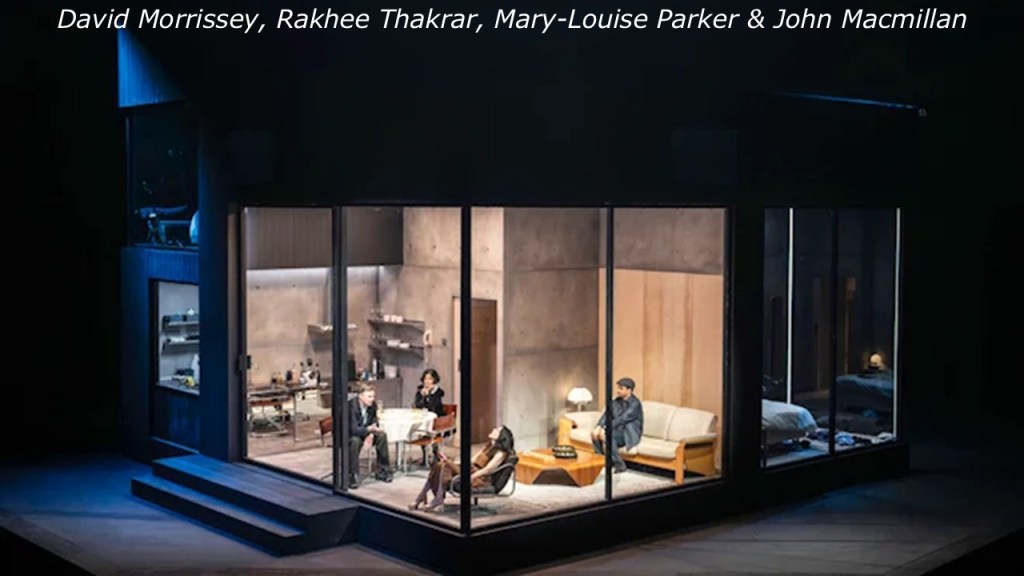
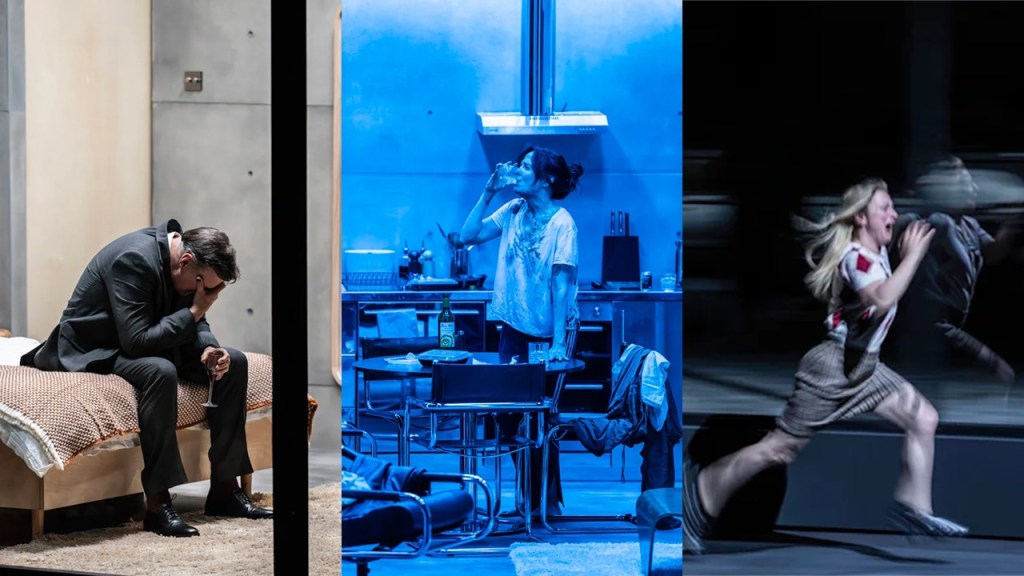
On the evening, even I found the first act disturbed my sense of what I should expect of a theatre performance – of its clarity of auditory reception (even without microphone projection errors) or of immediate comprehension. But after the first act (there are three – roughly (in as far as a changed story-line makes possible) covering the story of the three plays of the original (as far as classical scholars have rebuilt it) of The Oresteia itself) any issue was resolved. Perhaps one learns to accept that the solid theatrical convention of allowing each speaker to complete a line before the next starts theirs needed breaking by the hyper-realism of some of this play – played in the enclosed rooms of a house built on the stage that revolved, not that one knew that latter facr on entry to the auditorium. Below are three collaged photographs I took (checking first for permission for this outside of the start of performance rules that forbid it). They show one aspect of the house built on the proscenium, showing the visual access to the houses’ upstairs bedroom (that we would learn was used only by younger family members as living space, kitchen and living room. As you will see from the production photographs later in my blog – shared by the Bridge after the previews – acting occurred as actors traversed between rooms, often during the revolutions of the house on stage as they exited one room to another that we have not previously seen. The aspect showing the ‘back of the house had visual access to the house’ master bedroom and the all important bathroom – that room unseen in Aeschylus’s Agamemnon (the first play of The Oresteia, where that eponymous hero and his slave lover, the late Princess Cassandra of Troy, are murdered by Agamemnon’s wife, Clytemnestra, and her lover, ostensibly in revenge for the sacrifice of their daughter Iphigenia to gain fair winds for the Greek fleet to Troy and the war to be undertaken there. Side aspects or semi-aspects could also focus events, that soon the left of the frontage above contained a fuller view of the upstairs bedroom, the external front door of the house with entrance to the hall (seen only in occlusion through the door when it opened) and the bathroom – with a door to it from the hall. The aspect on the right haf full visual access to the living-room and master bedroom.
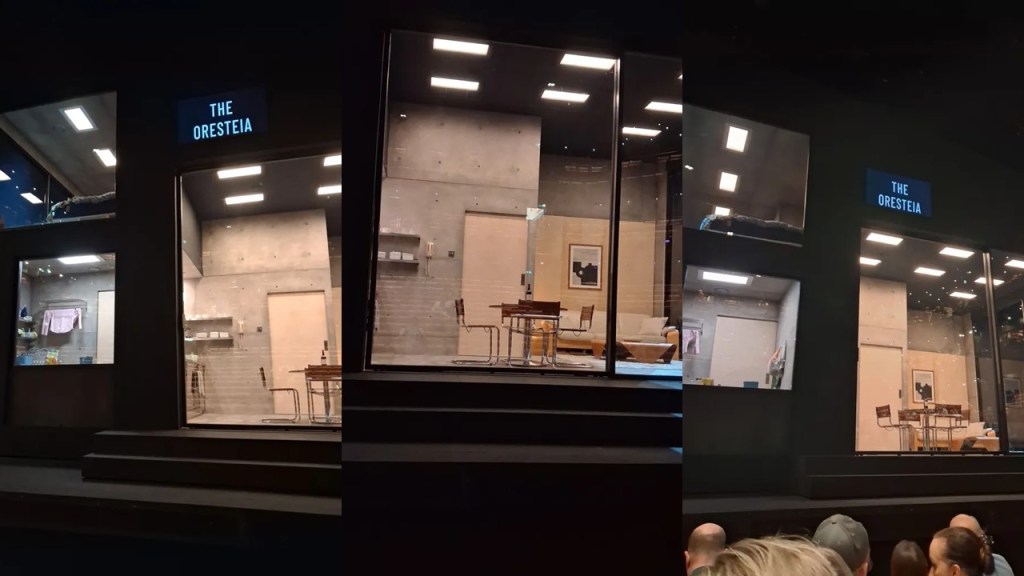
It is not however unusual for theatres with the resources – grand theatres in Victorian London were often built for spectacular displays of epic scenes – to have huge internal structures built upon the proscenium – not even revolving structures. Such a revolving house, and more was built on the stage for even so conventional a play as J. B. Priestley’s An inspector Calls recently – I saw some of it at the Sunderland Empire.

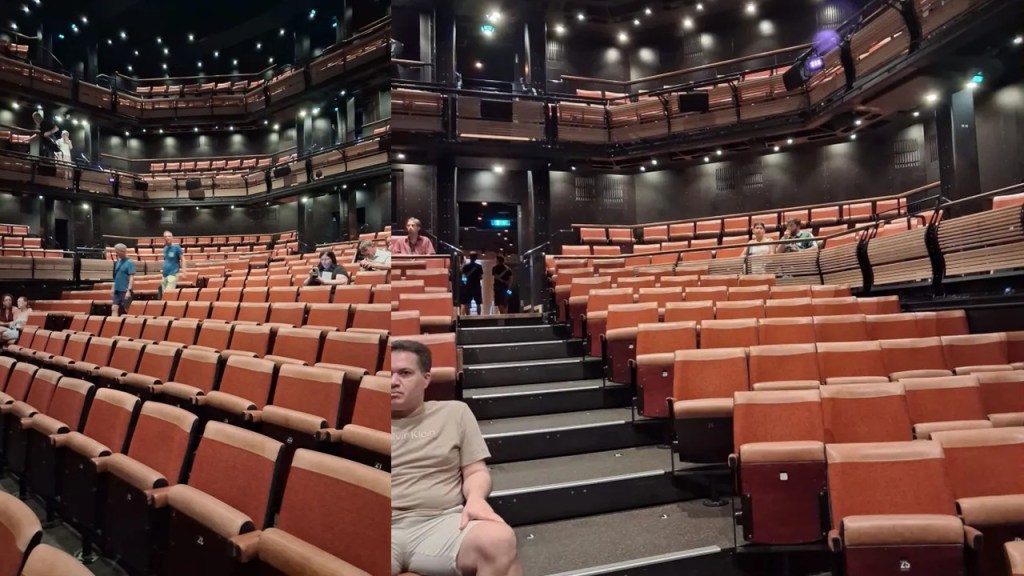
Often this kind of extravagance was another form of what we might mean by ‘theatrical’. Nor is The Bridge Theatre, though a fine theatre, built with all sight lines considered and with a semi circular auditorium not unlike Greek theatre (or the Olivier at the National Theatre. It too is still a theatre that could be described in the Peter Brooke quotation above – a long way from a mere ’empty space’.
What made it far from ‘theatrical’ in the sense we often intend is the acting with more of the hyper-realistic ‘conventions’ of film or television acting than those of the enclosed theatre. The murder of Christopher Middleton, the Chief Executive Officer of the family or ‘House’ firm Middletech, dealing with armaments and capable of creating incidentally far many more global deaths than ever occurred in the Trojan War or even what Edith Hall, Durham University’s Classics Professor extraordinaire, calls in the programme essay, his ‘public, political and macropolitical ambition’ (in analogy with Agamemnon’s settler colonial ambition as leader of the Argives at Mycenae) is related to his wife’s (Clytemnestra who has become Montie (Montgomery in full) in Stone’s version) grief and anger at the way her daughter was sacrificed (literally in the case of Iphigenia, symbolically driven to suicide in the case of Isabel). The murder in the literally ritual cleansing bath-space (still visible in the ruins of Mycenae) translates in this play to the stunning performance of Mary-Louise Parker (as Montie) dispatching Christopher (David Morrissey is exquisite, especially in this scene) as if she has fulfilled the task of murders made to look like suicide many times before.
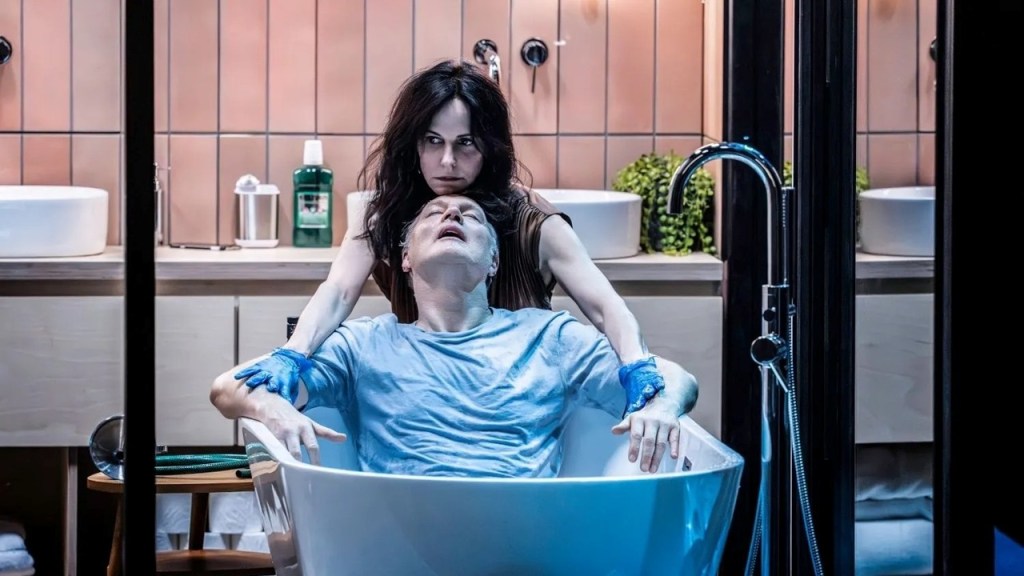
The House of Atreus fits perfectly in translation its equivalent of the ‘House’ firm of Middletech and its nub at the Middleton House where the family attempts to navigate internal dissension, ideological and otherwise – just as in the great aristocratic houses of Greek tragedy – always though houses from the early days of city-states (or polis) they considered foreign to their rational democracy which, amongst other things had addressed what was considered the dangerous structures of the entitled aristocratic family in the creation of structures in the sixth-century BC (well before the Classical age of Athenian democracy) that mediated them and the state, through the demes. The revolving house on stage is the revolution of the fate of that firm and its family membership that only the ancient tyrannies of other polis than that of Athens could supply in the ideologies promoted by the Greek dramatists (the polis of Athens indeed resolves the tribulations of the house of Atreus in Aeschylus’s trilogy, even rehousing the Furies and giving them an alternative name – the Kindly Ones).
All of that can be (apart from the hopeful resolution) can be shown by seeing the house in which the Middletons and their extended network – including Jerome, the equivalent of Aegisthus, the man who cuckolds Agamemnon before he helps to murder him whilst he is otherwise engages in war business). Below, in the upstairs bedroom the brilliant Tom Glynn Carney, playing Augustus / Augie – the equivalent of Orestes – talks with his remaining sister, Alice (played by Rose Sheehy with wonderful intensity and pretended control), the equivalent of Electra.Meanwhile downstairs Jerome (John Macmillan is perfect) tries to negotiate a tricky relationship with his son, Lorenzo (Archie Madekwe is finely boyish). In the play the shift of dialogue between rooms does not mean the engagement stops in the other space, it is mimed instead, often to brilliant contrastive or complementary effect depending on the themes / moods evoked.
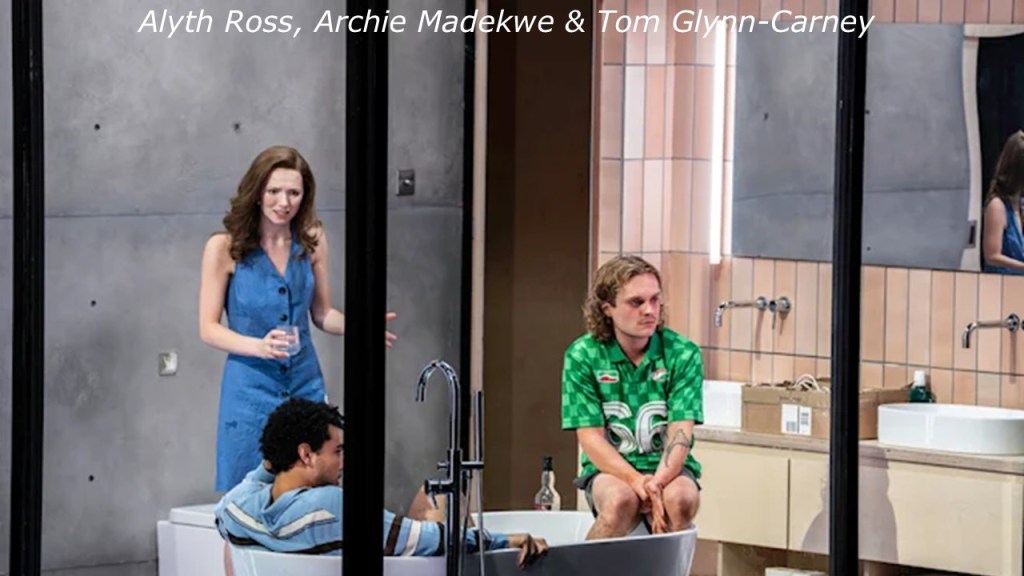
Jerome is a character added to the play, but his presence becomes all the more meaningful as his relationship with Augie veers from friendship, bromance to a kind of commitment, only to be shattered when Augie is committed. The tensions that lead to them kissing in the bath, a scene upon which Lorenzo’s girlfriend, Latitia (Alyth Ross who also plays another role with superb variation) enters to lead to the embarrassed separation we see below.
But my point here about the Stone play is that, being too proximate in time, rather spoiled Grace Pervades for me, however brilliantly acted (and it was, especially by Fiennes) and why because it was just ‘too theatrical’, even though oft it made it clear that that was what the play was about – the changing tone, timbre of the theatrical as drama moved in emptier spaces than the theatres of the Edwardians in England. This was Peter Brooke-ish indeed. For I still feel it is a mere ‘excuse’ to say that just because drama has happened in a few centuries of society in elaborate theatres that the ‘dramatic’ must also be the ‘theatrical’. Simon Stone proves otherwise.
Comedy like this runs throughout, and often peeks into the themes of tragedy. Edith Hall gives scholarly backing to this, saying, after detailing the kinds of humour and comedy Aeschylus employs:
Modern productions of ancient Greek tragedy which incorporate humour – however dark – into the emotional and psychological experience are thus entirely true to the spirit of tragic drama as it was experienced in antiquity.
Thus the tone of engagements between actors cross-over each in mood, topic and purpose as in this scene where Christopher’s downfall is being surveyed by his brother Melville (the fantastic Lloyd Hutchinson, who also plays police inspector Lester later), in the master bedroom, as a much more witty encounter occurs between Lorenzo and Montie, who clearly lusts after the tall handsome boy, though masking it (even from herself perhaps at this point) in substitutive motherhood.
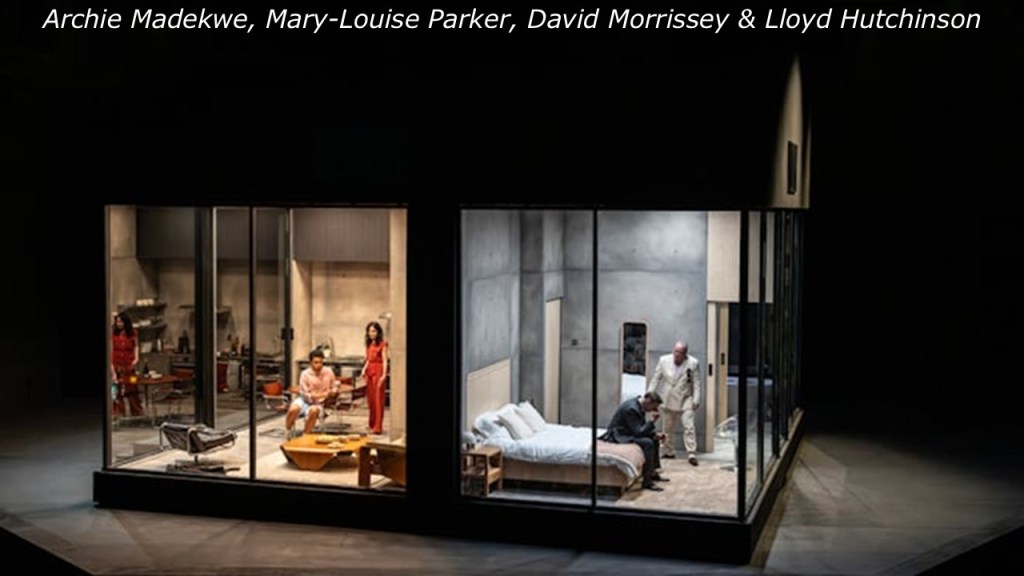
When event occur in the living room as in the scene below where the now divorced Christopher returns to the house occupied now by the married Montie and Jerome with his girlfriend (Chandra – clearly a deracinated Cassandra in every sense, though a therapeutic ‘wounded -healer’ rather than a prophetic Princess of Troy – Rakhee Thakrar is wonderful) they get full dramatic focus. But the exterior of the house matters too.
Witness below how isolated actors uses temporary stillness and its containment in a room compared to that moment when Alice, bereft of her sister, takes the chance to run from whatever knows what, something that Augie does locked up (literally in an asylum in the third Act, where the living room becomes his hospital room – for his Furies are the symptom of madness whose motivating genesis are those of a legion of factors in his role and character, as madnes (God help us) always will be.
This Oresteia is a triumph, but it hasn’t done with me yet. Instead , I await publication of the script and will read it and return (this may take time). Meanwhile I want to look at least two versions of modernised Oresteias. I had thought to look at T.S. Eliot but I cannot like The Family Reunion, however hard I try. That might change but Eugene O’Neill’s Mourning Becomes Electra is worth the candle and I have long wished to read Zinnie Harris’ This Restless House (which would be a good name for Stone’s version and the name of O’Neill’s ‘Electra’ is Vinnie – isn’t that spooky but for one letter). So I will return with that blog some time before I look again at Simon Stone, at lease for a close look.
Bye for now
With love
Steven xxxxxxxxxxxx
_________________
[1] YouTube (https://youtu.be/M6VFfGvAVZI?si=ZQNXu4msJgKwSnzy) entitled ‘What is theatre capable of?’.


One thought on “This blog contains all I have to say of the experience of David Hare’s ‘Grace Pervades’ playing at the Haymarket Theatre (seen by me on 9th July at 14.30) and all I have to say about the experience of Simon Stone’s ‘The Oresteia’ playing at the Bridge Theatre (seen by me on 8th July at 19.00) at the moment at least with regard to the last named: for about the latter there will be more. The excuse it addresses is this one: “that since theatre is the basis of theatrical art, no drama in it could ever be anything more nor less than ‘theatrical'”.”