


In Grace Pervades, the character named Henry Irving, based on the great actor-manager says to Ellen Terry, ‘I await eagerly to see what you will do next. It’s always different’. She replies ‘Then how can it always be perfect?’ The answer to that might be the answer to the question: ‘If you could instantly master any skill, what would it be?’ This blog is a preparation to see the play based on reading the script of Grace Pervades by David Hare.
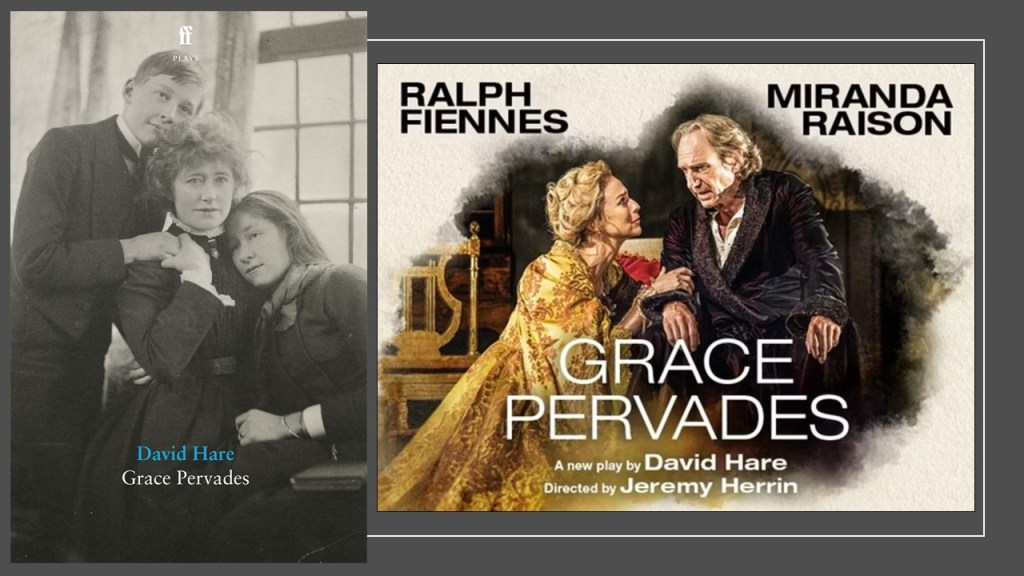
This piece refers to my overnight-er culture-fest visit to London in July (at this link).
In Act One Scene 3 of Grace Pervades, David Hare’s Ellen Terry character attempts to tease out of the Henry Irving character in the play why he, as actor-manager, gives so little direction on stage to her – or other women but particularly to her – as an actress (at the time she is playing Ophelia to his Hamlet). He gives a reason that, the more I rethink it and this strangely ‘baggy monster’ of a play (on first reading) of many themes and foci, puzzles and intrigues me as much as it does Ellen:
Irving hesitates, then is suddenly decisive.
Irving Ellen, listen: I do not speak to you because you are perfect.
Ellen Perfect?
Irving Yes.
Ellen That’s impossible.
Irving There is nothing to say.
Ellen But I vary my performance at each rehearsal.
Irving You do.
Ellen And so?
Irving I wait eagerly to see what you will do next. It’s always different.
Ellen Then how can it always be perfect?
Irving One of the mysteries of theatre, my dear.
Irving smiles. She stands, stunned. [1]
It is clear that this play by Hare, and any worthwhile performance of it, will be as interested in the art and act of its own playing as was Shakespeare when he penned Hamlet and made play-acting central to its plot and them. I have already indicated that Hare’s play is as interested in theatricality – a word resonant in the play with its meanings teased out comically – because the name of Henry Irving is inscribed in theatre history as the very definition of ‘theatrical’, whether intended as ‘abuse’ or praise – as below (from the same Act and Scene:
Irving You may think me overly theatrical –
Ellen Not at all –
Irving I’ve been accused of it –
Ellen Not in the slightest. And by the way I’ve never understood why ‘theatrical’ should be a term of abuse –
Irving Nor me –
Ellen Nobody says of music that it’s too musical, why then do they say of theatre that it’s too theatrical?
Irving I really don’t know. Though you yourself have a naturalness I envy – [2]
In my diary blog of yesterday (see it at this link) I described the play as an:
earnest attempt to make a summary of theatre (… ) that investigates theatre and theatricality in 2 aspects:
- The notion of individual performance and its relation to issues of spectacle, action to some end (often political or avowedly definitively not so), and nature (sometimes seen at odds with the notion of spectacle and pageant) and;
- The notion of theatre as a holistic art, torn between options –
- a theatre of grand gestures and appearances, in which acting is an art towards that end, and often patriarchal;
- a theatre of the natural turned into the mode of art, even of politics thus turned, and;
- a theatre that is entirely an aesthetic performance directed not in acting but in production values that cross the boundaries of other arts: dance, paintingand music.
I don’t intend to be bound by that description written quickly yesterday morning after just finishing the play, but it does set some structural parameters for interrogating this complex play about ‘play, performing, acting and its contextual settings in theatre history, social change and aesthetics, that needs to account for its range of characters – many more central than the plays, publicity would lead you to believe: Edward Gordon Craig (Teddy in the play), Edith Craig, and playing minor roles – Isadora Duncan, Konstantin Stanislavski, and others less known in the world of theatre and the stage performance now (such as Suler, in the secene I cite below). The reason these characters are chosen is clearly to emphasise the way in which Irving and Terry and their (in Irving’s case informally adoptive) child successors contributed to debates in theatre both mainstream and experimentally.

For instance the reason Edith is focused is because, she too is shown as having ambitions for the theatre, that like Teddy Craig’s, sprang from their mother, and perhaps their father (mentioned in the play) Edward William Godwin. That the Craig’s are seen as inheritors of some of the contradictory learning about the theatre by Hare might be clear from a scene (Act 2, Scene 18, where, on his trip to Moscow (arranged by Duncan) and directing his Hamlet, Teddy is really frustrating Stanislavski and Suler by his contradictory views (in the great director’s view) of acting and theatre, and his dictatorial management style:
Teddy No, no, this is terrible, this is not what I wanted. Why can nobody do what I want?
The actors stop, well used to this. Stage managers run on, and among the rush of activity is Konstantin Stanislavski, tall, dignified, at this point aged forty-nine, and Leopold Sulerzhitsky, forty, known as Suler, smaller, compact. They speak accented English.
Stanislavski Please tell us what is the problem?
Teddy Get rid of Suler. I can’t work with him.
Stanislavski Suler is helping you. He’s your assistant.
Teddy He’s out to destroy my production –
Suler I promise you, I’m doing no such thing –
Stanislavski Everyone’s doing their best.
Teddy He’s destroying it completely. Oh my God, this is why I never produce.
Suler is standing, uncomprehending. One or two of the actors struggle out from under the huge robe. They’ve seen it all before.
Suler It’s just as it was. Everything’s the same.
Teddy Exactly! Suler The actors are doing just what you wanted –
Teddy That’s what’s wrong!
Suler Yesterday you were happy.
Teddy I was happy yesterday. It was good yesterday. Today it is not. You don’t understand theatre. Theatre has to live. Gertrude’s not looking at Claudius.
Suler That’s what you asked for!
Teddy She’s looking out front!
Suler It was you who asked for that.
Teddy Yes, but it has to keep changing, or how does it breathe? You undermine me, you always keep it the same. That’s not theatre.
Teddy is shouting. [3]
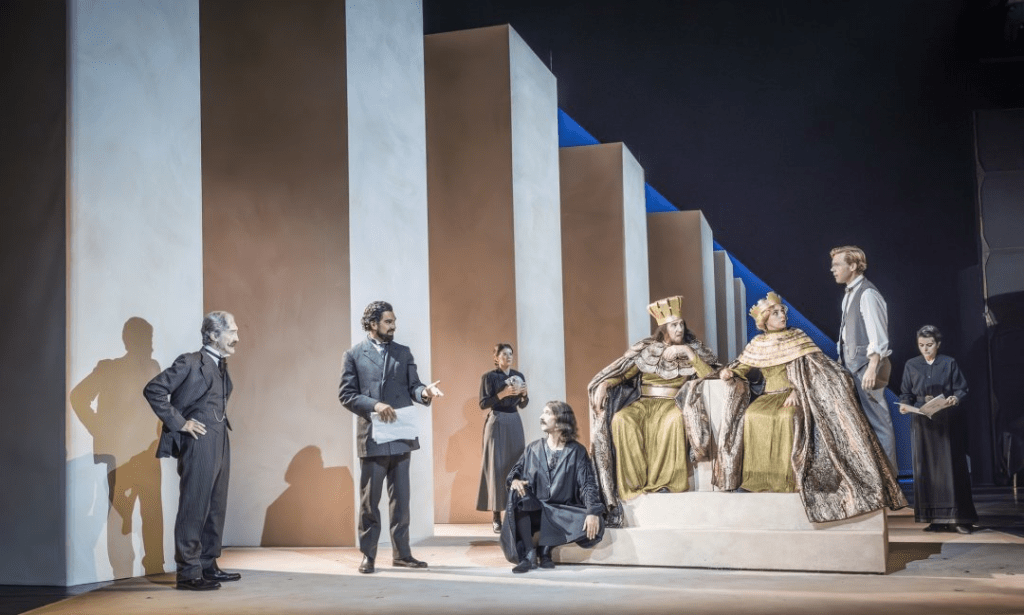
This is more than aimed at showing the kind of petulance and incomprehensibility of approach in working with ‘ordinary’ people directly, except of course with artists like W.B. Yeats on his Irish plays, that is well documented in Craig’s life, for it is also what Ellen Terry learned from Irving in the piece I quoted again (and presumably Hare thinks invested in her prodigy and ‘genius’ of a son, as she always called him: Perfection may seem unattainable because, despite our assumptions, it must rely on constant change not stasis, but you can see why actors get frustrated. It is an thing reported in a beautiful anecdote tod by Edith, who is a very practical theatre manager – intent on achieving social change not only aesthetic change in theatre:
Teddy loved to tell the story of working in Germany. In Berlin, I guess. Just inside the stage door was a notice saying No Speaking Allowed. Teddy thought he’d landed in heaven. It was everything he’d ever wanted in a theatre. Then he realised it only applied backstage. [4]
The story is generalised into self-statement by Teddy that he ‘should never have been involved in production. Theory’s far more important’. [5] Impossibly abstract, Teddy’s theatre today is as much remembered by his reduction of it to scale models, his theory of actors as marionettes controlled by a director in situ, the use of ‘Black figures’ in wood-cut illustrations of acting and scenes,and scene designs wherein the stage becomes a place for light to play on abstract shapes and produce meaningful icons, such as the emblematic scene of the projected victory of Fortinbras in Hamlet, the vision of Troy Burning, the turning of actors into vehicles for a psychology projected into their scenes by shaping and light: See these examples below from Janet Leeper’s (1948) Edward Gordon Craig: Designs for the Theatre, London, (King) Penguin Books, a loved book in my collection.

Janet Leeper (1948) Edward Gordon Craig: Designs for the Theatre, London, (King) Penguin Books
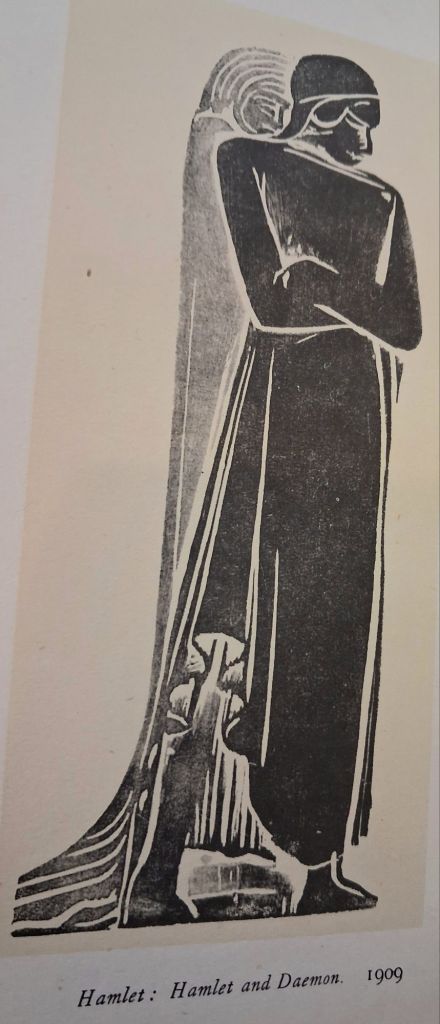
Ibid: plate 28: the Black Figure’ of Hamlet with his Demon, or Shadow. That chara ter cast dark shadows that were continuous with shadows in settings was a commonplace in Craig.
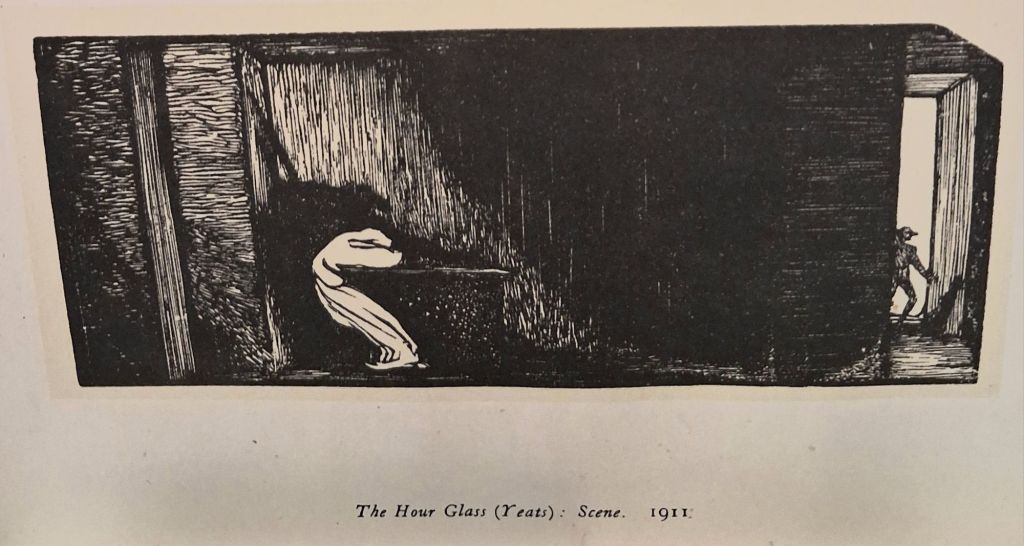
This was particularly exploited in Craig’s designs for W.B. Yeats’ production tions at the Abbey Theatre, Dublin: plate 24
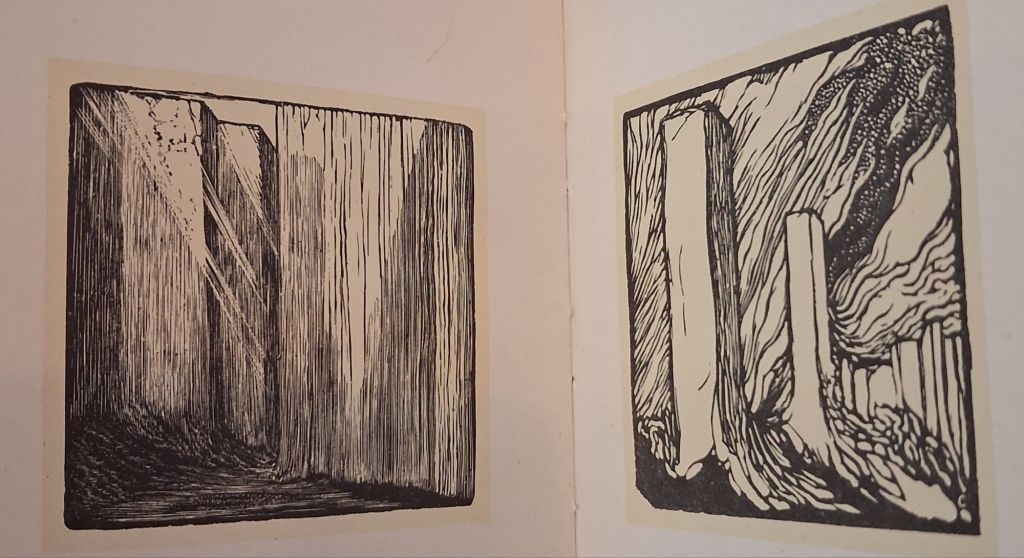
Idealised scenes or one intended for production are difficult to set apart in Craig’s publications of scenes: plates18 & 19
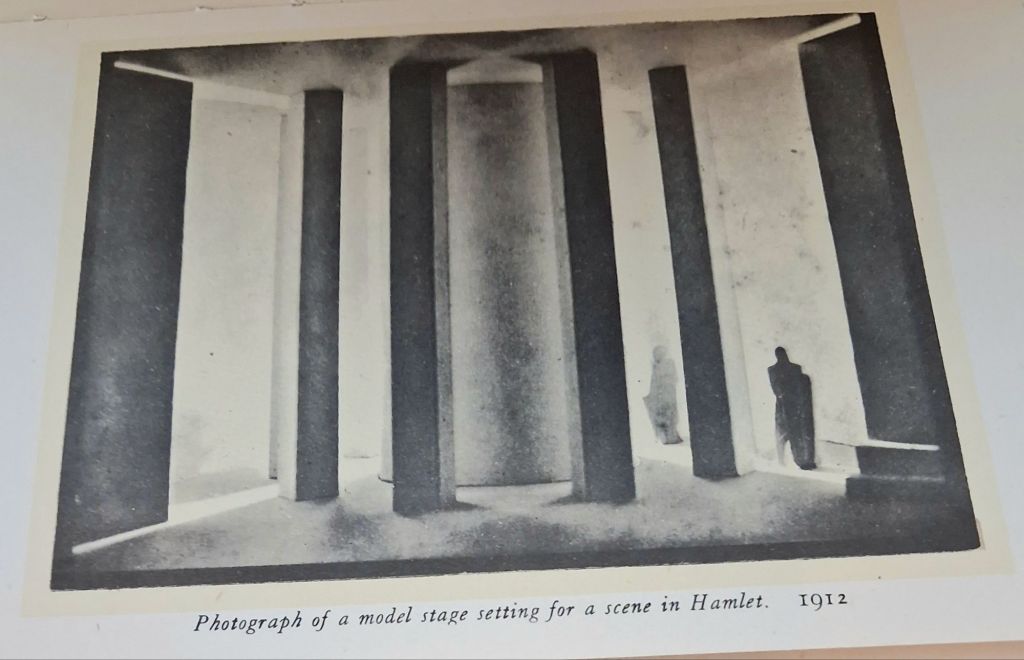
Indeed, you have to look twice at this monochrome photograph of one of Craig’ s Hamlet productions to see this was not another woodcut. Ibid: plate 25
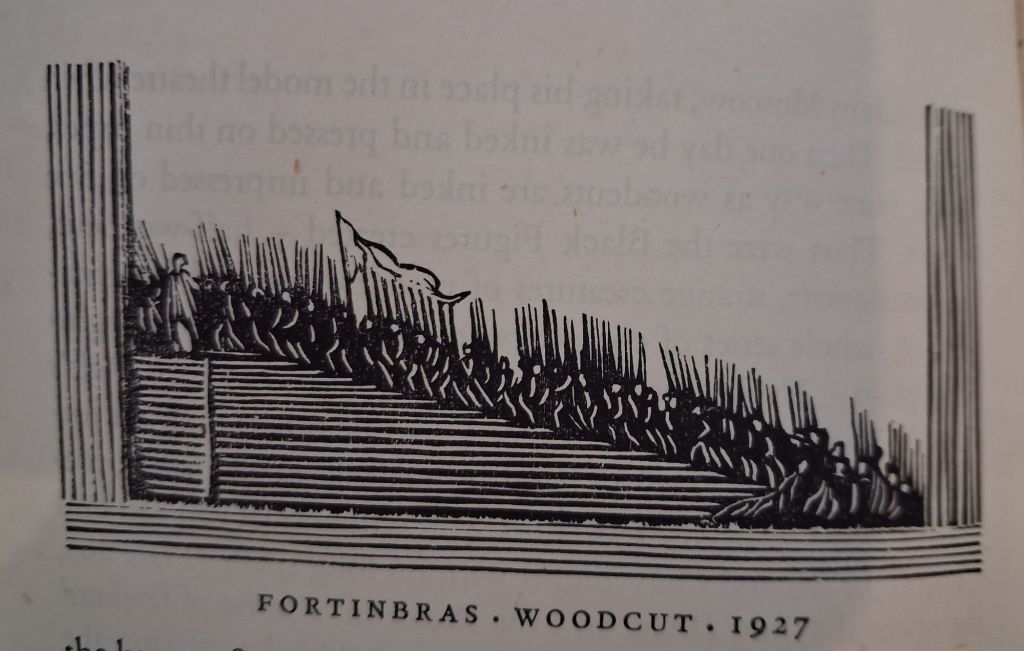
Sometimes a design drawing is a wondrous reading of the play. Tbis from 1927 shows how to stage the mivement of Fortinbras’ troops in Denmark to show how that political revolution can be shown to less than a natural transition from King Claudius to King Fortinbras of Denmark: ibid page 26 illustration.
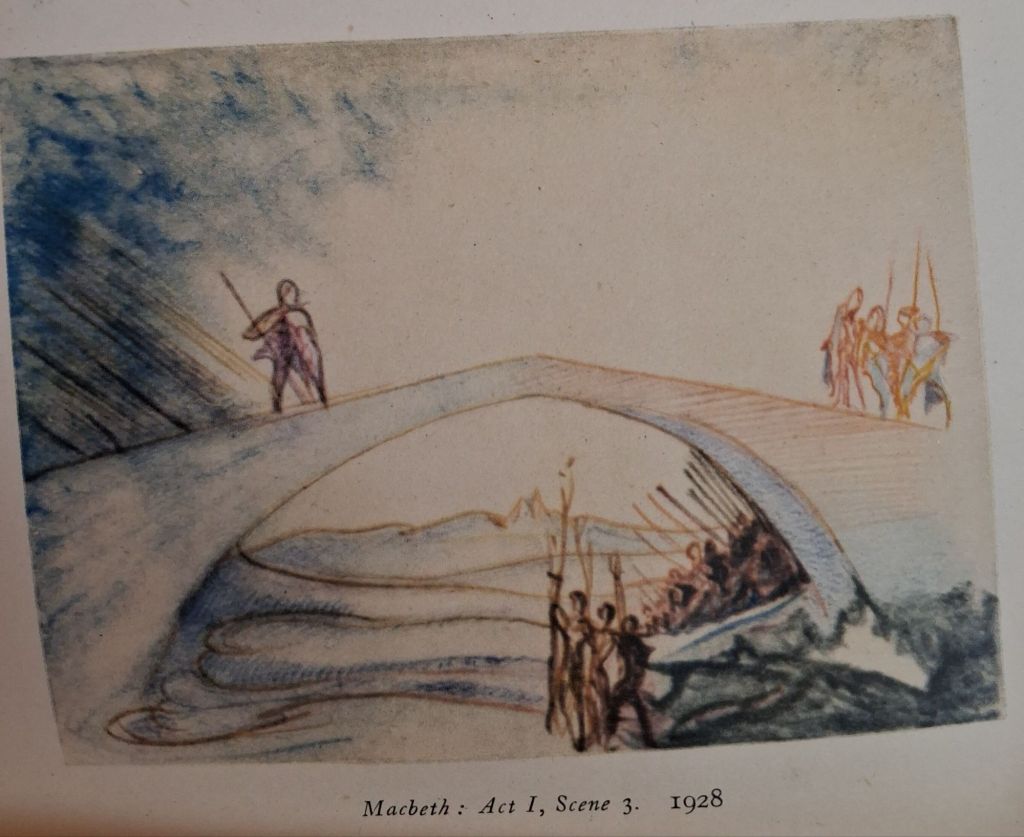
The colour drawings still emphasise contrasts of light but also, with colour of more specific mood projected from figures, individual or in mass. Ibid: plate 38.
That taste of Craig’s work, and Janet Leeper’s introduction to it in my source-book does help to support the basis of Hare’s over-interpretation (but what else is art for) of Craig’s symbolic artistic links to his mother (the ever ‘different’ actor) and his mother’s lover and his hero, Irving – the patriarchal controller of theatrical content. Even Irving recognises this saying that Craig loves him because he is ‘patriarchal’ (we should not condemn this without thinking how the line of thought, as this play recognises also birthed, named in Grace Pervades, ‘a young man called Peter Brook‘ (act 2, scene 21), who so radicalised the Royal Shakespeare theatre not only in directing a circus performed Midsummer Night’s Dream but also the ultra -radical play usually known as The Marat / Sade:
I’m a dictator. He admires dictators. He believes the theatre, like the realm, should be dominated by one man. That’s me. [6]
and its manner of display that was Irving, even if Irving’s manner was not just patriarchal and despotic, but also, unlike Craig, heavily married to idealised visions of the the status quo. Irving refuses to explain to Ellen why he will not perform or manage plays by Ibsen (which Craig did – the last one starring Ellen Terry), Shaw, Maeterlinck, and Strindberg (‘None of these’ insists Irving) – all plays with emotional depth and social conscience – except by saying they are ‘Too small, too petty. Not large enough‘ (as Craig too could have said), amplifying this thus:
People arguing, that isn’t theatre. People making points. And what’s more, you and I don’t belong in drawing rooms. Drawing rooms can’t contain us. We need courts and palaces and cathedrals. There’s scale for us there. We can move our elbows. Little rooms give us no space.
Ellen interprets this in terms of Irving knowing that this is the side of the political spectrum – of the established authorities – his bread is buttered on:
Ellen And is that because you fear all your judges and your politicians and your lords don’t like that kind of play?
Irving No.
Ellen That kind of play won’t go well at Windsor Castle? When we make our annual pilgrimage to perform? Are we stuck forever with patriotic myth? Do you never long for a theatre a little rougher than that?
Irving stares at her. [7]
The Ellen that admires the artist Irving is the one however that promotes her son’s aesthetic penchant for the same kind of control over stage and everything on it that characterises Irving (apart from over her constantly being ‘different’) but the Ellen who promotes Shaw and Ibsen that do not make ‘theatre the centre of things‘ but the social world in all its injustice and that is ‘challenging’ that order (in the way Terry thought that Charles Dickens was too) as a function of art. If Teddy is her aesthetic genius projected, her social conscience lives on in the theatre word of Edith. She is antagonistic to her brother’s aestheticism, as here, in Act 1, scene 1, where her taste for plays with a ‘point to make’ is clear, including a feminist – and lesbian – point. She speaks of her theatre having ‘no class divisions’ and earlier says:
Edith Plays should exist for a purpose. Only when we have something to say. And a good, clear way of saying it. If you don’t know why you’re doing a play, don’t do it. It will spare the audience a lot of needless suffering.
The play even puts that in context of the situation in Europe before the Second World War, with Edy’s own self-negating humour (almost Shavian):
Edith Somebody once accused me of taking dull plays to dull towns. I said, ‘I like that. Dull Plays to Dull Towns. That sums the Pioneer Players up perfectly. Can I use it in the advertising?’
Teddy For a genius, the chances of being understood in England are zero. The only honourable course is exile.
Edith I prefer the company of women. There’s less mess when you deal with women, and, contrary to what you might think, there’s much less emotion.
Teddy France is fine. France, Italy, Russia, they know about genius in Russia. And Germany, they’re civilised in Germany. All right, the Nazi experiment didn’t end well, but I’m happy to confess that at the beginning – yes, I supported it. It was refreshing.[8]
Craig was not the only modernist to favour Fascism ‘at first’ but that is because all modernist believed that civilised values were maintained by dictatorial ‘auteur’ power – in art and politics. Irving’s control of what Hare makes him assert that ‘Detail matters’ in matters of stage art is more liberal in its assertion of control – for it finds room for Ellen’s capricious changeability and pace (she flies down stairs, ‘sometimes even taking the banister’), but in theory it is an assertion of theory similar to Craig’s: detail matters; ‘Verbal, Visual, The articulation of the stage’. [9] Where it differs is that Craig has less truck with verbal detail-what matters is visual design in dynamic form. His view of Isadora Duncan is that of Yeats of Loie Fuller:
Teddy When I left London, I made the decision. No more mediocrity. Only perfection. Why else do you think I’m living with you? The first perfect thing I had ever seen.
Isadora shakes her head. Isadora You’re too kind to me, Teddy.
Teddy The first perfect thing I had ever seen.
Isadora Are you speaking artistically?
Teddy Artistically. Emotionally. Both. He gets up and kisses her, then goes back to his chair. You alone appreciate that theatre is movement. It’s shape and action and colour and light –
Isadora Since I was a little girl –
Teddy It’s a temple. What else? It takes us back to the gods.
Isadora They kept teaching me steps. I used to say: what use are steps?
Teddy Steps are as bad as words. The theatre died when it became a prisoner of words.
Isadora It’s sensation we need, Teddy. Not meaning. I was brought up by the sea. In San Francisco. For me, it was always the waves. I watched them for hours. And I listened.
Teddy I can tell. Isadora That’s what I want. To be like the waves. [10]
Meaning and content matter to Edy, if binaries and borders are not important. She supports the male-identifying Christopher St. John (aka Master Baby), who was born Christabel Marshall and in a moving and funny scene helps her to put the profession of beautiful words of love of Vita Sackville-West, in perspective for her. She is an activist like her mother, for Ellen tries to get irving to ally with Shaw and others in the formation of a National Theatre, outside the commercial system.
It is clear that a reading of this play helps sort out its patterns of thought, but since these very much discuss both the nature and point of both acting / performance and theatre as a holistic expression or otherwise, the only judgement that matters is probably that of the collaborative effort that is its production: Hence, I can’t wait to see it at The Haymarket on the afternoon of the 9th July 2026 (as I diaried at this link).

Fiennes as Irving as Hamlet
Bye for now
With love
Steven xxxxxxxx
___________________________________
[1] David Hare (2026: 38) Grace Pervades London, Faber
[2] ibid: 40
[3] ibid: 114f.
[4] ibid: 112
[5] ibid: 117
[6] ibid: 65
{7} ibid: 111
[8] ibid: 12 & 13 respectively
[9] ibid: 34
[10] ibid: 72


6 thoughts on “In ‘Grace Pervades’, the character named Henry Irving, based on the great actor-manager says to Ellen Terry, ‘I await eagerly to see what you will do next. It’s always different’. She replies ‘Then how can it always be perfect?’ The answer to that might be the answer to the question: ‘If you could instantly master any skill, what would it be?’”