


Controlled exclusion rarely also controls setting (and building) colonisation of the other: the meaning of borders and boundaries.
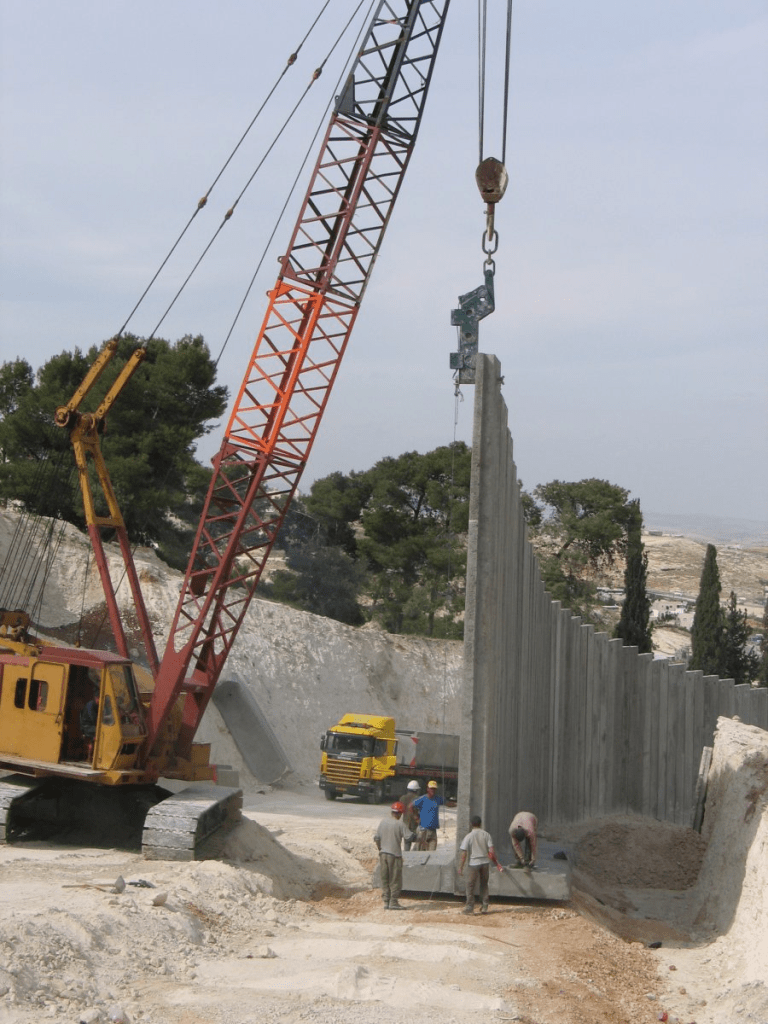
Building the West Bank Wall in 2004
Let’s begin by thinking about that adjective ‘healthy’ as applied to ‘boundaries’. If a boundary can be ‘healthy’ can it also be ‘unhealthy’? We rarely if ever hear of setting ‘unhealthy boundaries’, and yet it is not considered a good trait to be defensive, nor to set boundaries to learning or experience, for growth always involves some negotiation with otherness, or repression of it; otherness is that which is at the other side of the defining borders of the self.
I suppose healthy boundaries could be precisely boundaries that have a degree of porosity: porous, that is, to allow entry through them of good external experience and learning (in short otherness), whilst excluding bad versions of the other. That is the meaning of boundary policing and migration control, though of course binary value judgements, such as those mentioned, are a feature of control gates in any system and are intrinsically incapable of nuanced judgements, forcing judgements instead that use heuristics for determining oversimplistic distinctions, often heuristics based on prejudice and unfair and biased representations.
But can boundaries, or any other border be called ‘healthy’, where supplanting the word with the alternative some consider correct, ‘healthsome’. This is not just a matter of semantics, because the concept of health still applies a concept that can be considered appropriate to physical organisms to ones that are largely conceptual such as self, identity, or group definition. Note below in the Online Etymology Website‘s entry for health, Miss Leslie’s point about how to describe pork as a foodstuff allowed entry to the body by ingestion. Health is an aspect of the living body of the other, that pig before it is slaughtered by humans, not a thing judged to be allowed entry into my body or not.
Of course, Miss Leslie is wrong about how words develop. Many are developed into senses that apply them, when adjectives, to their effect on another rather than a trait or characteristic of the noun they qualify. But that is a particular function of the working of prejudicial heuristics in the language of a culture. For instance the adjective ‘toxic’ can be used to describe something described by a noun, solely from the point of view of someone who is capable of being poisoned by the thing represented by the noun, without implying toxicity is a quality or trait of that thing in itself.
healthy (adj.) 1550s, “being in a sound state;” also “conducive to health,” from health + -y (2). Earlier in the same sense was healthsome (1530s). Related: Healthily; healthiness.
It is wrong to say that certain articles of food are healthy or unhealthy. Wholesome and unwholesome are the right words. A pig may be healthy or unhealthy while alive; but after he is killed and becomes pork, he can enjoy no health, and suffer no sickness. [Eliza Leslie, “Miss Leslie’s Behaviour Book,” Philadelphia, 1839]
Healthsome is from 1530s in the sense “bestowing health.”
With boundaries and borders, it is obvious that the health they serve when described as ‘healthy’ is that of that included within them not those excluded, whose health, as with the unfortunate Miss Piggy of Miss Leslie, whose health is irrelevant, once having been processed, that is murdered, to meet the needs of that whi h owns and controls it.
Whether we ingest pork or not is not the same question as whether we evaluate a pig’s bodily health. All of these questions are brought into sharp difficulty however when we consider health as a factor in those cases of it that we describe and limit as being about ‘mental health’. In my view, it is still necessary to remember that the concept of physical health is still merely a metaphor of the thing we talk about as ‘mental health’, where a medical model of what we are talking about can be more easily applied.
However, that model is applied with lots of assumptions borne with it – such as whether a chosen role in life, partial self-defintion, or relationship of friendship or other attachment, is healthy or unhealthy that actually misrepresent the complexity of all those aspects of personal defintion and choice.
Setting boundaries is a means of controlling your environment such that it includes only what you wish it to include, although it does not and cannot guarantee that what you have included is as you wish to see it in its reality. Most boundaries involve a great deal of magical thinking to repress consciousness of some of the things we allow in to our selves, relationships and group identities. They involve representing things as we wish them, or are taught to wish them, to be, not as they are.
The mechanisms we use to represent those boundaries are likewise flexible. The whole concept of healthy boundaries in psychotherapy is a highly overdetermined system of analogies which supposes that all entities have boundaries and that conscious entities have the right to set their own boundaries against self-selected otherness and in what relation to their own centre they wish and can regulate in reality. Here is an example – common enough on the internet:
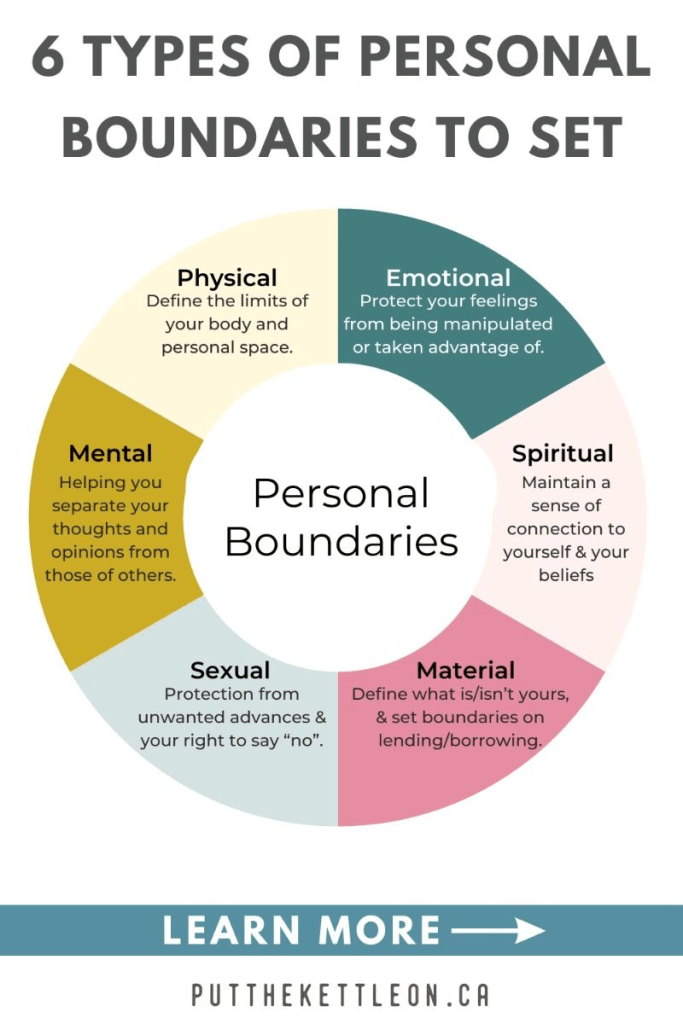
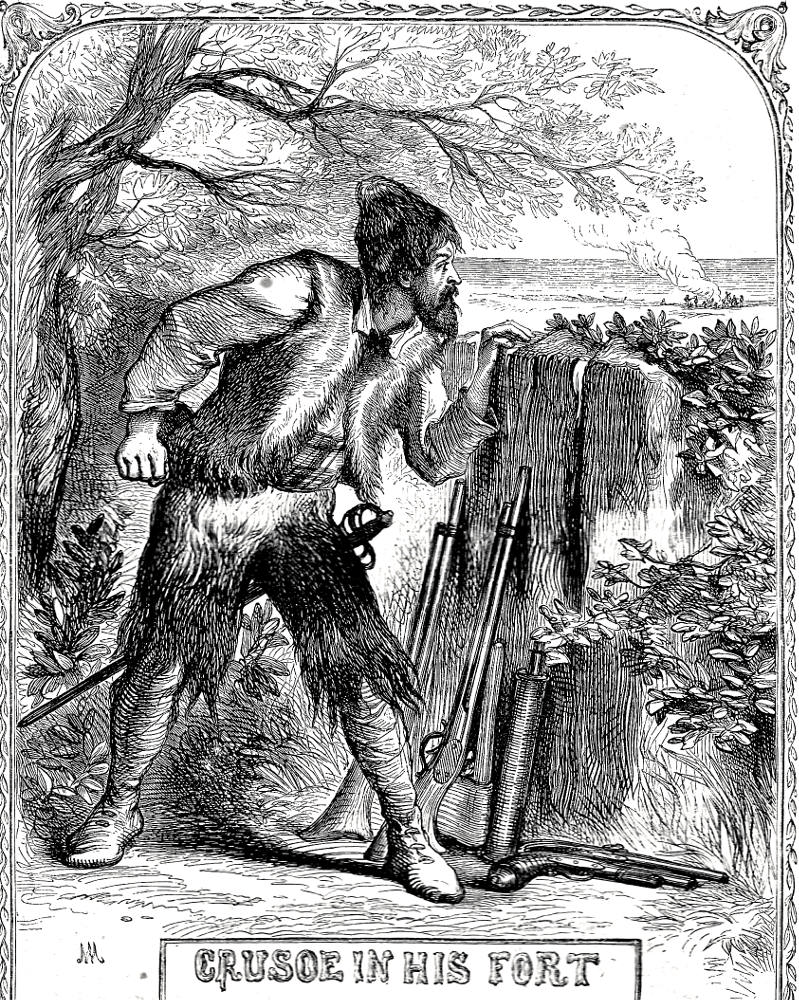
This isn’t anything other than a conceptual circle with its discrete contents and their relationship to each other seen as unproblematic, and because of this they depend on each other. For instance, the role in it of ‘Material boundaries’ is not just considered as one facet of self as this suggests. The issue of ‘possession’ is fundamental and applies to all of the other factors – where material includes bodies, emotions, spirit – the idea of spirit possession being resurrected here, almost, but in the context of belief. A good read for understanding this might be A.S. Byatt’s monumental novel Possession– where who has a right to colonise and include, or reject and exclude, whichever factor in otherness it desires or wishes for, is at its centre. It is easily asserted, because claiming to be ‘personal’ that self-possession is a basic and foundational truth that gets extended metaphorically to group identity – the ur-text here is Robinson Crusoe, in which an invisible society,much like the one he was born in, is set up by Crusoe that takes precedence and sets rights for him over other lives – the captured animals he domesticates and ‘Man Friday’, named after the day of his acquisition and enslavement (a wide value system thus imposed upon him). Crusoe asserts control over natural and built boundaries and inherited resources, like guns and gunpowder, for defending them.
Because, considered ‘foundational’ they are applied as the commonsense of other group relationships – and justify not only defensive walls but the extension of those walls into the other to further limit its rights upon us and for itself or themselves. That is why I start with the West Bank Wall, or ‘Apartheid Wall’. Its function is to minimise otherness and strengthen a national self-definition that is not only allowed to control intrusion but to build out into otherness and take it over. Thus the history of the settlement movement in Israel – not unlike that in historical White South Africa and, earlier in history, White North America and Australasia. It lies at the root of ‘Stop the Boats’ mentalisations, that also include defence of the right of white settlement elsewhere-often to evade the cost of expensive defensive policies. I found friends, I can no longer call such, defending the rights of white tax-evaders in Dubai in the Iranian War, prosecuted by Trump, whilst having no empathy at all for the ghettoisation and even genocide of Palestinians in Gaza and Lebanon.
West Bank settlement moreover is settlement on land over which Israel has no jurisdiction or right in international law, or Israeli law. It builds walled settlements over land farmed over generations by Palestinians, Christians, Muslims, and Druses. It establishes’healthy boundaries’, even in the air with ‘Iron Domes’, that are deleterious to anything other and still to-be, or already, excluded. It sets laws that define rights unevenly – even to life, since Israeli ‘democracy’ declares Palestinian lives subject to death penalties for crimes for which they are not not applied in the case of Israeli citizens. Jews have, in the diaspora, long been subject to such treatment themselves – notably the Russian pogroms and Nazi Holocaust – and that is why we need to challenge it in Israel, as many Jews themselves do, inside and outside of Israel, although the supposed ‘democracy’ of Israel does not have equal rights as a presumption within it. If we set boundaries, we usually have to build something to protect our assertion of them – whether in consenual agreement, or, failing that, laws, and, failing that, walls and ditches with lookout watchtowers like those vontrolling a West bank ghetto below.
Health? Healthy to whom?
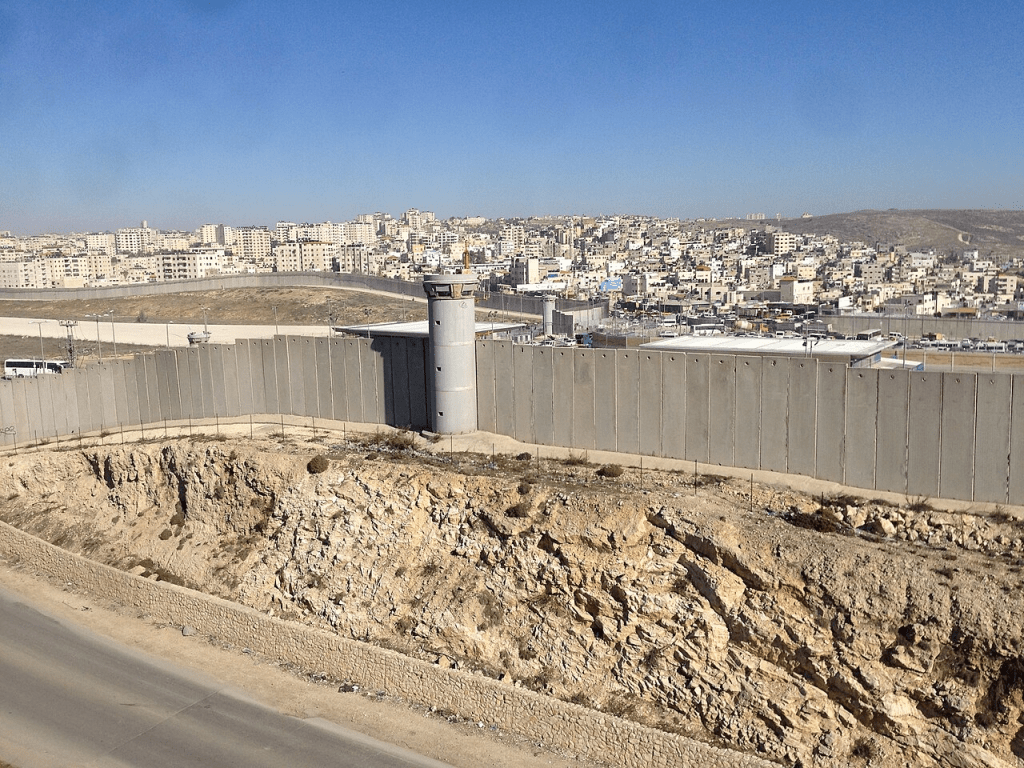
Qalandia checkpoint – panoramio (535) – West Bank barrier – Wikipedia By L-BBE, CC BY 3.0, https://commons.wikimedia.org/w/index.php?curid=57307620
With love
Steven xxxxxxxxxxx


.jpg)